
Room Thermometers That Tell You the Real Temperature in 2026
Room thermometers tell you what the air in your home is actually doing, rather than what the thermostat claims. The thermostat might say 21 degrees, yet the bedroom feels chilly and the baby’s room feels stuffy, and both can be true: a thermostat measures one spot, usually a hallway, while the rest of the house does its own thing. A good room thermometer puts a real number on the room you are sitting in — whether to turn the heating up, whether to open a window, and whether a baby’s bedroom is in the safe range for sleep. This guide covers the types worth buying in 2026, what accuracy means, where to put one, and which features are worth paying for.
Key Takeaways
- A room thermometer measures the air where you live; a thermostat measures one spot in the hallway.
- Accuracy within half a degree is enough for comfort and sleep.
- Placement decides whether the reading is true: keep it at breathing height, away from radiators and direct sun.
- A combined temperature and humidity display is the best value, because both decide whether a room feels comfortable.
- Smart sensors earn their price only if you use the history and alerts.
Why Your Room Feels Different From What the Thermostat Says
Most homes have one thermostat and many rooms, and that is the whole problem. The thermostat sits in a hallway and switches the heating on and off based on the air around itself. A bedroom with two people in it all night warms up on its own, a south-facing living room gains several degrees from afternoon sun, and a kitchen warms up every time the oven runs. None of that shows up on the thermostat, which is why one room can feel too hot while another feels cold on the same evening.
A room thermometer fixes the guesswork. Put one in the bedroom and you learn whether it really drops to 16 degrees overnight or stays at a stuffy 22. Put one in the nursery and you can check the safe sleep range at a glance. Put one in a home office and you find out whether the afternoon slump is tiredness or a room that has crept up to 24 degrees with the door closed. A draughty spare room reading 15 degrees is a draught problem, not a heating problem.
The Main Types of Room Thermometer
Room thermometers fall into four broad types, and each suits a different kind of home.
Digital room thermometers
The digital thermometer is the default choice for most homes in 2026. A small sensor measures the air temperature and shows it on a clear display, in large digits you can read from across the room. Most run for a year or more on a coin battery, cost very little, and are accurate to within half a degree. Many also show humidity and the highest and lowest temperatures since they were last reset. Cheap models can drift over time. For a quick, honest reading in any room, digital is the type to beat.
Analogue dial thermometers
The analogue dial is the oldest type still on sale. A bimetallic coil inside the case expands as it warms and moves a needle around a printed scale, with no batteries and nothing to fail. A good dial lasts for decades and can be read at a glance. Its weakness is accuracy: most dials are accurate to within one or two degrees, fine for knowing whether a room is roughly 18 or roughly 22, but not enough for tracking a baby’s bedroom to the degree. Dials are slow to respond and easy to misread from an angle. Buy one for charm, and for a room where roughly right is enough.

Smart room thermometers and sensors
Smart sensors are digital thermometers with a radio and an app. They measure the temperature every few minutes, store the history, and send it to your phone, where you can see the overnight curve and set an alert for when a room drops below a threshold. The sensor itself is no more accurate than a good standalone digital model, so what you are paying for is the record and the alerts, not a better reading. That record suits parents checking a nursery’s overnight range, or anyone tracking whether a home office overheats in the afternoon. If you only want to glance at the temperature before bed, an app adds nothing. Smart sensors need a hub or Wi-Fi and batteries changed more often, and work only as long as the app is supported.
Thermo-hygrometers: temperature plus humidity
A thermo-hygrometer measures temperature and relative humidity in one device, and for most homes this is the best value on the shelf. Temperature alone does not decide comfort: a room at 21 degrees and 30 percent humidity feels dry and scratchy, while the same room at 60 percent feels comfortable, and at 70 percent it starts to feel damp. The humidity reading tells you whether to ventilate. Most cost only slightly more than a temperature-only model, so if you buy one room thermometer for the whole house, make it one of these.
Room Thermometers Compared at a Glance
| Type | Best For | Accuracy | Power | Price |
|---|---|---|---|---|
| Digital display | Everyday checks | Within 0.5° | Coin battery, 1yr+ | £8–£25 |
| Analogue dial | Wall display | Within 1–2° | None | £5–£20 |
| Smart sensor | History, alerts | Within 0.5° | Battery, 6–12mo | £25–£80 |
| Thermo-hygrometer | Best value | Within 0.5° | Coin battery, 1yr+ | £10–£30 |
| Wall station | Living rooms | Within 0.5–1° | Battery or mains | £20–£60 |
Prices are typical for 2026, for decent-quality models; the cheapest unbranded devices can be several degrees out.
How Accurate Does a Room Thermometer Need to Be?
For comfort and sleep, accuracy within half a degree is plenty. The difference between 19 and 19.5 degrees is not something a person can feel, and the decisions a room thermometer supports do not change on a tenth of a degree. What matters is consistency: a thermometer that always reads half a degree high is still useful, because you learn its habit; one that reads differently every hour is not.
Cheap thermometers fail on consistency: a sensor with no calibration can leave the factory two or three degrees out. The fix costs nothing — place a new thermometer beside one you trust in the same room for a day, and if they disagree by more than a degree, return the new one. Repeat the check once a year.
Where to Put a Room Thermometer So It Tells the Truth
Placement is the single biggest cause of wrong readings. A thermometer measures the air immediately around itself, so put it where the air is typical of the room: at breathing height, roughly chest height when sitting or standing, and about a metre from any wall if you can. Heat rises, so one on top of a tall bookcase reads warmer than the air you breathe, and one on the floor reads colder. Keep it away from radiators, heaters, windows and exterior doors where draughts distort the air, and out of direct sunlight, which can warm the case by several degrees even through glass. Keep it away from lamps and electronics that run warm.
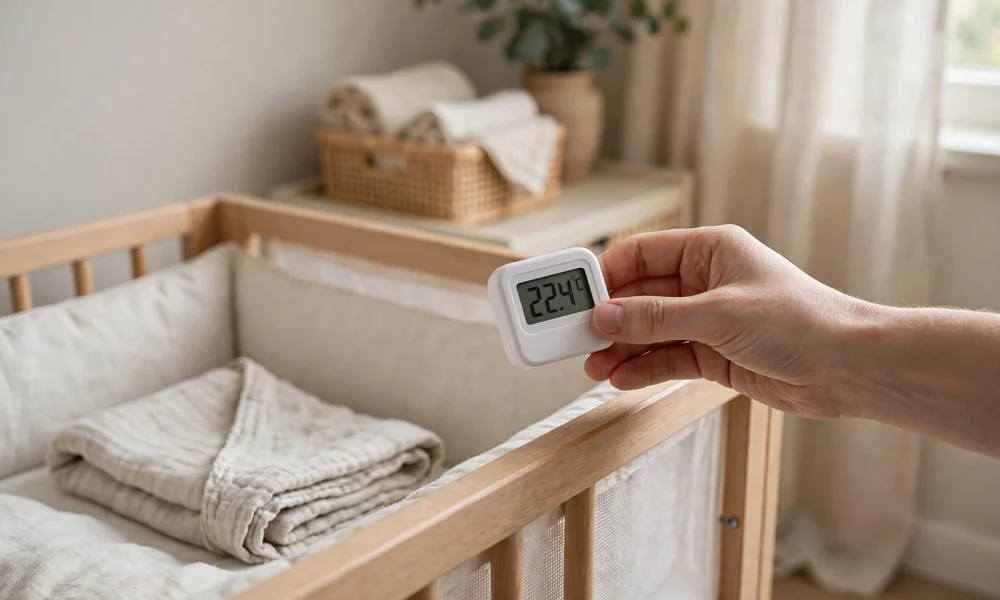
For a baby’s bedroom, place it near the cot but not right above it, at the height of the mattress, and check it at the same time each evening so the readings are comparable. For a living room, use a side table in the middle of the room, where people actually sit. Once you have found a good spot, leave it there: moving it around produces readings that cannot be compared. To compare rooms, buy one thermometer per room rather than carrying one around.
Room Thermometers for Nurseries and Bedrooms
The nursery is where a room thermometer earns its keep most clearly, because a baby cannot tell you whether the room is too warm or too cold. Most paediatric guidance puts the safe sleep range for a baby’s bedroom at roughly 16 to 20 degrees Celsius: too warm is linked to overheating, too cold to restless sleep. A thermometer by the cot takes the guesswork out of the evening routine, and one that records the overnight minimum shows whether the room held its temperature or dropped sharply after the heating went off. Choose a digital thermo-hygrometer with large, clear digits and a minimum-maximum memory, placed where you can read it without turning on a bright light. Keep the thermometer out of the baby’s reach, and remember the reading is a guide, not a diagnosis: if a baby feels hot or cold to the touch, trust your hands over the display.
Bedrooms for adults follow the same logic with a wider comfort band. Most adults sleep best between 16 and 19 degrees, cooler than the 20 or 21 that feels right during the day, and a thermometer showing the overnight minimum helps you find the setting that works for your room. A stuffy bedroom reading 22 degrees at midnight is a ventilation problem as much as a heating one, and opening a window slightly often fixes it.
Room Thermometer Buying Checklist
- Accuracy within half a degree, verified beside a thermometer you trust for a day.
- Large, clear digits you can read from across the room and in dim light.
- Humidity reading included, so you can tell whether a room feels dry, comfortable, or damp.
- Minimum and maximum memory, so you can see how cold a bedroom got overnight.
- Battery life of a year or more, with a low-battery warning.
- A stand and a wall mount, so you can place it at breathing height.
Room Thermometers and the Rest of the House
A room thermometer is one instrument in a small set that together describe a home. A weather station measures the conditions outside your own door, which explains why a room feels different on a still, damp evening than on a bright, windy one. An air quality monitor measures what is in the air rather than how warm it is: whether a stuffy bedroom needs fresh air or a purifier. And the general guide to why a good thermometer matters more than you think covers the wider family, from body temperature to kitchen probes. Each tool answers one question well.

Frequently Asked Questions
What is the ideal room temperature for a bedroom?
Most adults sleep best between 16 and 19 degrees Celsius, and most guidance puts a baby’s bedroom at 16 to 20 degrees.
Why does my room thermometer disagree with my thermostat?
Because they measure different places: the thermostat reads the air around itself, usually in a hallway, while the room thermometer reads the air in your room.
Where should I put a room thermometer?
At breathing height, away from radiators, windows, direct sunlight, and heat from lamps and electronics. Give it fifteen minutes to settle after moving it.
Do I need a smart room thermometer?
Only if you will use the history and alerts. For a quick glance, a simple digital thermometer is just as accurate and costs far less.
How do I know if my room thermometer is accurate?
Place it beside a thermometer you trust in the same room for a day and compare the readings. If they disagree by more than a degree, one of them is wrong. Repeat the check once a year.
Is a thermometer that also measures humidity worth it?
Yes, for most homes: temperature alone does not decide comfort, and the humidity reading tells you whether a room feels dry, comfortable, or damp. A thermo-hygrometer usually costs only slightly more than a temperature-only model.
The Bottom Line
The best room thermometer in 2026 is a simple digital thermo-hygrometer with large, clear digits, a minimum-maximum memory, and accuracy within half a degree, placed at breathing height away from heat and sun. It costs little, lasts for years, and tells you the real temperature of the air you are in. Buy one for each room that matters and stop guessing from the hallway thermostat.


