
Weather Stations That Tell You What’s Coming in 2026
A weather station that tells you what’s coming is a small set of sensors in your garden and a display in your house that measures the weather where you actually live. It reads the temperature, the humidity, the wind, the rain, and the air pressure outside your own door, and turns those readings into a forecast for your street rather than your region. Your station can tell you that it rained four millimetres on your garden last night, that the wind is picking up from the west, and that the pressure is falling fast, which means the rain is not finished yet.
Choosing one is harder than it looks, because the differences between stations are hidden in the sensors. A cheap station may look the part and still report temperatures several degrees wrong, miss light rain entirely, and lose its wireless signal every time it rains. A good station uses proper sensors, sits in the right place, and keeps working for years on a small solar panel and a battery.
Key Takeaways
- A home weather station measures the weather at your house, not your region, so its readings are more useful than a regional forecast for gardening, drying washing, and planning the day.
- Falling air pressure is the most useful forecast signal a station gives you: pressure dropping steadily usually means rain or a storm is on the way, while rising pressure usually means fair weather.
- The outdoor sensor must sit in open air, away from walls and roofs, about one and a half metres above the ground, or the temperature and wind readings will be wrong.
- A rain gauge that measures in small steps, a wind sensor that spins freely, and a solar panel that keeps the battery charged are the three features that separate good stations from cheap ones.
- Check the station’s readings against a thermometer you trust for the first week, and give the sensors time to settle before you rely on the forecast.
How We Judged the Best Weather Stations
Every weather station here was judged on the same five points. Accuracy came first, because a station that reports the wrong temperature is worse than no station at all, since it gives false confidence. We compared each station’s readings with trusted instruments over days of mixed weather. Sensor quality came next: the rain gauge had to catch light drizzle as well as heavy downpours, and the wind sensor had to spin in a light breeze. We also weighed how easy the display was to read, how far the wireless signal reached, and how long the station kept working without attention.
The Best Weather Stations at a Glance
| Station Type | Best For | Measures | Power | Approx. Price |
|---|---|---|---|---|
| Basic wireless station | A first station, simple checks | Temperature, humidity, pressure | Batteries | $40–$80 |
| Full sensor station | Gardeners, keen observers | Temperature, humidity, wind, rain, pressure | Solar panel, battery | $120–$250 |
| Smart home station | Phone alerts, automation | Temperature, humidity, wind, rain, pressure | Solar panel, battery | $180–$350 |
| Professional station | Serious records, accuracy | All measures, plus UV and light | Solar panel, mains backup | $300–$600 |
| Compact balcony station | Flats, small gardens | Temperature, humidity, pressure | Batteries, USB | $60–$120 |
| Rain-focused station | Watering decisions, drainage | Rainfall, temperature, humidity | Solar panel, battery | $90–$180 |
What a Weather Station Actually Measures
Temperature is the reading everyone looks at first, and it is also the easiest to get wrong. A temperature sensor in direct sunlight can read five degrees higher than the real air temperature, which is why the outdoor sensor must sit in shade with air moving freely around it. The best stations shield the sensor in a small white housing with vents, which keeps the sun off while letting the air through. Humidity is the second reading: it tells you whether the washing will dry and whether condensation will form on cold windows overnight.
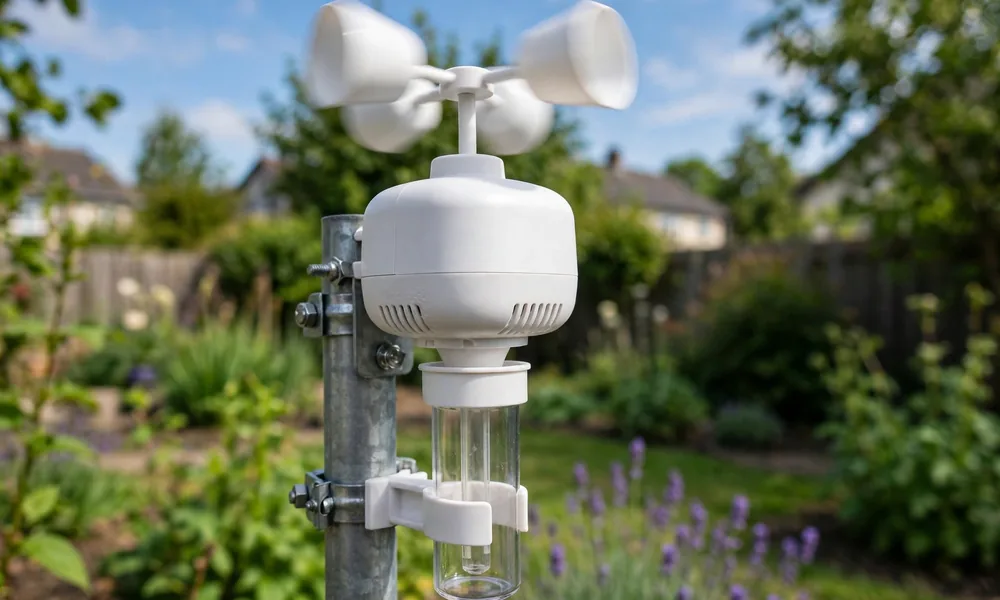
Wind speed and direction are the readings that tell you what is coming next. A steady wind from the west often brings rain in many regions, while a wind that swings round to the north usually brings colder, clearer air. The wind sensor, a small set of cups that spins in the breeze, needs open space to work: a sensor tucked behind a fence or under a tree will read far lower than the real wind. Rainfall is measured by a small tipping bucket, and the best gauges catch light drizzle, which is the rain that matters most for gardens.
Air pressure is the quiet star of the station, because it is the reading that forecasts the weather rather than just recording it. Pressure is measured indoors by the display unit, and its trend matters more than its absolute value. When pressure falls steadily over several hours, bad weather is usually on the way. When it rises steadily, fair weather is coming. Learning to watch the pressure trend is the fastest way to get real value from a weather station.
Where to Put the Outdoor Sensor
Placement decides whether a weather station tells the truth or not, and most disappointing stations are disappointing because of where they sit rather than what they are. The outdoor sensor needs open air, away from walls, roofs, and fences, which all radiate heat and block the wind. The standard height is about one and a half metres above the ground, over grass if possible, because concrete and paving heat up in the sun. A sensor mounted on a sunny wall can read several degrees too warm all afternoon.
The wireless signal matters too. The outdoor sensor talks to the indoor display by radio, and thick walls, metal roofs, and long distances all weaken the signal. Most stations manage thirty to a hundred metres in open air, but a stone wall or a metal shed can cut that sharply. Before you fix the sensor in place, test the signal from that spot for a day, and move the display closer to the garden if the readings drop out.

Reading the Forecast Your Station Gives You
Most home weather stations show a simple forecast icon: sun, cloud, rain, or storm. That icon is not magic; it is a guess based on the pressure trend and the current conditions, and it is right more often than people expect. A falling pressure with rising humidity means rain is likely within hours. A falling pressure with a strong wind means a storm may be coming, and it is time to bring in garden furniture. Smart stations can also send the readings to your phone; our guide to the best smart home hubs of 2026 explains which hubs work with weather sensors and which do not.
The best way to use a station is to watch the trends, not just the current numbers. Check the pressure each morning and evening, and notice how it moves before the weather changes. After a few weeks you will know what a fast fall means in your area and how much rain usually follows it. Gardeners get the most from this: a station that says two millimetres of rain fell overnight means the garden does not need watering, while a dry week with strong wind means it does.
Power, Maintenance, and Staying Accurate
Most full weather stations run on a small solar panel with a rechargeable battery, which means they need very little attention. The solar panel keeps the battery charged through the summer, and the battery carries the station through dark winter weeks. The weak point is the panel itself: if it gets covered in leaves, dust, or bird droppings, it stops charging and the battery runs down. Wipe the panel clean once a month, and check the battery level on the display now and then, especially in late autumn when the days get short.
The rain gauge needs cleaning too, because leaves and insects can block the small funnel and stop the rain reaching the tipping bucket. A blocked gauge will report no rain in a downpour, which is the most misleading failure a station can have. Clean the funnel every few weeks in autumn, when leaves are falling, and check the wind cups spin freely after a storm. Spiders love to build webs in wind sensors, and a web can slow the cups enough to halve the wind reading.

Weather Station Checklist
- Choose a station that measures temperature, humidity, wind, rain, and pressure if you want a real forecast, not just a thermometer.
- Mount the outdoor sensor in open air, about one and a half metres above grass, away from walls, roofs, and fences.
- Test the wireless signal from the sensor’s spot for a day before you fix it in place permanently.
- Check that the rain gauge catches light drizzle and that the wind cups spin freely in a light breeze.
- Clean the solar panel, the rain funnel, and the wind cups once a month, especially in autumn.
- Watch the pressure trend morning and evening for a few weeks until you know what it means in your area.
Frequently Asked Questions
How accurate are home weather stations?
A good station is accurate to about half a degree for temperature and a few percent for humidity, which is plenty for home use. Cheap stations can be several degrees out, especially if the sensor sits in sunlight. Placement matters as much as the station itself, so mount the sensor properly before you judge its accuracy.
Do I need Wi-Fi for a weather station?
No. A basic station works entirely on its own, with the outdoor sensor talking to the indoor display by radio. Wi-Fi is only needed if you want phone alerts, online history, or to share your readings with a weather network. Many owners are happy with a display on the windowsill and never connect the station to anything.
Where is the best place to put a weather station?
In open air, about one and a half metres above grass, away from walls and roofs, with a clear view of the sky for the rain gauge. The wind sensor works best on a pole about two metres high. Avoid sunny walls, roof overhangs, and sheltered corners, which all distort the readings.
Can a weather station predict rain?
It can give a useful short forecast, usually for the next few hours, based on the air pressure trend and the current conditions. Falling pressure usually means rain is coming, and rising pressure usually means fair weather. It will not beat the national forecast for tomorrow, but it is better at telling you what is happening on your street right now.
How long do weather station batteries last?
A solar-powered station can run for years without a battery change, because the panel tops the battery up every day. Battery-only stations usually need new batteries every six to twelve months. Cold weather shortens battery life, so check the battery level before winter sets in.
Is a weather station the same as an air quality monitor?
No. A weather station measures the weather outdoors: temperature, humidity, wind, rain, and pressure. An air quality monitor measures the air indoors: dust, carbon dioxide, and other gases. They answer different questions, and many homes have both. If you are draught-proofing the house as well, our guide to weather stripping that seals drafty windows in 2026 is a useful companion to a new station.
The Bottom Line
The best weather station in 2026 is the one with honest sensors, a clear display, and a spot in your garden where it can measure the real weather. Put the outdoor unit in open air, keep the solar panel and rain gauge clean, and learn to read the pressure trend. Do that, and your station will tell you what is coming before the sky does.


