
Air Quality Monitors That Tell You What’s in the Air in 2026
Air quality monitors that tell you what’s in the air in 2026 do one simple, useful job: they show you what you are actually breathing at home. You cannot see the fine dust from a busy road, the gases drifting off new furniture, or the carbon dioxide building up in a closed bedroom overnight, but a good monitor can measure all three and put a number on them. That number turns a vague worry into something you can act on.
Not all monitors are equally honest. Some measure one thing well and guess at the rest. Some use cheap sensors that drift within weeks, so the numbers look precise and mean very little. This guide explains what a monitor should measure, which sensors are worth paying for, where to put it, and what to do when the numbers go bad.
Key Takeaways
- A good air quality monitor measures fine dust (PM2.5) with a laser sensor, plus carbon dioxide and volatile organic compounds, not just temperature and humidity.
- Laser particle sensors are far more accurate than cheap infrared ones, and they are the single most important feature to look for.
- Put the monitor at breathing height, away from windows, doors and cooking fumes, and give it a day to settle before trusting its readings.
- Carbon dioxide above 1,000 parts per million means a room needs fresh air, even if nothing smells wrong.
- A monitor measures the air; it does not clean it. Use its readings to decide when to ventilate, run a purifier, or find the source of the problem.
How We Judged the Best Air Quality Monitors
Every monitor here was judged on the same five points. Sensor quality came first: a laser particle sensor for dust, a proper carbon dioxide sensor, and a volatile compound sensor that responds to real changes. Accuracy came next, because a monitor that reads twenty percent high or low is worse than no monitor at all, since it gives false confidence. Ease of reading mattered too: the display should make sense at a glance, with plain numbers and a clear good-or-bad signal. We also weighed how long the monitor keeps working well, and finally value.
The Best Air Quality Monitors at a Glance
| Monitor Type | Best For | Measures | Accuracy | Approx. Price |
|---|---|---|---|---|
| Laser PM2.5 monitor | Dust, pollen, smoke | PM2.5, PM10 | High | $60–$150 |
| CO2 monitor | Bedrooms, offices | CO2, temperature, humidity | High | $50–$120 |
| Multi-sensor monitor | Whole-home checks | PM2.5, CO2, VOCs, humidity | Good | $100–$250 |
| Portable handheld | Checking room by room | PM2.5, VOCs | Good | $80–$180 |
| Smart home monitor | Automation, alerts | PM2.5, CO2, VOCs | Good | $120–$300 |
| Basic display monitor | A first, simple check | PM2.5, humidity | Fair | $30–$60 |
What an Air Quality Monitor Actually Measures
The most important number on any monitor is PM2.5, the fine dust particles smaller than 2.5 microns across. These are the particles that get deep into the lungs, and they come from traffic, cooking, candles, wood smoke and dust stirred up by cleaning. A laser sensor counts them by shining a beam through the air and measuring the light that bounces off each particle. If you only care about one reading, make it PM2.5, and make sure the sensor behind it is a laser.
Carbon dioxide is the second number that matters. Outdoors it sits around 420 parts per million; indoors it climbs whenever people breathe in a closed room. Above 1,000 parts per million, most people start to feel stuffy and tired, and above 1,500 the air feels heavy and thinking gets harder. A monitor with a proper carbon dioxide sensor, one that measures the gas directly rather than guessing, will show you exactly when a room needs fresh air. Volatile organic compounds, or VOCs, are the third group: the gases given off by paint, new furniture, cleaning sprays and cooking. A monitor’s VOC reading is best treated as a trend, rising after you paint a room and falling as it airs, rather than an exact number.
Laser Sensors vs Cheap Sensors: Why It Matters
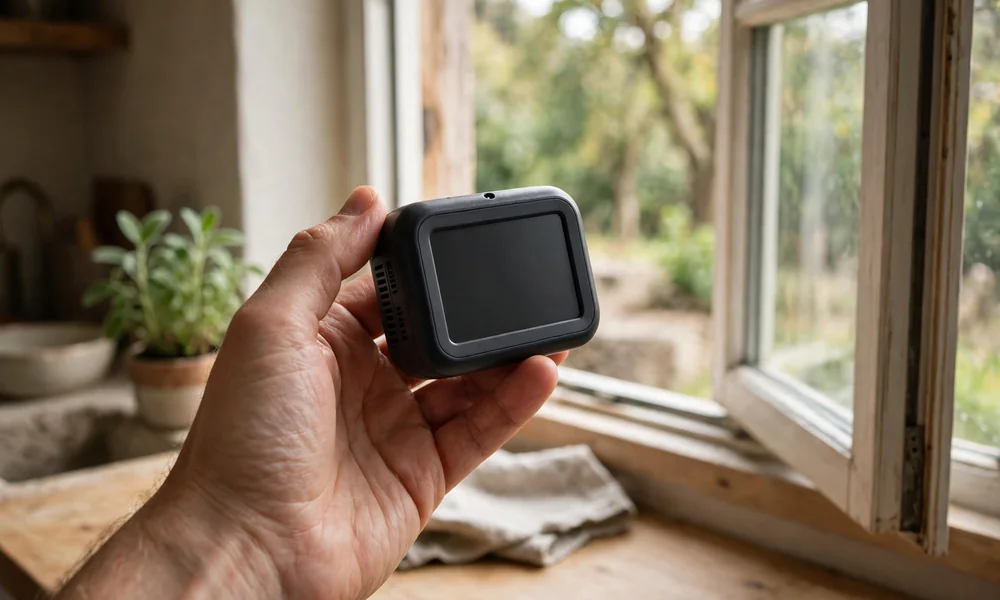
The sensor is the whole monitor. A laser particle sensor costs more to make, but it counts real particles and keeps its accuracy for years. A cheap infrared sensor, the kind found in the lowest-priced monitors, does not count particles at all: it shines a light into a chamber and guesses how dusty the air is from how much light comes back. That guess drifts with humidity and temperature, so after a few months the numbers can be wrong by half and still look confident.
Carbon dioxide sensors have the same split. The good ones use a method called NDIR, which measures the gas by how it absorbs infrared light, and they stay accurate for years, though they should be calibrated now and then in fresh outdoor air. The cheap ones do not measure carbon dioxide at all: they measure volatile compounds and estimate the carbon dioxide from that, which is why they can read high in a room full of cleaning spray and low in a stuffy bedroom. When comparing monitors, the sensor type decides whether the numbers are worth trusting.
Displays, Alerts and Apps: Reading the Numbers
A monitor is only useful if you can read it quickly. The best displays show the actual numbers in large type, with a simple colour scale, green for good, amber for fair, red for poor, so you can tell at a glance whether the air needs attention. A monitor that only shows a coloured light, with no numbers, tells you something is wrong but not what, or how wrong, and that is not enough to act on. Look for one that shows PM2.5 and carbon dioxide at the same time, and that keeps a short history.
Alerts are worth having if you will use them. A monitor that beeps or sends a phone notification when carbon dioxide passes 1,000 parts per million is genuinely useful in a bedroom or a home office, because it reminds you to open a window before the air gets stuffy. An app is a bonus, not a necessity: it is nice to check the air from another room, but a monitor that only works through an app is a poor choice. The display on the device itself should always work on its own.
Where to Put the Monitor So the Readings Mean Something
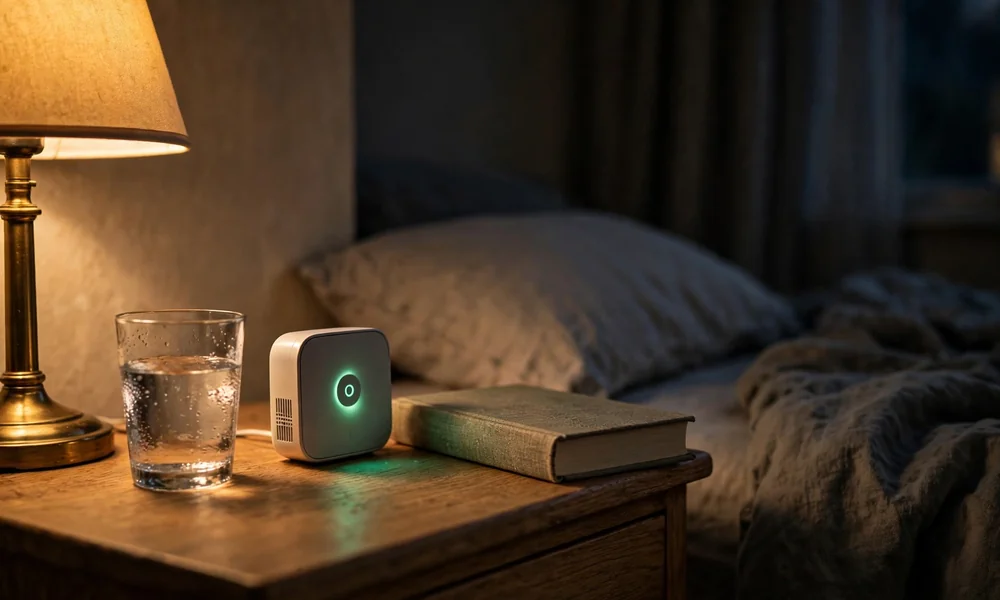
Placement decides whether the numbers are real. Put the monitor at breathing height, on a table or shelf about a metre off the floor, in the room where you spend the most time, usually the bedroom or the living room. Keep it away from windows and doors, where draughts will dilute the readings, and away from the kitchen, where cooking fumes will swamp them. Never put it right next to a purifier, a humidifier, or a heater, because it will measure that machine, not the room.
Give a new monitor a day to settle before you trust it. Sensors need time to adjust to a new room, and carbon dioxide sensors in particular need a period in fresh air to calibrate themselves. Once it has settled, leave it in one place for a week and watch the pattern: the morning peak in the bedroom, the evening peak when you cook, the slow fall when you open the windows. That pattern is more useful than any single reading. A good air purifier is the right tool once the monitor has shown you the dust is the problem.
What to Do When the Numbers Go Bad
A bad reading is a starting point, not a verdict. If PM2.5 is high, look for the source first: cooking without the extractor fan, a candle, a dusty room, or smoke drifting in from outside. Open the windows if the outdoor air is cleaner, or run a purifier if it is not. If carbon dioxide is high, the answer is almost always ventilation: open a window, even a little, and watch the number fall within minutes. If volatile compounds are high, the source is usually something new, paint, furniture, or cleaning products, and the answer is to air the room.
Some problems need more than a window. If the monitor shows high dust every morning, the cause may be a busy road outside, and a purifier running overnight is the practical answer. If humidity is constantly above sixty percent, mould can grow, and that is a job for ventilation or a dehumidifier. And if the numbers never change, suspect the monitor itself: a sensor clogged with dust will report the same number forever. Clean the air inlet gently, leave the monitor in fresh air for a day, and see if the readings start moving again. A good humidifier can help when the air is too dry, but it will not fix dirty air, and a smoke detector is still the device that saves lives in a fire; a monitor only measures.

Air Quality Monitor Checklist
- Choose a monitor with a laser PM2.5 sensor and a proper NDIR carbon dioxide sensor.
- Check that the display shows real numbers for PM2.5 and carbon dioxide, with a clear good-or-bad colour scale.
- Place the monitor at breathing height, away from windows, doors, cooking fumes and heaters.
- Give a new monitor a day to settle, and watch a week of readings before drawing conclusions.
- Act on the numbers: ventilate when carbon dioxide is high, and find the source when dust is high.
- Clean the air inlet gently every few months, and recalibrate the carbon dioxide sensor in fresh air once a year.
Frequently Asked Questions
Are air quality monitors accurate?
A good one is. A monitor with a laser particle sensor and a proper NDIR carbon dioxide sensor is accurate to within about ten to fifteen percent. A cheap monitor with an infrared dust sensor and an estimated carbon dioxide reading can be wrong by half.
What is a good PM2.5 reading indoors?
Below 12 micrograms per cubic metre is good, and below 35 is acceptable for most people. Above 55, the air is unhealthy for sensitive groups, and above 150 it is unhealthy for everyone. If your monitor regularly reads above 35 indoors, look for the source and ventilate or run a purifier.
What carbon dioxide level should I worry about?
Outdoor air is around 420 parts per million. Indoors, below 800 is good, and 800 to 1,000 is acceptable. Above 1,000, open a window or a door: most people start to feel stuffy and tired at that level. Above 1,500, the air feels heavy and concentration suffers.
Do air quality monitors detect mould?
Not directly. No home monitor measures mould spores, but a monitor that shows high humidity, above sixty percent for days at a time, is warning you that mould can grow. Keep humidity between thirty and fifty percent and ventilate damp rooms.
Where is the best place to put an air quality monitor?
At breathing height, about a metre off the floor, in the room where you spend the most time, usually the bedroom or living room. Keep it away from windows, doors, the kitchen, and any purifier or heater.
Is an air quality monitor the same as an air purifier?
No. A monitor measures the air and tells you what is in it; a purifier cleans the air by trapping dust and other particles. They work best together: the monitor shows you when the air is bad and whether the purifier is helping. A monitor on its own changes nothing.
The Bottom Line
The best air quality monitors in 2026 are the ones with a laser dust sensor and a proper carbon dioxide sensor, a display that shows real numbers, and a place at breathing height in the room where you spend the most time. Buy that kind, give it a day to settle, watch a week of readings, and then act on what it tells you: open a window when the carbon dioxide climbs, and find the source when the dust does.


