A Guide to Sprinklers That Water Evenly in 2026
A sprinkler that waters evenly is the difference between a lawn that looks like a photograph and one that looks like a patchwork quilt. Most lawns do not suffer from too little water; they suffer from water landing in the wrong places. One corner turns brown and crispy while another stays soggy, and the middle quietly thins out. The cause is almost always the same: a sprinkler chosen for its price or its packaging rather than for the shape of the garden it has to water. Even coverage is not a mystery. It comes down to matching the sprinkler type to your lawn, setting it up properly, and running it at the right time.
This guide explains how sprinklers work, how the main types differ, and how to choose one that keeps every square metre of your lawn equally happy.
Key takeaways
- Even coverage matters more than total water: a lawn watered evenly needs less water overall than one with dry patches that get overwatered to compensate.
- Oscillating sprinklers suit rectangular lawns, rotary and gear-driven heads suit large open areas, and impact sprinklers handle big spaces and low water pressure.
- Overlap is the secret to uniformity: space sprinklers so their spray patterns overlap by about a third, and no strip of grass is left relying on a single head.
- Water early in the morning, before the sun is high, so the water soaks in instead of evaporating and the grass dries before nightfall.
- Measure, do not guess: a few tuna cans or rain gauges scattered across the lawn will tell you in one session whether your coverage is actually even.
Why even watering matters more than you think
Grass is a surprisingly honest plant: it shows you exactly where the water went, within days. A patch that gets too little water turns straw-coloured, goes dormant, and eventually thins until weeds move in. A patch that gets too much stays soft and dark, grows fast, and becomes a home for fungal disease. The lawn that looks best is rarely the one that gets the most water; it is the one that gets the same amount everywhere.
Uneven watering also wastes water and money. When part of the lawn is always dry, the natural response is to run the sprinkler longer, which drowns the already-wet areas while the dry ones barely improve. Fixing the distribution is cheaper and more effective than adding minutes to the timer.
The main sprinkler types, compared
Sprinklers fall into a few clear families, each built for a particular shape of garden. Oscillating sprinklers sweep a bar of water back and forth across a rectangle, the natural choice for the classic rectangular suburban lawn. Rotary and gear-driven sprinklers throw a single stream in a circle or an arc, covering large areas from one position. Impact sprinklers, the familiar clicking heads on a spike or tripod, throw water in a strong, even arc and cope well with low pressure and large gardens. Soaker hoses are not really sprinklers at all, but they deserve a mention for beds and borders, where spraying water into the air is the last thing you want.

| Type | Coverage shape | Best for | Watch out for |
|---|---|---|---|
| Oscillating | Rectangle, up to about 300 square metres | Rectangular lawns, even gentle watering | Wind disturbs the fine spray; edges can stay dry |
| Rotary / gear-driven | Circle or adjustable arc | Large open lawns, uniform large-area coverage | Needs decent water pressure to reach full range |
| Impact | Circle, long throw | Big gardens, low pressure, tough conditions | Noisy clicking; can puddle if left in one spot |
| Stationary / fan | Fixed pattern, small area | Small lawns, flower beds, spot watering | Too small for a whole lawn; easy to overwater one patch |
| Travelling | Moves along a hose path | Very large lawns without an in-ground system | Slow; needs a clear, straight hose run |
| Soaker hose | Line along the ground | Garden beds, hedges, newly planted areas | Not for lawns; water stays in one line |
No single type is best for every garden. The right choice depends on the shape of your lawn and your water pressure.
Matching the sprinkler to your lawn
Start with the shape. A rectangular lawn is an oscillating sprinkler’s natural home: set it in the middle, adjust the width and range, and the sweep covers the rectangle neatly. A square or round lawn suits a rotary or impact head placed in the centre. An L-shaped or irregular lawn is the hardest case, and it usually needs two positions rather than one clever sprinkler: water one leg of the L, then move the sprinkler and water the other.
Size matters just as much. Small lawns under about 100 square metres are easy to overwater, so a gentle oscillating or stationary sprinkler with a low flow rate is safer than a powerful impact head. Large lawns over 400 square metres need the long throw of a rotary or impact sprinkler, or you will spend the whole morning moving a small one from spot to spot.
Water pressure is the factor most people forget to check. A rotary sprinkler rated for 30 metres of throw will only reach 15 on weak pressure, and the coverage will be patchy rather than even. If your pressure is low, an impact sprinkler is usually the better bet. A good garden hose matters here too: a long, narrow hose strangles pressure, so use the shortest, widest hose you can.
Setting up for even coverage
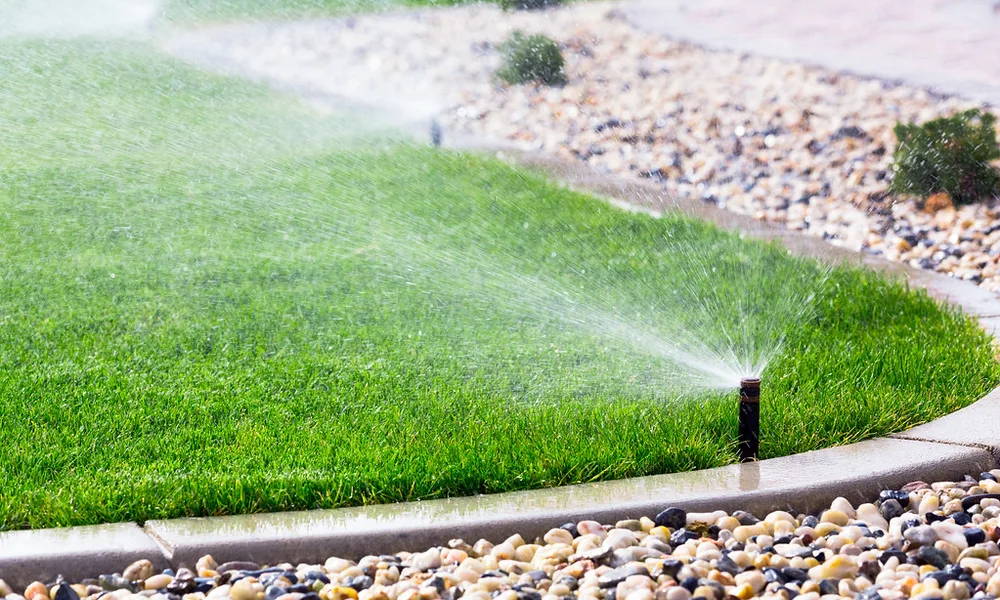
Buying the right sprinkler is only half the job; placing it is the other half. The single most useful rule is overlap: space sprinklers so the spray from one reaches about a third of the way into the area covered by its neighbour. Sprinklers throw less water at the far edge of their range than close in, so the overlap compensates for the thin edges — a lawn watered from a single central position will always be wetter in the middle than at the corners.
Keep the sprinkler low and level. Place it on flat ground, clear of plants that block the spray, and aim the arc at the grass rather than paths and driveways. Water on paving is water wasted.
Wind is the enemy of even coverage, and it is the reason morning watering works so well: a light breeze can push a fine spray metres off course, leaving one side of the lawn dry. The difference between hose setups shows up here as well: a stable, kink-free hose keeps the pressure steady, and steady pressure means a steady spray pattern.
How much water, and when
Most lawns need about 25 millimetres of water a week in the growing season, counting rainfall. It is better delivered in one or two deep soakings than in a daily sprinkle: deep watering encourages roots to grow down, while daily light watering keeps them at the surface, where the next hot day will scorch them. Water until the soil is damp to about 15 centimetres deep, then let it dry slightly before the next session.
Timing is almost as important as quantity. Early morning, between about five and nine, is the best window: the air is still, evaporation is low, and the grass has the whole day to dry. Watering in the middle of the day wastes up to half the water to evaporation. Watering in the evening leaves the grass wet overnight, which invites fungal disease.
Rain changes the maths, and a rain gauge is a cheap way to keep track: if a storm dropped 15 millimetres, your lawn only needs another 10 that week. A rain barrel under a downpipe gives you free, chlorine-free water for the garden.
The tuna-can test: checking your coverage
The fastest way to check whether your sprinkler waters evenly is the tuna-can test. Place five or six straight-sided cans across the lawn — in the middle, at the edges, in the corners, and anywhere the grass looks patchy. Run the sprinkler for fifteen minutes, then measure the water in each can. If every can holds roughly the same amount, your coverage is even. If one holds twice as much as another, you have found your problem: move the sprinkler, adjust the arc, or add overlap.
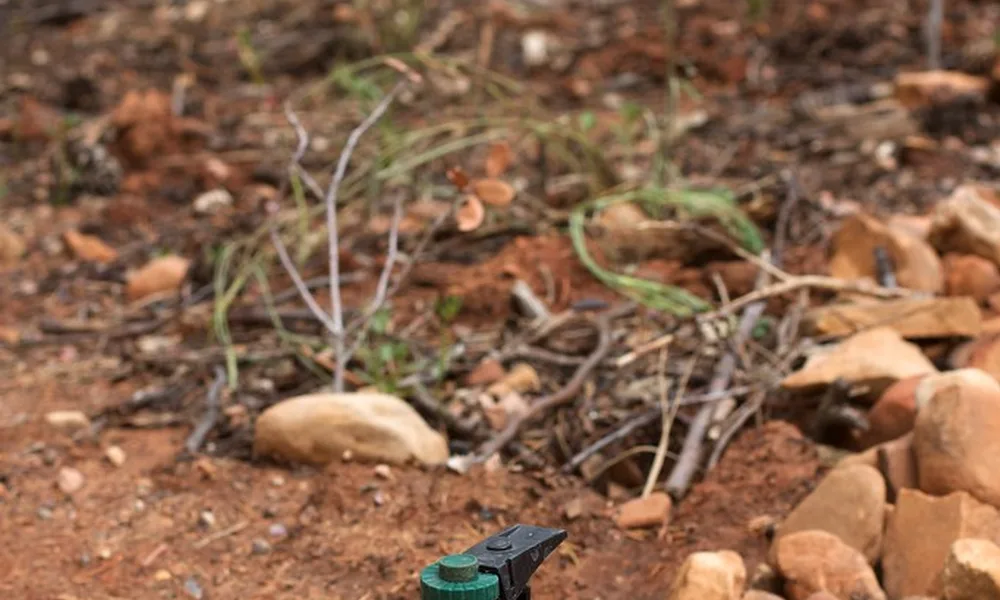
Run the test again after any change, and once a season. Sprinkler heads wear and nozzles clog with grit, so a head that was perfect in spring can throw a lopsided pattern by August. A clogged nozzle is the most common cause of a sudden dry patch: unscrew it, rinse it, and the pattern usually returns to normal.
The mistakes that ruin even watering
The most common mistake is watering every day for a few minutes. It feels diligent, but it trains the grass to keep its roots at the surface, and the lawn becomes dependent on constant watering. The second mistake is ignoring the edges: the strip along a path or fence dries out first, and it is the last place a centrally placed sprinkler reaches. Give the edges their own pass.
The third mistake is setting and forgetting: a sprinkler left running while you go inside is how lawns get drowned and water bills get shocking. The fourth mistake is watering the driveway: if more than a tenth of the spray lands on paving, the sprinkler is in the wrong place or the arc is set too wide.
Choosing well: a quick checklist
- Measure your lawn and sketch its shape before shopping: rectangle, circle or irregular decides the sprinkler type.
- Check your water pressure first; a powerful sprinkler on weak pressure will water patchily.
- Place sprinklers so their patterns overlap by about a third, and water the edges separately if they dry out first.
- Run the tuna-can test for fifteen minutes and adjust the position until every can holds a similar amount.
- Water early in the morning, deeply and infrequently, aiming for about 25 millimetres a week including rain.
- Clean the nozzles, check the pattern once a season, and use a timer so the sprinkler never runs unattended.
Frequently asked questions
How long should I run a sprinkler for even coverage?
It depends on your sprinkler’s flow rate and your soil. Run it for fifteen minutes, do the tuna-can test, and work out how long it takes to deliver about 12 millimetres. Most lawns need two such sessions a week in summer.
Is an oscillating sprinkler or a rotary sprinkler better?
An oscillating sprinkler is better for rectangular lawns and gentle watering. A rotary sprinkler is better for large, open lawns, because it throws further and its heavier droplets resist wind.
Why does one part of my lawn always stay dry?
Usually the spray is not reaching it, the arc is set too narrow, or wind is pushing the spray away. Move the sprinkler closer, widen the arc, or water that patch separately.
Can I water my lawn in the middle of the day?
You can, but you will lose a lot of water to evaporation. Early morning is better, and evening is the second choice if mornings are impossible.
Do I need an in-ground sprinkler system?
Not for most gardens: an above-ground sprinkler moved between two or three positions waters a typical suburban lawn just as evenly.
How do I know if I am overwatering?
Soggy soil, mushrooms, moss and spongy grass underfoot are the classic signs. Push a screwdriver into the soil: if it comes out muddy, skip the next session.
The bottom line
The best sprinkler in 2026 is not the most expensive head or the one with the longest list of spray patterns. It is the one that matches the shape of your lawn, works with your water pressure, and is placed so its pattern overlaps the next one by a third. Measure the lawn, check the pressure, run the tuna-can test, and water deeply in the early morning. Get those four things right and the lawn will do the rest: green edge to edge, with no dry corners and no soggy patches.