A good garden hose saves you more than time. It saves water, saves your plants, and saves you the weekly frustration of kinks, leaks and burst fittings that turn a ten-minute watering job into a forty-minute wrestling match. A cheap hose looks like a bargain, but it is the garden tool most likely to fail exactly when you need it, usually on the hottest day of the year.
Buying well takes a little knowledge. Diameter, length, material and fittings all affect how much water reaches your plants and how long the hose lasts. This guide explains what each means in practice, compares the main types, and shows how to choose a hose that will still be working five years from now.
Key Takeaways
- A 15-metre hose suits most gardens; buy longer only if you have measured the distance to the farthest bed.
- A 13-millimetre diameter is the standard choice, while 19 millimetres gives noticeably better flow for large gardens.
- Rubber hoses last longest and stay flexible in the cold, but they are heavy; vinyl hoses are light and cheap but kink easily.
- Brass fittings outlast plastic ones and are worth the small extra cost on any hose you use weekly.
- Always drain and coil your hose before storing it, and keep it out of direct sun when it is not in use.
What a Cheap Hose Really Costs You
The real cost of a cheap hose is not the price on the shelf. It is the water that leaks from poor fittings, the plants that suffer because the flow is too weak to reach the far beds, and the replacement you buy eighteen months later when the first one splits. A twenty-pound hose that lasts two seasons costs more per year than a fifty-pound hose that lasts eight.
Water waste is the hidden cost. A hose that leaks at the tap can lose several litres every time you water, and one that bursts under pressure can waste far more in a single afternoon. Over a summer, a leaking hose can easily waste hundreds of litres, which shows up on a metered water bill. A good hose with solid brass fittings and a proper washer stops almost all of that waste.
Garden Hose Types Compared
There are five main types, and the differences matter more than the marketing suggests. Rubber hoses are the traditional choice: heavy, flexible and very durable. Vinyl hoses are the cheapest and lightest, but they kink and crack easily. Reinforced hoses have a mesh layer inside that stops them bursting under pressure. Expandable hoses are fabric over an inner tube and stretch when the water is on, making them light and easy to store. Soaker hoses are flat and porous, seeping water slowly along their length, ideal for beds and borders.

| Hose Type | Weight | Durability | Kink Resistance | Best For |
|---|---|---|---|---|
| Rubber | Heavy | 8 to 10 years | Good | Daily use, large gardens |
| Vinyl | Light | 2 to 4 years | Poor | Occasional use, small gardens |
| Reinforced vinyl | Medium | 5 to 7 years | Good | Most gardens, good all-rounder |
| Soaker | Light | 3 to 5 years | Not applicable | Flower beds, vegetable rows |
Rubber is the best choice if you water every day and want a hose that lasts. It stays flexible in cold weather, resists kinking, and can be dragged across gravel and paving without damage. The downside is weight: a 25-metre rubber hose is heavy to carry and coil. For most people, a reinforced vinyl hose is the sweet spot, giving most of rubber’s durability at about half the weight and a lower price.
Expandable hoses are the most divisive type. They are wonderfully light and coil into a tiny space, which makes them popular with people who have small gardens or no storage. But they are the least durable, they can burst if the water pressure is high, and they shrink back when the water is off. They suit light, occasional watering, not daily use. Soaker hoses are a different tool: laid along a bed and left on, so water seeps slowly into the soil where the roots are.
Length, Diameter and Water Pressure
Length is the first decision, and the rule is simple: measure the distance from your tap to the farthest plant you water, add a few metres for going around corners, and buy that length. A hose that is too short forces you to drag pots closer to the tap, while one that is too long is heavy, kinks more, and loses pressure. For most gardens, 15 metres is enough; large gardens usually need 25 metres, and anything over 30 metres loses serious pressure.
Diameter matters more than most people think. A standard garden hose is 13 millimetres inside, which suits most taps and most watering jobs. A 19-millimetre hose carries roughly twice as much water, which makes a real difference when filling a water butt, running a sprinkler, or watering a large area. The trade-off is weight and price, and a wider hose needs a tap that can supply the flow, so check your water pressure first. If your pressure is low, a wider hose will not help, because the tap is the bottleneck.
Water pressure is the number nobody checks until it is too late. Most homes have between 2 and 4 bar at the tap, plenty for a standard hose. Below 2 bar, a sprinkler will struggle and a long hose will feel weak. Above 5 bar, cheap hoses and plastic fittings can burst, so you need a reinforced hose and a pressure reducer. Measure your pressure with a gauge that screws onto the tap before you spend money.
Fittings, Nozzles and Connectors
Fittings are where cheap hoses fail first. Plastic couplings crack in the sun, cross-thread easily, and start leaking within a season or two. Brass couplings cost a few pounds more, but they thread smoothly, seal properly, and last the life of the hose. Check the fittings before anything else: they should be solid and come with a rubber washer inside each coupling. A missing washer is the most common cause of a leak at the tap.

The nozzle matters almost as much as the hose. A good spray gun lets you switch between a gentle shower for seedlings, a jet for cleaning paths, and a mist for delicate plants, and it should feel solid in the hand with a trigger that does not stick. Cheap spray guns leak at the trigger and break when dropped, while a well-made metal one lasts for years. If you water a lot of pots, a watering lance, a long wand with a soft shower head, reaches into hanging baskets and deep beds without bending over.
Quick-connect fittings are the small upgrade that makes the biggest difference to daily use. They let you swap between a spray gun, a sprinkler and a lance in seconds, and they stop the drips from repeatedly threading couplings. Buy a set from the same brand as your hose, because sizes vary slightly, and a mixed set is the usual cause of connectors that pop off under pressure.
Storing Your Hose So It Lasts
How you store a hose matters as much as how you use it. Sunlight is the biggest enemy: ultraviolet light breaks down vinyl and rubber, making the hose stiff, cracked and prone to splitting. A hose left coiled in full sun all summer will age years faster than one stored in the shade. A wall-mounted reel or hose box keeps it out of the sun and off the ground, where mowers and foot traffic can damage it.
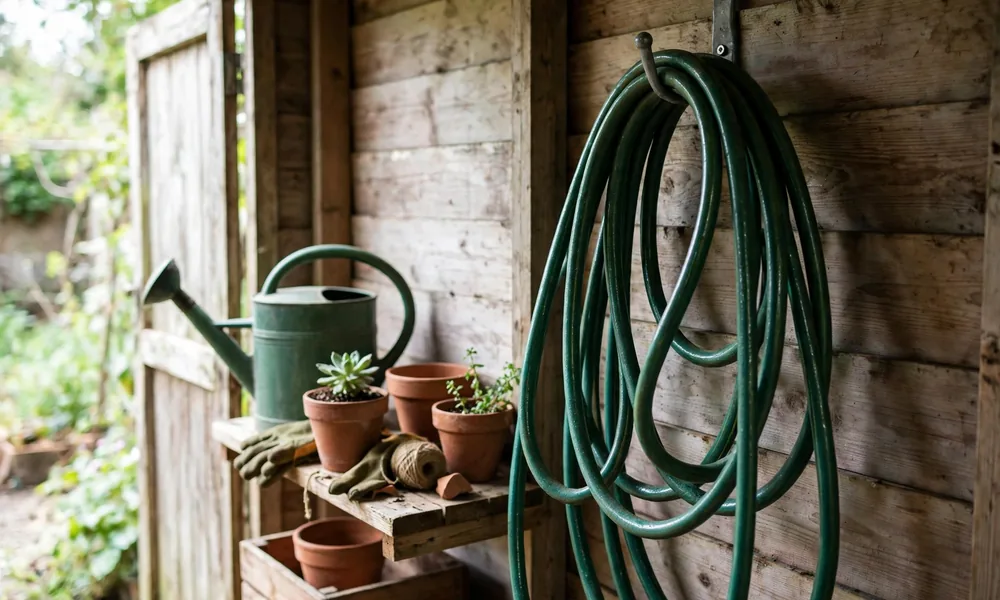
Always drain the hose before storing it. Water left inside adds weight, encourages algae, and in winter it freezes, expands and splits the hose from the inside. To drain it, turn off the tap, open the nozzle, and walk the length of the hose lifting it to let the water run out. Coil it in large, loose loops rather than tight ones, because tight coils kink the hose and weaken it at the bend. In winter, store it indoors if you can, or at least in a shed.
One more tip that saves money: keep the hose away from the lawn mower. Running over a hose is one of the most common ways to ruin one, and it can damage the mower blade too. Our guide to choosing a lawn mower that fits your garden covers garden layout and storage, including where to keep hoses so they stay out of the mower’s path. A wall-mounted reel near the tap is the simplest setup that works.
Garden Hose Buying Checklist
- Measure from the tap to the farthest plant and add a few metres before choosing a length.
- Choose 13-millimetre diameter for most gardens, 19 millimetres for large gardens or sprinklers.
- Pick rubber or reinforced vinyl for daily use, and expandable fabric only for light, occasional watering.
- Check the fittings are brass, not plastic, and that each coupling has a rubber washer.
- Buy a spray gun with several patterns and a quick-connect set from the same brand.
- Plan the storage: a wall reel or hose box in the shade, with the hose drained and coiled loosely.
Frequently Asked Questions
What length of garden hose do I need?
Measure the distance from your outdoor tap to the farthest plant you water, then add three to five metres for going around corners and beds. For most gardens, 15 metres is enough; large gardens usually need 25 metres. Longer hoses lose pressure and are heavier, so do not buy more length than you need.
Is a wider hose better?
A 19-millimetre hose carries roughly twice as much water as a 13-millimetre hose, which helps with sprinklers and watering large areas. For hand watering, 13 millimetres is usually enough, and it is lighter and cheaper. Check your tap pressure first: if it is low, a wider hose will not help.
Why does my hose keep kinking?
Kinking is usually a sign of a cheap vinyl hose, a hose that is too long for the job, or tight coils from storage. A reinforced or rubber hose resists kinking far better, and coiling in large, loose loops helps too. If your hose kinks in the same spot every time, that section is weakened and will probably split there eventually.
How long should a garden hose last?
A good rubber hose lasts 8 to 10 years, a reinforced vinyl hose 5 to 7 years, and a cheap vinyl hose 2 to 4 years. Expandable fabric hoses last 2 to 3 years. Storage matters as much as quality: a hose kept out of the sun, drained and coiled loosely, lasts years longer than one left on the lawn.
Can I leave my hose outside in winter?
You can, but it will not last as long. Water left inside freezes and splits the hose, and cold makes vinyl stiff and brittle. Drain the hose fully, coil it loosely, and store it in a shed or garage over winter. If you must leave it outside, use a covered reel and drain it completely.
Are expandable hoses any good?
They are good for light, occasional watering in small gardens, because they are very light and store in a tiny space. They are not good for daily use, high pressure, or large gardens, because they are less durable and can burst. For most gardeners, a reinforced vinyl hose is a better choice, and our guide to the patio furniture that turns your garden into a second living room covers the rest of the outdoor setup.
If you enjoy cooking outdoors too, our guide to the best grills for backyard cooking in 2026 is a useful companion.
The Bottom Line
A good garden hose saves you more than time: it saves water, protects your plants, and removes the daily frustration of kinks and leaks. Measure your garden, choose the right length and diameter, buy brass fittings, and store it drained and out of the sun. Spend a little more now on a hose that lasts eight years.