Top Magnetic Knife Strips for Handy Blades in 2026
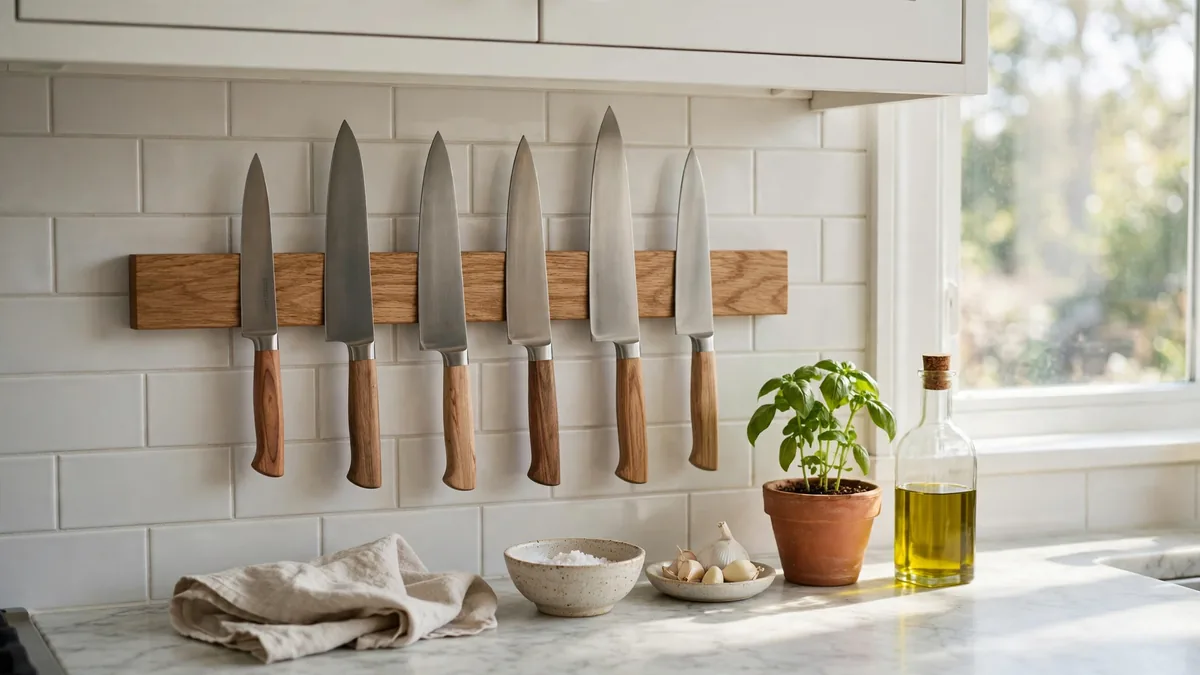
The best magnetic knife strips keep your blades visible, dry and within reach, and they free the whole worktop for cooking. A magnetic knife strip is a wall-mounted bar with a strong magnet hidden inside, and your knives stick to it blade-up, edge untouched, ready to grab. No more digging through a drawer, no more slots that dull the edge, and no more countertop block eating half the worktop. This guide compares the magnetic knife strips worth mounting in 2026, from warm wooden bars to slim stainless steel.
A strip is a simple idea done well, but the differences matter. Magnet strength decides whether a heavy cleaver stays put or slides down the wall. Length decides how many knives fit, the surface decides whether the blade is protected, and the mounting decides whether the bar stays on the wall.
Key Takeaways
- A magnetic strip holds knives by the flat of the blade, so the edge never touches anything.
- A strip is not a knife block: it is an open wall-mounted bar, while a block is a slotted countertop box.
- Full-length magnets hold heavy knives far better than strips with magnets only at the ends.
- Mount the strip into studs or solid fixings, never just into plaster, and place it out of reach of children.
- Wood protects blades best, stainless steel is easiest to clean, and 45 cm suits most kitchens.
A Strip Is Not a Knife Block
The distinction matters, because the two solve different problems. A knife block is a slotted box that sits on the worktop and hides the blades inside it. A magnetic knife strip is an open bar fixed to the wall: the blades hang in the open, visible at a glance, dry in the air, and free of the slots that dull an edge.
Our guide to the best and worst knife blocks of 2026 compares blocks in detail, and it reaches the same conclusion: a magnetic strip can beat a countertop block entirely if you are short on worktop space. A strip frees the worktop, keeps blades visible, and never gathers crumbs in slots you cannot clean. The trade-off is exposure: a strip suits a household without small children, and it needs a firm wall fixing.
That is why many kitchens end up with both: a block holds the everyday set where children cannot reach it, while a strip by the chopping board holds the two or three knives you use every day. If you only buy one, choose the strip when worktop space is tight, and the block when small children roam the kitchen.
How a Magnetic Knife Strip Works
Inside every strip is a magnet, or a row of magnets, set behind a face of wood, steel or plastic. The flat of the blade sticks to the face, held by magnetism alone, and the edge hangs free in the air. Nothing touches the cutting edge, which is why blades stored on a strip stay sharp longer than blades rattling in a drawer, and why a strip suits the knives in our guide to the best knife sets of 2026.
Magnet strength is the first thing to check. The best strips use a full-length magnet that runs the whole bar, so a knife is held along its full length and cannot pivot or slide. Cheaper strips use two or three small magnets, and a heavy knife hung between them can slowly creep downwards.
The second thing is the face material. Wood is kindest to blades: a knife laid against a wooden face will not scratch. Stainless steel is the easiest to clean, but a bare steel face can mark a blade, so look for a brushed finish rather than a polished one. Plastic faces are the cheapest and least durable, and they stain and scratch within a year.
The Main Types of Magnetic Knife Strip
Wooden strips are the classic choice. Usually oak, walnut or acacia, they hide a strong magnet behind a smooth wooden face, and they suit almost any kitchen. The only weakness is moisture: a strip mounted right above the sink can swell or stain if constantly splashed.
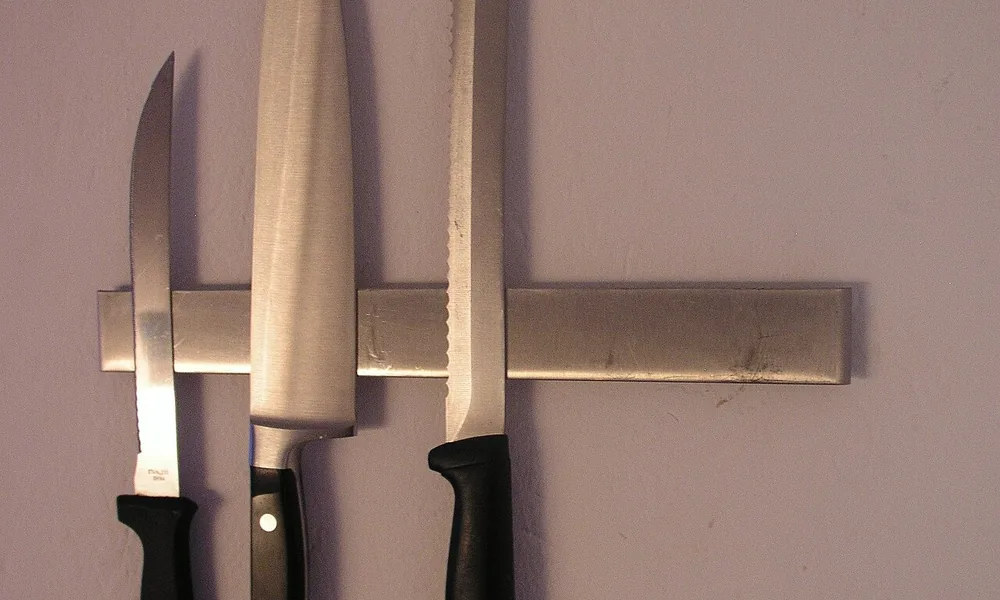
Stainless steel strips are the modern alternative. Slim, easy to wipe clean, and almost impossible to damage, they suit a busy kitchen where the strip gets splashed daily. The best use a strong magnet behind a brushed face; the worst use a weak magnet that lets a knife slide. Check the weight rating first.
Double-bar strips use two parallel magnetic bars, holding long or heavy blades at two points instead of one. They suit a cook with a cleaver or a long slicing knife, and they also hold scissors and shears that a single bar cannot grip. The cost is width: a double bar takes more wall space.
Some strips add hooks, a shelf or a rail for utensils, turning the knife bar into a small storage station. These suit a tiny kitchen, but they tempt you to overload the strip, and a bar crowded with ladles leaves no room for the knives. Buy the strip for the knives first.
Magnetic Knife Strips Compared
| Type | Best for | Blade care | Cleaning | Price |
|---|---|---|---|---|
| Wooden strip, 45 cm | Most home kitchens | Excellent | Wipe clean | Medium |
| Stainless steel strip, 45 cm | Busy modern kitchens | Good | Very easy | Medium |
| Wooden strip, 60 cm | Large knife collections | Excellent | Wipe clean | Medium |
| Double-bar strip | Cleavers and long blades | Excellent | Wipe clean | High |
| Compact strip, 30 cm | Small kitchens, two or three knives | Good | Easy | Low |
| Strip with hooks and rail | Tiny kitchens needing extra storage | Good | Easy | High |
The Top Magnetic Knife Strips of 2026
Best Overall: A Wooden Strip, 45 cm
The best magnetic knife strip for most kitchens in 2026 is a wooden bar about 45 cm long with a full-length magnet. It holds five or six knives, from a chef knife to a paring knife, and it fits neatly between a cupboard and a window in almost any kitchen. Wood protects the blade, and the length is the sweet spot: long enough for a full set, short enough to mount almost anywhere. It holds the most-used blade in the kitchen, the chef knife, so if you are still choosing one, read our guide to the best chef knives of 2026 first.
Best for Modern Kitchens: A Stainless Steel Strip
For a modern kitchen with steel appliances and a tiled splashback, a stainless steel strip looks right at home. It wipes clean in seconds, shrugs off splashes, and never stains. The best steel strips of 2026 use a strong, full-length magnet and a brushed face. Avoid the cheapest steel strips, because a weak magnet and a polished face make a knife slide and a blade scratch.
How to Mount a Magnetic Knife Strip Safely
Mounting is the part most people rush, and it matters most. Find a stud or a solid brick wall, or use proper fixings rated for the weight of the strip plus a full set of knives. Plaster alone will not hold a loaded strip, and a bar that pulls out drops sharp knives onto the worktop.
Height matters as much as strength. Mount the strip at shoulder height, where you can see every blade and lift one off without reaching up or bending down. The longest blade should hang clear of the worktop, and the strip should sit away from the hob, where heat and steam weaken magnets. Keep it out of reach of small children, and never mount it above a chair a child can climb.
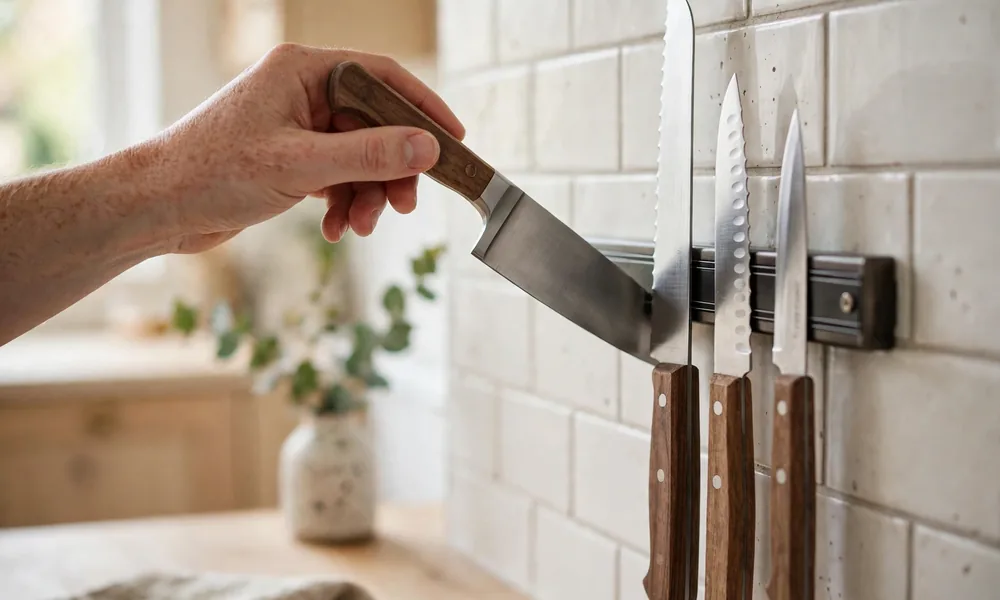
To hang a knife, lay the flat of the blade against the strip and let the magnet take it. Never slap the edge against the bar. To take a knife off, lift the handle away first so the blade pivots off, rather than dragging the edge along the face.
Mistakes That Make a Strip Fail
The most common mistake is mounting the strip with the screws or plugs it came with, without checking what the wall is made of. Plasterboard needs specialist fixings, brick needs masonry plugs, and a stud wall needs the screws in the stud. The fixings in the box are usually the cheapest option, not the right one, so buy fixings for your wall and test with your heaviest knife before loading it fully.
The second mistake is buying a strip that is too short. A 30 cm bar holds three knives, and a cook with six ends up with three on the strip and three back in the drawer. Measure your set first, allow about 7 cm per knife, and buy the next size up.
The third mistake is mounting the strip where steam and grease reach it. Above the hob or next to the kettle, the magnet weakens and the blades collect a film that needs constant cleaning. Mount the strip on a dry stretch of wall near the chopping board, where the knives are used.
The fourth mistake is treating the strip as a place for every blade-shaped object in the house. Cheap serrated knives, old scissors and a rusty cleaver crowd the bar and scratch the face. Keep the strip for the knives you use and care about, and store the rest elsewhere.

Magnetic Knife Strip Checklist
- Measure your knives first, allowing about 7 cm of strip per knife.
- Choose a full-length magnet, not one with magnets only at the ends.
- Pick wood to protect blades, or stainless steel for the easiest cleaning.
- Mount into a stud or solid fixings, never into plaster alone.
- Place the strip at shoulder height, clear of the hob and out of reach of children.
- Hang and lift knives by the flat of the blade, never dragging the edge.
Frequently Asked Questions
Will a magnetic strip damage my knives?
No, a strip is kinder to blades than a block or a drawer, because the edge never touches anything. The only risk is dragging the edge along the face when you take a knife off, so lift the handle away first.
Can a magnetic strip hold a heavy cleaver?
Yes, if the strip has a full-length magnet and is rated for the weight. A single-bar strip can hold a cleaver, but a double-bar strip grips it at two points and is safer. Check the weight rating first.
Is a magnetic strip safe with children in the house?
A strip is safe when mounted firmly and placed out of reach of small children. In a home with toddlers, mount it high, away from chairs or steps, or keep the knives in a block instead.
Do magnetic strips work on tiled walls?
Yes, and tiled walls are one of the best places for a strip, because tiles are usually fixed to a solid wall. Drill through the tile with a proper tile bit, use masonry plugs, and the strip will hold firmly. Avoid adhesive-only mounts, because steam and weight pull them down.
How do I clean a magnetic knife strip?
Wipe a wooden strip with a damp cloth and dry it straight away; wipe a steel strip with a damp cloth and a drop of washing-up liquid. Never soak a wooden strip, and never use an abrasive pad on either type. Clean the strip weekly, when you clean the worktop.
What length of strip do I need?
Allow about 7 cm per knife: a 30 cm strip holds three or four, a 45 cm strip holds five or six, and a 60 cm strip holds eight or more. Measure your set and buy the next size up.
The Bottom Line
The top magnetic knife strips in 2026 are a 45 cm wooden bar with a full-length magnet for most kitchens, and a stainless steel bar for modern kitchens. A strip is not a block: it holds blades in the open, protects the edge, and frees the worktop. Mount it firmly, place it out of reach of children, and hang knives by the flat of the blade.