
Choosing a lawn mower that fits your garden in 2026 is less about finding the most powerful machine on the shelf and more about matching the mower to the lawn you actually have. A mower that is too small for a large plot turns a forty-minute job into a two-hour chore, while a heavy petrol machine bought for a pocket-sized courtyard is wasted money and effort every week. The right mower disappears into the routine: it starts easily, cuts evenly, and leaves a lawn that looks cared for.
The market has changed fast. Battery mowers now rival petrol on small and medium lawns, while petrol still rules big, rough or sloping ground and ride-ons rule the largest gardens. This guide works through the decision step by step.
Key Takeaways
- Measure your lawn before you shop: size, slope and shape decide the mower type more than any brand.
- Battery mowers suit most lawns up to around 600 square metres; petrol and ride-ons still win on large or rough ground.
- Cutting width is a trade-off: wider decks finish faster but are harder to steer around beds and trees.
- Look for adjustable cutting height, a grass box that is easy to empty, and a folding handle if storage is tight.
- Budget for the battery, not just the mower: a second or larger battery can cost as much as the machine itself.
Start With Your Garden, Not the Mower
Start with a tape measure and a walk around the garden. Pace out the lawn and note the area in square metres. Under 100 square metres, a light cordless or hand push mower does the job in ten minutes. A typical suburban lawn of 200 to 400 square metres suits a battery mower with a 40 to 46 centimetre deck. Past 600 square metres, petrol makes sense; beyond 1,000, a ride-on becomes the sensible choice.
Slopes change everything. A gentle slope of up to 15 degrees suits most self-propelled mowers, but a steep bank of 20 degrees or more needs strong drive, good tyres and a low centre of gravity, or a strimmer for the bank while the mower handles the flat ground. Pick the machine up before you buy: a 30 kilogram mower is hard work to control on a hill, however good its engine is.
Shape matters too. A long, narrow lawn rewards a narrow deck that turns easily; a garden full of trees needs a machine you can lift and steer without tearing the turf. If the lawn is split into patches joined by paths, remember a light battery mower carries easily and a heavy petrol mower does not. The worst garden tools for beginners are usually bought without this walk-around, as our guide to the worst garden tools for beginners shows.
The Main Types of Lawn Mower Compared
Five mower types are worth considering in 2026. The table below compares them at a glance.
| Mower Type | Best For | Typical Lawn Size | Running Cost | Noise |
|---|---|---|---|---|
| Hand push (reel) mower | Tiny flat lawns, quiet mornings | Under 100 sq m | Nothing | Silent |
| Corded electric mower | Small lawns near a socket | Under 300 sq m | Very low | Quiet |
| Battery (cordless) mower | Most suburban lawns | Up to 600 sq m | Low | Quiet |
| Petrol mower | Large, rough or sloping lawns | 600 sq m and up | Moderate | Loud |
| Ride-on mower | Very large plots | 1,000 sq m and up | Higher | Loud |
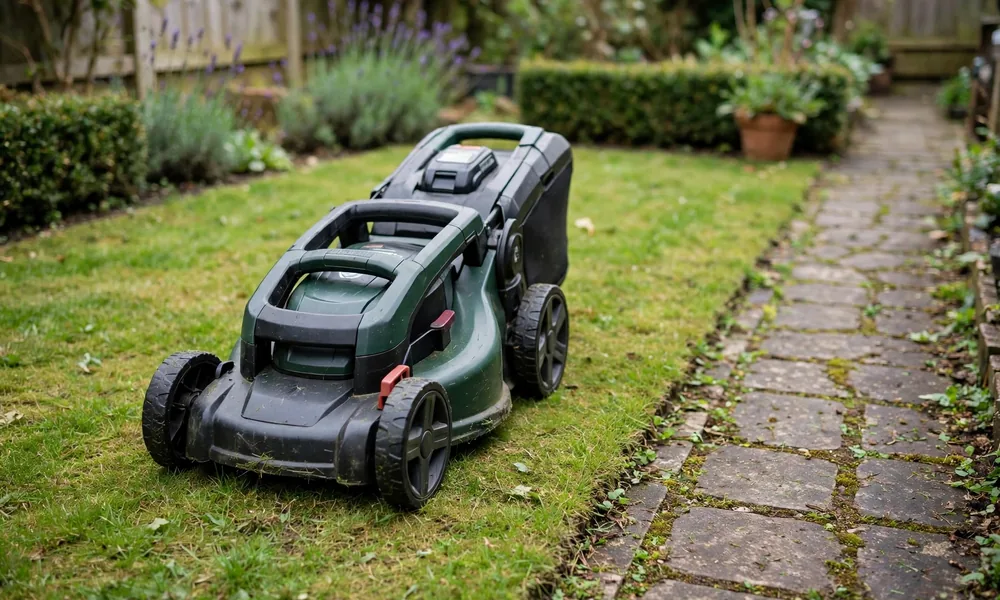
Battery Mowers: The Default Choice in 2026
Battery mowers have improved faster than any other type. A modern 36 or 40 volt mower with a 5 amp-hour battery cuts a 400 square metre lawn on a single charge. They start at the push of a button, need almost no maintenance, are quiet, and produce no exhaust. For most gardens in 2026, a battery mower is the right starting point.
The number to watch is not the voltage on the box but the battery capacity and the runtime on your lawn. Manufacturers quote runtimes on short, dry grass; a lawn that has grown for two weeks in May will cut that figure by a third. If the mower only just covers your lawn on paper, buy the larger battery or a second one, and check whether it fits other tools from the same brand.
Petrol Mowers: Still the Workhorse
Petrol mowers remain the best tool for large, rough or neglected lawns. A petrol engine does not fade, it powers through long, damp grass that would stall a cordless mower, and a full tank covers a big plot without a pause. Self-propelled models, where the engine drives the wheels, are worth the extra cost on any lawn over about 400 square metres.
The trade-offs are real: petrol mowers are louder, heavier and need servicing, with oil changes, air filters, spark plugs and fuel that goes stale over winter. Even so, if your lawn is big, sloping or often left to grow long, petrol is still the honest answer, and a well-kept one can last fifteen years or more.
Ride-On Mowers and Robot Mowers
Ride-on mowers turn a two-hour push into a twenty-minute drive on plots over 1,000 square metres, but they need storage space and a bigger budget, and they are poor on steep slopes.
Robot mowers are the other end of the spectrum: they mow a little and often, keeping the lawn tidy without you lifting a finger. They suit fairly simple lawns up to about 1,000 square metres, but they are no replacement for a conventional mower on rough or very steep ground. Our guide to the best robot lawn mowers of 2026 compares the models worth buying if you would rather automate the job.
Cutting Width, Height and Power: What the Numbers Mean
Cutting width is the most useful number on the box. A 33 centimetre deck is nimble and light, good for small lawns with lots of obstacles. A 41 to 46 centimetre deck is the versatile middle ground for most suburban lawns. A 51 centimetre deck or wider finishes a big lawn faster, but it is heavier, harder to turn, and more likely to scalp uneven ground. Every extra five centimetres saves about ten percent of your mowing time on open ground.
Cutting height matters more than most buyers realise. Grass cut too short goes brown in summer, lets weeds in, and needs watering more often. The healthy range is 25 to 40 millimetres in spring and autumn, rising to 40 to 50 in a dry summer. A good mower adjusts in small steps with a single lever that moves all four wheels at once. Avoid mowers where each wheel adjusts separately: you will never bother to change them.
Power figures are less straightforward. Petrol mowers quote engine size, and anything from 140cc upwards handles a normal lawn, with 160cc or more better for rough ground. Battery mowers quote voltage and amp-hours; the honest comparison is watt-hours, volts times amp-hours. A 36 volt, 5 amp-hour battery holds 180 watt-hours, a useful benchmark for a medium lawn. None of these numbers tells you how well the mower cuts, which is why blade design and deck shape matter just as much.

The Features Worth Paying For
Self-propulsion is the most valuable upgrade on any mower over about 15 kilograms, and variable speed drive is worth paying for on a large lawn. A grass box with a fill indicator saves you from mowing with a full box, which leaves clumps across the lawn. Rear-wheel drive grips better on slopes, and larger rear wheels roll better over bumpy ground. Mulching chops clippings back into the lawn and feeds it, but only works if you mow weekly.
Lawn Mower Buying Checklist
- Measure your lawn in square metres, and note the slopes, narrow spots and obstacles before you shop.
- Match the mower type to the lawn: battery for most gardens up to 600 square metres, petrol for large or rough ground, ride-on above 1,000.
- Check the cutting width: 33 to 41 centimetres for small lawns, 46 for medium ones, 51 or more for large plots.
- Make sure the cutting height adjusts from at least 25 to 50 millimetres, ideally with a single lever.
- Pick the mower up in the shop: if it feels too heavy to lift over a step or push up a slope, it is the wrong one.
- Confirm the battery, the warranty and the cost of spares before you pay, not after the first breakdown.

Common Mistakes When Choosing a Lawn Mower
The most common mistake is buying on power alone: a big engine does not guarantee a good cut, and a heavy mower that is hard to push gets used less than a light one. The second is ignoring the battery, because a cordless mower is only as good as its runtime. The third is buying too wide: a wide deck scalps bumps, catches on bed edges and cannot fit through a narrow gate. Finally, many buyers forget storage and running costs. A mower left outside rusts, a petrol mower needs fuel and servicing, and a replacement battery can cost half as much as the mower itself. Budget for the whole life of the machine.
Frequently Asked Questions
What size lawn mower do I need for a medium garden?
For a lawn of 200 to 400 square metres, a battery mower with a 41 to 46 centimetre deck and a 4 to 5 amp-hour battery is the right size. It finishes the lawn on one charge and stores easily. Go wider only if the lawn is mostly open ground.
Are battery lawn mowers as good as petrol?
On lawns up to about 600 square metres, yes. Modern battery mowers cut as cleanly as petrol models, start instantly and need almost no maintenance. Petrol still wins on very large, rough or sloping lawns, and on grass left to grow long, because a petrol engine does not fade as the job goes on.
How often should I mow my lawn?
In the main growing season, from April to October, once a week is right for most lawns. Cutting little and often keeps the grass healthy, because you never remove more than a third of the blade at once. In a dry summer, mow less often and raise the cutting height.
Is a self-propelled mower worth it?
Yes, on any lawn over about 300 square metres, or on any slope. Self-propulsion takes the effort out of mowing and keeps the speed steady for a more even cut. On a small flat lawn it is unnecessary, and the extra weight makes the mower harder to lift and store.
Should I mulch or collect the clippings?
Mulch if you mow weekly and the grass is short, because the fine clippings feed the lawn. Collect if the grass is long, wet or weedy, because long clippings clump and smother the grass. Most good mowers let you switch between the two.
How long should a lawn mower last?
A well-kept petrol mower lasts ten to fifteen years, a battery mower five to ten, and a hand push mower decades. The battery is usually the first part to fail on a cordless mower, so check its warranty, and store it indoors over winter, charged to about half.
The Bottom Line
The best lawn mower for your garden in 2026 is the one that matches your lawn, not the one with the biggest engine or the highest price. Measure the lawn, note the slopes and the tight corners, and choose the lightest mower that finishes the job on one charge or one tank. For most gardens that means a battery mower with a 41 to 46 centimetre deck; for big, rough or sloping ground, a self-propelled petrol mower; for the largest plots, a ride-on. Once the mowing is done, the garden is yours to enjoy, and our guide to the best fire pits of 2026 is a useful companion. Buy the right size, keep the blades sharp, and mowing becomes the easy part of the weekend.


