
The best TVs of 2026 are not decided by a single specification. They are decided by the room they live in, the people who watch them, and the hours they are actually used. A set that shines in a dark cinema room can look washed out beside a sunny window, and a screen built for fast gaming can be wasted on a household that mostly watches the evening news. The smartest purchase starts with your home, not with a showroom wall.
This guide takes that household-first approach to the best TVs of 2026. Instead of ranking screens by one feature, it matches different homes and viewing habits to the size, panel, sound and smart features that suit them.
Every recommendation below is built around real use: how far you sit from the screen, how much light the room gets, who controls the remote, and how long you expect the set to last. Prices change with sales, so the focus is on what to look for in each bracket. Use the table to narrow your shortlist, then read the section that matches your household.
Key Takeaways
- Start with the household, not the spec sheet: room light, seating distance and who watches matter more than any single feature.
- Match the panel to the room: deep-contrast screens suit dark rooms, while very bright screens suit sunny, open-plan spaces.
- Buy the biggest screen your wall and seating distance comfortably support, and mount it at eye level from your usual seat.
- For sport and gaming, a fast 120Hz panel and low input lag matter far more than extra resolution beyond 4K.
- Plan for sound separately: even excellent slim televisions have thin speakers, so a soundbar is worth budgeting for.
The Best TVs of 2026 at a Glance
| Household | Best Match | Ideal Size | What Matters Most | Typical Price |
|---|---|---|---|---|
| Busy family room | Bright Mini-LED QLED | 65–75 inches | Brightness, wide viewing, simple menus | $700–$1,400 |
| Film lovers | OLED | 55–65 inches | Contrast, colour accuracy, HDR depth | $1,200–$2,500 |
| Sport fans | Bright QLED, 120Hz | 65–75 inches | Motion handling, brightness, large screen | $800–$1,600 |
| Console gamers | 120Hz QLED or OLED | 55–65 inches | HDMI 2.1, variable refresh, low lag | $800–$1,800 |
| Bright open-plan room | Mini-LED QLED | 75–85 inches | Peak brightness, anti-glare finish | $1,100–$2,200 |
| Bedroom or second room | Simple QLED or LED | 43–55 inches | Easy menus, good value, quiet sound | $250–$600 |
| Tight budget | Value QLED | 55–65 inches | Real HDR, solid smart platform | $350–$700 |
Start With the Household, Not the Spec Sheet
Most television regret comes from buying for the wrong room. A screen that looked spectacular under shop lights can disappoint at home, because shops are bright and crowded and designed to make every set look its best. Your living room has windows in particular places, seats at particular angles, and people who watch at particular times of day. Watch your own habits: a household that gathers for films needs different strengths from one where the set runs all day as background.
Next, check the light. Stand where the television will go at the brightest time of day: if sunlight falls directly on it, brightness and glare control should top your list, while a shaded room that is mainly used in the evening calls for contrast and black levels instead.
Measure the Room Before You Shop
Measure the wall, the seating distance and the height of your usual seat before you look at a single model. A good rule is to sit roughly twice the screen’s diagonal away: a 65-inch screen feels comfortable from about 11 feet, while a 55-inch screen suits a seat around 9 feet back. The centre of the screen should sit close to eye level from your usual seat, about 42 to 46 inches from the floor for most sofas. Finally, count your devices: most households need at least three or four HDMI ports, and gamers should make sure at least two are full-bandwidth HDMI 2.1.
The Best TVs for Busy Family Rooms
The family room television is the hardest-working screen in the house: watched from several seats, at different angles, in changing light, by people with very different tastes. The best family set handles films, daytime news and games alike without a trip into the settings menu.
Brightness and viewing angle matter most here. A bright Mini-LED QLED screen holds its colour and punch in daylight and stays watchable from the side sofa, where half the family usually sits. For most families, a 65-inch bright QLED is the sweet spot, and in a large open-plan room it is worth stepping up to 75 inches rather than paying more for a fancier panel at 65.
The Best TVs for Film Nights
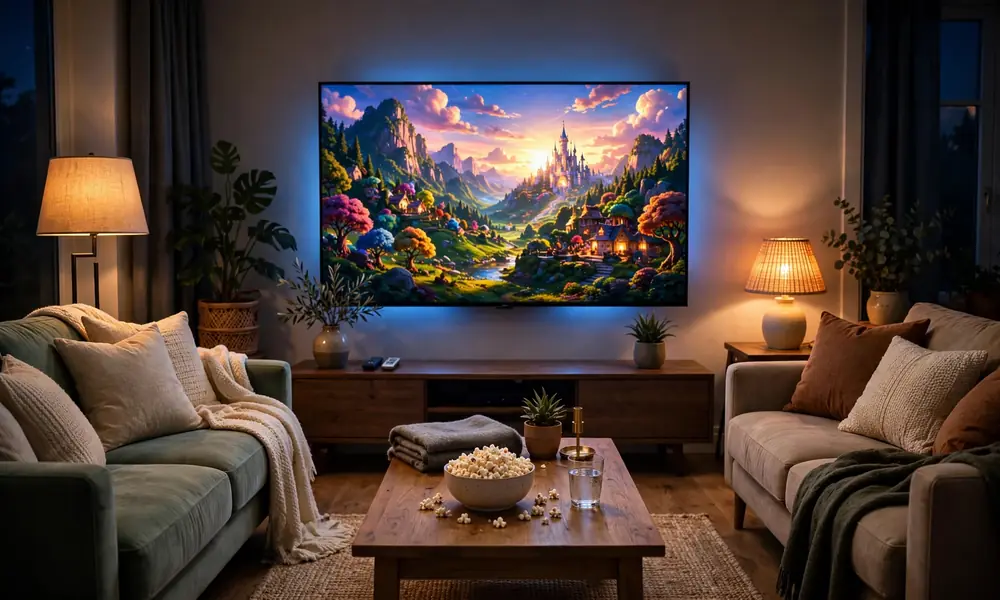
Film lovers should choose contrast first and everything else second. The difference between a good film-night television and a great one is rarely resolution: it is whether a night scene looks deep and detailed or flat and grey. Screens that can switch individual pixels off produce the darkest blacks and the most convincing shadows, which is why they remain the first choice for dedicated film watching in a dark or dim room.
Colour accuracy matters just as much, so look for a filmmaker or cinema picture mode and use it: it reproduces colour faithfully rather than exaggerating it. Plan for a soundbar from the start, since even a premium slim television cannot fill a room with dialogue and music. If you are weighing a television against a projector for a dedicated film room, our comparison of smart TVs versus projectors for movie nights covers the trade-offs in brightness, size and setup.
The Best TVs for Sport and Gaming
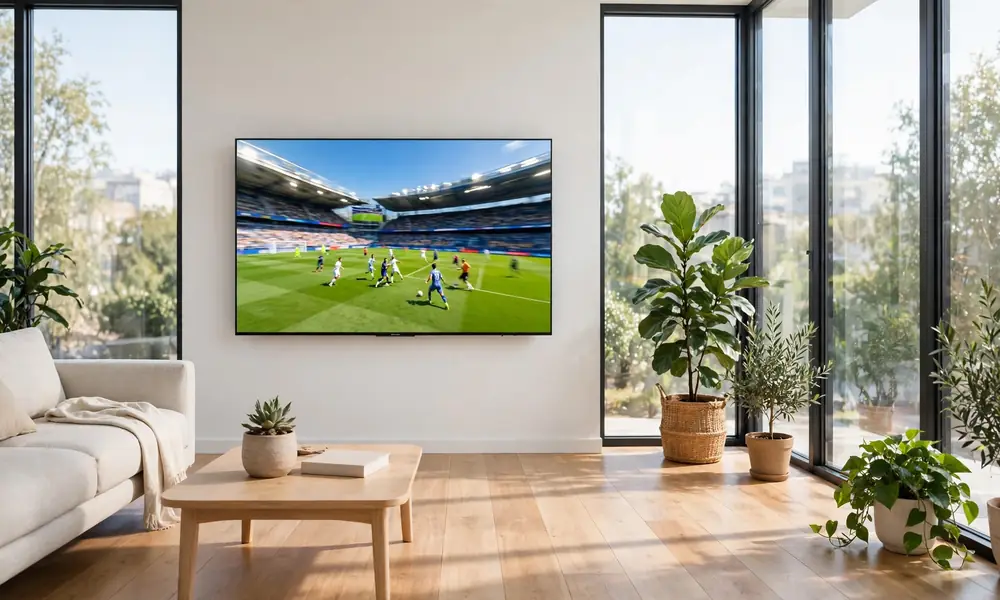
Sport and gaming punish slow screens. A football that smears across the pitch or a game that stutters when the action speeds up will ruin the experience no matter how good the still picture looks. The feature that prevents this is a fast panel: 120Hz refresh, good motion handling and low input lag. For sport, brightness and size matter almost as much, because matches are usually watched in daylight.
Gamers need at least two HDMI 2.1 ports, variable refresh rate, automatic low-latency mode and a game mode that does not wash out the picture. Variable refresh rate matches the television’s refresh to the console’s output, removing tearing and stutter. Do not pay extra for resolution beyond 4K: no current console makes good use of it. Our guide to the best smart TVs of 2026 compares the smart platforms and gaming features across the main panel types, which is a useful cross-check before you commit.

The Best TVs for Bright Rooms
A bright room is the hardest test a television faces, and it is the test most buyers forget to plan for. Sunlight falling on a screen washes out colour, flattens contrast and turns dark scenes into a mirror. The answer is not a bigger screen or a higher resolution: it is raw brightness and a finish that controls reflections. Very bright Mini-LED screens are the strongest choice for sunlit rooms, and a matte or low-reflection coating helps further. Position the set so windows are to its side rather than directly opposite it.
The Best TVs for Bedrooms and Second Rooms
Second rooms have simpler needs. A bedroom television is watched from close up, usually by one or two people, often at night with the lights low. It needs a good picture at a sensible size, quiet and clear sound at low volume, and menus that are easy to use when you are half asleep.
A 43-inch or 50-inch screen suits most bedrooms, and a simple QLED set in this size offers noticeably better colour than the cheapest LED screens for very little extra money. Look for a good night or dialogue mode, which keeps speech clear without turning up the volume, and mount the screen so its centre is at eye level from the bed.
How Much Should You Spend?
The best value sits in the middle of the market. A set costing roughly $700 to $1,200 now offers the brightness, colour and smart features that cost twice as much a few years ago. Spending more buys refinements — slightly deeper blacks, slightly better motion — but rarely a different experience.
Budget carefully, and treat the television as part of a system rather than a single purchase. A $900 screen with a $200 soundbar will give most households a better evening than a $1,100 screen on its own, because sound is the weakest part of almost every slim television. Our guide to the best 4K TVs under $1,000 in 2026 shows what the budget end of the market now offers, and it is a useful benchmark even if you plan to spend more.
Setup, Sound and Longevity
A television’s first week decides how much you enjoy it for the next five years. Switch out of the vivid shop mode and into cinema, movie or filmmaker mode, then turn off motion smoothing for films and drama. The picture will look dimmer at first, but after a day it will look natural, and colours and skin tones will be far more accurate.
Even a modest soundbar transforms dialogue clarity; place it directly under the screen, not inside a closed cabinet. Think about longevity too: choose a smart platform that receives regular updates, enough HDMI ports for future devices, and support for the main HDR formats.
Before You Buy Checklist
- Measure the wall, the seating distance and the eye-level height from your usual seat.
- Check the room’s light at the brightest time of day and note where windows fall relative to the screen.
- Confirm the panel suits the room: bright screens for sunny rooms, deep-contrast screens for dark rooms.
- Count your devices and make sure the set has enough HDMI ports, with at least two HDMI 2.1 for gaming.
- Budget for sound separately, and leave room for a soundbar if films and dialogue matter to you.
- Test a dark scene in the shop, check the menus feel fast, and confirm the return policy before you pay.
Frequently Asked Questions
What size TV should I buy for my living room?
Buy the largest screen your seating distance comfortably supports. A 65-inch screen suits most living rooms, with 75 inches a better choice for large or open-plan spaces, provided you sit roughly twice the screen’s diagonal away.
Is OLED or QLED better in 2026?
It depends on the room. OLED wins on contrast and dark-room cinema, while bright QLED and Mini-LED screens win on brightness, value and sunny living rooms. Choose OLED for a dark room, and Mini-LED QLED for a bright room or a larger screen on a budget.
Do I need a 120Hz TV?
You do if you watch a lot of sport or play console games, where a fast panel keeps motion smooth and responsive. For films and news, a good 60Hz screen is fine.
Is 8K worth buying in 2026?
For almost every household, no. There is very little 8K content, and the difference over 4K is invisible at normal seating distances on screens under 85 inches. Spend the difference on a better 4K panel or a soundbar instead.
How long should a TV last?
A good television should last seven to ten years with normal use. Choose a set with an updated smart platform, enough ports and support for the main HDR formats.
Do I need a soundbar with a new TV?
Almost certainly, if films and dialogue matter to you. Slim televisions have little room for speakers, so even excellent sets sound thin. A modest soundbar is the biggest upgrade most households can make after the screen itself.
The Bottom Line
The best TV of 2026 fits your household: bright enough for your room, large enough for your seating distance, fast enough for your sport and games, and simple enough for everyone who uses it. Choose the panel for the light, the size for the sofa, and the sound for the films, and you will end up with a set that still feels right years after the box is gone.


