A lint roller is one of the smallest tools in the house, and one of the most judged. It has a single job: to lift lint, dust and pet hair off your clothes in the few seconds before you leave the house. When it works, a dark coat looks clean, a black sweater looks new, and nobody notices the tool at all. When it does not work, you walk out with a sleeve full of white fluff, a sheet that tears halfway across your chest, or a sticky film that attracts even more dust than it removed.
The best lint rollers of 2026 do that job without fuss. They pick up hair in one or two passes, peel cleanly to a fresh sheet, hold together after weeks in a drawer, and leave no sticky residue behind. The worst look identical in a packet and then fail on the details that matter: sheets so thin they shred, adhesive so weak it leaves the hair behind, handles that bend or snap, and rollers so narrow that cleaning a whole coat takes a dozen passes. This comparison separates the rollers worth keeping by the door from the ones worth throwing away.
Key Takeaways
- The best lint rollers pick up pet hair and lint in one or two passes and leave no sticky residue on fabric.
- Wide, tear-off sticky sheets are best for coats and pet owners; washable rollers suit light, everyday dust.
- Look for a strong handle, a clean tear line, and sheets that peel without shredding or sticking together.
- Avoid rollers with weak adhesive, thin sheets that tear mid-roll, and handles that flex or snap under pressure.
- Keep one roller by the door and one in the car, and replace the roll before the last sheets start to fail.
How This Comparison Was Judged
We judged lint rollers the way they are actually used: in a hurry, on real clothes, in ordinary light. So the judging started with pickup. Does the roller lift pet hair from a wool coat in one pass, or does it push the hair around and leave most of it behind? Does it cope with fine dust on black fabric, where every missed speck shows, as well as with long dog hair on a sofa cushion?
The Best Lint Rollers of 2026
Wide tear-off rollers
Wide tear-off rollers are the best all-round choice, and the best pick for anyone with a pet. The wider roll covers a coat front in three or four strokes instead of ten, and a good adhesive grabs hair, dust and crumbs together rather than picking up only the lightest fluff. The best of them have a perforated tear line that actually works: you peel one sheet, it comes away cleanly, and the next sheet is ready underneath. Their handles are solid, with a grip that does not twist in your hand, and the roll sits squarely on its spindle instead of wobbling from side to side. A wide roller lives by the front door, gets used every morning, and needs a refill only every few weeks in a pet-free home. If you buy only one lint roller, buy a wide tear-off roller with a firm handle and sheets that peel cleanly.
Reusable washable rollers
Reusable washable rollers are the best choice for light, everyday use and for anyone who dislikes throwing away sheet after sheet. They use a sticky silicone or rubber surface that picks up dust and fine hair, then rinses clean under a tap and dries ready to use again. The best ones keep their stickiness through dozens of washes, feel solid in the hand, and work well on smooth fabrics, curtains and car seats. They are not the best tool for heavy pet hair, because long hair wraps around a washable roller rather than sticking flat to it, and a very hairy coat can take longer to clean than with a fresh tear-off sheet. But for a quick pass over a jacket before a meeting, a dusty lampshade, or a car seat after a school run, they are fast, cheap to run and always ready.
Travel and mini rollers
Mini rollers are the best rollers for bags, cars and holidays, where a full-size roller is too bulky to carry. The best minis are short, sturdy versions of the wide tear-off design, with a cap that protects the sticky surface and a handle that does not snap when the bag gets squeezed. They are ideal for a quick fix before a wedding, a job interview or a dinner out, when you notice the lint only after you have already left the house. Their weakness is capacity: a mini roll holds far fewer sheets than a full-size roll, and on a very hairy coat it can run out halfway through the job. That is a fair trade for something that fits in a pocket, but it means a mini roller is a backup, not a replacement for the roller by the door.

The Worst Lint Rollers of 2026
Thin sheets that shred
The most common bad roller is the one with paper-thin sheets. It looks fine in the packet, but the first time you press it against a coat, the sheet splits, curls at the edges, or tears in the middle of a stroke. You end up peeling away half-used sheets, picking scraps of paper off your sleeve, and using three sheets to do the work of one. The adhesive is often patchy too, strong in the middle and weak at the edges, so the roller leaves a neat stripe of hair untouched along each side. These rollers are usually the cheapest on the shelf, and they are a false economy: a roll that looks like a bargain can cost more per clean coat than a good roller, because you burn through sheets so fast.
Weak adhesive that leaves hair behind
The second worst kind is the roller with adhesive too weak for the job. It picks up light dust well enough, so it passes a quick test on a clean shirt, but it cannot lift pet hair from wool, long hair from a coat, or lint that has worked its way into the weave of a sweater. You roll and roll, the hair stays put, and the sheet fills up with dust while the visible problem remains. On dark fabric, the result is easy to see: the coat looks exactly as hairy as before, only now you have wasted a sheet as well. Weak adhesive is also the hardest fault to spot before you buy, because the roller feels sticky to a fingertip. The test is on fabric, not on skin: a good roller grabs hair the moment it touches wool, while a weak one slides over it.
Flimsy handles and wobbling rolls
The third worst kind fails at the handle. The plastic is thin, the grip flexes when you press down, and the roll wobbles on its spindle so that only part of the sheet touches the fabric. Some handles snap at the neck after a few weeks, usually just when the roll is still half full. Others have a roll that slides sideways, so the sheet bunches up at one end and leaves the other end bare. A flimsy handle matters more than it sounds, because a lint roller only works when you can press it firmly and evenly across the fabric. A handle that bends absorbs the pressure you need, and a wobbling roll means half your strokes do nothing at all. Pick the roller up before you buy it if you can, and give the handle a gentle squeeze. If it flexes, put it back.
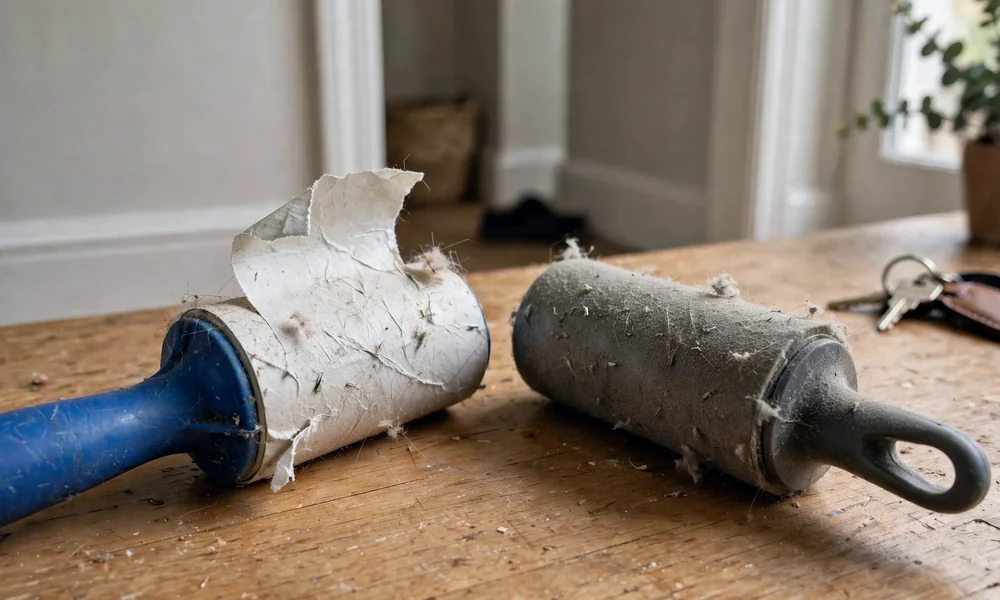
Best vs Worst: Lint Rollers Compared
| Type | Pickup | Sheets | Best for |
|---|---|---|---|
| Wide tear-off roller | Excellent | Clean tear, many sheets | Coats and pet owners |
| Washable roller | Good on dust | None, rinses clean | Light daily use, travel |
| Mini roller | Good | Few, runs out fast | Bags, cars, quick fixes |
| Thin-sheet roller | Poor | Shreds and wastes sheets | Avoid |
| Weak adhesive roller | Poor on hair | Fills with dust only | Avoid for pet hair |
| Flimsy handle roller | Uneven | Bunches and wobbles | Avoid |
Which Lint Roller Should You Buy?
For most homes, the answer is a wide tear-off roller by the front door, plus a washable roller in the car. The wide roller handles coats, pet hair and the morning rush, while the washable roller covers the light jobs and the places where a paper roll would get crushed. Add a mini roller to a handbag or a work bag if you often notice lint only after leaving the house, and you have the whole problem covered for very little money.

Getting the Most From a Lint Roller
Technique matters as much as the roller. Roll in short, firm strokes in one direction, and lift the roller at the end of each stroke instead of rolling back and forth over the same patch. Rolling backwards pushes hair back into the fabric and can leave a sticky smear. On wool, use a light touch and let the adhesive do the work; pressing too hard can flatten the fibres and make the coat look shiny. Store the roller with its cover on, because a roller left open in a drawer collects dust from everything around it and loses its stick before you use it.
Lint control starts before the roller, too. Clothes fresh from the wash pick up less lint when they are shaken out before hanging, and a quick brush of a coat after a walk with the dog stops hair working deep into the weave. Washing dark clothes inside out also helps, and choosing the right wash for sensitive skin matters as much as the finish: our guide to the best laundry detergents for sensitive skin in 2026 covers detergents that clean well without leaving residue that attracts lint. Small habits like these mean the roller has less to do each morning, and do not expect a lint roller to fix pilling or stains: it is a finishing tool, not a repair tool.
The Verdict
The best lint rollers of 2026 are the wide tear-off rollers with strong adhesive, clean-tearing sheets and a firm handle. They are cheap, reliable and fast, and they handle the hardest job in the category, pet hair on dark wool, without fuss. Washable rollers are the best second roller, ideal for light dust, cars and travel, while mini rollers are a useful backup for bags and pockets.
The worst lint rollers are the ones with thin shredding sheets, weak adhesive, or flimsy handles, and they are not worth the shelf space even at a low price. A roller that tears, leaves hair behind, or wobbles as you use it will cost you more in wasted sheets and wasted mornings than a good roller ever will. Buy the wide tear-off roller, keep it by the door, and pair it with a washable roller for the light jobs. And if lint is only part of a wider tidy-up, our guides to why dryer balls beat dryer sheets in 2026 and closet organizers that double your storage space in 2026 will help with the laundry and the wardrobe around it.