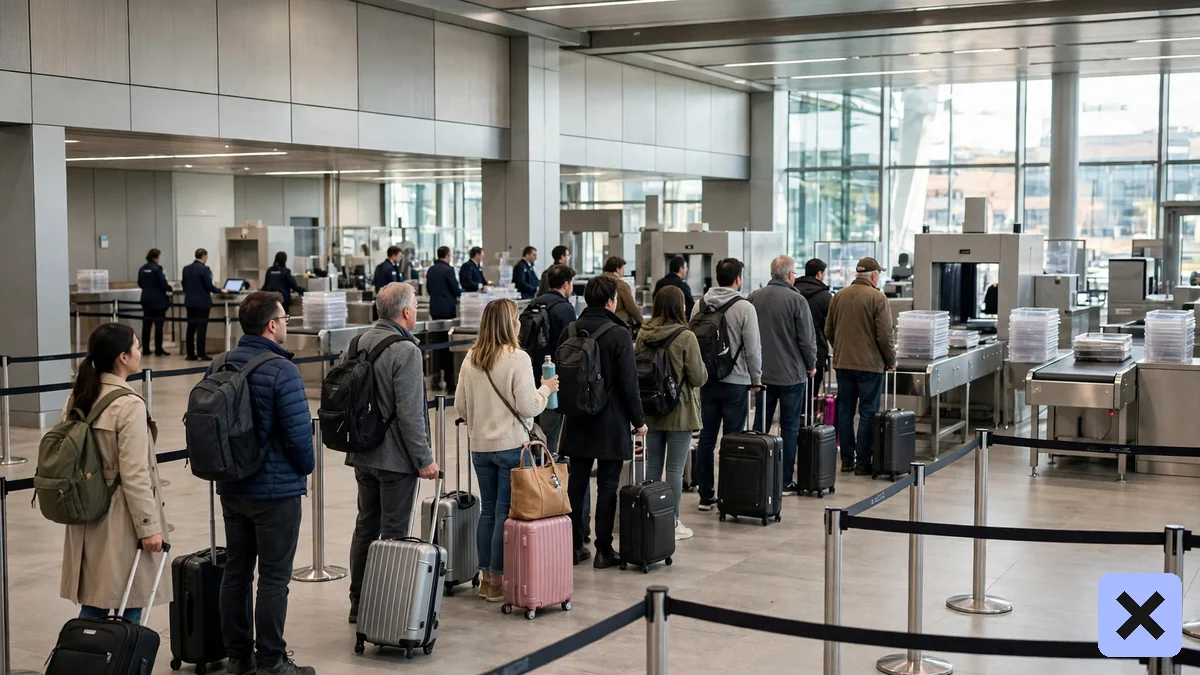
The best wireless headphones for travel in 2026 do far more than play music: they turn a noisy cabin into a quiet room, stretch a single charge across a full day of flying, and stay comfortable from takeoff to landing. On a long-haul flight, the right pair is the difference between arriving rested and arriving exhausted.
Travel puts demands on headphones that everyday listening never does. Engine drone, crying babies, and terminal announcements compete with your audio, battery life matters more when there is no outlet at your seat, and comfort matters more when you wear them for eight hours straight.
This guide compares the strongest wireless headphones for travel in 2026, judged on noise cancellation, battery life, comfort, portability, and call quality — and on how they perform on planes and in terminals, not just on a spec sheet.
Key takeaways
- Strong active noise cancellation is the single most important feature for frequent flyers.
- Look for at least 30 hours of battery life with noise cancellation switched on.
- Over-ear headphones beat earbuds for comfort on flights over three hours.
- A foldable design and a hard travel case protect your investment in a packed bag.
- Multipoint Bluetooth keeps you connected to your phone and laptop at the same time.
What Makes a Great Travel Headphone
Not every good headphone is a good travel headphone — the best travel pairs share a specific set of strengths.
Noise Cancellation That Actually Works
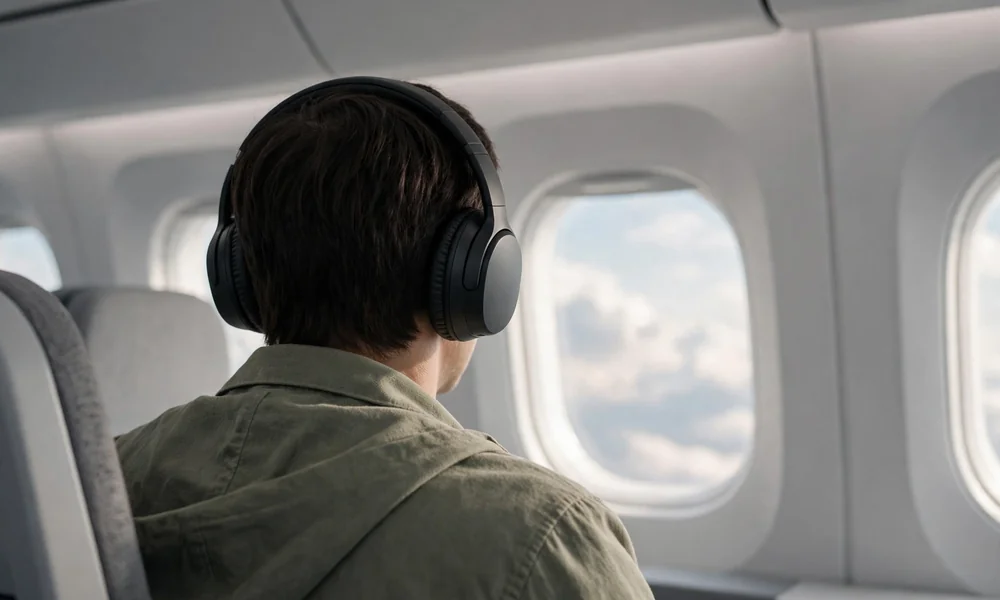
Active noise cancellation is the feature that matters most at 35,000 feet. Good systems use microphones to detect low-frequency engine drone and cancel it before it reaches your ears. The result is a dramatic drop in background roar that lets you listen at lower, safer volumes.
The top models in 2026 cancel low-frequency noise far better than budget pairs. If you fly more than a few times a year, this is where your money should go. Our roundup of noise-cancelling headphones built specifically for travel goes deeper into how the leading systems compare on real flights.
Transparency mode matters too: you need to hear gate announcements and boarding calls without taking your headphones off, and the best travel headphones switch between cancellation and transparency with a single tap.
Battery Life for Long Hauls
A flight from New York to London takes about seven hours, and with airport time on both ends you need at least 12 hours of reliable playback — before any delay. The strongest travel headphones now offer 30 to 60 hours per charge.
Fast charging is the backup plan: many top models give five hours of playback from a ten-minute charge, enough to rescue a dead battery during a layover. Keep a cable in your personal item so a short charge at the gate is always an option.
For longer trips, pairing your headphones with one of the best portable chargers for travel means you never have to ration listening time — a compact power bank can recharge headphones several times over.
Comfort and Foldability
Comfort is personal, but a few things are universal: soft memory-foam ear cushions, a well-padded headband, and a clamping force that holds the headphones in place without squeezing your head. Glasses wearers should pay special attention, since tight ear cups press frames into the temples.
Weight matters on a long flight: the most comfortable travel headphones weigh under 260 grams, and you forget you are wearing them after an hour.
Foldability is the practical side of travel design: headphones that fold flat and come with a slim hard case slip into a carry-on without a fight, while bulky non-folding designs are frustrating on the road.
The Best Wireless Headphones for Travel in 2026
The six models below are the strongest travel picks of the year, each excelling in a different area.
| Headphone | Battery Life | Weight | Best For |
|---|---|---|---|
| Sony WH-1000XM5 | 30 hours | 250 g | Best overall |
| Bose QuietComfort Ultra | 24 hours | 254 g | Best noise cancellation |
| Sennheiser Momentum 4 | 60 hours | 293 g | Best battery life |
| Soundcore Space Q45 | 50 hours | 292 g | Best value |
| Apple AirPods Max | 20 hours | 385 g | Best for Apple users |
| Bowers & Wilkins Px7 S2e | 30 hours | 307 g | Best sound quality |
Sony WH-1000XM5: Best Overall
The Sony WH-1000XM5 remains the best all-round travel headphone in 2026. Its noise cancellation is among the strongest available, its sound is rich and adjustable through a detailed app, and its call quality is excellent even in a noisy terminal.
At 250 grams it is light enough for long days, the battery covers a full day of travel, and a three-minute charge adds three hours of playback.
For most travelers, this is the safest pick: it does everything well, is widely available, and goes on sale regularly.
Bose QuietComfort Ultra: Best Noise Cancellation
If silence is your priority, the Bose QuietComfort Ultra is the pair to beat. Bose has long set the standard for noise cancellation, and the Ultra model adds spatial audio and a noticeably more premium build than earlier QuietComfort models.
Comfort is where Bose shines: plush ear cushions and light clamping force make these the easiest headphones here to wear for eight hours straight. Battery life is a more modest 24 hours, still enough for a full travel day.
They sit at the top of the price range, but for weekly flyers the comfort and quiet are worth it.
Sennheiser Momentum 4: Best Battery Life
The Sennheiser Momentum 4 offers a remarkable 60 hours of battery life with noise cancellation switched on. That is double most rivals, and it means you can take a two-week trip without packing a charger for your headphones at all.
Sound quality is superb, with the warm, detailed signature Sennheiser is known for. Noise cancellation is strong, though a step behind Sony and Bose on the lowest engine frequencies.
It does not fold into a compact shape, so it takes up more room in a bag — but if battery life is your top concern, nothing else comes close.
Soundcore Space Q45: Best Value
The Soundcore Space Q45 proves that good travel headphones do not need a premium price. At well under half the cost of the flagship models, it delivers strong noise cancellation, 50 hours of battery life, and a comfortable fit.
Sound quality is very good for the price, with a bass-forward tuning that suits movies and pop music, and the app offers a full equalizer and customizable noise cancellation levels.
Build quality is the main compromise: the plastics feel less premium and call quality in very noisy places is average. For occasional travelers, though, it is an outstanding deal.
Apple AirPods Max: Best for Apple Users
The AirPods Max are the heaviest headphones on this list at 385 grams, but they offer a unique set of strengths for Apple users. Spatial audio with head tracking is genuinely impressive on flights, and switching between iPhone, iPad, and Mac is seamless.
Build quality is the best here, with aluminum ear cups and a knit mesh headband that distributes weight well, and transparency mode is the most natural-sounding of any pair on this list.
The downsides are real: 20 hours of battery life is the shortest here, the case is poor, and the price is high. They make most sense if you already live in the Apple ecosystem.
Bowers & Wilkins Px7 S2e: Best Sound Quality
For travelers who care about sound above all else, the Bowers & Wilkins Px7 S2e is the pick. Its drivers deliver a level of detail, clarity, and spaciousness that the other models cannot quite match, and it makes the most of high-resolution streaming services.
Noise cancellation is strong, battery life is a solid 30 hours, and the design is the most elegant on this list. Comfort is good, though the 307-gram weight is noticeable on very long flights.
The app is simpler than Sony or Bose and offers fewer options. If you want the best-sounding travel headphone, this is the one.
Over-Ear Headphones vs Earbuds for Travel
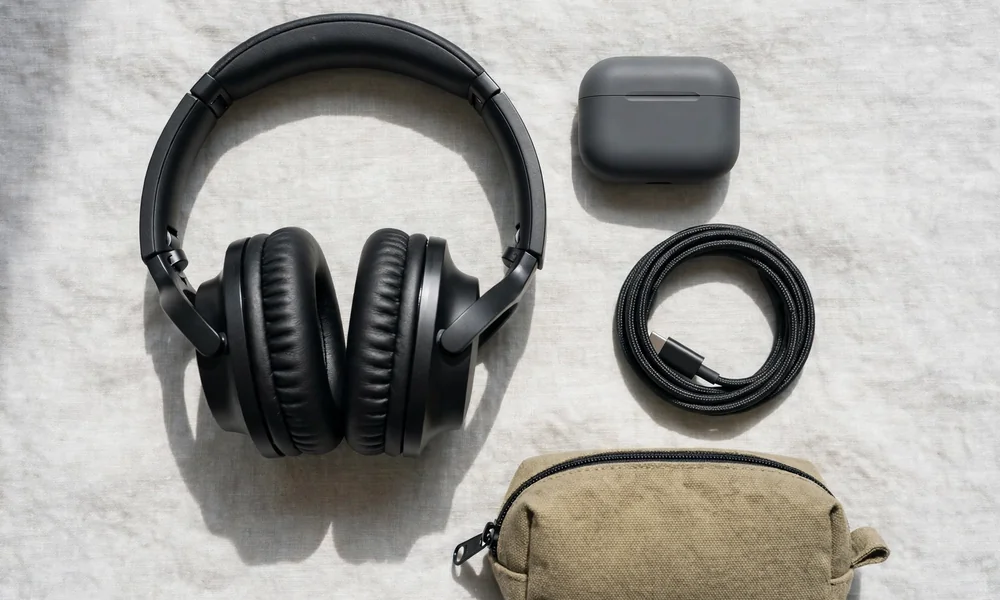
Over-ear headphones win for long flights. They are more comfortable over many hours, their noise cancellation is stronger, and their batteries last longer.
Earbuds win for packing light and for sleeping: they take up almost no space, are easier to wear against a pillow, and the best models now offer surprisingly effective noise cancellation. Many frequent travelers carry both: over-ears for the flight, earbuds for the destination.
If you prefer the smaller option, our guide to the best wireless earbuds for travel covers the top compact picks and their noise cancellation. Choose based on how you actually travel, not on which form factor looks better in a photo.
Features Worth Paying For
Multipoint Bluetooth is the most useful travel feature buyers often overlook: it keeps your headphones connected to two devices at once, so you can watch a film on your laptop and still hear a call on your phone. Every flagship here supports it.
Wired backup is another quiet essential: a 3.5 mm cable plugs into the in-flight entertainment system, which still does not support Bluetooth on most airlines. A cable is cheaper than a Bluetooth transmitter and always works.
Good call quality matters more than travelers expect: airport calls and work calls from a lounge sound better with multiple microphones and wind-noise reduction.
Finally, check the warranty and whether replacement ear cushions are available. Cushions wear out after a year or two of heavy travel.
Travel Headphone Checklist
Before your next trip, run through this checklist.
- Charge your headphones fully the night before you fly, and check the battery level in the app.
- Pack a USB-C charging cable in your personal item, not in checked luggage.
- Bring a 3.5 mm audio cable for the in-flight entertainment system.
- Download your music, podcasts, and films before you leave, since airport Wi-Fi is slow.
- Test noise cancellation and transparency mode at home so you know the controls by touch.
- Store the headphones in their hard case inside your bag, not loose on top of everything else.
Frequently Asked Questions
Are wireless headphones allowed on planes?
Yes. Bluetooth is permitted once the aircraft is in the air, and it can stay on in airplane mode on most airlines, though devices must be in airplane mode during takeoff and landing.
How long should travel headphone batteries last?
Look for at least 30 hours with noise cancellation on — enough for a full day of flying plus airport time. Anything over 40 hours is excellent.
Do noise-cancelling headphones work against crying babies?
Noise cancellation works best on steady, low-frequency sounds like engine drone. It helps less with sudden, high-pitched sounds such as a crying baby, though it still reduces them noticeably, and over-ear headphones block extra sound physically.
Can I use wireless headphones with in-flight entertainment?
Most in-flight entertainment systems still need a wired connection, so bring a 3.5 mm cable — a few newer aircraft support Bluetooth, but a cable is the reliable option.
Are expensive headphones worth it for occasional travelers?
Not always. If you fly a few times a year, a good mid-range pair like the Soundcore Space Q45 gives you most of the experience for much less money. Premium models are worth it mainly for frequent flyers.
How do I keep my headphones clean while traveling?
Wipe the ear cushions with a dry cloth after each trip and let them air out before packing them away. Replace them every year or two if you travel often, since worn cushions reduce comfort and noise cancellation.
The Bottom Line
The best wireless headphones for travel in 2026 are the Sony WH-1000XM5 for most travelers, the Bose QuietComfort Ultra for the quietest flights, and the Sennheiser Momentum 4 for the longest battery life. Budget buyers should look at the Soundcore Space Q45, while Apple users and sound lovers have strong options in the AirPods Max and the Px7 S2e. Pick the pair that matches how you travel, charge it before you fly, and your next long flight will feel noticeably shorter.