The best noise-cancelling headphones for travel in 2026 do more than block engine noise. They turn a cramped economy seat into a quiet room, a noisy terminal into a private lounge, and a twelve-hour flight into something you can actually enjoy. The right pair makes the difference between arriving exhausted and arriving rested, and that difference starts with silence.
Travel is the hardest test any pair of headphones will ever face. Cabin pressure changes how sound behaves, constant low-frequency drone wears you down over hours, and a pair that feels fine for twenty minutes at home can become painful by hour three at thirty thousand feet. Battery life, weight, foldability, and comfort matter just as much as sound quality when you are living out of a carry-on.
This guide ranks nine pairs that hold up on real journeys, from long-haul flights to crowded trains and busy airport lounges. Every pick was judged on cancellation strength, comfort, battery life, portability, and value.
Key takeaways
- The Sony WH-1000XM5 is the best all-round travel pair, with class-leading noise cancellation and 30 hours of battery.
- Comfort matters more than sound quality on long flights, so prioritise light weight, soft ear cushions, and low clamping force.
- Look for at least 24 hours of battery life with noise cancellation switched on, plus fast charging for tight connections.
- Foldable designs with a slim hard case pack far better than bulky pairs that refuse to collapse.
- Budget picks like the Sony WH-CH720N and Anker Soundcore Space Q45 cancel cabin noise surprisingly well for under half the flagship price.

Why Noise Cancellation Matters on the Move
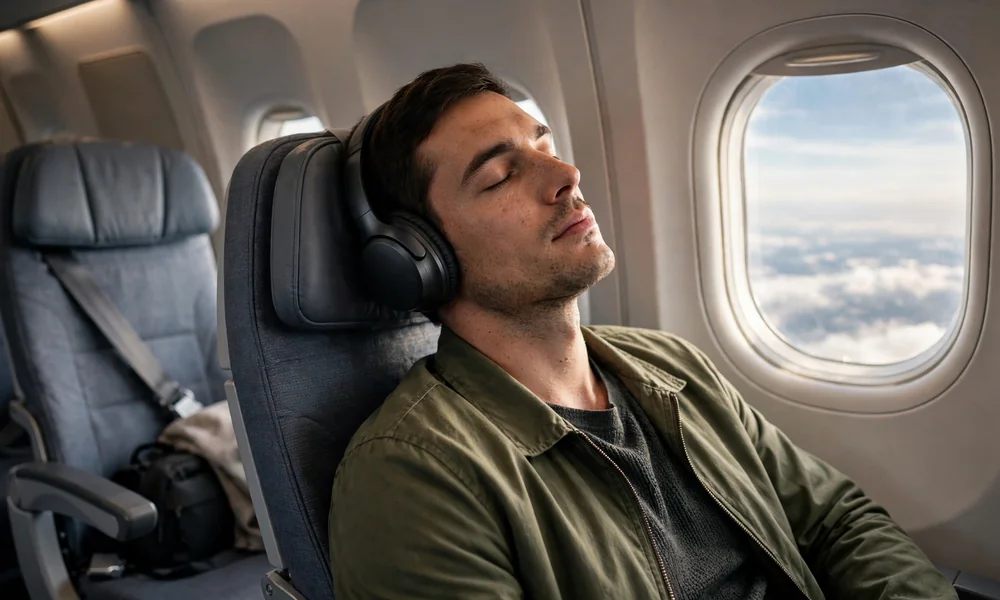
Airplane cabins sit at around 80 to 85 decibels during cruise, a constant low roar that your brain never fully tunes out. That drone is tiring in a way that is easy to underestimate until you step off a long flight feeling drained for no obvious reason. Active noise cancellation listens to that steady background sound and produces an opposite signal that cancels it out, which is why it is so effective against engines, air conditioning, and train rumble.
The effect is not only about hearing your music better. With the background roar removed, you can listen at lower volumes, which is kinder to your ears over a long day. You fall asleep more easily, you arrive with less of that dull, pressured feeling in your head, and films and podcasts stop competing with the cabin.
Good travel headphones also need a strong transparency mode. You want to hear gate announcements and flight attendant questions without taking the headphones off every five minutes. The best pairs switch between full cancellation and ambient awareness with a single tap. For a broader view, our roundup of the best noise-cancelling headphones overall covers the full field beyond travel.
The 9 Best Noise-Cancelling Headphones for Travel 2026
These nine pairs cover every kind of traveller, from the frequent flyer who wants the quietest cabin possible to the occasional holidaymaker who wants solid cancellation without spending flagship money.
1. Sony WH-1000XM5: Best Overall
The WH-1000XM5 remains the safest recommendation for travel. Its noise cancellation is the most effective at silencing low engine drone, and the sound is warm and detailed. Battery life reaches around 30 hours with cancellation on, and a three-minute charge adds roughly three hours, a lifesaver during a short layover. The soft cushions stay comfortable for hours, though the earcups do not fold flat.
2. Bose QuietComfort Ultra Headphones: Best Comfort
If comfort is your top priority, the QuietComfort Ultra is hard to beat. Bose has long set the standard for headphones you can forget you are wearing, and this pair continues that tradition with plush cushions and a light, balanced fit. Noise cancellation is superb, particularly on voices that other pairs let through. Battery life is around 24 hours and the folding design packs down neatly.
3. Apple AirPods Max: Best for Apple Travellers
AirPods Max are the most expensive pair on this list, and the most seamless choice if you live inside the Apple ecosystem. They switch effortlessly between iPhone, iPad, and Mac, and spatial audio makes films cinematic. Noise cancellation is excellent and the aluminium build feels luxurious. Battery life is around 20 hours, the shortest here, and they do not fold, which makes them awkward to pack.
4. Sennheiser Momentum 4 Wireless: Best Battery Life
The Momentum 4 solves the one problem every traveller dreads: a dead battery halfway across the Atlantic. With around 60 hours per charge, it outlasts every other pair here by a wide margin. Sound is rich and detailed. Noise cancellation is strong, though a step behind Sony and Bose on the deepest rumble.
5. Bowers & Wilkins Px7 S2e: Best Sound Quality
For travellers who care most about how music actually sounds, the Px7 S2e is the pick. Its sound is clear, spacious, and refined, making familiar albums feel new again. Noise cancellation is good rather than best in class, handling steady drone well but letting more chatter through than Sony or Bose. Battery life is around 30 hours and the leather-trimmed design looks smarter than most travel headphones.
6. Bose QuietComfort Headphones: Best Value Bose
The standard QuietComfort Headphones deliver most of what makes the Ultra great at a noticeably lower price. Noise cancellation is outstanding, comfort is among the best available, and battery life is around 24 hours. They fold flat, the case is slim, and the controls are simple and reliable.
7. JBL Tour One M2: Best for Calls
Travellers who take calls from airports and hotel rooms should look closely at the JBL Tour One M2. Its microphone array produces unusually clear voice quality, so you sound crisp on work calls even in a noisy terminal. Noise cancellation adapts automatically to your surroundings, battery life is around 50 hours, and the sound is lively and punchy. As a travel workhorse, they are excellent value.
8. Sony WH-CH720N: Best Budget Pick
The WH-CH720N proves that you do not need to spend flagship money to get real silence. Its noise cancellation handles steady engine drone far better than its price suggests, and at just 192 grams it is one of the lightest pairs you can buy, which makes it genuinely comfortable for long wear. Battery life is around 35 hours, and multipoint Bluetooth keeps you connected to phone and laptop at once.
9. Anker Soundcore Space Q45: Best Under $150
The Space Q45 is the budget surprise of the year. Its adaptive noise cancellation is remarkably effective for the price, cutting cabin drone to a soft murmur, and battery life stretches to around 50 hours. The sound is warm and bass-forward, with an app that lets you tune it. They fold flat, the case is slim, and the build feels far more expensive than it is,
At a Glance: Comparison Table
| Headphones | Battery Life | Weight | Folds | Best For |
|---|---|---|---|---|
| Sony WH-1000XM5 | 30 hours | 250 g | No | Best overall |
| Bose QuietComfort Ultra | 24 hours | 254 g | Yes | Best comfort |
| Apple AirPods Max | 20 hours | 385 g | No | Apple users |
| Sennheiser Momentum 4 | 60 hours | 293 g | Yes | Battery life |
| Bowers & Wilkins Px7 S2e | 30 hours | 307 g | Yes | Sound quality |
| Bose QuietComfort Headphones | 24 hours | 254 g | Yes | Value Bose |
| JBL Tour One M2 | 50 hours | 268 g | Yes | Calls |
| Sony WH-CH720N | 35 hours | 192 g | Yes | Budget pick |
| Anker Soundcore Space Q45 | 50 hours | 264 g | Yes | Under $150 |
How to Choose the Right Pair for Your Trip
The best travel headphones are not necessarily the ones with the best sound. They are the ones you can wear for six hours, charge once a week, and pack without a fight.
Fit and Comfort
Comfort is the feature you will notice most on a long journey. Look for soft memory foam ear cushions, a headband that spreads weight evenly, and earcups large enough to sit around your ears rather than pressing on them. Over-ear designs seal better and cancel noise more effectively than on-ear models, which is why every pick on this list is over-ear. Our guide to the best neck pillows for flights covers the other half of arriving rested.
Battery and Charging
As a rule, aim for at least 24 hours of battery life with noise cancellation switched on. That covers even the longest direct flights with charge to spare. Fast charging matters too: a ten-minute top-up that adds several hours can save a trip when you are sprinting between gates. USB-C charging is now standard on good travel headphones, which means one cable can charge your headphones, phone, and laptop. As a backup, the best noise-cancelling earbuds fit in a jacket pocket and cover you if your main pair runs flat.
Foldability and Case
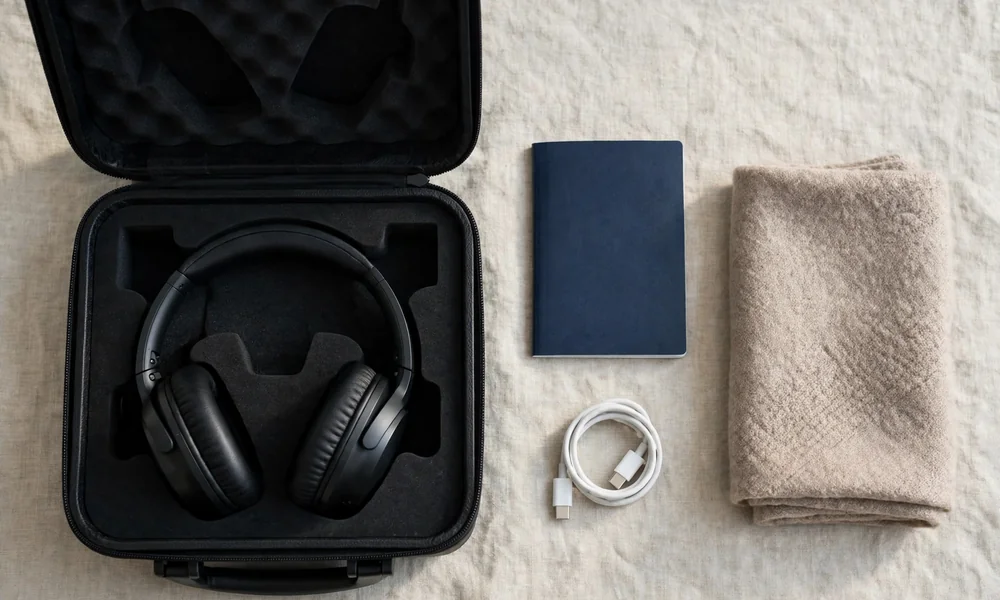
A pair that folds flat or collapses into a compact case takes up far less room in a carry-on, and the case protects the headphones from being crushed by everything else in your bag. Check whether the case has room for a charging cable and an in-flight adapter, since many airlines still use dual-pin headphone sockets.
Travel Checklist: Before You Board
A little preparation before departure makes your headphones far more useful in the air. Run through this checklist the night before you fly.
- Charge your headphones fully and top up at the gate before flights over eight hours.
- Download films, playlists, and podcasts for offline listening.
- Pack the charging cable and dual-pin adapter in your personal item, not your checked bag.
- Pair the headphones with every device you plan to use before you leave.
- Update the app and firmware at home, where Wi-Fi is fast and free.
- Clean the ear cushions and check the case zip before you go.
Frequently Asked Questions
Are noise-cancelling headphones worth it for flying?
Yes, and the difference is bigger than most people expect. Active noise cancellation removes the constant low-frequency drone of the cabin, which reduces fatigue, lets you listen at lower volumes, and makes it much easier to sleep.
Can you use noise-cancelling headphones during takeoff and landing?
Yes. You can wear them throughout the flight, but most airlines ask you to switch Bluetooth off during takeoff and landing, so keep a wired cable handy. With the cable connected, noise cancellation still works, and you can keep listening without interruption.
Do noise-cancelling headphones work on trains and buses?
They work very well on trains, where the noise is a steady rumble similar to an aircraft cabin. On buses, results are more mixed, because traffic noise changes constantly and cancellation handles steady sounds better than sudden ones.
How long should travel headphones last on one charge?
Look for at least 24 hours with noise cancellation on, which covers the longest direct flights. The best travel pairs now offer 30 to 60 hours, and fast charging can add several hours from a ten-minute top-up. Battery life drops a little in cold cabins and with volume turned up high.
Are earbuds or over-ear headphones better for travel?
Over-ear headphones cancel noise more effectively, sound fuller, and are more comfortable for long sessions, which is why they lead this guide. Earbuds win on size and portability, and they are a great backup pair to keep in a pocket.
Will noise-cancelling headphones help me sleep on a plane?
They help a great deal. By removing the engine drone, they make it easier to fall asleep and stay asleep, especially with a sleep mask and a good neck pillow.
The Bottom Line
The best noise-cancelling headphones for travel in 2026 are the Sony WH-1000XM5, which combine the strongest cancellation, excellent comfort, and 30 hours of battery in a package that suits almost every traveller. If comfort matters most, choose the Bose QuietComfort Ultra. If you want to fly for a week without charging, the Sennheiser Momentum 4 is unbeatable. And if your budget is tight, the Sony WH-CH720N and Anker Soundcore Space Q45 deliver real silence for far less. Pick the pair that matches how you travel, charge it before you leave, and enjoy the quiet.