Fresh coffee starts with the grind, and the best compact coffee grinders for home prove you do not need a countertop the size of a cafe to get cafe-quality results. A small grinder that tucks into a corner or a drawer can still deliver the even, consistent grounds that turn a flat cup into a bright, flavourful one.
The problem with most full-size grinders is not their performance but their footprint. They are tall, heavy, and loud, and they demand a permanent spot on the counter. Compact grinders solve that by shrinking the hopper, the motor, and the body without shrinking the burrs that do the actual work.
This guide compares the strongest compact coffee grinders for home use in 2026, explains what actually matters when you are shopping small, and gives you a simple checklist so you can buy once and buy well.
Key Takeaways
- Conical burrs are the minimum for a compact grinder worth buying; blade grinders chop unevenly and waste good beans.
- Manual hand grinders give the best grind quality per pound in a tiny package, while compact electrics win on speed and convenience.
- Measure your space first: the best compact grinders are under 30 cm tall and fit under standard kitchen cabinets.
- A hopper that holds 40 to 60 grams is enough for one or two cups and keeps beans fresher than a giant hopper.
- Budget between $70 and $200 for a compact grinder that will last years; below that, grind consistency drops fast.

Why a Compact Grinder Beats a Big One at Home
Most home coffee drinkers brew one or two cups at a time. A full-size grinder with a 250-gram hopper is built for a household that grinds all day, and that is not most of us. A compact grinder matches the way real people brew: a small dose, ground fresh.
Smaller grinders also keep your beans fresher. A big hopper invites you to fill it and forget it, and beans left sitting in a hopper go stale faster than beans kept sealed in a bag. A compact hopper encourages you to grind only what you need.
Then there is space. A grinder that is 15 cm wide and 25 cm tall disappears into a corner, while a full-size machine dominates the counter.
The Real Difference Is the Burr, Not the Size
What makes a grinder good has almost nothing to do with how big it is. The burrs inside decide how evenly the beans are ground, and even grounds extract evenly for a balanced cup. Compact grinders use the same conical burr designs as their full-size cousins, just in a smaller housing.
The Best Compact Coffee Grinders for Home 2026
The grinders below cover every way to brew at home, from a quick morning espresso to a slow weekend pour over.
Best Overall Compact Electric: Fellow Opus
The Fellow Opus is the compact electric grinder most home brewers should buy first. It stands about 26 cm tall, takes up less space than a kettle, and covers the full grind range from fine espresso to coarse French press. Its 40 mm conical burrs produce a remarkably even grind, and it grinds a dose for two cups in under 30 seconds.
Best Budget Compact Electric: OXO Brew Conical Burr Grinder
The OXO Brew is the cheapest compact electric grinder that still grinds properly. Its stainless steel conical burrs produce a consistent medium grind that suits drip and pour over beautifully, and its simple dial makes it easy to find your setting and stay there. It is not the best choice for true espresso, but for filter coffee it is excellent value.
Best Manual Compact Grinder: 1Zpresso JX-Pro
If you want the best grind quality for the least money and the smallest footprint, a manual grinder is the answer, and the 1Zpresso JX-Pro is the best of them. It is barely wider than a jam jar, fits in a bag for travel, and its 48 mm steel burrs grind as evenly as electrics costing three times as much. Grinding by hand takes about 40 seconds for a single cup, and it is silent.
Best Travel Compact Grinder: Timemore Chestnut C3
The Timemore Chestnut C3 is the grinder to buy if you want great coffee away from home as well as in it. It weighs around 430 grams, slips into a backpack side pocket, and its 38 mm steel burrs produce a clean, sweet cup that suits pour over and AeroPress perfectly. It is the most affordable grinder in this guide, yet its build quality beats its price.
Best Compact Grinder for Espresso: Eureka Mignon Silenzio
Espresso is the hardest test for any grinder, and the Eureka Mignon Silenzio is the smallest electric that passes it properly. Its 50 mm flat burrs grind fine and evenly enough for real espresso, and its stepless adjustment lets you dial in a shot precisely. Pair it with one of the best espresso machines under $300 and you have a home setup that rivals many cafes.

Compact Coffee Grinder Comparison
The table below puts the five picks side by side so you can compare size, burr type, and best use at a glance.
| Grinder | Type | Burrs | Height | Best For | Price Range |
|---|---|---|---|---|---|
| Fellow Opus | Electric | 40 mm conical | 26 cm | All-round brewing | $180–$210 |
| OXO Brew Conical Burr | Electric | Conical steel | 27 cm | Filter coffee | $90–$110 |
| 1Zpresso JX-Pro | Manual | 48 mm steel | 18 cm | Espresso and pour over | $150–$170 |
| Timemore Chestnut C3 | Manual | 38 mm steel | 16 cm | Travel and pour over | $70–$90 |
| Eureka Mignon Silenzio | Electric | 50 mm flat | 35 cm | Espresso | $380–$430 |
Prices are typical 2026 retail ranges and move with sales, so treat them as a guide. Manual grinders give you more burr for your money, while electrics charge a premium for speed and convenience.
Electric vs Manual: Which Compact Grinder Suits You?
The first decision is not which brand to buy but which type. Electric and manual compact grinders suit different mornings.
Choose Electric If You Brew for More Than One Person
Electric grinders earn their keep when you brew several cups a day or make coffee for a household. Grinding 40 grams by hand every morning gets old fast, and an electric does the same job in seconds with the push of a button. They are also the better choice if anyone in the house has wrist or grip trouble.
Choose Manual If You Want the Best Grind for the Money
Manual grinders put almost all of their cost into the burrs, which is why a $150 hand grinder can out-grind a $300 electric. They are also silent, tiny, and have no motor to break. The cost is your time: forty seconds of cranking for one cup is pleasant, but the same for four cups is a chore.
What to Look for in a Compact Coffee Grinder
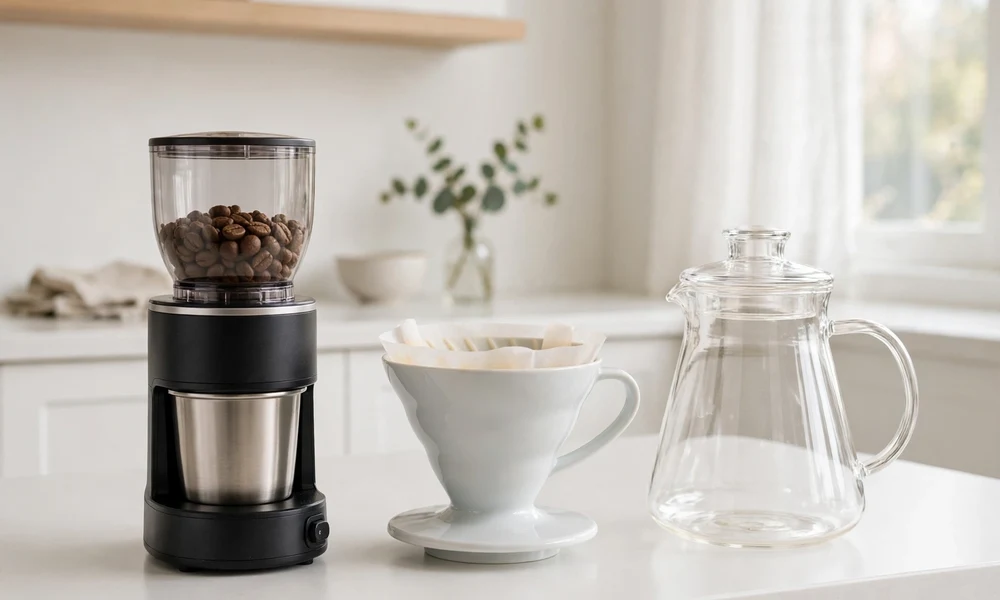
Shopping for a small grinder is simpler than shopping for a big one, because the same few features decide almost everything.
Burr Type and Size
Conical burrs are the standard in compact grinders, and they are excellent. Flat burrs appear in pricier models and give a slightly more uniform fine grind for espresso. Either way, insist on burrs: any grinder with a blade will ruin good beans.
Grind Adjustment
Look for clear, repeatable adjustment. Stepped adjustment with marked settings is easiest for beginners, because you can note your setting for each brew method and return to it. Stepless adjustment gives finer control for espresso. Avoid a vague dial with no markings, which makes it impossible to repeat a good cup.
Footprint and Height
Measure before you buy. The classic mistake is buying a grinder too tall to fit under the kitchen cabinets, which means it lives on the counter forever or gets buried in a cupboard. Check the height with the hopper lid on.
Hopper and Dosing
A compact hopper is a feature, not a compromise. A 40 to 60 gram hopper holds enough for two generous cups and keeps the rest of your beans sealed and fresh. Some compact electrics offer a single-dose design with no hopper at all.
Noise, Static, and Cleaning
Small motors can be surprisingly loud, so check reviews for noise before buying an electric; quieter models use slower motors and better insulation. Static is the other annoyance: cheap grinders spray grounds across the counter, while better ones use anti-static coatings. Coffee oils also go rancid, so pick a grinder that comes apart without tools and brush the burrs every couple of weeks.
How to Get the Best Cup from a Compact Grinder
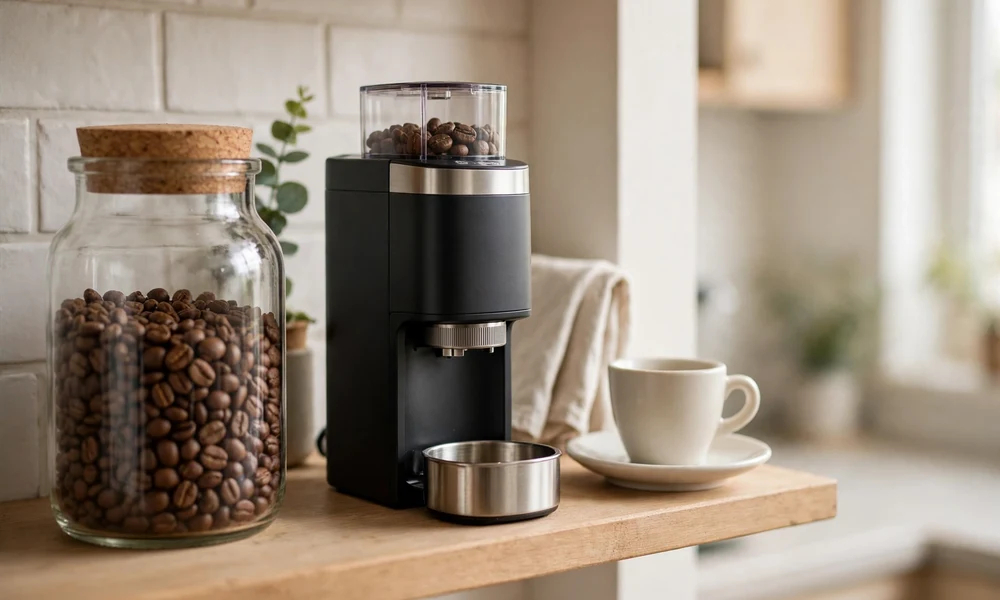
A good grinder only helps if the rest of your routine is right. Buy whole beans and grind just before brewing, since pre-ground coffee loses its aroma within hours. Weigh your beans: 60 grams per litre of water is a reliable starting point. Match the grind to the method, with a coarse grind for French press, a medium grind for pour over, and a fine grind for espresso. If your coffee tastes sour, grind finer; if it tastes bitter, grind coarser. Pair your grinder with one of the best pour-over coffee makers for a simple brewing station that fits on any counter, and see how compact grinders compare with their bigger cousins in our guide to the best coffee grinders for home.
Compact Grinder Buying Checklist
- Measure your counter space and cupboard clearance before ordering, including the hopper lid height.
- Choose burrs over blades, and conical burrs at minimum, with a 38 mm diameter or larger.
- Match the grinder to your brew method: fine and stepless for espresso, medium and stepped for pour over and drip.
- Decide electric or manual based on how many cups you brew each day, not on price alone.
- Favour a small hopper or single-dose design for fresher beans.
- Confirm the grinder comes apart for cleaning without tools, and brush the burrs every two weeks.
Frequently Asked Questions
Are compact coffee grinders as good as full-size grinders?
Yes, for home use. Compact grinders use the same burr designs as full-size models, so the grind quality is often identical.
Is a manual grinder worth it for everyday coffee?
It is if you usually brew for one person. A good manual grinder produces an excellent, even grind and costs far less than an equivalent electric. For households brewing four or more cups a day, an electric is the better choice.
Can a compact grinder handle espresso?
Some can, but not all. Espresso needs a very fine, very even grind, and many compact electrics cannot go fine enough. Manual grinders like the 1Zpresso JX-Pro and dedicated espresso grinders like the Eureka Mignon Silenzio handle espresso properly.
How much should I spend on a compact coffee grinder?
Between $70 and $200 covers the best compact grinders for most home brewers. Below $70, grind consistency falls away quickly.
How do I clean a compact coffee grinder?
Brush the burrs every two weeks with a stiff brush, and wipe the hopper and grounds cup with a dry cloth. Never wash the burrs with water. For a deeper clean, run grinder cleaning tablets through once a month.
Do compact grinders work for French press?
Yes, most compact grinders handle French press well, since it needs a coarse grind that is easy for any burr grinder to produce.
The Bottom Line
The best compact coffee grinders for home in 2026 prove that small can be serious. The Fellow Opus is the best all-round electric, the 1Zpresso JX-Pro is the best manual for pure grind quality, and the Timemore Chestnut C3 is the best value in the smallest package. Pick the type that matches how many cups you brew, buy burrs over blades, and measure your space before you order.