
Tumbles That Trip: The Worst Acrobats of 2026
The worst acrobats of 2026 do not fail because their tricks are simple. They fail because the trick never quite happens: the tumble stalls halfway across the mat, the handstand wobbles and comes down, the pyramid folds before it is finished, and the lift never leaves the ground at all. Acrobatics is the most honest physical craft on a stage, because balance either holds or it does not, and the audience can see the answer in the first ten seconds. When it holds, a tumbling pass looks effortless and a human pyramid looks impossible. When it does not, the act is over before it has begun, and no amount of smiling, bowing, or dramatic music can put it back together again.
Key takeaways
- Acrobatics is a single floor-based craft judged on balance, timing, and landing, not a mixed bill of circus acts sharing a ring.
- The worst acts fail on the landing first: the tumble stalls, the handstand drops, or the pyramid folds before the audience can applaud it.
- A wobble is not the problem by itself; the problem is an act with no recovery, no second trick, and no sense of where the routine is going.
- More bodies, higher stacks, and faster music do not fix a broken balance, they only make the collapse louder and more awkward.
- Watch the first thirty seconds, and walk away from any act whose balance has already failed twice.
How the worst acrobats of 2026 were chosen
Every type below was scored on five measures. Balance comes first: does the body hold its line, or does it wobble, drift, and come down early? Timing is second, judged on whether the tumble, the lift, and the catch arrive together or fall apart in sequence. Landing is third, because an acrobatic act is remembered by how it finishes a move, not by how it starts one. Variety is fourth: does the routine build from one skill to the next, or does it repeat the same safe move until the music runs out? Safety is fifth, judged on whether the performers protect each other when a move goes wrong, or whether a fall turns into a scramble.
Two notes before the list. First, this guide is about floor-based acrobatics as a single craft only: tumbling, hand-balancing, partner lifts, human pyramids, and trampoline work on the ground. A circus is a different thing, a whole bill of acts in a ring, so aerial silks, trapeze, tightrope, contortion, fire, and juggling do not appear here, even though acrobats can appear inside a circus. Readers who want the wider ring will find those acts ranked in our guide to the worst circus acts of 2026, and the most honest single-prop craft of all in our guide to the worst juggling acts of 2026, where a drop is visible to everyone. Second, no real performer is named as the worst, because the same bad patterns appear in many acts, and what matters is learning to recognise them before you give an act your evening.

Comparison table: the worst acrobats of 2026
| Rank | Acrobat type | Main fault | First warning sign |
|---|---|---|---|
| 1 | The tumbling pass that stalls halfway | No momentum, no landing | The run slows before the first flip |
| 2 | The handstand that never steadies | Balance never holds | Arms shake, legs scissor |
| 3 | The human pyramid that folds | Base gives way | The bottom row sways at once |
| 4 | The partner lift that never leaves the ground | No lift, no trust | The flyer stays at waist height |
| 5 | The trampoline act with no landing | Bounce without a finish | Every jump lands in a crouch |
| 6 | The slow floor routine that is only stretching | Poses, no tumble | Five minutes, no move completed |
| 7 | The finale that is just a bow | No closing trick | The group lines up early |
The worst acrobats of 2026
1. The tumbling pass that stalls halfway: the run that gives up
The tumbling pass is the first skill every acrobat learns, and it is the first skill that gives a bad act away. A good pass builds speed across the mat, launches into a flip, and lands on two feet with the body still moving forward. In the worst version, the run slows before the first flip, the performer hesitates at the take-off, and the tumble collapses into a roll that stops halfway across the floor. The stall is the whole story.
2. The handstand that never steadies: arms shaking, legs everywhere
A handstand should look still, and the worst version never stops moving. The performer kicks up, the arms shake, the legs scissor in the air, and the body tips forward before the balance has even begun. In the worst act, the legs never find that line. One leg bends, the other kicks, the hips drift sideways, and the performer comes down after three seconds, smiles, and tries again with the same kick and the same result.
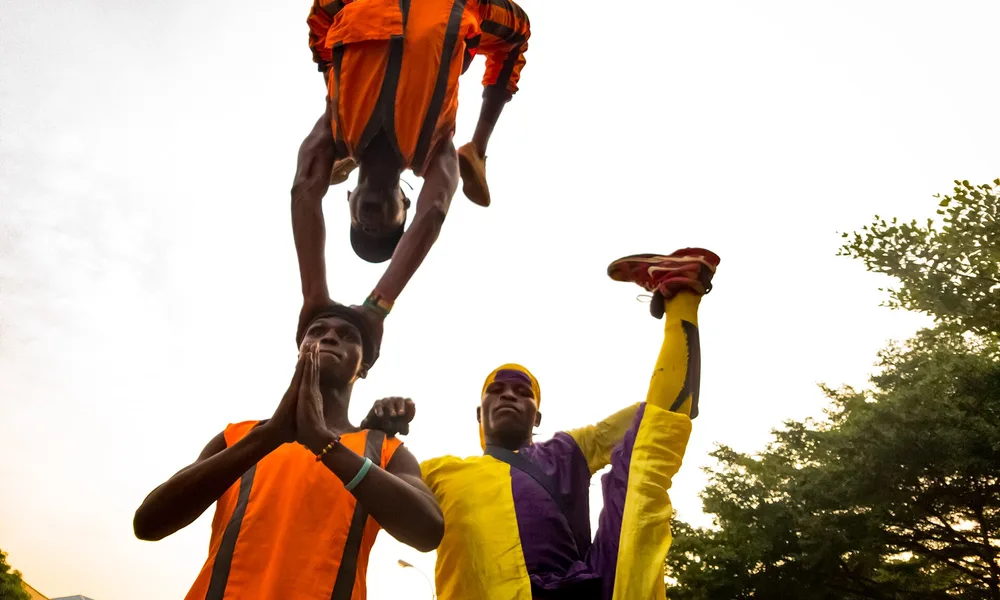
3. The human pyramid that folds: the base gives way first
A human pyramid should rise slowly and hold still long enough for the audience to believe in it, and the worst version folds before it is finished. The bottom row locks its knees, the middle row climbs too fast, and the whole structure sways sideways before the top performer has even stood up. In the worst act, everyone moves at once, the base wobbles, and the pyramid comes down in a tangle of arms and legs while the music keeps playing.
4. The partner lift that never leaves the ground: a flyer who stays put
Partner lifting is a conversation between two bodies, and the worst version is a conversation that never starts. The base bends, the flyer steps on, and then nothing happens: the flyer stays at waist height, the base straightens halfway and stops, and the pair stand there holding a pose that was supposed to be the beginning of a lift.
5. The trampoline act with no landing: bounce without a finish
A trampoline should make height look easy, and the worst version makes it look pointless. The performer bounces, rises, and comes down in a crouch, then bounces again and comes down in the same crouch, with no flip, no twist, and no landing the audience can applaud. In the worst act, the bounce is the whole routine, repeated until the music runs out, and every landing is a stumble that the performer covers with a wave.
6. The slow floor routine that is only stretching: five minutes, no move completed
Some of the worst acrobatic acts of 2026 are not failed tricks but missing ones. The performer walks to the centre of the mat, stretches, rolls slowly across the floor, holds a pose, stretches again, and calls it a routine. In the worst version, nothing becomes anything. The poses are held too long, the rolls go nowhere, and the audience waits for a move that never comes, because the routine was designed to fill time rather than to show skill.

7. The finale that is just a bow: no closing trick at all
Every acrobatic act needs a finish, and the worst version has none. The performers line up, wave, and bow, and the audience realises that the act they were waiting for was the act they just watched. In the worst act, the finale is the cast waving, because the routine ran out of tricks two minutes earlier and nobody noticed until the music stopped. If the group is lining up before the music ends, the act never had a closing trick, and the bow is just an admission of it.
What to avoid when watching acrobats
The most common mistake is to judge an acrobatic act by its poster, which always shows a pyramid at full height or a tumbler frozen mid-flip. Judge it instead by the first thirty seconds: if the first tumble stalls, the first handstand drops, or the first lift never leaves the ground, the pattern is set, and the rest of the act will repeat it. Avoid acts that fill time with talking, bowing, or stretching between tricks, because those are the signs of a routine with too few skills and too many minutes. The same warning signs work for other live performance too, and our guide to the worst variety shows of 2026 makes the same point about padding and flat finishes, because the traps are the same on every stage. And never confuse height with skill: a high pyramid that folds is worse than a low one that holds, and a fast tumble that lands badly is worse than a slow one that lands clean.
Checklist: spotting a bad acrobatic act early
- Watch the first tumble: if the run slows before the flip, the act is already in trouble.
- Count the seconds a handstand holds: under five seconds, twice in a row, means the balance is not there.
- Look at the base of any pyramid: if the bottom row sways before the climb finishes, expect a fold.
- Check the lift: if the flyer never rises above the base’s shoulders, there is no lift to watch.
- Listen for padding: long stretches, repeated bows, and talking between tricks mean the routine is short on skills.
- Leave after two failed attempts at the same trick: a good act recovers, a bad one repeats the failure.
Frequently asked questions
What makes an acrobat bad rather than just simple?
Simplicity is not the problem. A simple tumble landed cleanly is a good act. A bad act is one where the balance fails, the landing fails, and nothing recovers, so the same failure repeats through the whole routine.
How quickly can you tell a bad acrobatic act?
Within thirty seconds. The first tumble, handstand, or lift shows whether the balance and timing are there, and a bad act gives itself away on the first attempt, not the fifth.
Is a human pyramid dangerous when it folds?
It can be, which is why a good pyramid is built slowly, one level at a time, with spotters ready. A pyramid that folds because the base rushed the climb is a sign of poor preparation, not daring.
Why do bad acrobats repeat the same failed trick?
Because the routine has nothing else in it. A good act has a second trick ready when the first fails; a bad act has only the failed trick, so it tries it again and fails the same way.
Are trampoline acts easier than floor tumbling?
No, they only look easier. A trampoline gives height for free, but the landing still needs control, and an act that bounces without ever landing cleanly is failing at the hardest part of the skill.
Should I leave in the middle of a bad acrobatic act?
Yes, after two failed attempts at the same trick. A bad act rarely recovers, and the evening is better spent on a performance that respects the audience enough to rehearse its finish.
Bottom line
The worst acrobats of 2026 are the ones whose balance never holds long enough to earn the applause: tumbling passes that stall, handstands that drop, pyramids that fold, and lifts that never leave the ground. Watch the first thirty seconds, trust what the landing tells you, and leave when the same failure repeats, because a good acrobatic act shows its skill in the first move, not the last bow.


