The worst airline food 2026 has a reputation that somehow keeps getting worse, even as ticket prices climb and airlines promise a better onboard experience. Passengers open their tray tables to find grey pasta, limp sandwiches, and desserts that taste like sweetened cardboard, then wonder how an industry that moves billions of people a year still cannot serve a decent meal at 35,000 feet.
This is not just a matter of taste. Airline food is cooked hours before it is eaten, chilled, reheated in a convection oven, and served in a pressurised cabin where your sense of taste dulls by as much as a third. The result is a meal that was never going to be great, made worse by cost-cutting, shrinking portions, and menus designed for logistics rather than flavour.
In this guide, we look at what makes the worst airline food in 2026 so disappointing, which meals fail most often, and what you can do to avoid the worst of it.
Key takeaways
- Airline food is cooked up to 12 hours before serving, then chilled and reheated, which destroys texture and flavour.
- Low cabin humidity and pressure dull your sense of taste by up to 30 percent, so even decent food tastes flat.
- Pasta, fish, and egg dishes are the worst performers in the air, while stews, curries, and braised meats hold up best.
- Economy meals have shrunk in 2026, with more airlines replacing hot meals with cold boxes on short and medium flights.
- Bringing your own food, choosing the right dish, and eating before you fly are the simplest ways to avoid the worst meals.

Why Airline Food Got So Bad in 2026
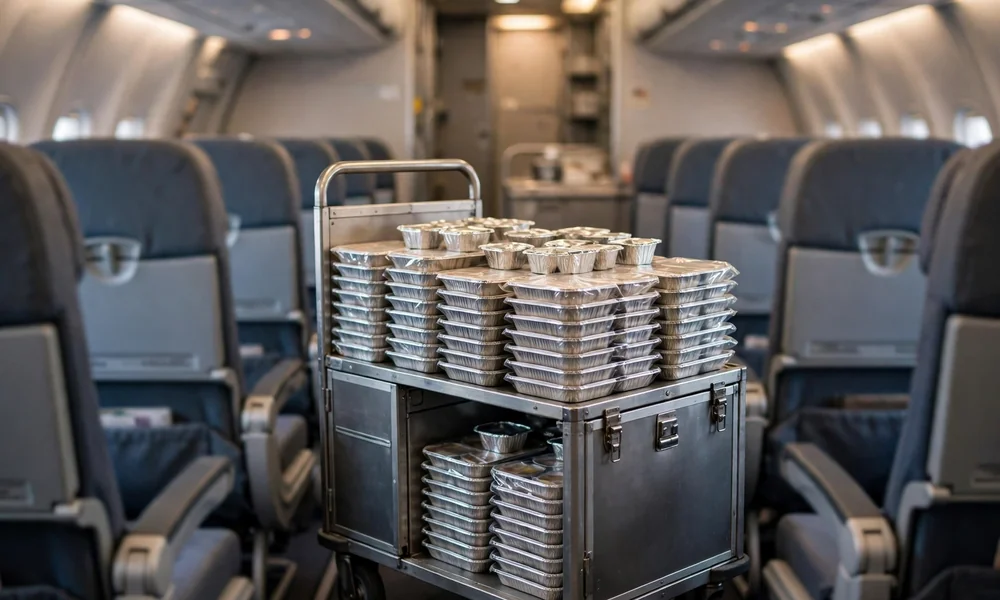
Airline catering is one of the most difficult cooking jobs in the world. Meals are prepared in industrial kitchens, blast-chilled, loaded onto trolleys, and reheated in a small oven before being served to hundreds of people at once. Every step in that chain takes something away from the food.
In 2026, the pressure has grown. Fuel costs, labour shortages, and the push to cut weight on every flight have squeezed catering budgets. Several carriers have quietly reduced the size of economy meals, swapped hot dishes for cold snack boxes on flights under four hours, and cut the number of meal choices from three to two. The problem starts before you even board, since the worst airport food courts of 2026 often serve the same tired, overpriced food you are trying to escape in the air.
The economics are stark. A typical economy meal costs an airline four to eight dollars to produce and deliver. When a carrier saves fifty cents per meal across millions of passengers, the savings are enormous, and the quality drop is felt in every tray.
The 12-Hour Journey From Kitchen to Tray
Most airline meals begin in a catering facility up to half a day before departure. The food is cooked in bulk, portioned into foil containers, chilled rapidly, then stored, trucked to the aircraft, and reheated shortly before service.
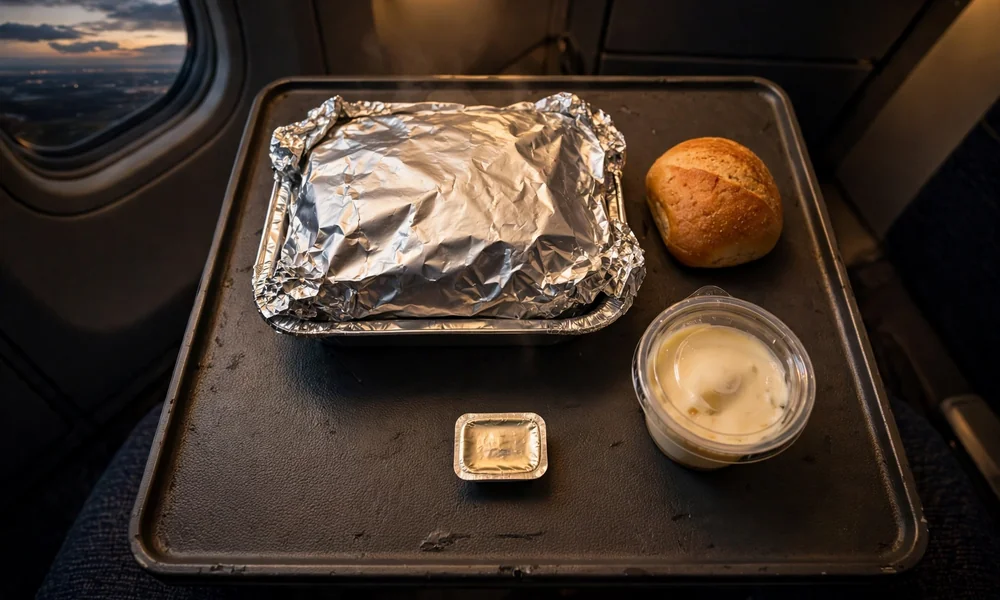
That journey is brutal for texture. Rice dries out and clumps, vegetables go soft, and bread baked fresh in the morning turns chewy and stale by the time the tray reaches your seat. Safety rules make this unavoidable: meals must stay cold until reheating, and onboard ovens are built for speed, not careful cooking, so food often arrives hot on the outside and lukewarm in the middle.
The Worst Offenders: What Passengers Actually Get Served
Ask frequent flyers which airline meals they dread, and the same answers come up again and again. The worst dishes share a pattern: they are foods that depend on freshness, crispness, or delicate flavour, all of which are destroyed by the catering process. The best airline meals, by contrast, are built to survive it.
The single worst category is pasta in a cream or tomato sauce. It is cheap and easy to portion, so it appears on almost every economy menu, yet it is almost always terrible in the air. The pasta overcooks during reheating, the sauce separates or thickens into glue, and the dish arrives as a pale, stodgy mass.
The Dishes That Fail Most Often
Fish is the second great failure. A fillet that was delicate when it left the kitchen becomes rubbery and dry after chilling and reheating, and its smell fills the cabin. Airlines keep serving it because it appeals to health-conscious passengers, but it is one of the least reliable choices you can make.
Eggs are just as bad. Scrambled eggs cooked hours earlier turn grey-green and rubbery, while salads arrive as a damp, wilted pile in a plastic tub. The dessert, usually a mousse or a cake, is often the most enjoyable item simply because it was never meant to be hot.
The Dishes That Survive the Flight
Not everything fails. Dishes with strong flavours and plenty of moisture hold up far better than delicate ones. A spicy curry, a rich stew, or a braised beef dish can survive chilling and reheating because the sauce protects the meat and the spices are bold enough to cut through dulled senses at altitude. Experienced travellers often choose the Asian or Indian option for exactly this reason. When you pick from the menu, choose the dish that would still taste like something after being reheated in a small oven. Bold, saucy, and spicy beats delicate, dry, and subtle every single time.
Economy vs Premium Economy vs Business: The Gap in 2026
The difference between cabins has never been wider. In business class, meals are plated on real crockery, served in courses, and often designed by a named chef. In economy, the same airline may serve a tray that looks like it came from a hospital canteen. Business class meals use better ingredients and are finished on board, while economy gets the industrial version: the cheapest ingredients, the most reheating, and the least attention.
| Cabin | Typical Meal | Plating | Choices | Quality in 2026 |
|---|---|---|---|---|
| Economy | One hot main, roll, dessert | Foil tray, plastic cutlery | Two options | Poor, shrinking portions |
| Premium Economy | Larger main, salad, dessert | Tray with ceramic dish | Two to three options | Fair, noticeably better |
| Business | Multi-course, chef-designed | Real crockery, plated onboard | Three to four options | Good, sometimes excellent |
| First | Multi-course, fine dining | Full table service | Full menu, dine on demand | Excellent, restaurant standard |
The gap matters because it shapes expectations. A passenger who has eaten well in business class and then flies economy on the same airline will feel the drop sharply, especially after the worst airport layovers of 2026 have already tested their patience.
The Science of Why It Tastes Worse at 35,000 Feet
The cabin itself is working against the food. At cruising altitude, cabin pressure is equivalent to standing on a mountain at around 6,000 to 8,000 feet. That lower pressure reduces the sensitivity of your taste buds, particularly for sweet and salty flavours, by roughly 20 to 30 percent.
The cabin air is also extremely dry, with humidity often below 20 percent, which dries out your nasal passages and dulls your sense of smell, the source of most flavour. Loud engine noise suppresses sweet and salty perception while enhancing bitter and sour notes. Airlines adjust recipes with extra salt, sugar, and spice, which is why a curry that would be too spicy at sea level can taste just right in the air. The worst airline food in 2026 is partly a cooking problem and partly a physics problem.
The Worst Airline Meals Ranked by Category
Some dishes are simply more likely to disappoint than others. The ranking below reflects what passengers report most often. If you see one of these dishes on your menu, consider the alternative.
Worst: Creamy Pasta and White Sauce Dishes
Creamy pasta is the most common and the most consistently disappointing airline meal. The sauce thickens and separates, the pasta goes soft, and the dish arrives as a bland, starchy lump. It is cheap and easy for caterers, which is why it appears so often.
Second Worst: Reheated Fish
Fish is delicate, and the catering process is the opposite of delicate. The result is a dry, rubbery fillet with a smell that fills the cabin, and it is the dish most likely to be overcooked, because caterers would rather overcook fish than risk serving it undercooked.
Third Worst: Scrambled Eggs and Breakfast Plates
Breakfast on a plane is often the weakest meal of the day. The eggs are cooked hours earlier and held at temperature, the sausage is rubbery, and the potatoes are soggy. A fruit plate or a yoghurt is usually safer. The pattern is clear: the worst meals need freshness, precise cooking, or delicate texture, while the best are robust, saucy, and strongly flavoured.
How to Survive a Bad Meal: A Practical Checklist
You cannot fix the catering system, but you can avoid its worst outcomes. A little preparation before your flight makes a bigger difference than any menu choice, and it starts with getting through the terminal smoothly instead of arriving hungry and stressed after the worst airport security lines of 2026.
- Eat before you fly. Have a proper meal at the airport or before you leave home, so the onboard tray is a bonus rather than your only food.
- Choose the saucy option. Pick curries, stews, and braised dishes over pasta, fish, and eggs, which fail most often after reheating.
- Order a special meal. Vegetarian, vegan, and other special meals are often prepared in smaller batches and can be noticeably better.
- Bring your own snacks. Pack sandwiches, nuts, fruit, and crackers in your hand luggage for short flights with no hot meal.
- Drink water and tomato juice. Stay hydrated, and choose tomato juice over wine, since its flavour holds up best in the cabin.
- Skip the meal if it looks bad. There is no rule that says you must eat what is served. Save your appetite for landing.
Frequently Asked Questions
Why does airline food taste so bad?
It is cooked hours before serving, chilled, and reheated, which damages texture and flavour. Low cabin pressure and dry air also dull taste and smell by up to 30 percent, so even a decent meal tastes flat in the air.
What is the worst airline food in 2026?
Creamy pasta, reheated fish, and scrambled eggs are the worst. They depend on freshness and precise cooking, both lost in the catering process. Dishes with strong flavours and plenty of sauce, such as curries and stews, hold up far better.
Is business class food actually better?
Yes, and the gap is wide. Business class meals use better ingredients, are prepared in smaller batches, and are plated on real crockery in courses. Economy meals are produced industrially and reheated in foil trays.
Can I bring my own food on a plane?
In most cases, yes. Solid foods such as sandwiches, fruit, nuts, and crackers can be carried through security and eaten on board. Liquids are still restricted, so buy drinks after security. Check your destination’s customs rules before bringing fresh food into another country.
Are special meals better than standard meals?
Often, yes. Special meals such as vegetarian, vegan, halal, and gluten-free options are usually prepared in smaller batches and with more care, and they are served first. Order at least 24 hours before departure.
Which airlines serve the worst food?
There is no single answer, because quality varies by route, cabin, and catering station. Short-haul economy on budget carriers tends to be weakest, since many offer no hot meal at all. Long-haul economy is usually better, though the worst dishes are the same everywhere.
The Bottom Line
The worst airline food 2026 comes from a system that prioritises cost, safety, and logistics over flavour, combined with a cabin that dulls your senses. The meals that fail most, creamy pasta, reheated fish, and scrambled eggs, never stood a chance against the catering process. Eat before you fly, choose the sauciest and spiciest option on the menu, and carry your own snacks. The tray is not going to get better on its own, so the best defence is a plan.