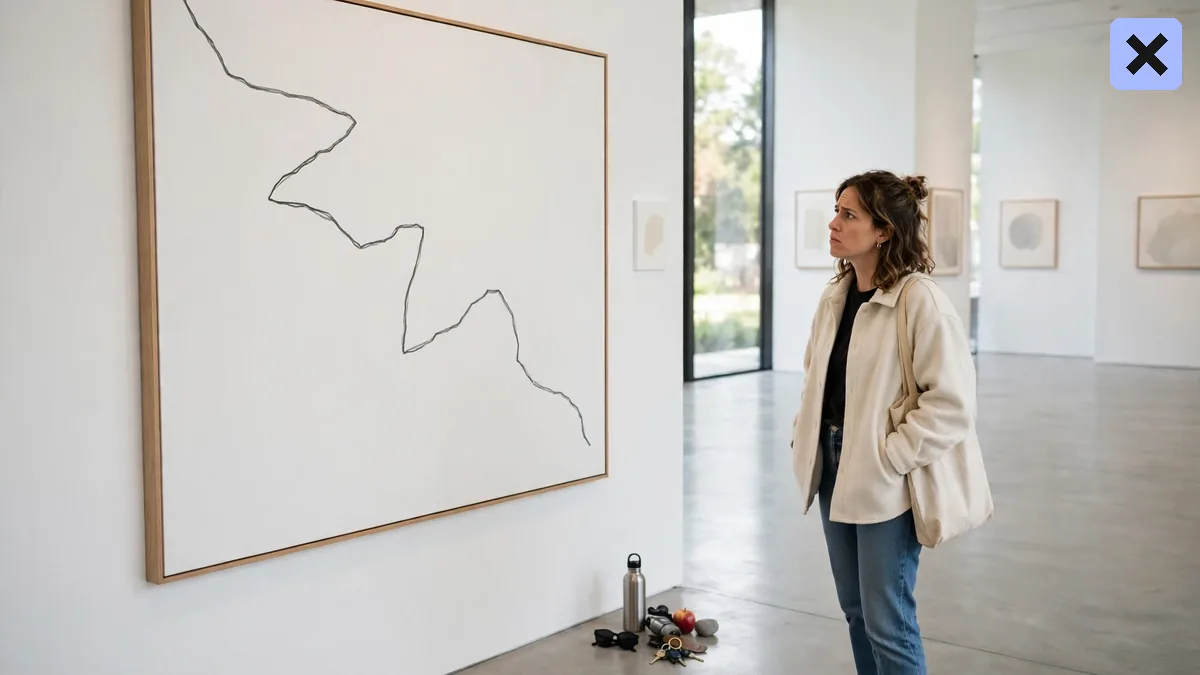
Some of the worst art trends do not fail because they are strange. They fail because they confuse more than they inspire, leaving visitors standing in a white room, tilting their heads, and wondering whether they missed something. The work offers no foothold and no idea worth carrying home, yet the price tag and the press release insist it is important.
Art has always had room for difficulty. A painting can be unsettling, a sculpture can be ugly on purpose, and an installation can demand patience. The worst art trends are different. They are not difficult in the service of an idea. They are difficult because difficulty has become the product, a shortcut that lets a work look serious without saying anything at all.
This guide walks through the trends that most reliably leave audiences cold, explains why each one took hold, and shows what to look for instead. None of this is an attack on experimental art. The goal is simpler: to help you tell the difference between work that challenges you and work that merely wastes your attention.
Key takeaways
- Confusion is not the same as depth. A work that cannot be felt or described after a few minutes probably has nothing underneath the mystery.
- The worst art trends hide weak ideas behind jargon, shock, scale, or price tags instead of earning attention honestly.
- Wall text that does all the work is a warning sign. Strong art can survive without its explanation.
- Trends built for photographs and social feeds age fast, because they were designed to be seen once, not lived with.
- Your own response is valid evidence. If a work leaves you cold, that is information, not ignorance.
Why Confusion Became a Selling Point
Confusion sells because it flatters everyone involved. The artist looks brave, the gallery looks daring, the collector looks sophisticated, and the visitor feels too unsure to object. Nobody wants to be the person who admits they do not get it, so silence becomes agreement, and agreement becomes a trend.
There is also a practical reason. Genuine originality is hard, slow, and risky, while a blank canvas or a pile of household objects is fast to produce and easy to describe in a press release. When the market rewards novelty over quality, artists and dealers learn to manufacture novelty, and the result is work that photographs well and says nothing once the opening-night crowd goes home.
Trend 1: The Empty Canvas as a Masterpiece
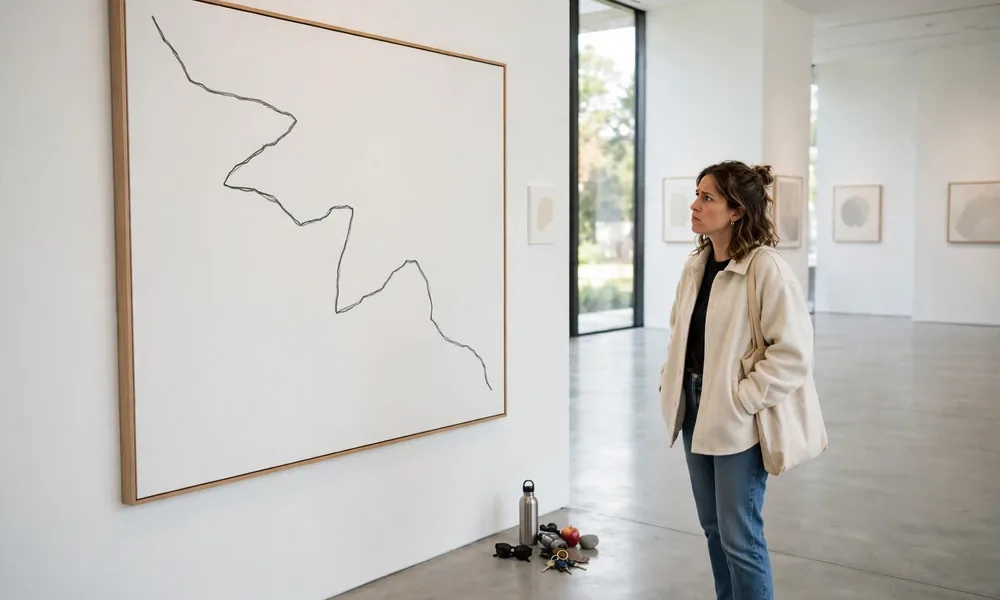
Minimalism can be powerful. A single line or a field of colour can hold real tension when the artist has made deliberate choices about scale, surface, and light. The trend that confuses people is different: a canvas with almost nothing on it, presented as profound, with no evidence of decision-making at all. Emptiness as a subject still needs craft, and when an artist cannot point to a single decision worth discussing, emptiness is not a subject. It is a shortcut.
Trend 2: Art That Needs a Paragraph to Exist
Some of the worst art trends produce objects that are meaningless without their wall text. A stack of bricks or a chair in a corner becomes significant only after you read that it explores the architecture of power. Take the text away and the work collapses into furniture. Art should work on more than one level: a painting can be beautiful before you know its history, and the best conceptual art still gives your eyes and body something to do. When a work offers nothing to the senses and everything to the reader, it has become an essay with expensive props.
Trend 3: Shock Without Substance
Shock has a legitimate place in art. It can wake an audience up and force a confrontation with something uncomfortable. The worst version of this trend uses shock as a substitute for an idea: a disturbing image or a deliberately offensive gesture grabs attention for a day, and then there is nothing left to think about once the jolt fades. The giveaway is what happens after the shock. Strong provocative work keeps unfolding, as you argue about it and notice details you missed, while empty shock does the opposite. The second viewing is boring, the conversation dries up, and the work survives only as a story about how people reacted to it.
Trend 4: The Algorithm-Friendly Spectacle
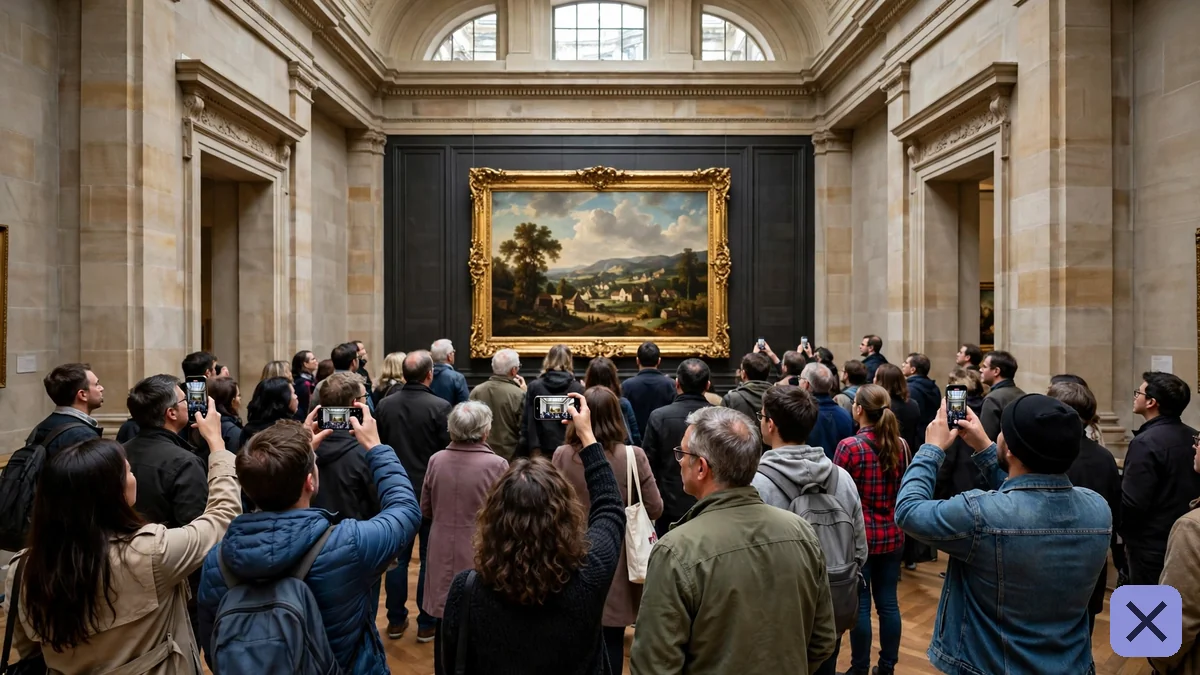
Mirror rooms, neon tunnels, flower walls, and projection-mapped floors are built to be photographed, and they succeed brilliantly at that one job. The problem is that the photograph is often better than the experience, and the experience is often better than the art. These spectacles confuse visitors because they mistake scale and immersion for meaning. Standing inside a room full of lights feels impressive for about ninety seconds, then the novelty wears off, and you realise you have not learned anything or felt anything specific. When the spectacle is the idea, you are paying for a backdrop, and the backdrop will look dated the moment the next one opens across town.
Trend 5: Overproduced Minimalism
At the opposite end of the scale sits a quieter trend: the overproduced minimalist object. A perfectly smooth ceramic form or a flawless monochrome print, sanded and polished until every trace of the human hand is gone. These objects look expensive, and they often are, but they leave viewers cold because there is nothing to connect with. Perfection without personality is just a product. The trend borrows heavily from interior design, where a flawless object looks good in a photograph of a living room, and a living room photograph sells the object. The same pattern shows up at home, where the home design trends that date fastest are often the ones that chased a flawless, magazine-ready look instead of something personal.
Trend 6: The Endless Series and the Limited Drop
Some artists find one idea that works and repeat it until it stops working. The endless series, dozens of near-identical paintings or prints with tiny variations, turns a genuine discovery into a production line. Collectors love it because the work is recognisable and safe, while viewers get bored because they have seen it before. The limited drop is the same idea dressed up as scarcity: a small run of objects, a numbered edition, a release that sells out in minutes, designed to create urgency around work that would not command attention on its own merits. Both habits feed on hype, and when everything is described as iconic, the word stops meaning anything, and the art underneath the noise gets harder to see.
| Trend | What it promises | What you actually get | Better alternative |
|---|---|---|---|
| The empty canvas | Profound silence | An unmade decision | Minimalism with visible craft |
| Art that needs its wall text | Deep conceptual rigour | An essay with props | Ideas you can see and feel |
| Shock without substance | A bold confrontation | One jolt, then boredom | Provocation that keeps unfolding |
| Algorithm-friendly spectacle | An unforgettable experience | A photo backdrop | Immersion that serves an idea |
| Overproduced minimalism | Timeless perfection | A beautiful product | Work with a human trace |
| Nostalgia remixed | A clever twist on the past | Borrowed affection | References that add meaning |
| Endless series and drops | Scarcity and status | Repetition and urgency | Artists who keep evolving |
How to Tell the Difference Between Challenging and Empty
Challenging art and empty art can look identical at first glance. Both can confuse you, both can annoy you, and both can make you feel like an outsider. The difference appears over time. Challenging work rewards a second look: you notice a detail or a tension that was invisible at first, and the work grows larger in your mind. Empty work shrinks. The more you look, the less there is.
Another difference is specificity. Challenging art is usually specific about something: a place, a material, a memory, a question. Empty art is vague about everything, and the vagueness is presented as depth. If you cannot say what a work is about, even roughly, after spending real time with it, the work may not know either.
What to Do Instead
The alternative to these trends is not to play it safe. It is to look for work that earns its effect, whatever form that takes. Seek out artists who make clear decisions, who care about materials, and who trust the viewer enough to leave something unsaid without leaving everything unsaid.
It also helps to spend time with art outside the hype cycle. Small galleries, open studios, and museum collections offer work made to be looked at rather than photographed, and the rooms are quieter, so the work has to stand on its own. Most of all, trust your own taste. Your own taste is worth paying attention to, not because it is always right, but because it is the only honest starting point you have. A work that bores you has told you something true, even if the room disagrees.
Checklist: Spotting Art Trends That Confuse More Than They Inspire
- Cover the wall text and ask whether the work still holds your attention for a full minute.
- Look for deliberate decisions: choices about material, scale, colour, or composition you can actually point to.
- Ask whether the work would matter in an ordinary room, without the gallery lighting and the hush.
- Notice whether your reaction is yours, or borrowed from the crowd, the price, or the press release.
- Check whether the work rewards a second look, or whether it shrinks the longer you spend with it.
- Before buying or praising a trend, ask whether you would still like it in five years.
Frequently Asked Questions
Are all abstract or minimalist artworks part of these bad trends?
No. Abstraction and minimalism have produced some of the strongest art of the last century. The problem is not the style but the lack of decision-making behind it.
Is it okay to dislike a famous artwork?
Yes, completely. Fame, price, and critical praise are not proof that a work will move you. Disliking a famous piece does not mean you failed to understand it. It may mean the work genuinely does not speak to you.
How can I tell if wall text is helping or hiding a weak work?
Read the text after looking at the work, not before. If it deepens something you already noticed, it is helping.
Why do some confusing artworks sell for so much money?
Price reflects scarcity, reputation, dealer networks, and speculation as much as quality. A high price can create its own aura, making viewers assume the work must be important. None of that guarantees the work itself is strong.
Should I avoid immersive exhibitions altogether?
No. Some immersive exhibitions are wonderful. The question is whether the immersion serves an idea or replaces one. If you leave with a feeling or an image you cannot shake, the experience was real.
What should I do when I feel confused in a gallery?
Stay with the feeling instead of hiding it. Spend a minute with the work, notice what you actually see, and move on if nothing happens. Confusion is a normal part of looking at art. It only becomes a problem when the room insists the confusion is your fault.
The Bottom Line
The worst art trends confuse more than they inspire because confusion is easier to manufacture than meaning. A blank canvas, a shocking object, a mirrored room, or a borrowed cartoon can all look like art, and all of them can fail to be art in the only way that matters: by leaving you with nothing to feel, think, or remember. Look slowly, trust what you notice, ask what the artist actually decided, and let your own response count.