
Avoid the Worst BMX Bikes of 2026: Small Frames, Weak Parts and Stunt Bikes That Break
Avoid the worst BMX bikes of 2026, because a bad BMX does not just disappoint you, it breaks underneath you. BMX bikes are small, stiff and built to be jumped, dropped and landed hard, so every weak part shows up fast: a frame that cracks at the head tube, a headset that comes loose on the first landing, single-wall rims that buckle on a kerb, or cranks that bend the first time you stand on them. A bad BMX feels fine in the shop, then the skatepark exposes it within the first session. This guide ranks the worst types of BMX bike by what actually ruins ownership. It covers small-frame stunt and race BMX bikes only: not mountain bikes, not road bikes, and not electric-assist bikes.
Key takeaways
- A BMX frame lives or dies at the head tube and the bottom bracket: cracks there mean the bike is finished, not fixable.
- Single-wall rims are the clearest warning sign on a cheap BMX, because they buckle on the first hard landing.
- A loose headset or a flexing fork takes away control exactly when you need it most, in the air and on landing.
- Cheap cranks, pedals and grips fail under the forces of jumping, and they fail suddenly rather than gradually.
- Check the frame, headset, wheels and cranks before you pay, and walk away from any BMX that hides its specification.
How the worst BMX bikes of 2026 were chosen
Every type below was scored on five measures. Frame strength comes first: a BMX frame should be built from proper chromoly steel, with gussets at the head tube. Wheels are second, judged on whether the rims are double-wall and the hubs survive repeated landings. The headset and fork are third, because a loose headset or a bending fork can fail without warning. Cranks are fourth: three-piece cranks, a chain that stays on, and pedals that grip. Parts support is fifth, because a BMX is only a bargain if a local shop can replace the parts that wear out, at a fair price, with standard sizes.
Two notes before the list. First, no single bike is named as the worst, because the same bad patterns appear across many models. Second, BMX covers two jobs, racing and freestyle, so each type is judged on the job it claims to do. Riders who spend their time on trails rather than in the park will find the same logic in our guide to the worst mountain bikes of 2026, where the fork and the brakes matter just as much.

Comparison table: the worst BMX bikes of 2026
| Rank | BMX type | Claims to be | Watch out for |
|---|---|---|---|
| 1 | The toy-shop BMX | A real stunt bike for kids | Frame cracks, parts bend |
| 2 | The heavy hi-ten BMX | Tough and cheap to fix | Weight that kills every jump |
| 3 | The single-wall rim BMX | Ready for the skatepark | Rims that buckle on landing |
| 4 | The race bike for the street | Fast everywhere you ride | Fragile parts, no pegs |
| 5 | The gyro-brake BMX | Barspins with full brakes | Brakes that never work right |
| 6 | The wrong-size BMX | One size fits everyone | A top tube that never fits |
| 7 | The flatland lookalike | A pro freestyle machine | Zero brakes, zero grip |
The worst BMX bikes of 2026
1. The toy-shop BMX: the worst first buy
The toy-shop BMX is the worst BMX you can buy, because it looks like a real stunt bike and behaves like a toy. It arrives with bright paint, chunky tyres, pegs on the axles and a price that undercuts every bike shop in town. Then the frame cracks at the head tube, the one-piece cranks bend the first time you stand on them, and the brakes barely slow you on flat ground. The parts are the problem: a thin frame with no gussets, plastic pedals that snap, and a chain that stretches in a week.
2. The heavy hi-ten BMX: tough on paper, too heavy to jump
The heavy hi-ten BMX is sold on toughness, and it is tough in the worst way: it will survive longer than your enthusiasm for lifting it into the air. The frame is made from thick high-tensile steel, and once you add a heavy fork, steel bars and cheap wheels, the bike can weigh as much as a small suitcase. On flat ground that only feels sluggish, but the first time you try to jump, the weight pulls you down early and lands hard on the wheels.

3. The single-wall rim BMX: ready for the park, ruined by the first landing
The single-wall rim BMX is the clearest trap in the whole BMX market, because the fault is hidden in plain sight. The rims look fine in the shop, but they are made from a single thin wall of aluminium instead of the double-wall box section a real BMX needs. The first hard landing, the first case on a jump, or the first sideways slide into a kerb bends them out of shape, and once a rim is bent it will never run true again. Check the rim profile before you buy: if you cannot see a double wall, walk away.
4. The race bike for the street: fast on the track, fragile everywhere else
The race bike for the street takes a BMX race machine, with its light frame, skinny tyres and long top tube, and sells it as a bike for the skatepark. On a smooth race track it is quick and precise, but the moment you take it to the park, the parts tell the truth: the lightweight frame dents on the first pedal strike, the narrow tyres slide on dusty concrete, and the long geometry makes it hard to pull up for a jump. If your riding is mostly racing, a proper race BMX is the honest choice.
5. The gyro-brake BMX: barspins with brakes that never work
The gyro-brake BMX promises the best of both worlds: a brake cable that lets the bars spin all the way round, and brakes that still work when you need them. On a cheap bike, neither half of that promise holds. The gyro itself is made from soft metal that bends, the cables stretch and fray within weeks, and the brake pads are so hard they squeal without slowing you down. The result is a bike that cannot stop properly and cannot spin properly either. If the brakes do not stop both wheels cleanly in the shop, the gyro is not a feature, it is a fault.
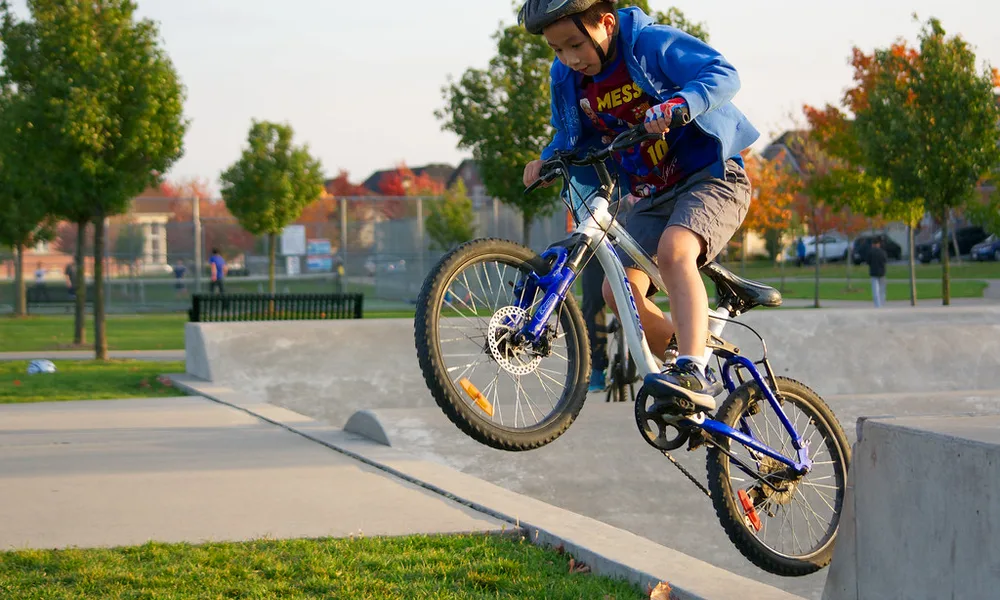
6. The wrong-size BMX: one size that fits nobody
The wrong-size BMX is the most common BMX mistake, because BMX sizing is measured in inches of top tube and most buyers never check it. A top tube that is too short folds you up like a pocket knife, with your knees hitting the bars and your back aching after ten minutes. A top tube that is too long stretches you out and makes it hard to pull the front wheel up. The wrong size ruins any BMX, however good its parts are, so fit comes before specification. Compare the top tube length with a sizing chart for your height before you pay.
7. The flatland lookalike: a pro machine with nothing that works
The flatland lookalike wears the costume of a professional freestyle bike: zero-offset forks, tiny gearing, pegs on all four axle ends, and a pro-style paint job. The problem is that everything underneath the look is built for the shelf. The fork bends on the first hard landing, the pegs are made from soft metal that strips its threads, and the brakes, if the bike has any at all, are an afterthought that barely slow the wheels. Buy a proper entry-level freestyle bike instead, and learn on parts that actually work.
What to avoid when buying a BMX bike
The most common BMX regret is a wrong match: a race bike bought for the skatepark, or a toy-shop BMX bought for a teenager who jumps. Avoid the trap by checking four things before you pay: the frame, the headset, the wheels and the cranks. Check the frame for cracks, rock the bike to feel for a loose headset, spin the wheels to check they run true, and stand on the cranks to feel for play. The same checks catch the worst bikes of every kind, and our guide to the worst bicycles of 2026 makes the same point about frames and brakes. Electric-assist bikes have their own failure patterns too, and our guide to the worst electric bikes of 2026 shows how a weak battery hides behind a bold range claim.
Checklist: buying a BMX bike in 2026
- Check the frame for cracks at the head tube and the bottom bracket before you pay anything.
- Hold the front brake and rock the bike back and forth; any knocking means a loose headset.
- Spin both wheels and check they run true, with double-wall rims and evenly tensioned spokes.
- Stand on the cranks and check for flex, play or bending; one-piece cranks are a warning sign.
- Test the brakes hard on flat ground and reject any bike that cannot stop both wheels cleanly.
- Check the top tube length against a sizing chart for your height, and confirm a local shop can service the bike.
Frequently asked questions
What is the worst type of BMX bike to buy?
The toy-shop BMX is the worst first buy: a thin frame with no gussets, one-piece cranks and parts no shop wants to fix. A cheap bike that breaks while you are riding it is not a bargain, it is a hazard.
Are single-wall rims bad on a BMX?
Yes. Single-wall rims buckle on the first hard landing and cannot be repaired properly. Double-wall rims are the single most important upgrade on any BMX, and any bike without them is not ready for the skatepark.
How much should a good BMX bike weigh?
Most decent BMX bikes weigh between 10 and 12 kilograms. Anything much heavier will feel sluggish in the air and land hard on the wheels, and the extra weight usually means cheap hi-ten steel rather than useful strength.
What size BMX should I buy?
BMX sizing is measured by top tube length in inches. A top tube around 20 inches suits most teenagers, while taller adults usually need 20.5 to 21 inches. Check a sizing chart for your height and test the fit before you buy.
Do I need a gyro on a BMX?
Only if you plan to spin the bars all the way round. A gyro is a clever part when it is made well, but a cheap one bends, snags and leaves you with brakes that do not work. A simple straight cable is better than a bad gyro.
What should I check first on a second-hand BMX?
Check the frame for cracks at the head tube and the bottom bracket, the headset for looseness, and the wheels for buckles. Then check the cranks for play and the chain for stretch, because a worn drivetrain is expensive to replace.
Bottom line
Avoid the worst BMX bikes of 2026, because they promise stunt ability and deliver only the look of it: a frame that cracks, rims that buckle, a headset that comes loose, and cranks that bend on the first hard landing. Buy the simplest BMX that works for the riding you do, check the frame, headset, wheels and fit before you pay, and the park gets better instead of worse.


