Beware the Worst Caterers of 2026
The worst caterers of 2026 are not the ones with the plainest menus or the smallest vans. They are the caterers whose food lets the whole event down: the hot dishes that arrive lukewarm, the buffet that runs out before half the guests have eaten, the bill that doubles between the quote and the invoice, and the team that treats allergies as a suggestion rather than a safety issue. This guide ranks the worst types of caterer you will meet in 2026, so you can spot a bad one before you book.
Key takeaways
- Hot food must arrive hot: a caterer with no hot-holding equipment will serve lukewarm food every time.
- Portions are a promise: ask how many servings are cooked per guest, and walk away from any caterer that will not say.
- Get the full price in writing before you sign, including staff, travel, hire, overtime and service charges.
- Allergy handling is a safety test, not a preference: a caterer that shrugs at it is not safe to book.
- Always attend a tasting, or at least see the food served at a real event, before you pay a deposit.
How the worst caterers of 2026 were chosen
Every type below was scored on five measures. Food quality comes first: is the food hot, fresh and properly cooked, or tired, cold and reheated? Quantity is second: does every guest get a proper portion, or does the buffet run dry halfway through? Honesty about price is third: the real cost once staff, travel, hire and overtime are added, not the headline quote. Reliability is fourth, because a caterer that arrives late or short-staffed cannot recover the event. Care for guests is fifth: how allergies, dietary needs and older guests are handled.
Two notes before the list. First, no single caterer is named as the worst, because the same bad patterns appear in many towns, and what matters is learning to recognise them before you sign. Second, this guide is about the caterer, not the room: our guide to the worst event venues of 2026 covers the halls that fail on space and sound, while this one covers the food and the service.
Comparison table: the worst caterers of 2026
| Rank | Caterer type | Main fault | Warning sign |
|---|---|---|---|
| 1 | The cold-food caterer | Hot dishes served lukewarm | No hot-holding equipment on site |
| 2 | The short-portion caterer | Food runs out mid-service | No per-guest serving numbers in the quote |
| 3 | The hidden-fee caterer | Bill far above the quote | Staff, travel and hire listed as extras |
| 4 | The late caterer | Arrives late or half-ready | No written arrival and service times |
| 5 | The allergy-blind caterer | Ignores allergies and diets | No labels, no separate serving tools |
| 6 | The foil-tray drop-off | Trays dumped, no service at all | No staff, no heating, no clearing up |
| 7 | The one-menu caterer | Same menu for every event | No tasting, no changes, no questions |
The worst caterers of 2026
1. The cold-food caterer: the worst caterer of all
The cold-food caterer is the worst caterer you can book, and it is not close. The food leaves their kitchen hot and arrives lukewarm, because they have no hot-holding equipment and no plan for keeping food at serving temperature. The roast dries out, the sauces skin over, and the guests eat food that tastes like it has been waiting since lunchtime. A good caterer treats temperature as part of the job: heated chafing dishes, covered trays, and food cooked in batches through the service. The test is simple. Ask what equipment they bring to keep hot food hot. If the answer is vague, your food will arrive cold.
2. The short-portion caterer: the buffet runs dry
The short-portion caterer quotes for a hundred guests and cooks for seventy. The first guests eat well, the middle of the queue gets smaller helpings, and the last guests find empty trays being cleared away. Everyone in the room can see it happening, and the guests who missed out remember it long after the speeches. Good caterers cook to the guest list plus a margin, and they say so in writing. Ask for those numbers before you sign, and be suspicious of any quote that talks about the menu in loving detail but never mentions quantities. If a caterer will not state quantities per guest, they are not cooking enough.
3. The hidden-fee caterer: the quote is a fiction
The hidden-fee caterer wins the booking with a low quote and then adds the real price in a dozen separate lines. Staff are charged by the hour on top of the menu price, travel is added per mile, the hire of plates and cutlery is extra, the cake cutting carries a fee, and overtime starts earlier than you were told. The defence is a single written quote listing everything — menu, staff hours, travel, hire, service and overtime — with a total that cannot move unless you change the guest numbers. Get it in writing, and compare totals, not headlines.
4. The late caterer: dinner at nine, speeches at ten
The late caterer turns a timetable into a suggestion. The team arrives an hour after the agreed time, the food is still being unpacked while guests are already seated, and dinner is served so late that the speeches, the dancing and the evening itself all slide backwards. Reliable caterers work to a written schedule, with arrival, setup and service times and a named person in charge. Ask what happens if they miss it. A caterer that will not commit to times in writing is telling you, politely, that your timetable is not their problem.
5. The allergy-blind caterer: a safety failure, not a preference
The allergy-blind caterer is the most dangerous type on this list. They take the dietary list, nod, and then serve the nut-free guest from the same tray as everyone else, with the same tongs, from a dish that was never labelled. Allergies are not fussy eating, and a caterer that treats them that way is not safe to book. A careful caterer asks for the dietary list in writing, labels every dish, uses separate serving tools for allergen-free dishes, and briefs the serving team by name. At the tasting, ask how they handle a severe nut allergy at a buffet: a real process is reassuring, a shrug is a reason to walk away.
6. The foil-tray drop-off: catering without the catering
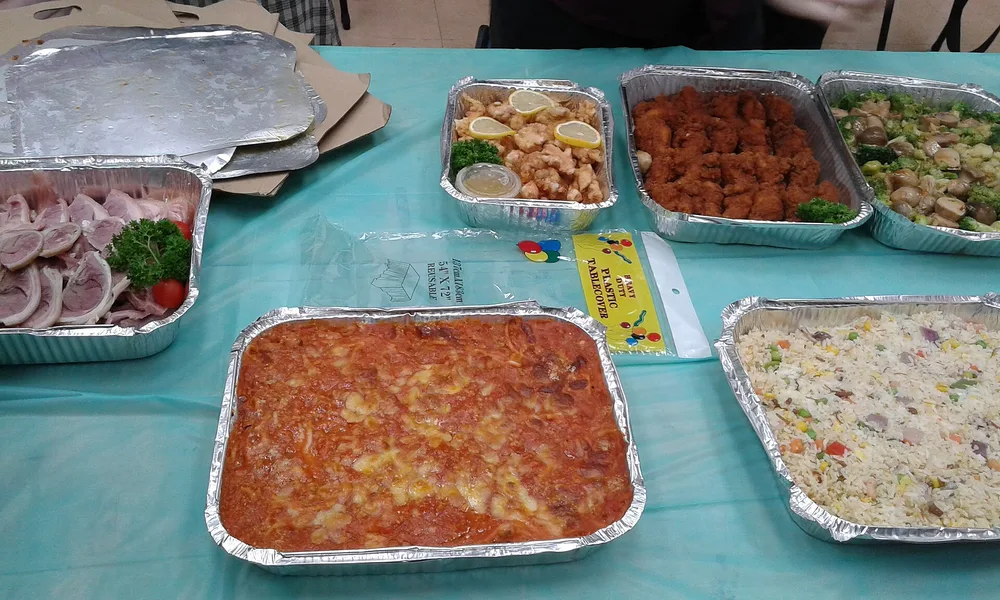
The foil-tray drop-off is not really a caterer at all. A van arrives, a stack of foil trays is put on a table, and the driver leaves. There is no staff to serve, no heating to keep the food warm, no plates laid out, no one to clear the empty trays, and no one to answer when a guest asks what is in the dish. For a casual office lunch it might be enough, but for a wedding or a formal party it is a miserable experience. If a quote is far cheaper than every other, ask what is included: staff, heating, crockery, service and clearing. If the answer is none of those, you are buying takeaway in bulk, not hiring a caterer.
7. The one-menu caterer: the same food at every event
The one-menu caterer serves the same four dishes at every event, whatever the occasion, the season or the guests. A summer wedding gets the same heavy winter menu as a January christening, and the vegetarian option is a plate of side dishes. There is no tasting, no discussion of the season, and no interest in who is coming. The food is usually adequate, which is exactly the problem at a once-in-a-lifetime event. A good caterer asks about the event, the guests, the season and the budget, offers a tasting, and builds a menu around the answers. Ask what they would change about their standard menu for your event. If they cannot answer, you are booking a production line, not a caterer.
What to avoid when booking a caterer in 2026
The most common catering regret is not a bad meal but a wrong match: a drop-off service booked for a formal wedding, a buffet quoted for eighty guests feeding a hundred and twenty, or a caterer chosen on price alone with no tasting and no written schedule. Avoid the trap by checking four things before you pay a deposit: the food at a tasting, the quantities, the full price, and the arrival and service times. Our guide to the worst wedding planners of 2026 makes the same point about written schedules and hidden costs, and our guide to the worst food halls of 2026 shows what happens when the venue, not the caterer, lets the meal down. A caterer that welcomes these checks is a caterer worth booking. A caterer that resists them is telling you everything you need to know.
Checklist: booking a caterer in 2026
- Attend a tasting, or see the caterer serve at a real event, before you pay any deposit.
- Get the per-guest serving numbers in writing, with a margin above the guest list, not just a menu.
- Ask for one written total covering menu, staff, travel, hire, service and overtime, and compare totals.
- Put arrival, setup and service times in the contract, with a named person in charge on the day.
- Send the full allergy and dietary list in writing, and ask how each dish is labelled and served separately.
- Check what clearing up is included, and who stays until the last tray is gone.
Frequently asked questions
How far in advance should I book a caterer?
For a wedding or a large party, six to nine months is sensible. For a smaller event, eight to twelve weeks is usually enough. Book early for a Saturday in summer, and never leave it to the last month if you want a tasting first.
What should a catering quote include?
The menu, the number of servings per guest, the staff and their hours, travel, hire of plates and cutlery, the service charge and the overtime rate, all in one written total. If any are missing, the final bill will be higher than the number you agreed to.
How do I know if the portions will be enough?
Ask how many servings are cooked per guest and what happens when a dish runs out. A good caterer cooks a margin above the guest list and refills trays through the meal.
Should I always have a tasting first?
Yes, for any event where food matters, which is nearly all of them. A tasting tells you how the food actually tastes, how it is presented, and whether the caterer listens. If a caterer refuses a tasting, treat that as a warning sign.
Who is responsible for allergies at a catered event?
The caterer is responsible for the food they serve, but you must give them the full list in writing and in good time. Ask how each allergen-free dish is labelled and kept separate, and never accept a verbal promise on allergies.
Is a drop-off caterer ever the right choice?
For a casual office lunch or a family gathering at home, where nobody expects service, a good drop-off can work well. For a wedding, a formal party or any event with a timetable, you need staff, heating and service.
Bottom line
The worst caterers of 2026 fail in the same few ways: cold food, short portions, hidden fees, late arrivals, ignored allergies, no service at all, and the same menu for everyone. The best do the opposite: they let you taste the food, put quantities and prices in writing, arrive on time, and treat dietary needs as a safety issue. Check those things before you sign, and the food will be the part of the day your guests remember for the right reasons.