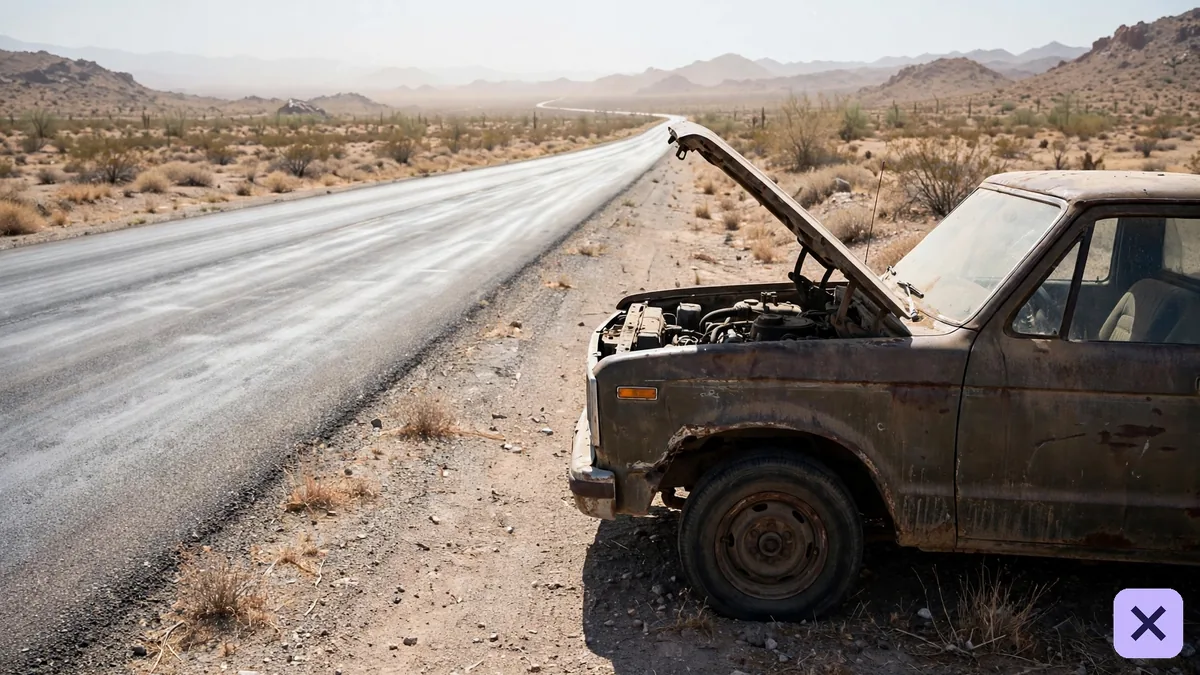
Summer is the season that exposes a bad pickup truck. The worst pickup trucks for summer driving are the ones that overheat in traffic, drink fuel on every trip, cook their passengers with weak air conditioning, and turn a holiday into a series of repairs. A pickup can be a brilliant summer vehicle, but the wrong one is a heavy, thirsty liability, and heat makes every weakness worse. This guide names the types to avoid, and the warning signs that tell you to walk away.
We judged them on the failures that ruin holidays: cooling that cannot cope with heat and towing, air conditioning that fades at idle, fuel economy that turns a road trip into a budget problem, cramped or poorly ventilated cabins, and old trucks whose age shows up when the temperature climbs. None is necessarily bad in every situation; they are bad for summer.
Key takeaways
- Old pickups with tired cooling are the biggest risk: overheating on a hot climb can end a holiday and cost thousands.
- Weak air conditioning is a deal-breaker in summer, especially in trucks without rear vents or with a single-zone system.
- Thirsty V8 trucks without modern efficiency tech can add hundreds of dollars in fuel to a single summer trip.
- Oversized trucks are miserable in beach towns and resort car parks, where width, length, and turning circle become a daily problem.
- Always check a used pickup for rust, cooling history, and air conditioning on a hot day before buying it for summer use.
How we judged the worst summer pickups
Our judgement starts with heat, which separates a good summer truck from a bad one. A pickup that runs fine in spring can overheat in July, with air conditioning at full capacity, a loaded trailer, and a road that climbs for miles. We marked down trucks with small radiators, no auxiliary transmission cooler, and a history of temperature warnings when towing: a cooling system merely adequate in mild weather is not adequate for summer.
Next came comfort and cost. Weak air conditioning, a dark interior, and no rear vents make every passenger miserable on a hot day, and poor fuel economy punishes you on every mile of a summer tour. We also considered size: a full-size truck is fine on an open highway, but a burden in a seaside town. Finally, age and condition: a worn-out truck brings breakdown risk that no optimism can fix.
The worst summer pickups at a glance
| Truck type | Main summer problem | Typical fuel use | Why it fails in summer | Who should avoid it |
|---|---|---|---|---|
| Ageing workhorse, 15+ years | Overheating, breakdowns | Poor, and worsening | Tired cooling, worn parts | Anyone towing or touring |
| Old thirsty V8, no hybrid | Fuel costs | Very high in town | No efficiency tech | Long-distance holiday drivers |
| Base model, weak air conditioning | Hot, stuffy cabin | Average | Small compressor, no rear vents | Families with children |
| Oversized full-size, long bed | Parking and manoeuvring | High | Too big for resort towns | Beach and town drivers |
| Underpowered small engine, heavy load | Struggling on hills | Poor when loaded | Engine works at its limit | Anyone towing in hills |
Summer punishes trucks that are old, thirsty, poorly cooled, or too big for the trip. A truck can be a good work vehicle and still a bad summer vehicle, so the rest of this guide explains each failure, so you can spot it before it spoils a holiday.
Ageing workhorses: the breakdown risk
An old pickup with 150,000 miles or more can look like a bargain, but summer is when its age shows. Radiators clog, hoses crack, water pumps weaken, and thermostats stick, and each failure appears first on a hot day with a load behind it. A breakdown on a desert highway or mountain pass can mean a long tow wait, a ruined booking, and a repair bill worth more than the truck.
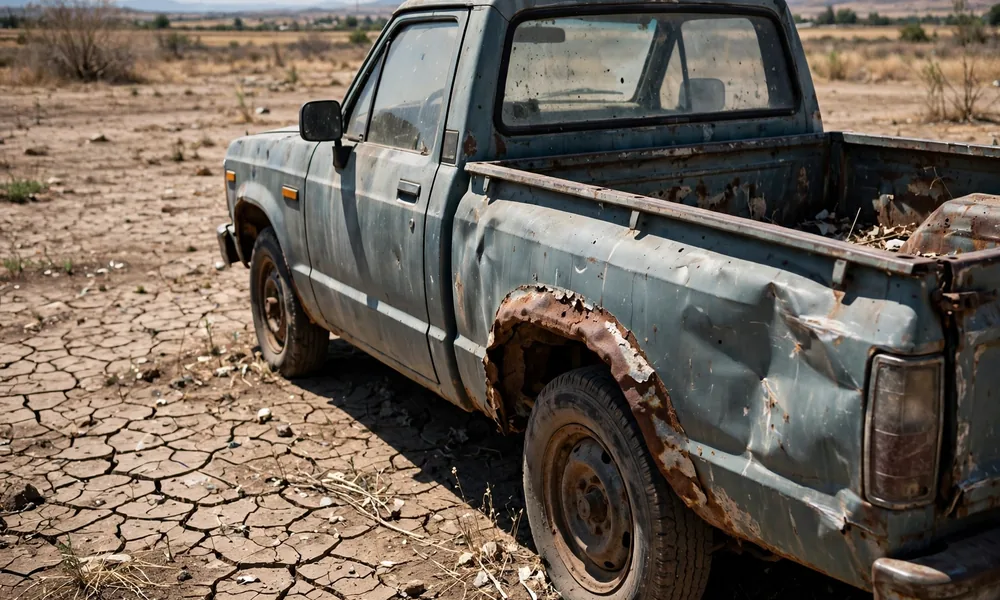
Rust makes it worse: a truck that spent winters on salted roads may look solid outside while its frame, brake lines, and fuel lines corrode underneath, and summer heat and heavy loads stress exactly those parts. Before buying any older pickup for summer use, inspect the underside, check the service history for cooling work, and take a long test drive on a hot day with the air conditioning on full. If the temperature gauge climbs in traffic, walk away.
Warning signs on a used summer pickup
Look for coolant stains around the radiator and hoses, a sweet smell from the engine bay, and air conditioning that blows cool at speed but warm at idle. Check that the cooling fan engages and the temperature gauge sits steady in traffic. Ask when the radiator, water pump, and thermostat were last replaced, and be wary of a seller who cannot answer: a truck with no cooling history and high mileage is a gamble in summer.
Thirsty V8s and weak engines: the two fuel traps
Fuel is the hidden cost of a bad summer pickup. An older V8 without cylinder deactivation, a modern turbo, or hybrid assistance returns poor economy in town and on the motorway, and summer makes it worse: the air conditioning adds load, the truck carries more weight, and holiday routes involve more stop-start traffic. Over a two-week tour, the difference between a thirsty truck and an efficient one can reach several hundred dollars.
At the other extreme, an underpowered truck is no better: a small engine in a heavy loaded truck with a trailer works at its limit all day, returning worse economy than a larger engine, while struggling on hills and in overtaking lanes. The worst summer combination is a heavy truck with a small, strained engine and no torque to spare: slow, loud, thirsty, and hot. If you tow in hills, choose a truck with enough torque that the engine rarely works hard, and check real-world fuel figures, not brochure claims.
Weak air conditioning and cramped cabins
A pickup with weak air conditioning is miserable in summer, and the problem is easy to miss on a mild test drive. Base models often have a smaller compressor, a single-zone system, and no rear vents, so the front seats cool eventually while the back seats stay hot for the whole journey, and the gap is worse in a big crew cab. Children, dogs, and older passengers suffer first.
Cabin design matters too. Dark leather seats in direct sun can burn on contact, and a large glass roof with no sunshade turns the truck into a greenhouse when parked. Cramped rear seats are another failure: a midsize truck with tight rear legroom is tolerable briefly, but after three hours in the heat it feels far smaller. Before buying, sit in the back on a hot day, run the air conditioning at idle for ten minutes, and see whether the cabin cools down. If it does not, no horsepower makes up for it.
Oversized trucks in summer towns
A full-size pickup with a long bed is a fine highway machine, but in a summer resort town it is a daily headache. Beach car parks, narrow lanes, and multi-storey garages were not built for vehicles over 5.5 metres long and 2 metres wide: the result is hunting for spaces that fit, folding mirrors to squeeze through, and worrying about the tailgate on every turn. Our roundup of the worst pickup trucks for city driving covers the same problem in urban settings, and it is twice as bad in a crowded seaside town in August.
The turning circle is the part buyers forget: a long-wheelbase truck needs far more room to turn than a car, which makes three-point turns on a busy beach road slow and stressful. Fuel use is the other penalty: a big truck in town traffic, air conditioning running and engine idling in queues, returns its worst economy exactly where summer driving puts it most. If your summer is mostly towns and beaches, a smaller truck will make the holiday more relaxing.

What goes wrong in summer heat
Heat attacks a pickup in several ways at once: the engine and transmission run hotter, the air conditioning works harder, the tyres wear faster, and the battery ages more quickly. A truck with marginal cooling shows a rising temperature gauge on long climbs, and ignoring it can mean a blown head gasket or a seized engine. Transmission fluid also breaks down faster in heat, so towing without an auxiliary cooler is one of the quickest ways to damage an older truck.
Tyres deserve attention too: hot roads increase pressure and wear, and an old or under-inflated tyre is far more likely to fail on a summer motorway. Check pressures when the tyres are cold, inspect for cracks and uneven wear, and replace tyres more than six years old before a long hot trip. Do not forget the spare: a flat tyre in 35-degree heat is bad enough without discovering the spare is flat too. If you are weighing other vehicle types, our guide to the worst convertibles for summer driving shows how heat punishes open-top cars in much the same way.

Walk-away checklist: six signs to avoid a bad summer pickup
- Temperature gauge climbs in traffic or on a hill on a hot-day test drive.
- Air conditioning blows warm at idle, or the rear seats never cool.
- Coolant stains, a sweet smell, or a seller who cannot explain cooling history.
- Visible rust on the frame, brake lines, or fuel lines underneath.
- Tyres older than six years, or a spare that is flat or cracked.
- Fuel economy far worse than a modern equivalent, with no hybrid or turbo.
Frequently asked questions
What is the worst kind of pickup truck for summer driving?
An old, high-mileage pickup with a tired cooling system is the worst kind for summer: it risks overheating and breakdowns on hot days. Close behind are trucks with weak air conditioning and thirsty engines, which make every summer mile hot and expensive.
Do old pickup trucks overheat in summer?
They can, especially when towing or climbing in hot weather: radiators clog, hoses crack, and water pumps weaken with age. A cooling service before summer, and a hot-day test drive, will reveal most problems before they strand you.
Are big pickup trucks bad for beach holidays?
They are bad for beach towns, though fine for the drive there: a long, wide truck is hard to park, hard to turn, and thirsty in resort traffic. A midsize or compact pickup is usually a better fit, and our roundup of the worst hatchbacks for summer driving shows small cars have their own summer weaknesses too.
Why does my pickup use more fuel in summer?
Air conditioning adds load, holiday driving involves more weight and stop-start traffic, and hot air is less dense. The biggest factor is load: a truck with a full bed and a trailer at motorway speed uses far more fuel than the same truck unloaded.
Can I fix weak air conditioning in a pickup?
Sometimes: a regas, a new cabin filter, or a faulty fan can restore performance, but a small compressor or a system without rear vents cannot be fixed cheaply. If the air conditioning is weak on a hot-day test drive, assume an expensive repair and factor it into the price, or walk away.
Should I avoid buying a used pickup in summer?
No, but summer is the best season to test one, because heat exposes cooling and air conditioning problems that hide in winter. Take a long test drive on a hot day, check the temperature gauge in traffic, and inspect the underside for rust first.
Bottom line
The worst pickup trucks for summer driving are the ones that cannot handle heat: old trucks with tired cooling, thirsty engines with no efficiency tech, cabins with weak air conditioning, and oversized trucks that do not fit summer towns. A pickup should make summer easier, not harder: if a truck overheats, cooks its passengers, or costs a fortune in fuel, it is the wrong truck for the season, whatever it cost.


