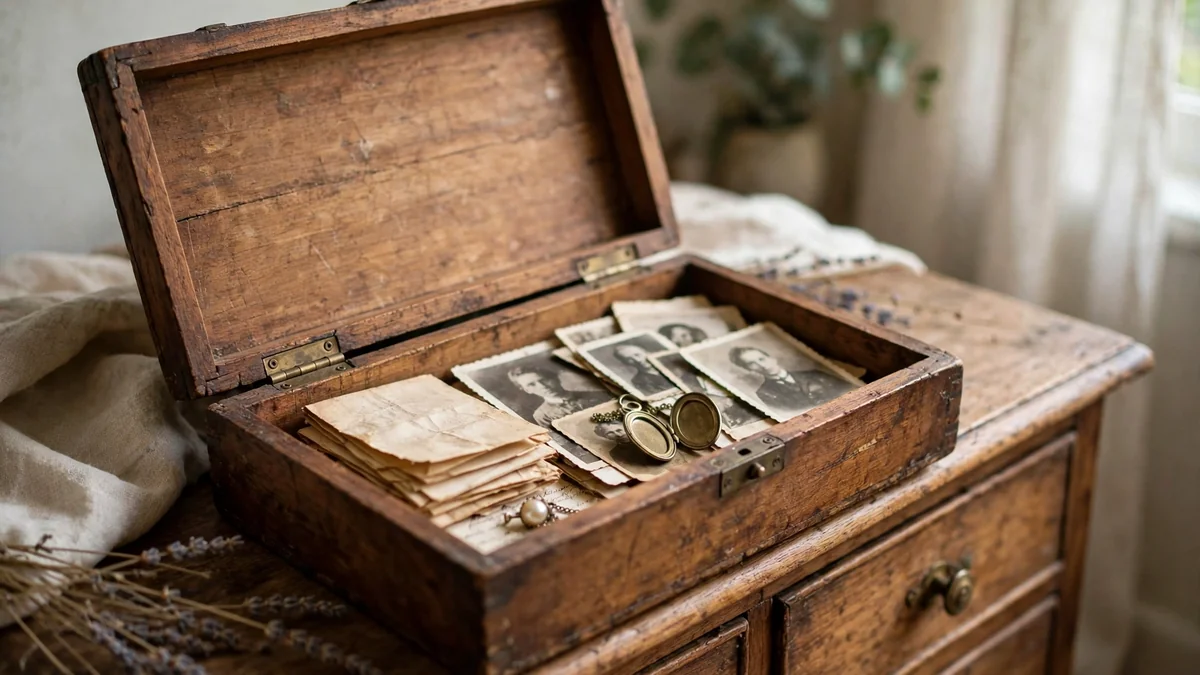
Why do the things that matter most end up in the worst place in the house? The letters from your grandmother sit in a carrier bag on top of the wardrobe. Your child’s first shoes are loose in a drawer with old phone chargers. Nothing is lost, exactly, but nothing is looked after either. A keepsake box is a small, lidded box with one job: to give the things you cannot replace a proper home, so they are still there in twenty years.
Key Takeaways
- A keepsake box protects irreplaceable things: a lid keeps out dust and light, and a rigid box stops crushing, which a drawer never does.
- Choose the box by what you keep: letters need a flat box, baby clothes need a deeper one, and medals need a firm base.
- Acid-free lining matters more than fancy wood, because ordinary cardboard slowly stains and damages paper.
- Buy a little bigger than you need today, since a keepsake box fills steadily.
- Keep the box somewhere cool, dry and easy to reach, because a box buried in a loft is never opened.
Keepsake Boxes 2026 at a Glance
| Best for | Box type | Typical size | Standout strength |
|---|---|---|---|
| Best overall | Wooden box with hinged lid | 30–35 cm long | Rigid, long-lasting, looks good on a shelf |
| Best for letters and photos | Flat archive box | A4 flat, 8–10 cm deep | Papers lie flat and never curl |
| Best for baby keepsakes | Fabric-lined deep box | 35–40 cm long, 15 cm deep | Room for shoes, clothes and first toys |
| Best for medals and small objects | Compartment box with tray | 25–30 cm long | Dividers stop objects knocking together |
| Best for travel memories | Small lidded tin or box | 15–20 cm long | Light, tough, fits in a drawer |

Why a Drawer Is Not a Keepsake Box
A drawer feels like storage, but it treats everything the same. Heavy things sit on top of light things. A pen leaks onto a photograph. A damp winter swells the wood and the drawer sticks. Most of all, a drawer hides things: out of sight, out of mind, and out of reach when you want to show a grandchild the letter their great-grandmother wrote.
A keepsake box changes that. Because it is small and lidded, only the things that matter go in. Because it is rigid, nothing inside gets crushed. Because the lid closes properly, dust and light stay out, and light is the quiet enemy of photographs and paper: a print left on a sunny shelf fades in a few years, while the same print in a closed box keeps its colours for decades. Opening one is also an occasion: the contents are arranged, not jumbled, which is why owners actually look at their keepsakes.
What Belongs in a Keepsake Box
Almost anything small and irreplaceable qualifies, but the best boxes hold a mix that tells a story. Letters and cards are the heart of most keepsake boxes: birthday cards, postcards, a note someone wrote by hand. Photographs come next, especially prints. Baby items are a classic third group: a first pair of shoes, a hospital bracelet, a lock of hair, a tiny knitted blanket folded flat.
Then there are the odd, personal things no shop would sell: a ticket stub, a dried flower, a medal, a shell from a beach holiday, a concert programme. These are what make a keepsake box different from a photo album. Our guide to the best photo albums of 2026 covers photographs in detail; an album suits a large collection of prints, while a keepsake box suits the mixed, three-dimensional things that will not fit in one.
What does not belong is anything damp, sticky or decaying. Never put fresh flowers in a closed box, never store anything wet, and keep food and candles out entirely. If something is fragile, wrap it in acid-free tissue first. And if an item is genuinely valuable, remember that a keepsake box is for memories, not security: a lock slows a curious child, it does not stop a thief.
The Main Types of Keepsake Box
The classic wooden box with a hinged lid is the best all-rounder: solid wood or good plywood with a fabric lining, good on a shelf, and built to last decades. Check the hinges open smoothly and hold the lid upright, and pay extra for a clasp, because a lid that stays shut keeps dust out.
Flat archive boxes suit letters and photographs best. Shallow and usually A4-sized, they let papers lie flat instead of curling. Look for acid-free board, the single most important feature for paper: ordinary cardboard slowly releases acids that yellow and weaken it.
Fabric-lined deep boxes are the baby-keepsake favourite. Usually 35 to 40 centimetres long and 15 deep, with a soft linen or cotton lining, they take folded baby clothes, first shoes and soft toys without squashing them. Make sure the lining is removable or washable, because baby items can carry milk and dust.
Compartment boxes with a lift-out tray suit medals, coins and keys, keeping little things separate so they do not scratch each other. This is the closest a keepsake box comes to a jewellery box, but the two differ: our guide to jewellery boxes worth buying covers ring rolls, necklace hooks and tarnish-proof lining, none of which a keepsake box needs.
Small lidded tins are the humblest option. A metal tin is light, tough and cheap, and it suits travel memories: shells, tickets, a foreign coin, a folded map. Tins do not breathe, so keep them dry and never store paper in one left in a damp garage.

Materials, Lining and Acid-Free Protection
The outside is about looks and strength; the inside is about protection. Wood is the strongest choice, and a well-made wooden box will outlast its owner. Rigid board covered in fabric is lighter and cheaper, fine for a shelf, but it will not survive being dropped. Metal tins are the toughest of all, but they dent and can rust if damp.
Lining matters more than most buyers realise. Velvet and felt feel luxurious, but they can shed fibres onto photographs. Plain cotton or linen is the safest all-round lining: soft, breathable and easy to brush clean. Check that the lining is fixed firmly and does not peel at the corners, because loose lining traps dust.
For paper, insist on acid-free tissue, dividers and board: they will not yellow letters or stain photographs, and if a box does not say acid-free, assume it is not. Wrap photographs individually, never stack bare prints face to face, and never use rubber bands, which perish and stain, or sticky tape, which yellows and tears paper.
Size, Compartments and How to Fill It
Measure before you buy. Gather the things you want to keep, lay them out, and measure the largest item: the longest letter, the widest photograph, the bulkiest baby shoe. A keepsake box should fit its largest item flat, with a little spare room. If you have to fold a letter to fit, the box is too small.
Then buy bigger than today needs. A keepsake box fills up steadily as life happens, and a box that is exactly full on the day you buy it will be overflowing within a year. A good rule is to leave a third of the box empty when you first fill it.
Compartments help, but only if they match what you keep. A tray with two or three sections suits mixed collections, and removable dividers beat fixed ones. Small cloth bags keep tiny items from getting lost. Fill the box in layers, heaviest at the bottom, with acid-free tissue between layers, and put a list inside the lid saying what is inside.
Keepsake Box vs Shadow Box: Display or Storage?
The nearest neighbour is the shadow box, and the difference is display versus storage. A shadow box is a deep frame that hangs on a wall and shows three or four keepsakes behind glass; a keepsake box sits on a shelf and holds many more things, out of the light. Our guide to shadow boxes for keepsakes explains the display side in full.
Choose a shadow box for the few things you want to see every day, and a keepsake box for the many things you want to keep safe and look at sometimes. Plenty of families use both: the best three objects on the wall, the rest in the box.

Where to Keep It and How to Look After It
Keep the box somewhere cool, dry and easy to reach: a bedroom shelf, the top of a wardrobe or a dresser drawer. Avoid lofts, which bake in summer and freeze in winter, and damp garages and cellars, which grow mould on paper and rust on metal. Keep the box out of direct sunlight, even with the lid on.
Open the box once or twice a year. Air it briefly, check for damp or insects, and enjoy what is inside. When you add something new, write the date on the back in pencil and add it to the list inside the lid. If you move house, the keepsake box travels with you in the car, not in a removal van. To clean it, dust the outside with a dry cloth and brush the lining gently; never use polish or spray cleaner inside. A sachet of silica gel helps in humid houses, and a cedar block keeps moths away from wool, though it should not touch photographs.
Checklist: Buying a Keepsake Box
- Measure your largest keepsake first, then buy a box that fits it flat with room to spare.
- Choose acid-free lining, tissue and dividers whenever the box will hold paper or photographs.
- Check the lid closes properly and the hinges hold it open without flopping.
- Leave a third of the box empty on day one, because a keepsake box fills up steadily.
- Pick removable dividers or a lift-out tray so the layout can change as your collection grows.
- Store the box somewhere cool, dry and easy to reach, never in a damp garage or a hot loft.
Frequently Asked Questions
What size keepsake box should I buy?
Measure your largest item first, then buy a box that fits it flat with room to spare. For most families a box about 30 to 35 centimetres long and 10 to 15 centimetres deep is right.
Are keepsake boxes safe for old photographs?
Yes, if the box and lining are acid-free and photographs are wrapped in acid-free tissue or sleeves. Never stack bare prints face to face, and keep the box out of sunlight and damp.
What is the difference between a keepsake box and a memory box?
There is no real difference: memory box is simply another name for a keepsake box. Do not confuse either with a shadow box, which displays keepsakes on a wall behind glass.
Can I keep jewellery in a keepsake box?
You can, but a jewellery box does it better, with ring rolls, necklace hooks and tarnish-resistant lining. A keepsake box suits mixed sentimental items; a jewellery box suits pieces you wear regularly.
How do I stop paper keepsakes from yellowing?
Use acid-free tissue and dividers, keep the box closed and out of sunlight, and store it somewhere cool and dry.
Where is the best place to store a keepsake box?
On a bedroom shelf, on top of a wardrobe or in a dresser drawer: somewhere cool, dry and easy to reach. Avoid lofts, damp garages and cellars, and keep the box out of direct sunlight.
Bottom Line
A keepsake box is a small purchase that protects things no shop can replace. Buy one that fits your largest keepsake flat, with acid-free lining, a lid that closes properly and room to grow, and keep it somewhere cool, dry and easy to reach. Fill it in layers, label what is inside, and open it once in a while.


