How to Slice Onions Evenly Every Time with the Best Onion Slicers of 2026
The best onion slicers turn the fiddliest job at the chopping board into a calm, repeatable one. A good onion slicer holds the onion steady while your knife runs between its prongs, so every slice comes out the same thickness and the rings separate cleanly. A bad one wobbles and leaves you chasing the last slippery piece. This guide covers the onion slicers worth buying in 2026 and how to choose one.
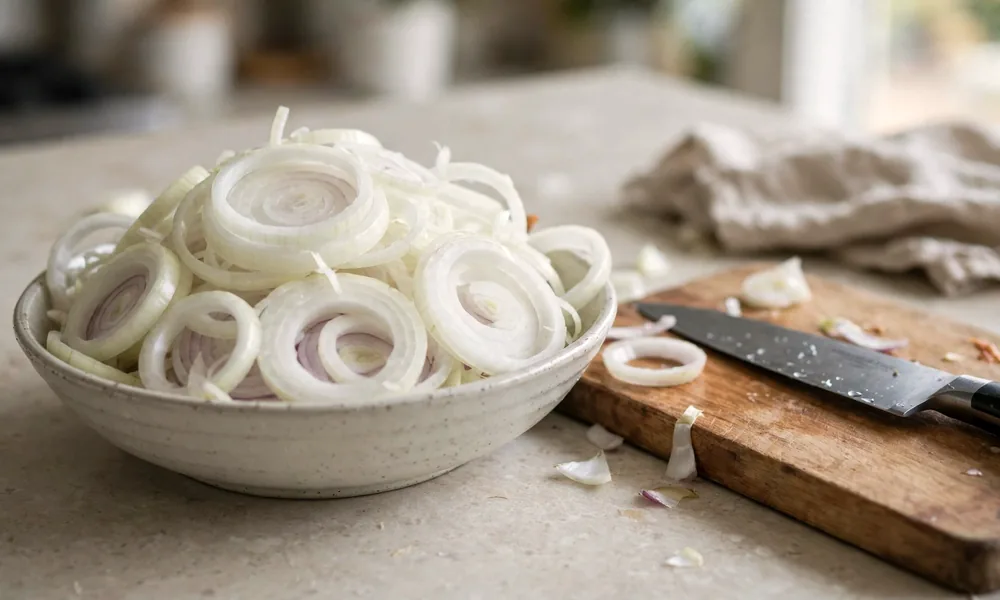
Onions are round, slippery, and layered, and cutting one makes your eyes water. A slicer changes the job, not the onion: the prongs pin it in place and the gaps set the thickness. Even slices cook evenly, so thin ones do not burn while thick ones stay raw.
Key Takeaways
- A pronged stainless steel holder is the best all-round onion slicer: it steadies any onion, works with the knife you own, and rinses clean.
- Prong spacing sets the slice thickness: narrow gaps suit fine salad rings, wider gaps suit chunky grilling slices.
- Onion slicers cut slices and rings, not dice: neat cubes need a different tool with a different mechanism.
- A slicer earns its drawer space by keeping fingers away from the blade, especially on the last piece.
- Buy for the onions you slice each week, and pick a holder that fits your usual knife.
What an Onion Slicer Actually Is
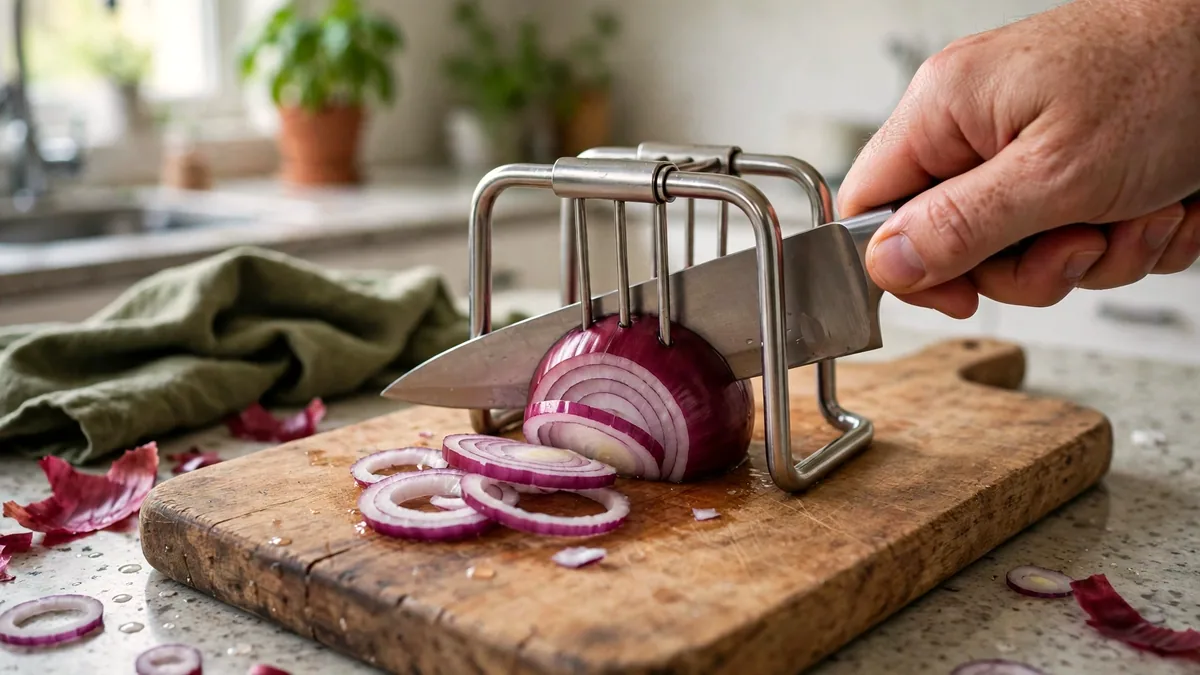
An onion slicer holds an onion still while you slice it with a knife: a row of long stainless steel prongs joined by a handle, pressed through the onion like the teeth of a comb. Run the knife between the prongs, and each gap gives one slice of the same thickness. Lift the holder, and the slices fall apart into rings. There is no motor or blade of its own: your knife cuts, and the slicer holds, spaces, and guards your fingers.
It is not an onion chopper: a chopper presses an onion through a grid into small even dice for the pan, while a slicer cuts flat slices and rings for salads, burgers, and grilling. If you want dice, our guide to the best onion choppers of 2026 covers grid-press choppers that dice an onion in one press. A chopper cannot make a ring.
It is not a mandoline either: a flat bed with a fixed blade you slide food across, faster for paper-thin slices of many vegetables at once. Our comparison of the best and worst mandoline slicers of 2026 shows what a good one does well and where cheap ones fail. An onion slicer is narrower and simpler: one vegetable, your own knife, and no sliding your hand across an exposed blade.
The Main Types of Onion Slicer, Compared
Every onion slicer in 2026 falls into one of four families, differing in how the onion is held, how thickness is set, and how much of the onion you can use.
| Type | Best for | Slice control | Weakness |
|---|---|---|---|
| Pronged holder | Everyday slicing | Knife follows prong gaps | Last slice needs care |
| Comb slicer | Small hands, weak grip | Fixed narrow gaps | Small onions only |
| Ring cutter | Identical burger rings | Fixed ring sizes | One thickness only |
| Guide board | Big batches | Built-in slots | Bulky to store |
The Pronged Holder
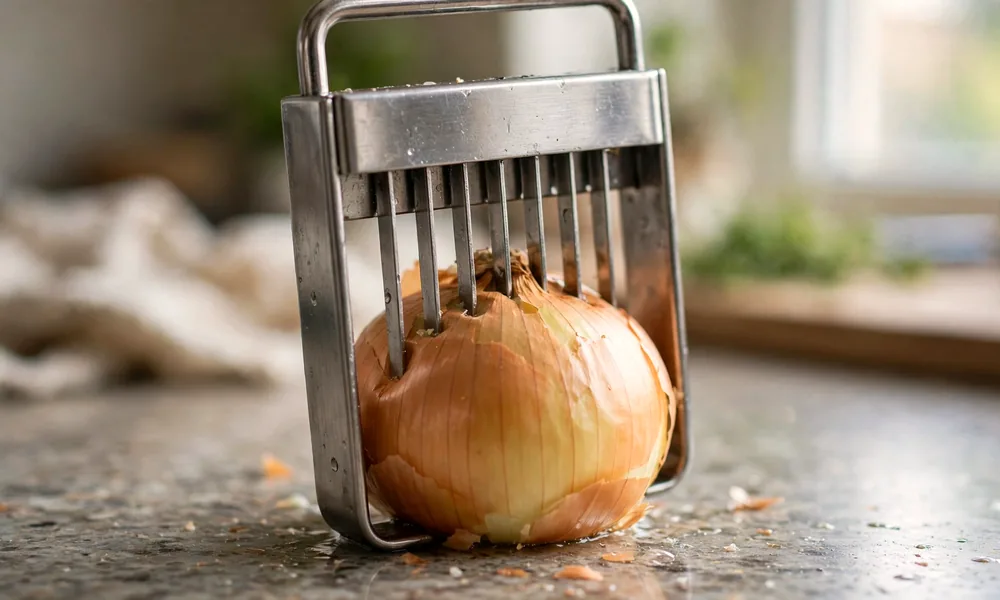
The pronged holder is the classic design and still the best choice for most cooks. Press the prongs through the onion until they meet the board, then run the knife between them: every slice matches the gap, and your fingers stay on the handle. The best holders have prongs long enough for a large onion, evenly spaced, with a handle wide enough to grip wet. Cheap ones have short prongs that stop halfway, leaving the bottom half to roll free.
The Comb Slicer
The comb slicer is a smaller, lighter version: a single row of fine steel teeth on a short handle, closer to a fork than a full holder. It suits small hands and small onions, and it is kindest if gripping a wide handle hurts your wrist. The trade-off is capacity: the teeth are short and close, so a large onion needs two passes and the slices come out thin either way.
The Ring Cutter
The ring cutter cuts the rings itself instead of guiding your knife: concentric steel rings pressed through a halved onion, each ring separating cleanly. It produces the most uniform rings of any tool, which is why burger lovers favour it. The trade-off is flexibility: one thickness, set by the rings, with no adjustment. It is also hardest to clean, because juice collects between the rings.
The Slicing Guide Board
The slicing guide board is the bulkiest option: a board with built-in slots that set the thickness, the onion clamped at one end. It gives the most even slices of all, because the knife cannot wander, and suits big batches, such as five onions for caramelising. The trade-off is storage: a board needs a cupboard shelf of its own, though a Sunday batch cook will find it earns the space.
How to Choose the Right Onion Slicer
Do you slice one onion a night, or five at the weekend? Fine rings for a salad, or thick slices for the barbecue? The answers decide the type, the spacing, and the size. Start with the onions you actually buy.
Prong Spacing and Slice Thickness
Prong spacing is the most important specification, because it is the slice thickness. Most holders have gaps of five to eight millimetres: thick enough to hold its shape on the grill, thin enough to soften quickly in a pan. Narrower gaps, around three millimetres, suit raw rings for salads; wider gaps suit grilling, where a thin slice would fall through the bars or burn. Some holders offer two spacings in one tool, worth paying for if you cook both ways. Check the prongs are evenly set: one wide gap and one narrow gap gives uneven slices.
Steel, Grip, and the Handle
Look for solid stainless steel prongs, not plated metal, which dulls, flakes, and rusts where the coating wears thin. Stainless steel holds its point, survives the dishwasher, and does not pick up yesterday’s onion smell. The handle matters too: a wide, flat handle lets you press with your palm, easier on the wrist and steadier than a narrow handle you must pinch. A non-slip grip helps when your hands are wet.
Size, Fit, and Your Knife
Measure the onions you buy first. A holder made for small onions will not reach through a large one, and one for large onions is clumsy on a shallot. Prongs should be at least as long as the onion is tall, so they meet the board and pin it. Then check your knife: a thick blade needs wider gaps to pass without wedging, while a thin, sharp knife slides through narrow gaps. Soft produce needs a different touch, and our guide to the best tomato slicers of 2026 covers tools that cut soft fruit without crushing it.
Cleaning and Storage
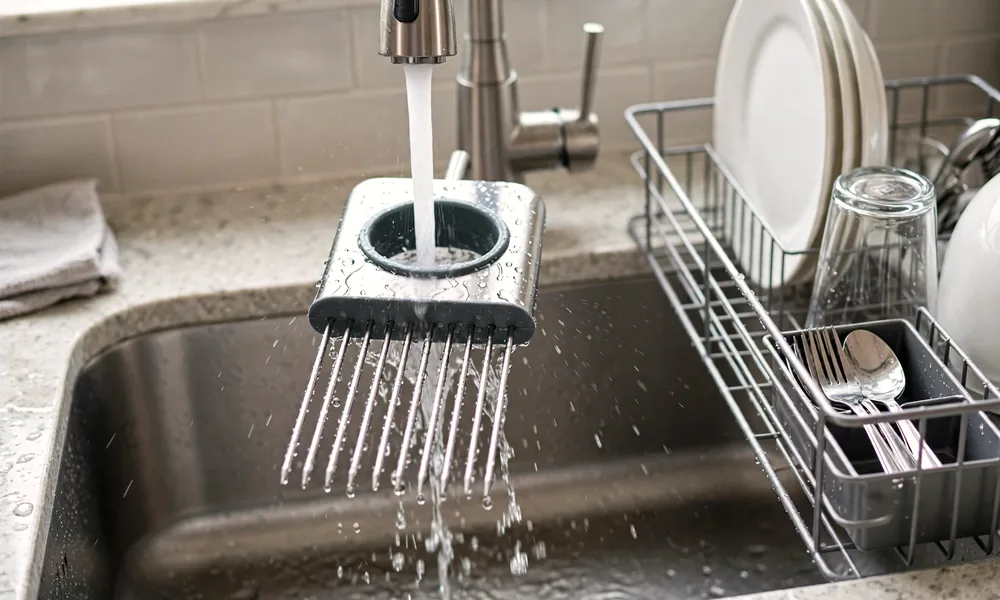
Cleaning decides whether a slicer gets used three times a week or twice and then lives in a drawer. A pronged holder with smooth, widely spaced prongs rinses clean in seconds, and most go in the dishwasher. A ring cutter or comb with tight teeth needs a brush to clear juice from between the blades, and that extra minute puts people off. Dry it properly before storing: trapped water leaves spots and, over time, a smell. Cover the prong tips or store them point-down, because bare steel points in a crowded drawer are a nasty surprise.
How to Use an Onion Slicer Well
Peel the onion and cut off the top, leaving the root end intact: the root holds the layers together. Place the onion flat-side down and press the prongs through it until they touch the board. Hold the handle firmly and run the knife between the prongs in long, smooth strokes, not sawing. A sharp knife glides; a dull one drags and tears. Do not rush the last slice: it is the smallest, least stable, and closest to your fingers. Lift the holder straight up and the slices fall into rings.
Chill the onion for half an hour first: a cold onion is firmer, slips less, and waters your eyes less. Do not press two onions in at once, or the prongs splay. For the last small piece, slice freehand or save it for dicing. Sliced onion keeps sealed in the fridge for two or three days and freezes well flat.
Mistakes to Avoid
The most common mistake is prongs too short for your onions, leaving the bottom half unpinned and rolling. The second is a dull knife, which tears rather than cuts. The third is pressing the holder down at an angle, so the slices come out wedge-shaped. The fourth is cutting off the root too early, so the layers separate. The fifth is storing the holder loose with bare points, which blunts the tips and risks a cut. The sixth is expecting it to dice: slicing twice gives ragged chunks, not cubes.
Onion Slicer Buying Checklist
- Prongs are solid stainless steel, long enough to reach through your usual onions and meet the board.
- Prong spacing matches the slices you want, with a second spacing if you cook both fine rings and chunky slices.
- Handle is wide enough to press with your palm, with a grip that works when wet.
- Your usual knife passes between the prongs without catching or wedging.
- Holder rinses clean under the tap or goes in the dishwasher, with no tight gaps that trap juice.
- Prong tips can be covered or stored point-down, so the holder is safe in a drawer.
Frequently Asked Questions
Do onion slicers really give even slices?
Yes, if the prongs are evenly spaced and long enough to pin the onion to the board: the gaps set the thickness. Uneven slices usually come from short prongs or a dull knife, which drags the layers instead of cutting them.
Is an onion slicer better than a mandoline for onions?
For onions alone, yes, for most home cooks. A holder works with the knife you own, sets up and washes in seconds, and never asks you to slide your hand across an exposed blade. A mandoline is faster for paper-thin slices of many vegetables at once, but for one or two onions a night the holder is simpler.
Can an onion slicer dice onions?
No: a slicer cuts in one direction only, producing slices and rings. Dicing needs a second cut at right angles. For dice, use an onion chopper with a grid press, built for the job.
What size onion slicer should I buy?
Buy for the onions you slice most often: the prongs should be at least as long as a typical onion is tall. A holder for large Spanish onions is clumsy on shallots, and a small holder cannot pin a large onion.
How do I stop my eyes watering when I slice onions?
Chill the onion for thirty minutes, keep your knife sharp so it cuts rather than crushes, and work steadily. A slicer helps by shortening the job: the faster the onion is sliced, the less stinging gas reaches your eyes.
How do I clean an onion slicer?
Rinse a pronged holder under hot water straight after use, and use the dishwasher for a deeper clean. Brush only ring cutters and comb slicers with tight teeth, where juice collects. Dry it fully, with the prong tips covered or pointing down.
The Bottom Line
The best onion slicer is the simplest one that fits your onions and your knife: a solid stainless steel pronged holder, prongs long enough to pin the onion, a handle you can press with your palm, and gaps that match the slices you cook. It will not dice, and it will not replace a mandoline for paper-thin work. It makes the everyday job steadier, safer, and more even.