The best French press coffee makers for offices 2026 prove that great workplace coffee does not need a complicated machine, a subscription, or a long queue at the nearest cafe. A French press brews rich coffee in about four minutes, costs far less than a bean-to-cup machine, and asks for nothing more than hot water and coarse grounds.
Offices are not kitchens, though. Glass breaks in a busy sink, a small press means brewing round after round, and a weak filter leaves grit in every cup. The best office presses solve that with sturdy steel, generous capacities, and fine mesh filters.
This guide compares the presses that hold up best in office life, from compact one-litre models to large insulated presses for meeting rooms, plus what to check before you buy and how to brew a good pot.
Key takeaways
- Match the press to your team: about 350 ml per person, so a 1-litre press serves three people and a 1.5-litre press serves four or five.
- Stainless steel survives office sinks far better than thin glass, and double-walled models keep coffee hot for a second round.
- A fine, tight-fitting mesh filter is the difference between smooth coffee and a gritty cup, so check the filter before you check the price.
- Coarse grounds, water just off the boil, and a four-minute steep are the three habits that matter most for flavour.
- Press the plunger down slowly and serve the coffee straight away, because coffee left sitting on the grounds keeps getting bitter.

Why a French Press Works So Well in an Office
A French press fits office life because it is fast and quiet. There is no grinder whirring through a video call, no pod to throw away, and no descaling cycle to remember. One person can brew a pot while the kettle boils.
The flavour is the other reason offices keep coming back. Immersion brewing pulls out the oils and body that paper filters trap, giving a fuller, rounder cup. A good press also costs less than a month of takeaway coffees for one person, and the only running cost is beans and hot water. For a broader view beyond the workplace, our guide to the best French press coffee makers overall compares the leading models for home use too.
What to Look for in an Office French Press
Buying for an office is different from buying for yourself. The press will be shared, washed in a hurry, and occasionally knocked against a tap, so durability, capacity, and ease of cleaning matter more than looks.
Size and Capacity
A 350 ml press makes one generous mug, a 1-litre press serves three people, and a 1.5-litre press covers four or five. Buying too small means brewing twice every morning, which quickly kills the habit, while buying far too large means the last cup sits on the grounds and turns bitter. Count the regular drinkers, allow one mug each, and round up.

Materials and Durability
Glass looks beautiful and lets you watch the brew, but thin glass is the most fragile choice for a shared space. If you choose glass, look for a thick beaker, a sturdy frame, and a replacement beaker that is easy to buy. Stainless steel is the practical office choice: it does not shatter, it holds heat well, and it shrugs off knocks. Double-walled steel keeps coffee hot much longer, which matters when a pot is brewed for a meeting that starts late.
Filter Quality
The filter decides whether the coffee is smooth or gritty. A good mesh fits tightly against the beaker wall, with no gap for grounds to slip past, and double filters catch more sediment for a cleaner cup. Check that the filter comes apart for cleaning, because trapped grounds are the fastest route to stale coffee, and that spares are cheap and available, since mesh wears out.
Ease of Cleaning
Office coffee fails most often at the sink, not at the brew. A press that is awkward to clean will be left dirty, and dirty equipment makes every cup taste worse. Look for a wide mouth a brush can reach into, a plunger that unscrews easily, and dishwasher-safe parts. Then scoop out the grounds, rinse the beaker, wash the filter, and leave the parts to dry apart.
Heat Retention
French press coffee cools fast, so heat retention matters where people pour at different times. Double-walled steel and thick stoneware hold heat best, while single-wall glass loses warmth quickly. Brew only what will be drunk within fifteen minutes, or pour the brewed coffee into a thermal jug.
The Best French Press Coffee Makers for Offices 2026
The presses below were chosen for office life: sturdy builds, sensible capacities, reliable filters, and quick cleaning. Match the size and material to your office before you match the price.
| Press | Capacity | Material | Best for |
|---|---|---|---|
| Bodum Chambord | 1 litre | Glass and steel | Classic style, small teams |
| Bodum Brazil | 1 litre | Glass and plastic | Budget offices |
| Frieling Double-Walled | 1 litre | Stainless steel | Heat retention |
| Le Creuset Stoneware | 800 ml | Stoneware | Stability and warmth |
| Espro P3 | 950 ml | Glass and steel | Clean, grit-free cups |
| Stanley Classic | 1.4 litres | Stainless steel | Large teams, tough use |
| Bodum Columbia | 1.5 litres | Stainless steel | Meetings and long brews |
| Mueller Austria | 1 litre | Stainless steel | Everyday value |
Bodum Chambord
The Bodum Chambord is the classic French press for offices that want a proven design rather than a gadget. The glass beaker sits in a polished steel frame, the plunger moves smoothly, and the one-litre size brews three good mugs at once. Replacement beakers are widely available if the glass ever breaks.
Bodum Brazil
The Bodum Brazil is the budget-friendly way to put a press in the office, using the same glass beaker and mesh filter as its more expensive sibling with a simple plastic frame. For an office testing whether French press coffee will catch on, this is the low-risk starting point, and the brewing is just as good as presses costing twice as much.
Frieling Double-Walled Stainless
The Frieling is the press for offices that take coffee seriously and want it to stay hot. Its double-walled steel body keeps coffee warm far longer than glass, and the all-steel filter is built to a higher standard than most rivals. The one-litre size serves three people, and in a busy office it is the press least likely to need replacing.
Le Creuset Stoneware
The Le Creuset stoneware press brings weight and stability to the office counter. The thick body holds heat well, the wide base resists tipping, and the enamel finish wipes clean easily. At 800 ml it brews two generous mugs, suiting a pair of colleagues rather than a whole floor, and it is heavy when full, so it belongs in a settled spot.
Espro P3
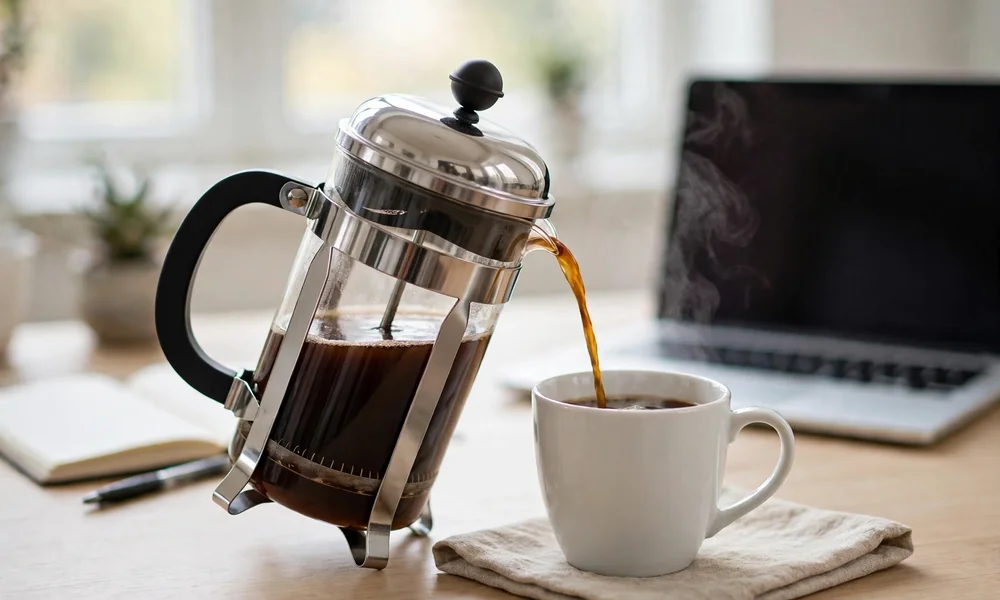
The Espro P3 is the pick for offices where gritty coffee has put people off the press. Its double micro-filter uses two fine meshes that catch far more sediment than a standard filter, so the cup is noticeably cleaner while keeping the full flavour. The 950 ml beaker serves three people, and a quick rinse after each brew keeps the double filter clean.
Stanley Classic
The Stanley Classic is built like outdoor gear, which makes it oddly perfect for a hard-working office. The 1.4-litre steel body serves four or five people, the vacuum insulation keeps coffee hot for hours, and the whole press can survive drops, knocks, and a dishwasher. It is the press most likely to still be brewing in five years.
Bodum Columbia
The Bodum Columbia is the large insulated press for meetings and bigger teams. Its 1.5-litre double-walled steel body brews five mugs at once and keeps them warm while the meeting runs long. It pours cleanly and looks at home in a modern office kitchen, but it is big and heavy when full, so it belongs on a counter or sideboard rather than a desk.
Mueller Austria
The Mueller Austria press is the everyday value pick: a stainless steel body, a one-litre capacity, and a price that makes it easy to buy two. It brews three mugs, it does not shatter, and it cleans up quickly under a tap. Use a coarse grind, and the cup is smooth and satisfying.
How to Brew Great Office Coffee with a French Press
Good press coffee follows a simple routine anyone can learn in one go. Start with coarse grounds, about the texture of coarse sea salt, at roughly 60 grams per litre of water, or two heaped tablespoons per mug. Heat fresh water to just off the boil, warm the press with a splash of hot water, add the grounds, pour in half the water, stir gently, and after thirty seconds pour in the rest.
Put the lid on with the plunger up and wait four minutes. Break the crust, skim off any foam, then press the plunger down slowly. Pour all the coffee out straight away, because coffee left in the press keeps brewing and turns bitter. A simple filtered jug often improves the cup noticeably. Teams that want a stronger setup can also consider other equipment, and our guide to the best espresso machines for offices covers the automatic alternative for busier floors.
Office French Press Checklist
Use this short checklist before you buy.
- Count the regular coffee drinkers and allow about 350 ml per person before choosing a size.
- Pick stainless steel or thick stoneware if the press will be washed by many hands in a busy sink.
- Check that the mesh filter fits tightly, comes apart for cleaning, and has spares available.
- Make sure the press fits under your kettle spout and on the shelf or counter where it will live.
- Agree who cleans the press and when, so the job does not fall to the same person every day.
- Buy coarse-ground coffee or a grinder, and keep beans in an airtight jar away from heat and light.
Frequently Asked Questions
How much coffee does a French press make for an office?
A one-litre press makes about three mugs, and a 1.5-litre press makes about five. Allow 350 ml per person, and size the press to the people drinking at the same time.
Is a glass or steel French press better for an office?
Steel is better for most offices because it does not shatter, keeps coffee hotter for longer, and survives busy sinks. Glass looks nicer and lets you see the brew, so it suits a small, careful team.
How long should French press coffee steep?
Four minutes is the standard steep, after a thirty-second bloom with half the water. Shorter steeps taste weak and sour, while longer steeps taste bitter and heavy.
Why is my French press coffee gritty?
Grit usually comes from grounds that are too fine, a loose or worn filter, or pressing too fast. Use a coarse grind, check the mesh sits tightly, press slowly, and pour the coffee out straight away.
Can I make French press coffee for a meeting?
Yes. A 1.5-litre insulated press serves about five people and keeps coffee warm through a meeting. Brew it just before the meeting starts, and do not leave it sitting on the grounds.
How do I clean a French press at work?
Scoop out the grounds, rinse the beaker, wash the filter, and leave the parts to dry separately. Wash with warm soapy water each day, and soak the filter occasionally to remove oils. For smaller spaces, our guide to the best coffee makers for small offices includes compact options that are easy to keep clean too.
The Bottom Line
The best French press coffee makers for offices 2026 match your team size, survive daily use, and make cleaning easy enough that it happens. A one-litre steel press suits most small teams, a 1.5-litre insulated press serves meetings, and a double-filter model wins over anyone who dislikes grit. Choose the size first, choose steel for a busy kitchen, and brew with coarse grounds for four minutes.