Action Cameras That Survive the Rough Stuff in 2026
The best action cameras of 2026 are built for days that break ordinary cameras: strapped to helmets, dunked in the sea, frozen on a ski slope, dropped on rocky trails, yet still recording smooth video. This guide sorts the cameras that genuinely survive the rough stuff, matched to the sports that test them hardest, so you buy for the adventures you have rather than the ones on the box.
Key Takeaways
- Waterproofing without a case matters most, because a separate housing fogs up, hides the screen, and muffles the sound.
- Stabilisation matters more than resolution: steady 1080p beats shaky 4K.
- Cold halves battery life, so cheap spares you can swap with gloves on win on a ski trip.
- Mounts matter as much as the camera: a weak mount turns a good camera into a rattling mess.
- Replaceable lens covers are worth paying for: the lens meets gravel first, and a scratched lens ruins every clip after it.
What “Tough” Really Means in an Action Camera
Every action camera claims to be tough, but toughness is four separate promises, and a camera can keep three while failing the fourth on the worst possible day.
The first promise is waterproofing. A camera waterproof to ten metres without a case can be taken surfing, swimming, and kayaking, and it dries quickly. A camera that needs a case for even a light shower is a different proposition: the case fogs up, hides the touchscreen, and muffles the microphones. Check the depth rating, and whether it applies bare or only inside its housing.
The second promise is stabilisation. An action camera has no zoom and almost no moving parts, which is why it can be dropped and shaken, but the footage still has to be watchable. The processor reads the camera’s movement hundreds of times a second and crops the frame to cancel the shake, so a bumpy ride looks like a smooth glide. The best cameras also keep the horizon level when you lean into a turn, the difference between footage that feels professional and footage that makes the viewer queasy.
The third promise is battery life in real conditions. The figure on the box is measured in a warm room with the camera sitting still, and it has little to do with a ski slope. Cold drains batteries fast, and high-resolution recording with stabilisation drains them faster still. A camera that records forty minutes or more per battery in real use, with cheap spares that swap in seconds, will still be recording at the end. The fourth promise is the body itself: a replaceable lens cover, a mount thread that does not strip, and buttons big enough to press with gloves on.
The Best Action Cameras by the Rough Stuff They Survive
Rather than ranking cameras in the abstract, this guide matches them to the punishment they will take. The camera that is perfect on a surfboard is not the one you want on a ski slope.
1. For Surfing and Water Sports: The Waterproof All-Rounder
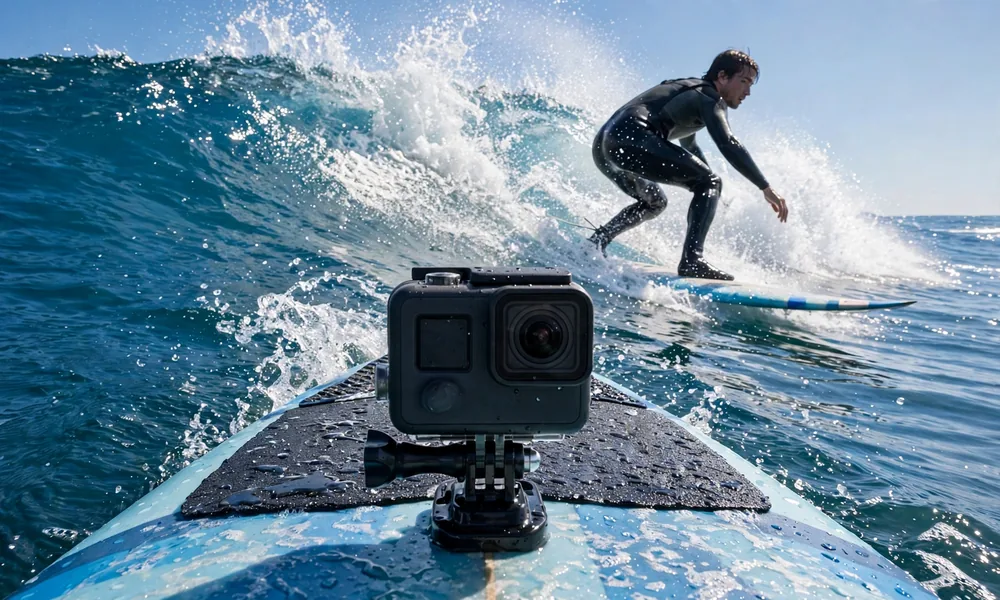
Surfers, kayakers, and swimmers need a camera that treats water as its natural home. The best choice seals properly without a case, waterproof to ten metres or more, with a touchscreen that responds with wet fingers and microphones that keep working after a dunk. A floaty grip or a brightly coloured mount is worth having, because a small black camera sinks fast. Look for a lens cover that sheds water quickly, since droplets are the most common reason a surf clip looks smeared.
2. For Mountain Biking and Trail Riding: The Stabilisation Champion
Mountain biking is the hardest test of stabilisation, because the camera shakes constantly and the light changes every few seconds under the trees. The best trail cameras pair strong stabilisation with a horizon lock, so the picture stays level when you lean into a corner, and a sensor large enough to hold detail in shadow without blowing out the sky. A helmet mount keeps the camera high and steady; a chest mount gives a more immersive view at the cost of vibration. A replaceable lens cover is essential here, because the first time you come off the bike, the lens is what meets the gravel.
3. For Skiing and Snowboarding: The Cold-Weather Performer
Snow is where batteries go to die, and a camera that lasts an hour in summer can manage twenty minutes on a cold mountain. The best snow cameras use cold-proof batteries and big buttons you can press through gloves. Voice control helps too: start recording while your hands are on your poles. A helmet mount is the natural fit, and a spare battery kept warm in an inside pocket, swapped in at lunchtime, is the cheapest upgrade there is. The footage is worth it: a bluebird day on fresh snow is footage you will still watch in ten years.
4. For Motorbikes and Road Trips: The Long-Distance Workhorse
Motorbike riding asks for long recording times, a mount that survives vibration for hours, and a camera that does not overheat in direct sun. The best choice has a large battery or a power bank connection, a bolt-on mount, and a lens that copes with glare in and out of tunnels. A second camera on the tail, facing backwards, turns a solo ride into a film with two angles. If you ride in the rain, the same waterproofing that serves surfers serves you, and a hydrophobic lens cover keeps the picture clear.
5. For Diving and Snorkelling: The Deep-Water Specialist
Diving is the one activity where a housing is usually welcome, because depth ratings without a case rarely go beyond ten or twenty metres, and colours change as you go deeper. The best dive cameras offer a proper dive housing, a red filter or a white-balance setting that restores colour, and controls that work through the housing at depth. For snorkelling and shallow reef swimming, a bare waterproof camera is simpler and lighter, and the footage is often better with no extra plastic between lens and fish. Either way, rinse the camera in fresh water after every session in the sea: salt will find any seal you neglect.
6. For Travel and Everyday Adventure: The Pocketable Second Camera
Not every rough day involves a helmet. Travellers want a camera they can hand to a child, drop on a rocky beach, and rinse under a tap at the end of the day. The best travel action camera fits a jacket pocket, records clean 4K video with strong stabilisation, and pairs with a phone app that makes trimming and sharing clips quick. It is a natural second body beside a larger camera, covering the wet, fast moments a big camera cannot survive. If you want a camera for stills and video together on a trip, our guide to the best travel cameras for beginners covers the larger cameras that pair well with a rugged little action camera.

Action Cameras at a Glance
| Best For | What Matters Most | Mount to Buy First | Watch Out For |
|---|---|---|---|
| Surfing and water sports | Waterproof without a case | Floaty grip | Water drops on the lens |
| Mountain biking | Stabilisation and horizon lock | Helmet mount | Scratched lens covers |
| Skiing and snowboarding | Cold-weather battery life | Helmet mount | Small buttons with gloves |
| Motorbikes and road trips | Long recording, no overheating | Bolt-on mount | Glare and vibration |
| Diving and snorkelling | Depth rating, colour correction | Dive housing | Salt on seals |
| Travel and everyday | Size, stabilisation, app | Chest mount | Footage never edited |
Mounts, Batteries, and the Kit That Keeps You Filming
The camera is only half the purchase; the kit decides whether you get the footage.
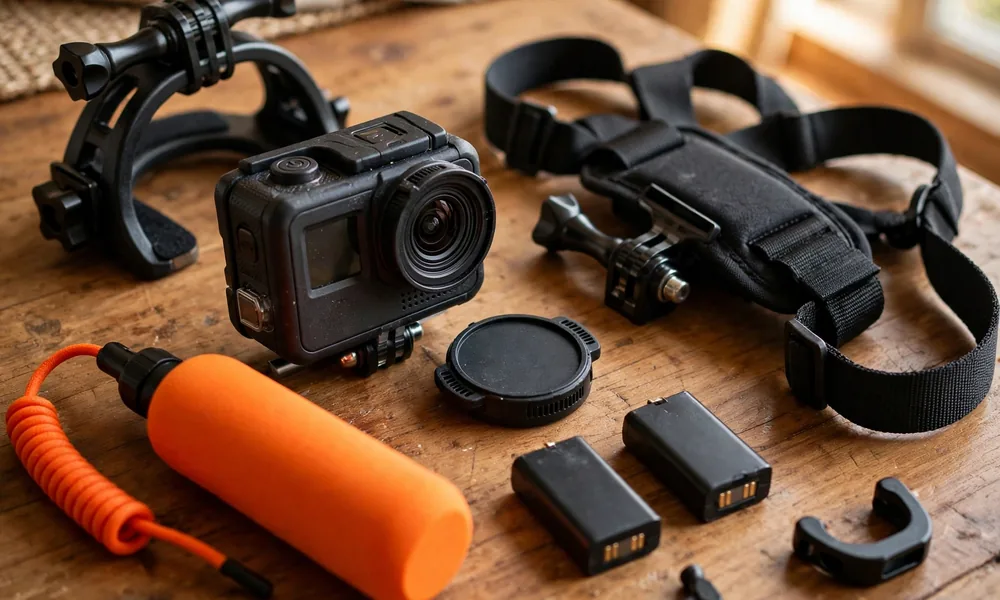
Mounts come first. A helmet mount is the most versatile, suiting bikes, skis, and climbing, while a chest mount gives the most immersive view. A handlebar mount suits bikes and motorbikes, and a suction mount works on car windscreens and boat hulls, provided the surface is clean. Buy mounts from the camera maker or a reputable third party, and replace adhesive pads regularly, since a sun-baked pad is the most likely to let go at speed. A tripod is useful too, for the moments when you want the camera still: our guide to the best tripods covers the stands that keep a small camera steady on uneven ground.
Batteries come second. Two spares and a dual charger cost less than a single accessory, and they are the difference between a full day of footage and a camera dead before lunch. Keep spares warm in cold weather, charge them the night before, and number them. Memory cards come third: buy a fast card from a known brand, in the largest size the camera supports, because 4K fills cards quickly and a slow card can stop a recording mid-clip. And before you buy, think about editing. The best footage is no use on a memory card forever, so check that the camera’s app lets you trim and share clips quickly. Our guide to the best video editing apps for phones will help you turn raw clips into something worth sharing.
Action Camera Buying Checklist
- Check the waterproof rating for the bare camera, not inside its housing.
- Watch sample footage at full speed, and judge stabilisation before resolution.
- Confirm spare batteries are cheap and available, and swappable with gloves on.
- Look for a replaceable lens cover and mounts with spares you can buy.
- Test the buttons and touchscreen with wet hands, or with gloves, before you commit.
- Budget for two spare batteries, a fast memory card, and the mount for your main sport.
Frequently Asked Questions
Do I really need 4K, or is 1080p enough?
For most people, 4K is worth having, because it gives you room to crop and stabilise without losing sharpness. That said, a good 1080p camera with strong stabilisation beats a bad 4K camera every time, so resolution should never be the first thing you compare.
Can action cameras really survive being dropped?
Yes, within reason. A good action camera has almost no moving parts, a tough body, and a replaceable lens cover, so it survives drops that would end a normal camera. The lens cover is the sacrificial part, designed to take the scratch so the lens does not.
How long does an action camera battery last in the cold?
Expect roughly half the warm-weather life on a ski slope, sometimes less in 4K. Carry a spare in an inside pocket where your body keeps it warm, and swap it in at lunchtime rather than waiting for the camera to die mid-run.
Do I need a waterproof case as well?
For surfing, swimming, and snorkelling, a bare waterproof camera is simpler and better, since a case fogs up and hides the screen. For diving below the camera’s depth rating, a proper dive housing is essential, rinsed in fresh water after every session.
What is horizon lock, and is it worth having?
Horizon lock keeps the picture level even when the camera tilts, so a leaning rider still gets a straight picture. It is one of the most useful features on a modern action camera, and it matters most on bikes and skis, where the camera leans constantly.
Can I use an action camera as my only travel camera?
You can, and many travellers do, but it is a compromise for stills and low light. An action camera is at its best as a second camera beside a larger one, covering the wet, fast moments while the main camera handles careful photography.
The Bottom Line
The action camera that survives the rough stuff in 2026 is the one matched to your sport: waterproof without a case for the water, strong stabilisation and a replaceable lens cover for the trail, and a cold-proof battery for the snow. Buy reliability first, spend the rest on spares and the right mount, and choose stabilisation you have seen working. The camera that comes home with the footage you wanted is the only one worth it.