A tropical fish tank looks calm and effortless when everything is working, but that calm depends on one quiet piece of equipment more than any other. Water temperature decides whether fish eat well, swim actively, resist illness and show their best colours. A few degrees too cold and tropical fish slow down, stop eating and become vulnerable to disease. The best aquarium heaters of 2026 are the ones that hold a steady temperature day and night, without fuss, without sudden swings and without turning the tank into a risk.

What Makes an Aquarium Heater Good
The first thing to judge is stability. A good heater does not chase the temperature up and down. It warms the water to the set point, switches off, and switches on again only when the water cools slightly. The swing between those two points should be small, ideally a degree or two, so the fish never feel a sudden change.
Accuracy matters just as much. The number on the dial should match the water, not just the heater. A heater that claims twenty-six degrees but actually holds the tank at twenty-three is misleading its owner every day. Good heaters pair a reliable thermostat with a clear temperature scale, and they reward the owner who checks the real water temperature with a separate thermometer rather than trusting the dial alone.
Safety is the third test, and it is the one that matters most. A heater sits in water, plugged into the mains, for years at a time. It should shut off automatically if it runs dry, it should be fully submersible where it claims to be, and its seals, suction cups and cable should feel solid rather than flimsy.
The Main Types of Aquarium Heater
Submersible heaters are the most common type, and for most tanks they are the best choice. The whole unit sits underwater, usually fixed to the back glass with suction cups, near the filter outlet so the warmed water circulates. Most of the heaters worth buying in 2026 are submersible models with an adjustable thermostat.
Preset heaters are simpler. They are set at the factory, usually to around twenty-five or twenty-six degrees, and they have no dial to adjust. That simplicity is their appeal: there is nothing to set wrong, and they suit small tanks and beginners who want one less decision. The trade-off is flexibility. If the fish need a warmer or cooler temperature than the preset, or if the room is unusually cold, a preset heater cannot adapt.
Inline heaters sit outside the tank, plumbed into the filter tubing, so the water is heated as it flows back into the aquarium. Nothing sits inside the tank at all, which keeps the display clean and gives the fish more room. They suit larger tanks and owners who dislike visible equipment, but they cost more, they need compatible filter tubing, and they are harder to move between tanks.
Choosing the Right Wattage
Wattage is the heater’s power, and getting it right matters more than brand or looks. The usual rule is around three to five watts per gallon, or roughly one watt per litre, for a tank kept in a normally heated room. A twenty-gallon tank, about seventy-five litres, generally needs a heater of around seventy-five to one hundred watts.
An undersized heater is the most common sizing mistake. It runs constantly, never quite reaches the set temperature on cold nights, and wears out sooner because it never gets a rest. Fish in an under-heated tank eat less, move less and fall ill more easily, and the owner often blames the fish or the food when the heater was the problem all along. If the tank is borderline between two sizes, the larger heater is usually the safer choice, provided its thermostat is reliable.
An oversized heater has the opposite risk. It heats the water very fast, which means a thermostat fault can push the temperature up quickly before anyone notices. That is why very large tanks are often heated with two medium heaters rather than one huge one. Two heaters share the work, they heat the tank more evenly from two points, and if one fails, the other still provides some warmth while the owner notices the problem. For tanks over fifty gallons, a pair of heaters is a sensible, practical setup.
Heaters for Tropical Fish
Most tropical community fish, including tetras, guppies, mollies, platies and corydoras, do best between twenty-four and twenty-seven degrees. That range keeps them active and feeding well without pushing oxygen levels down. A good adjustable heater lets the owner sit in the middle of that range and stay there, rather than drifting between the edges. The exact number matters less than the steadiness: a tank that holds twenty-five degrees all day is healthier than one that swings between twenty-three and twenty-eight. Our guide to the best aquariums of 2026 covers tank sizes that make heating easier.
Heaters for Bettas and Small Tanks
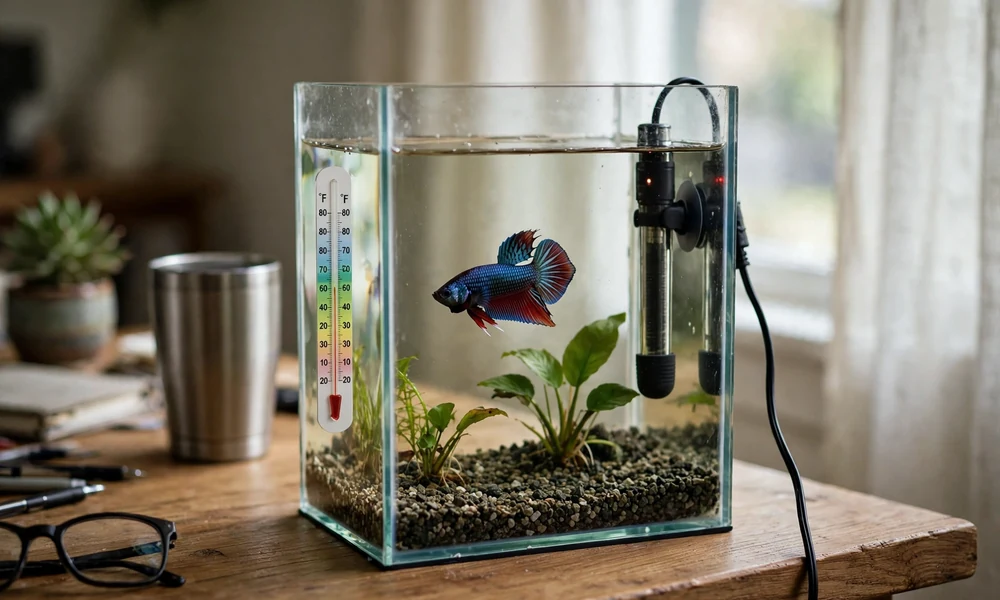
Bettas are tropical fish, and they need warm water just as much as any other tropical species, even though they are often sold for tiny bowls and unheated containers. A betta kept at room temperature in a cool house will be sluggish, will eat poorly and will be far more likely to fall ill. The ideal range for a betta is twenty-five to twenty-seven degrees, and a small heater is what makes that possible in a five- or ten-gallon tank. Warm fish eat better, so pair the heater with good food from our guide to the best fish food of 2026.
Nano tanks and desktop aquariums have the same needs on a smaller scale. The heater must fit without crowding the fish or the plants, its cable must reach the socket without pulling, and it must not create a hot spot in one corner. A short, slim heater placed horizontally low in the tank often works better in a nano setup than a tall heater standing upright, because it spreads the warmth more evenly through the small volume of water.
Setting Up a Heater Properly
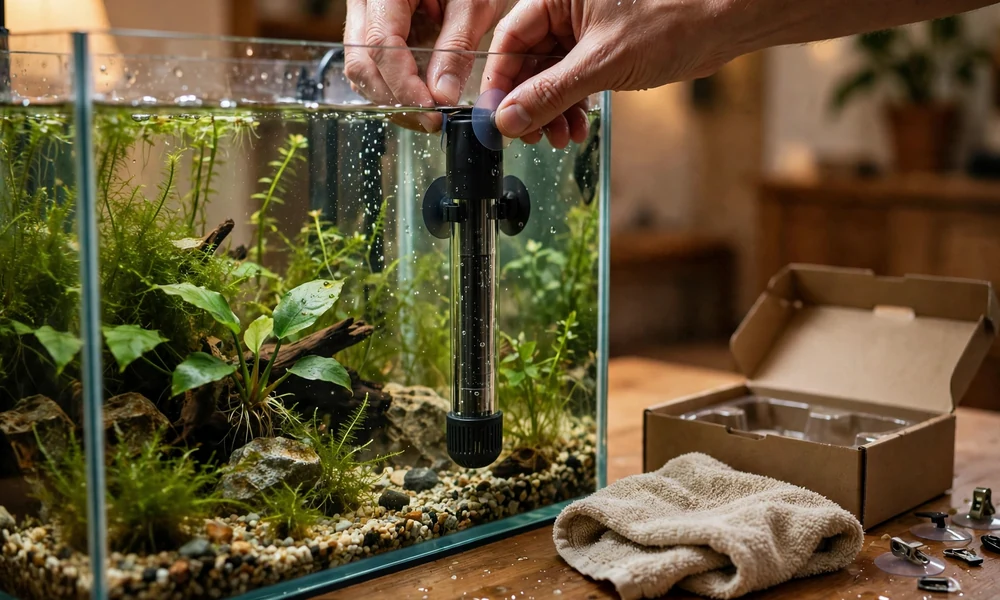
Setup order matters. Place the heater in the tank, fill the tank with water, and wait at least fifteen to thirty minutes before switching the heater on. That wait lets the glass and the thermostat reach the water temperature, so the heater does not crack from thermal shock or switch on while still dry. It is a small step, and skipping it is one of the fastest ways to damage a new heater.
Position the heater where the water moves. Near the filter outlet is ideal, with the suction cups holding it firmly to the glass and the whole unit underwater. Leave a little space between the heater and the glass, the gravel and any decoration, so water can flow around it and the heat can spread. Do not bury a submersible heater in gravel, and do not let it rest against plastic plants or the tank wall, where the heat can concentrate.
Keeping the Temperature Steady
A separate thermometer is the cheapest insurance a fish keeper can buy. A stick-on strip, a floating glass thermometer or a small digital probe all do the job, and any of them is more trustworthy than a heater dial alone. Check it daily, at the same time, so a slow drift shows up as a pattern rather than a surprise. A tank that was twenty-six degrees yesterday and twenty-four today has a problem worth investigating, even if the fish still look fine.
Heater Safety and Maintenance
Unplug the heater before any work that lowers the water level. Water changes, gravel cleaning and rearranging decoration can all expose a heater to air, and a heater switched on in air can crack or overheat in minutes. Switch it off, wait a few minutes for it to cool, do the work, refill the tank, and only then switch it back on. Making that sequence a habit removes the most common cause of heater failure.
Watch for the signs of a failing heater. A heater that stays on constantly, a temperature that drifts without any change to the dial, a heater that clicks or buzzes, or water that smells faintly of burning are all reasons to unplug it and replace it straight away. Do not wait to see whether the problem goes away, because a stuck heater can overheat a tank in hours. A spare heater in the cupboard is worth having, especially in winter, when shops may be closed and the tank cannot wait.
Heaters for Large and Outdoor Tanks
Large tanks need more than a bigger heater; they need a heating plan. Two heaters placed at opposite ends of the tank, each sized for about half the tank, heat more evenly than one large heater in the middle. They also give the tank a safety margin: if one heater fails, the other keeps the water from cooling too fast while a replacement is arranged. The two heaters should be set to the same temperature and checked against the same thermometer. For outdoor water, circulation matters first — see our guide to the best pond pumps of 2026.
Mistakes to Avoid
The most common mistake is buying a heater and never checking it. The dial is set, the fish look fine, and nobody looks at the thermometer for months. Then a cold snap, a failing thermostat or a slipped suction cup changes the temperature, and the first sign is a sick fish. A daily glance at the thermometer takes seconds, and it is the single most useful habit in fish keeping.
The second mistake is choosing on price alone. The cheapest heater in the shop is often the one with the loosest thermostat, the thinnest glass and the weakest seals, and it is the one most likely to fail at the worst moment. A heater is not the place to save a few pounds, because the cost of replacing fish, plants and a crashed tank is far higher than the difference between a cheap heater and a reliable one. Spend a little more, and spend it on a heater with a good thermostat and solid build.
The Bottom Line
There is no single best aquarium heater for every tank, because the best heater depends on the size of the tank, the temperature of the room and the fish that live in it. A small adjustable heater suits a betta tank. A mid-range submersible heater suits most tropical community tanks. A pair of heaters suits a large tank. A preset heater suits a small, stable setup where the preset temperature is exactly right. The best heater of 2026 is the one that matches the tank, holds its temperature steady, and keeps working safely for years.
The simplest way to choose is to start with the tank and the fish. Note the tank size, check the temperature the fish need, and pick a heater with the right wattage and a reliable thermostat. Set it up carefully, let the tank settle, and check the thermometer every day. A heater that holds the water steady is easy to forget about, and that is exactly how it should be: the fish stay warm, the tank stays calm, and the heater quietly does its job in the background.