Baby Bottle Drying Racks That Dry Every Part Properly in 2026
The best baby bottle drying racks in 2026 solve a problem most parents only notice when it goes wrong: a washed bottle that stays damp inside grows a sour smell, and a nipple left in a puddle on the counter picks up whatever the counter holds. A good rack holds every part of the bottle upside down, spaced so air can reach it, with the water draining away instead of pooling. Here is how to choose one, and how to use it.
Drying is half of washing, and it is the half most kitchens get wrong. A bottle washed perfectly and left upright stays wet at the base, and a wet base in a warm kitchen is where smells start. A rack holds the bottle upside down on a peg, so water runs out, air flows in, and the bottle dries in an hour or two.
Key Takeaways
- Airflow decides everything: pegs must hold bottles upside down and spaced apart, never touching, so air reaches every surface.
- Match capacity to your day: count the bottles, nipples, rings, and pump parts you wash at once, then buy a rack that holds them all.
- A drip tray matters: water must drain into a tray you can empty and wash, not pool on the counter or under the rack.
- Stability beats looks: a rack that tips when a bottle is lifted is worse than no rack, especially with glass bottles.
- Clean the rack weekly: a rack that never gets washed grows the same film it is meant to prevent.
Why Drying Matters as Much as Washing
Washing removes milk film, but only drying removes the water that lets new film grow. A bottle that stays damp inside smells sour within a day, and that smell survives the next wash. A nipple stored wet goes cloudy faster, and a ring left in a puddle picks up crumbs from the counter. Drying is the step that keeps the wash honest.
The mistake most parents make is drying bottles upright. An upright bottle traps water at the base, because air cannot circulate inside a narrow neck. Upside down on a peg, the same bottle drains in minutes and dries in an hour or two, and the rack makes that position automatic.
Drying Racks vs Other Ways to Dry Bottles
The obvious alternative is a tea towel, and it is the worst option: it holds moisture against the bottle, goes damp within a day, and leaves lint on nipples. A dish rack is better, but general drying racks are made for plates and cutlery, with slots too wide for bottle necks and no pegs for nipples or rings. Bottles balanced on their sides in a dish rack roll and tip.
The other near neighbour is the full cleaning kit. Our guide to baby bottle cleaners covers the whole wash station, and a drying rack is one part of it, alongside the brush, the soap, and the steriliser. This guide covers the rack alone: the part that decides whether a clean bottle stays clean, and the part most parents buy separately when a bundled rack proves too small.
Air drying on the counter with no rack works only if every part is spaced out and turned upside down by hand. In practice, bottles end up upright and nipples end up in a pile. The rack is worth buying because every part has a peg, every peg drains, and the whole day of bottles dries in the same place.
The Main Types of Baby Bottle Drying Rack Compared
Almost every baby bottle drying rack falls into one of five types. The right choice depends on how many bottles you wash at once, how much counter space you have, and whether you need the rack to travel.
| Rack type | Best for | Capacity | Footprint | Watch out for |
|---|---|---|---|---|
| Tree or branch rack | Small kitchens, daily use | 4 to 6 bottles | Small | Tips if overloaded |
| Flat peg board | Many bottles at once | 6 to 10 bottles | Large | Needs counter space |
| Two-tier rack | Bottles plus small parts | 4 to 8 bottles | Medium | Upper tray traps water |
| Folding travel rack | Travel, grandparents | 2 to 4 bottles | Tiny when folded | Less stable, small |
| Countertop rack with tray | Full day of bottles | 8 or more bottles | Large | Tray needs emptying |
The tree or branch rack is the classic choice and the best all-round option for most kitchens. A central stem with branches holds four to six bottles upside down, with smaller pegs for nipples and rings, and it takes up barely more counter space than a single bottle. Its weakness is stability: load it unevenly and it tips, so keep the load balanced.
Flat peg boards suit families who wash many bottles at once: a wide board with rows of pegs holds six to ten bottles, plus nipples and rings on shorter pegs. The trade-off is counter space, since a full board needs a permanent spot by the sink. Two-tier racks add a tray above the bottles for small parts, but the upper tray can trap water without drainage holes. Folding travel racks collapse flat for a bag and hold two to four bottles, enough for a weekend away but not for a full day at home.

What Makes a Good Baby Bottle Drying Rack
Capacity and peg spacing
Count what you actually wash at once before you buy. A family washing six bottles a day needs a rack that holds six bottles plus six nipples, six rings, and any pump parts, all at the same time. Pegs must be spaced so bottles do not touch, because two bottles touching trap moisture between them. As a rule, pegs about eight centimetres apart suit wide bottles, and closer spacing suits slim ones.
Drip tray and drainage
Water has to go somewhere, and the tray decides whether it goes away or comes back. A good tray catches every drip, holds enough water for a full load, and lifts off so you can empty and wash it. A rack with no tray leaves a puddle on the counter, and a tray you cannot remove grows a film of its own within a week.
Stability
A rack that tips when you lift a bottle is worse than no rack, especially with glass bottles. The base should be wide and heavy enough that the rack stays put with a full load, and rubber feet help on smooth counters. Load the rack unevenly before you buy, and lift one bottle off: if it rocks or slides, it will tip one night when you reach for a bottle in the dark.
Material and cleaning
Plastic racks are light, cheap, and easy to wash, and most are dishwasher-safe on the top rack. Stainless steel racks are heavier and more stable, but they cost more. Whatever the material, the rack must come apart enough to wash: pegs, trays, and stems all collect milk residue over time, and a rack you cannot clean becomes part of the problem.
Size and storage
Measure your counter before you buy, not after. A rack that is too wide for the space beside the sink ends up on the dining table, where it dries nothing. If counter space is tight, a tree rack or a folding rack earns its place; if you have a wide run of counter, a flat board holds a full day without crowding.
How to Dry Baby Bottles Properly
Wash every bottle first with a brush, because drying cannot fix a bottle that is still dirty. Use a good baby bottle brush to scrub the base, the shoulder, and the nipple, then rinse under hot running water until no soap film remains. Shake each part hard once, then place it on the rack straight away. Do not towel-dry bottles: a towel leaves lint on nipples.
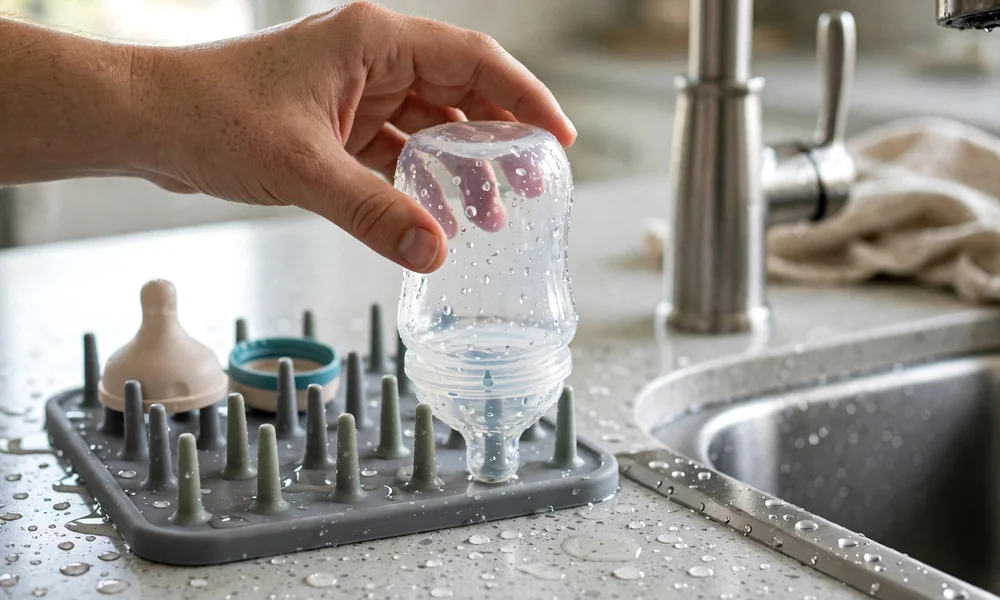
Place bottles upside down on the tallest pegs, nipples upside down on the short pegs, and rings flat on the tray. Keep every part separate and spaced apart so air can move between them, and leave the rack where air flows, away from the wall. Most bottles dry in one to two hours; in a damp kitchen, leave them overnight. If you sterilise as well, use a baby bottle steriliser after the wash, because steam on a wet bottle leaves water sitting in the base.
Checklist: Choosing a Baby Bottle Drying Rack
- Count your daily bottles, nipples, rings, and pump parts, and buy a rack that holds them all at once.
- Check peg spacing: bottles must not touch, or moisture gets trapped between them.
- Make sure the drip tray lifts off, holds a full load of water, and is easy to empty and wash.
- Test stability: the rack must stay put when loaded unevenly and when a bottle is lifted off.
- Choose a material you can wash weekly, and check the rack comes apart for cleaning.
- Measure your counter first, and pick a rack that fits beside the sink without crowding it.

Frequently Asked Questions
How long do baby bottles take to dry on a rack?
Most bottles dry in one to two hours on a rack with good airflow, and nipples and rings dry faster. In a cold or damp kitchen, leave them overnight. If a bottle is still wet after a full night, the pegs are too close together or the rack is against a wall.
Can I put a drying rack in the dishwasher?
Most plastic racks are dishwasher-safe on the top rack, but check the maker first, because heat can warp thin trays. Wash the tray by hand once a week even if the rack goes in the dishwasher, because the tray collects the most residue.
Do I need a drying rack if I use a steriliser?
Yes, for most families. A steriliser finishes the job with steam, but it does not dry bottles for storage, and bottles left wet in a steriliser go stale. Wash, dry on the rack, and sterilise when you need to.
How often should I clean the drying rack itself?
Once a week at least. Take it apart, wash the pegs, stem, and tray in hot soapy water, rinse well, and let it dry fully. If you see a white film or a sour smell on the tray, clean it at once.
What size drying rack do I need?
Count the bottles you wash in one batch and add the nipples, rings, and pump parts. Buy for your busiest day, not your quietest, because a rack that is too small leaves bottles on the counter.
Are tree racks or flat racks better?
Neither is better in every kitchen. Tree racks take up the least counter space and suit four to six bottles. Flat racks hold more bottles but need a wide run of counter. If space is tight, buy a tree rack; if you wash eight bottles at once, buy a flat board.
Bottom Line
The best baby bottle drying rack is the one that holds your whole day of bottles upside down, spaced so air can reach every part, with a tray that catches the water and lifts off for washing. For most families that means a tree rack for four to six bottles, or a flat peg board for a bigger daily load. Buy for your busiest day, keep the pegs spaced, and clean the rack weekly. Do that, and the wash stays done, the bottles stop smelling, and every feed starts clean.