
Top Bar Carts for Small-Space Entertaining in 2026
A bar cart is the easiest way to give a small home a proper drinks station without giving up a whole room to it. A bar cart holds the bottles, glasses and tools you actually use, rolls out when guests arrive and tucks back against the wall when the evening ends. In a flat or a small house that flexibility matters more than size, and the best carts prove that a well-chosen piece of furniture can make entertaining feel effortless rather than cramped. This guide covers the styles worth buying in 2026 and how to make one work in a tight space.
Key Takeaways
- The best bar carts for small spaces are narrow, on lockable wheels, and sized to fit a specific wall or corner rather than a vague idea of one.
- Two tiers are the sweet spot: one for bottles and tools, one for glasses and spares, with the top kept clear enough to mix a drink.
- Glass shelves look light and open up a small room, while wood shelves hide clutter and suit a warmer, more traditional interior.
- Measure the route the cart will travel as well as its parking spot, because a cart that cannot pass the dining table is just a side table.
- Stock a cart for the drinks you actually make, not the ones you imagine making, and keep the guest list of bottles to a short, useful set.
Why a Bar Cart Works in a Small Home
A built-in home bar is a luxury most small homes cannot afford, in space or in money. A bar cart solves the same problem with a fraction of the footprint. It gathers everything for drinks into one mobile station, so there is no more hunting through kitchen cupboards for the shaker while guests wait with empty glasses. When the evening is over it rolls back to its corner, and the room returns to normal.
There is a social point too. A cart changes how a room is used. Instead of guests crowding into the kitchen while the host mixes drinks, the cart brings the drinks to the living room, where people already are. That matters most in a small home, where the kitchen is often barely big enough for one cook.
The Main Types of Bar Carts
Bar carts come in a handful of styles, and the right one depends on your room, your taste and how much you need it to hold.
Brass and Glass Carts
Brass and glass carts are the classic choice, and they suit small rooms particularly well. The glass shelves let light through, so the cart looks lighter than its footprint, and the brass frame adds warmth without visual weight. They suit modern and mid-century interiors and show off good bottles beautifully. The trade-off is maintenance: glass shows fingerprints and water rings, and a brass finish needs an occasional polish to stay bright.
Wooden Carts
Wooden carts suit warmer, more traditional rooms and hide clutter better than glass. A walnut or oak cart with solid shelves reads as furniture rather than a drinks trolley, which helps in a living room where the cart is on display all day. Wood shelves also forgive the odd ring mark and give glasses a more stable footing. They are usually heavier than metal and glass carts, so check the wheels are sturdy and lockable.
Metal and Industrial Carts
Black metal carts with a simple frame suit industrial and contemporary interiors and are often the most practical choice. They are tough, easy to wipe clean, and usually the most affordable. Many have a rail around the top tier that stops bottles sliding when the cart moves, which is a detail worth having. They can look stark in a soft, traditional room, so soften them with a plant or a linen napkin.
Compact and Folding Carts
Compact carts are designed for the smallest spaces: narrower than a standard cart, sometimes with a single tier and a folding shelf that extends when needed. Some fold flat for storage between parties. They hold less, so they suit households that keep a short bottle list, but they fit where a full-size cart never could, including a hallway nook or the end of a kitchen counter. If your flat is genuinely tiny, start here.
Bar Carts Compared
| Type | Best For | Looks Lightest | Maintenance | Small Spaces |
|---|---|---|---|---|
| Brass and glass | Classic and mid-century rooms | Excellent | Regular wiping | Very good |
| Wooden | Warm, traditional rooms | Moderate | Low | Good |
| Metal and industrial | Modern rooms, heavy use | Good | Very low | Very good |
| Compact and folding | Tiny flats, occasional use | Excellent | Low | Excellent |
If the room is small and light matters most, brass and glass or a compact cart wins. If the cart will be a permanent piece of living room furniture, wood earns its place. If it will be rolled around every weekend, a sturdy metal cart is the practical pick.
How to Choose the Right Bar Cart
Measure twice, and measure the right things. Measure the wall or corner where the cart will live, and then measure the route it will travel: the gap between the sofa and the dining table, the doorway it must pass, and the turning circle at the end. A cart that fits its parking spot but cannot reach the guests is no use. As a rough guide, a width of sixty to seventy-five centimetres suits most small rooms, and anything deeper than forty-five centimetres starts to crowd a walkway.
Wheels decide whether a cart is genuinely mobile or just furniture with decoration. Look for smooth-rolling castors that lock, ideally two locking and two free, so the cart stays put on a slope or a rug and moves easily on hard floors. Check the weight rating too, since a cart loaded with full bottles and glassware is heavier than it looks, and flimsy wheels are the first thing to fail.
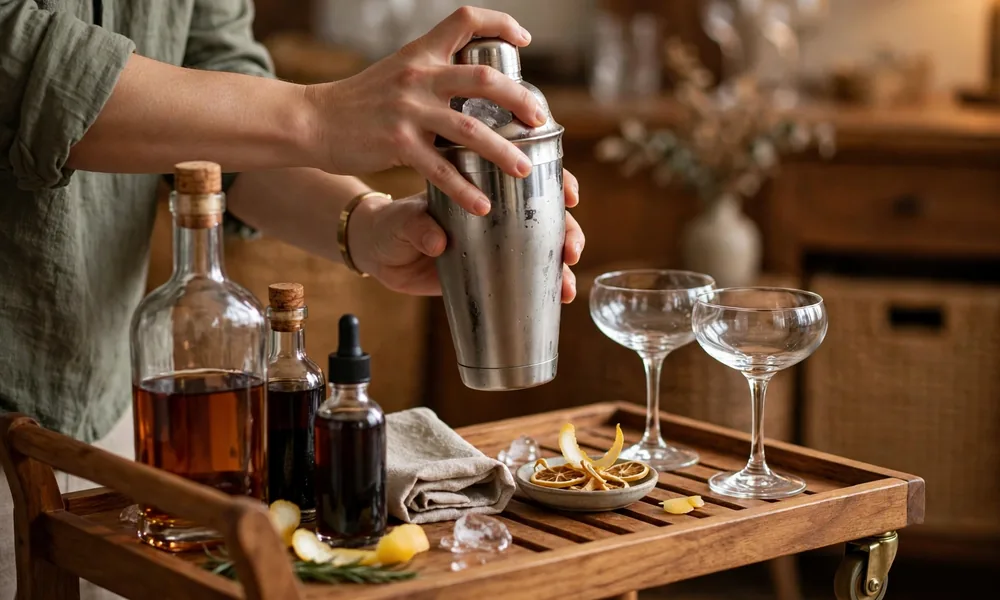
Shelving shapes how the cart is used. A raised rail around the top tier stops bottles sliding, a lower tier with a higher clearance holds tall bottles, and a hanging rail or hook underneath can hold stemware if the design allows it. Avoid carts with a top shelf so crowded with decoration that there is nowhere to set down a shaker. The tools matter as well: a cocktail shaker for a home bar is the one tool every cart needs, and it should live on the top tier within easy reach.
Styling a Bar Cart Without the Clutter
A bar cart looks its best when it is stocked like a working bar and styled like a piece of furniture. Keep the top tier for the essentials: two or three bottles you actually use, the shaker, a jigger and a small bowl of citrus. The lower tier holds the wine glasses, the spare bottles and the less-used tools. Leave some empty space on every shelf, because a cart packed edge to edge looks like a storage shelf, not a bar.
A few finishing touches make the difference. A small plant softens the metal and glass, a folded linen napkin adds texture, and a single framed print or a small vase on the lower tier gives the cart personality. Keep the glasses clean and the bottles wiped, because a dusty cart is worse than no cart at all.

Stocking a Small Bar Cart
Small carts force good decisions, and a short bottle list is a virtue. A useful core is a gin, a vodka or white rum, a whisky and a vermouth, plus a couple of mixers and bitters. That set covers most classic cocktails without filling the cart. Add one bottle that is purely for you, whatever you love drinking, and one bottle for guests who do not drink alcohol, because a good cart serves everyone at the party.
Buy smaller bottles if you entertain rarely. A full-size bottle of something you open twice a year wastes space and goes stale; a half bottle stays fresh and leaves room for something else. Keep syrups and mixers in small bottles too, and store the bulk spares in a kitchen cupboard rather than on the cart. The cart is the stage, not the warehouse. For the bigger picture of what a home bar needs, a home bar essentials guide helps you decide what earns a place on the cart and what stays in the cupboard.
Where to Put a Bar Cart
The best spot is usually the corner of the living room nearest the seating, where the host can reach it without crossing the room and guests can help themselves. A wall beside the sofa, the end of a sideboard, or the space beside a dining table all work. Avoid blocking a walkway or a radiator, and keep the cart away from direct sun, which fades labels and warms spirits. If the living room has no free corner, a hallway nook or the end of a kitchen island can work, as long as the cart can roll to the guests.
Checklist: Buying a Bar Cart
- Measure the parking spot and the route the cart will travel.
- Choose two tiers as the default, with a raised rail on top and room for tall bottles below.
- Check the wheels: smooth-rolling castors, at least two lockable, rated for a fully loaded cart.
- Match the style to the room: glass for light, wood for warmth, metal for hard use.
- Stock for the drinks you actually make, with a short core list and one good non-alcoholic option.
- Leave breathing room on every shelf and keep the top tier clear enough to mix a drink.
Frequently Asked Questions
What size bar cart is best for a small apartment?
Most small apartments suit a cart sixty to seventy-five centimetres wide and no more than forty-five centimetres deep. That holds a useful set of bottles and glasses without blocking a walkway. Measure your space and route before ordering.
Do bar carts need lockable wheels?
Yes, ideally. Lockable wheels stop the cart drifting on hard floors or slopes, which matters when it is loaded with glass bottles. Two locking castors and two free ones are the usual setup, and they also make the cart safer around children and pets.
What should I put on a bar cart?
Keep the top tier for what you use every time: two or three core bottles, a shaker, a jigger and citrus. The lower tier holds glasses, spare bottles and tools. Leave empty space on every shelf so the cart looks styled rather than stuffed.
Can a bar cart work in a kitchen?
Yes, and it often works better there than in the living room if the kitchen is where you entertain. Tuck it at the end of a counter or in a corner, keep it clear of the cooker and the sink splash zone, and make sure it can roll out to the dining area when guests arrive.
How do I stop a glass bar cart looking messy?
Limit the bottles to a short list, group items in small clusters, and leave a third of each shelf empty. Wipe the glass weekly, keep labels facing forward, and remove anything that has not been used in a month. A small plant or a linen napkin softens the look.
Is a bar cart better than a bar cabinet?
For a small home, usually yes. A cart rolls to the guests, takes up less space, and costs less than a cabinet. A cabinet suits a larger room where the bar is a permanent feature and you want to hide everything behind doors. In a flat, the cart wins on flexibility.
The Bottom Line
A bar cart is a small piece of furniture that changes how a small home entertains. Choose one that fits your actual space and your actual drinks, with lockable wheels and two well-planned tiers, and stock it for the cocktails you really make. Keep it tidy, keep it mobile, and it will earn its corner.


