Best Bath Thermometers for a Perfectly Warm Soak in 2026
The best bath thermometers in 2026 take the guesswork out of the water. Dip your elbow in and you might call it warm; a thermometer tells you it is 38 degrees. That number matters most when a baby is going in the tub, because feel alone is a poor judge of water only a few degrees too hot. A good bath thermometer reads quickly and is easy to read with wet hands.
This guide covers the bath thermometers worth buying in 2026: floating digital models, classic glass tube thermometers, duck-shaped thermometers for the nursery, and infrared models. Accuracy, readability, and safety matter far more than brand names.
Key Takeaways
- Aim for 37 to 38 degrees Celsius (98 to 100 degrees Fahrenheit) for a baby bath, never above 38 degrees.
- Floating digital thermometers are the easiest to read at a glance, because the display sits on the surface of the water.
- Classic glass tube thermometers are cheap, need no batteries, and are accurate enough for an adult soak.
- Always test the water in the middle of the tub, not at the tap end where hot water pools.
- Stir the water before you read it, and re-check after adding cold water.
Bath Thermometers 2026 at a Glance
| Best for | Thermometer type | Standout strength |
|---|---|---|
| Best overall | Floating digital thermometer | Large display you can read from across the bathroom |
| Best for babies | Duck-shaped floating thermometer | Colour change warns you the water is too hot |
| Best on a budget | Classic glass tube thermometer | No batteries, nothing to break, costs very little |
| Best for adults | Digital stick thermometer | Fast precise reading for a long hot soak |
| Best no-touch option | Infrared bath thermometer | Reads the surface in a second without dipping in |
What a Bath Thermometer Actually Measures
A bath thermometer measures the temperature of the water, not the person in it. Your hand adapts to heat within seconds, so water that felt scalding at first touch can feel comfortable a moment later, even though it has not cooled. A thermometer gives you the same number every time, and that number keeps a bath safe.
Most adults enjoy a bath between 38 and 40 degrees. For babies, the range is narrow: a baby bath should be about 37 degrees, roughly body temperature, and never above 38 degrees. A baby cannot tell you the water is too hot, and a baby’s skin scalds faster than an adult’s.
A bath thermometer is not a body thermometer, and the two should never be swapped. Our guide to the best baby thermometers of 2026 covers forehead, ear, and rectal readings for fever checks, a different job: measuring a child’s temperature to decide whether to call a doctor. A bath thermometer measures water, so keep it in the bathroom, not the medicine cabinet.
The Main Types of Bath Thermometer
Every bath thermometer falls into one of four families, and the differences decide how fast you get a reading and how easy it is to read.
Floating digital thermometers
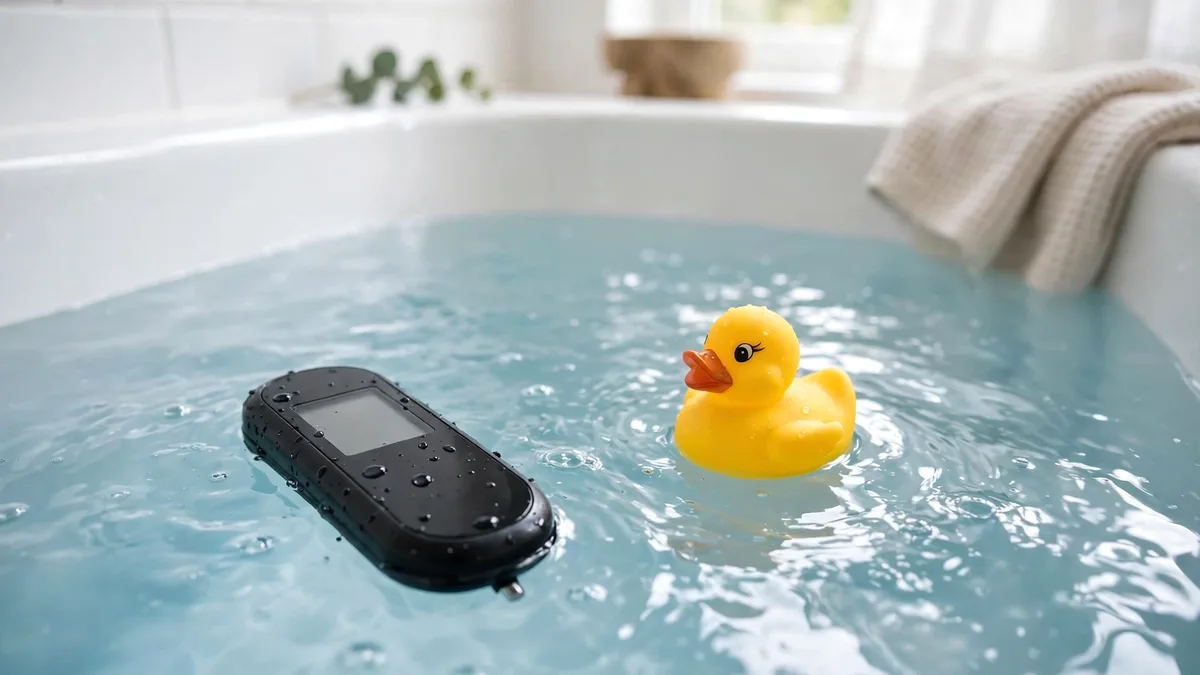
A floating digital thermometer is a sealed plastic unit that bobs on the surface with its display facing up. It is the most popular type, because you can read it without picking it up or drying your hands. Most models show the temperature in large digits, beep or change colour when the water is too hot, and switch themselves off after a few minutes. The trade-off is batteries: a sealed unit usually takes a small button cell.
Classic glass tube thermometers
The classic glass tube thermometer is a slim case with a coloured liquid column inside, the kind that has sat on bathroom shelves for decades. It needs no batteries and costs very little. You drop it in the water, wait a minute, and read the column against the printed scale. The trade-off is readability: the numbers are small and the column is thin, so in dim light you may need to lift it out to read it.

Duck-shaped floating thermometers
A duck-shaped floating thermometer is a thermometer built into a rubber-duck body, made for baby baths. The duck floats where you can see it, the baby treats it as a bath toy, and many models change colour when the water passes 39 degrees. That colour change is genuinely useful when you are holding a wriggling baby with one hand and running the taps with the other. The trade-off is precision: most read to the nearest degree, and the chunky body reacts slowly.
Infrared bath thermometers
An infrared thermometer reads the water’s surface without touching it: point, press, and a number appears in about a second. It suits people who want a quick check before stepping in. The trade-off is that it reads the surface only: hot water rises, so the surface can read a degree warmer than the bottom, and steam can throw off a cheap sensor. Stir first, point at the middle, and treat the reading as a guide.
What to Look for Before You Buy
Accuracy comes first. A thermometer that reads two degrees low is worse than none at all, because it tells you the water is safe when it is not. Good digital models claim plus or minus 0.5 degrees. Test a new thermometer against one you trust before the first baby bath, and send it back if it reads more than a degree out.
Readability comes second: a thermometer you cannot read is decoration. The display should be large enough to read from a metre away, and the unit should float display-up rather than rolling over. A display that turns red above 39 degrees is easier to notice than a small number when you are tired and wet.
Safety matters most with babies. The thermometer should be BPA-free plastic, with no small parts that can come loose and no glass that can shatter in the tub. Rinse it after every bath and let it dry, because a damp thermometer grows mildew within a week. A sealed floating model should be fully waterproof, not merely splash-proof: if it fogs inside, the seal has failed and the reading will drift.
A thermometer that lives on the side of the tub gets used; one that lives in a drawer does not. Look for a hanging loop or a suction hook, and a shape that sits flat on the rim without rolling off. A bath pillow makes the soak comfortable, and a thermometer on the rim beside it makes the soak safe.

The Best Bath Thermometers of 2026
The best all-round bath thermometer is a floating digital model with a large display and a hot-water alarm. It floats in the middle of the tub, reads in seconds, and the alarm means you do not have to watch the numbers while filling the bath. Look for a display at least two centimetres high and an alarm above 39 degrees.
The best bath thermometer for a baby is a duck-shaped floating model with a colour-change warning. The duck is easy to spot, the baby cannot hurt themselves on it, and the colour change is visible from across the room. Choose one with a printed scale as well as the colour change.
The best budget bath thermometer is a plastic-cased glass tube model. It costs very little, needs no batteries, and reads accurately enough for an adult soak. Give it a full minute in the water, and hold it up to the light to read the column.
The best bath thermometer for a long hot soak is a digital stick thermometer. It reads to a tenth of a degree in seconds and checks the water at different depths, which matters when the surface is hot and the bottom is cool. It does not float, so you hold it, read it, and put it down again.
The best no-touch bath thermometer is an infrared model with a clear display and one-button operation. Point it at the middle of the stirred water, take two readings, and use the average. Do not rely on it alone for a baby bath: confirm a borderline reading with a floating thermometer first. Our guide to the shower filters that soften hard water in 2026 covers filters that tackle chlorine and hardness before the water reaches you.
How to Use a Bath Thermometer Properly
Run the bath, stir the water, and put the thermometer in the middle of the tub, away from the taps. Hot water pools at the tap end and cold water sinks, so a reading at the wrong end can be several degrees out. A digital model settles in seconds, a glass tube takes about a minute, and a chunky duck thermometer can take two minutes.
For a baby bath, fill the tub with cold water first, then add hot water, stirring as you go. Check with the thermometer, then with the inside of your wrist, which is more sensitive than your fingertips. If the thermometer says 37 degrees and your wrist says hot, trust your wrist and add cold water. Re-check if the bath sits a while: a full tub loses about a degree every ten minutes, and topping up creates a hot layer on top, so stir and re-check.

Mistakes to Avoid
The most common mistake is trusting your elbow alone: hands adapt to heat quickly, and water that feels fine after a few seconds can still scald a baby. Use the thermometer every time. The second mistake is reading it at the tap end, where the water is hottest. Stir first and read in the middle. The third mistake is leaving the thermometer in the tub between baths: standing water breeds mildew, and a damp thermometer will fog and read wrong. Rinse it and hang it on a hook.
Your Bath Thermometer Checklist
- Check the stated accuracy is within half a degree before you buy.
- Choose a display you can read from a metre away with wet hands.
- Pick a floating model that sits display-up and cannot roll over.
- Make sure it is fully waterproof and BPA-free.
- Stir the water and read in the middle of the tub, not at the tap end.
- Rinse and dry the thermometer after every bath so it stays accurate.
Frequently Asked Questions
What temperature should a baby bath be?
About 37 degrees Celsius (98.6 degrees Fahrenheit), never above 38 degrees. Test in the middle of the stirred water, then double-check with the inside of your wrist.
What temperature should an adult bath be?
Most adults enjoy 38 to 40 degrees. Above 40 degrees the water can make you feel dizzy, so keep it at 40 or below and get out if you feel light-headed.
Are floating bath thermometers accurate?
Good ones are accurate to within half a degree. Cheap ones can read a degree or two out, so test a new one against a trusted thermometer before the first baby bath.
Can I use a bath thermometer for a baby bath?
Yes, that is its main job. Duck-shaped thermometers are made for baby baths, but any accurate floating digital thermometer works just as well.
How long does a bath thermometer take to read?
A digital model takes a few seconds, a glass tube takes about a minute, and a duck thermometer can take up to two minutes to settle.
Do I still need to test the water by hand?
Yes. Use the thermometer first, then check with the inside of your wrist. If they disagree, trust your wrist and add cold water.
The Bottom Line
The best bath thermometer for most homes in 2026 is a floating digital model with a large display and a hot-water alarm: fast, readable, and hard to get wrong. For a baby bath, a duck-shaped floating thermometer with a colour-change warning is the friendliest choice, and for a tight budget a plastic-cased glass tube thermometer does the job for very little. Stir the water, read in the middle of the tub, and double-check with your wrist.