Best Bathroom Vanities for Small Bathrooms in 2026
The best bathroom vanities for small bathrooms in 2026 prove that a tight floor plan does not have to mean a cramped, cluttered sink area. A well-chosen vanity does three jobs at once: it holds the sink, it hides the everyday mess, and it leaves enough floor visible that the room still feels open. The vanities below were picked for real small bathrooms, not showroom-sized ones, and every one of them earns its footprint.
Key Takeaways
- Measure the wall, the door swing, and the plumbing position first: a cabinet two inches too wide costs a return and a weekend.
- A 24-inch or 30-inch vanity is the sweet spot, and a floating design makes the floor look bigger.
- Drawers beat doors: a deep drawer keeps bottles upright and visible instead of lost at the back.
- A quartz or solid-surface top with an undermount sink is easier to wipe and frees up counter space.
- Check the sink against the mirror and light before ordering: standing off-centre annoys you every morning.
Why Small Bathrooms Punish the Wrong Vanity
A small bathroom forgives almost nothing. In a large room, a vanity that is a little too deep just sits there; in a small one, the same cabinet blocks the door, crowds the toilet, or turns the walk to the shower into a sideways shuffle. A vanity is a cabinet, a countertop, and a basin working as one unit. A big furniture-style vanity looks grand in a catalogue and then eats the only clear wall in the room. The right choice sits between those extremes. Check the drain position before ordering, since moving plumbing means opening a wall.
How We Judged These Vanities
We judged every vanity the way a household actually uses one: two people sharing a bathroom at 7 a.m., a child reaching for a toothbrush, and a guest who needs to find the spare towels without opening every drawer. Then came storage, build quality, the countertop, and how easy the sink is to clean.
| Vanity | Best for | Width | Storage | Countertop |
|---|---|---|---|---|
| Compact 24-inch single vanity | Tiny cloakrooms and ensuites | 24 in | Two doors, one shelf | Quartz |
| 30-inch floating vanity | Most small bathrooms | 30 in | Two deep drawers | Solid surface |
| 36-inch double-drawer vanity | Shared bathrooms | 36 in | Four drawers | Quartz |
| Corner vanity unit | Awkward layouts | 24 in | One door, shelving | Ceramic |
| Freestanding furniture vanity | Classic style, larger small rooms | 30 in | Doors and drawers | Marble-look |
The Best Bathroom Vanities for Small Bathrooms in 2026
1. The compact 24-inch single vanity
This is the vanity for the bathroom that barely fits a person, let alone furniture. At 24 inches wide it slides onto the narrow wall beside the door or into the alcove that nothing else fits, and its shallow cabinet leaves a usable walkway. The single undermount sink keeps the countertop clear, and the quartz top wipes clean in seconds. Storage is modest, so it suits one person or a guest bathroom rather than a family of four.
2. The 30-inch floating vanity
The floating vanity is the small bathroom’s best friend, and the 30-inch version is the one most homes should buy. It hangs on the wall, so the floor runs underneath it and the room instantly looks bigger, and cleaning the floor becomes a two-minute job instead of a negotiation with cabinet legs. Two deep drawers slide out fully so nothing hides at the back. The solid-surface countertop has the sink moulded in, so there is no rim to trap grime.
3. The 36-inch double-drawer vanity
For a shared bathroom, 36 inches is the smallest width that genuinely works for two people, and this design uses every inch of it. Four drawers, two per side, mean each person gets their own space and the morning argument about whose bottles are whose quietly disappears. The quartz top gives a landing strip each side of the sink.
4. The corner vanity unit
Some small bathrooms have a corner that nothing else can use: the door opens one way, the toilet sits on the other wall, and the only free space is the corner by the window. That is where a corner vanity earns its keep. It tucks into the angle, the basin sits diagonally, and the cabinet underneath uses space that would otherwise hold a plant or nothing at all. It turns dead space into a working sink.
5. The freestanding furniture vanity
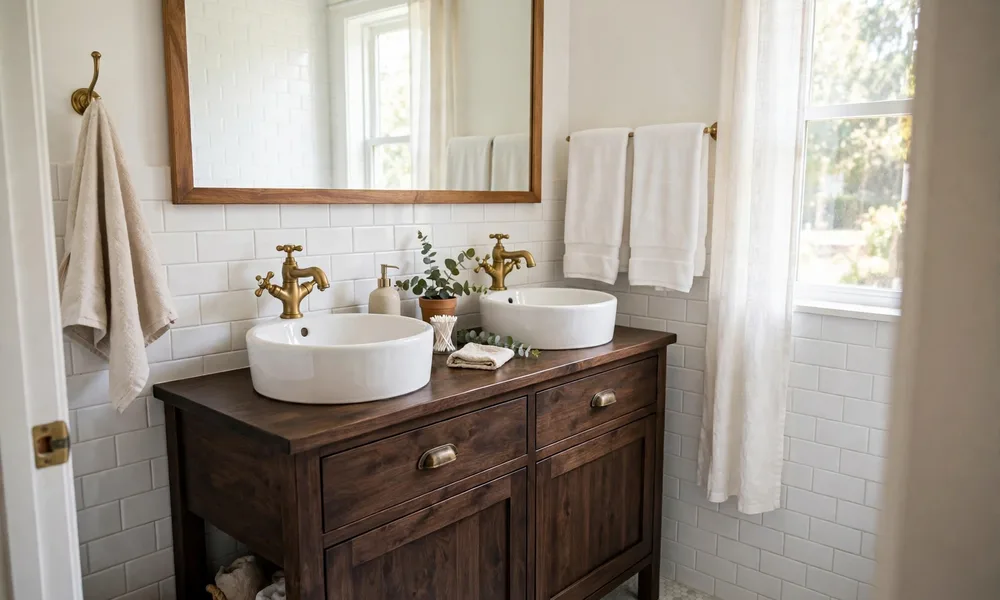
Not every small bathroom wants to look modern, and this is the vanity for the ones that do not. It looks like a small chest of drawers, with legs, panelled doors, and a marble-look top, and it brings warmth to a room that would otherwise be all tile and chrome. The 30-inch width fits most small bathrooms, and the mix of doors and drawers gives flexible storage for towels below and toiletries above. For a period home, it is the vanity that looks like it belongs there.
Sizes That Actually Fit a Small Bathroom
Vanity widths are measured in inches, and the jump from one size to the next is bigger than it sounds. 24 inches suits a cloakroom, 30 inches is the all-rounder, and 36 inches works for couples if the room has 60 inches of clear wall. Depth matters just as much: standard vanities run 18 to 21 inches deep, and in a narrow bathroom the shallower end keeps the walkway clear. Measure the gap to the toilet and the door swing, then subtract a 24-inch walkway; what is left is your real maximum.

Height is the measurement people forget entirely. Standard vanities sit around 32 to 34 inches high, which suits most adults, but a household with tall people or with children will notice the difference every day. The mirror height follows the vanity: hang the mirror so its centre sits at eye level for the tallest regular user, and leave a gap of a few inches between the top of the backsplash and the bottom of the mirror so the room does not feel cramped.
Storage That Works Instead of Storage That Hides
The difference between a vanity that stays tidy and one that becomes a junk cupboard is not how much storage it has, but how that storage is shaped. Doors hide things, and hidden things get forgotten, so a cabinet with one big cupboard and no shelves becomes a pile within a month. Drawers, by contrast, keep everything visible in a single layer, and a drawer with dividers is worth more than a cupboard twice its size. Check the drawers extend fully and close softly.
Inside the cabinet, a few cheap additions make more difference than the cabinet itself. A pull-out tray under the sink keeps cleaning products upright and reachable. Small boxes or drawer dividers stop bottles from sliding into a heap every time a drawer closes. The best bathroom sinks guide is worth reading alongside this one, because the sink you choose decides how much counter space you actually keep. The right bathroom sink paired with the right vanity is what makes the whole setup work, not either piece on its own.
Materials and Countertops: What Lasts in Steam
A bathroom is a wet room, and vanity materials live in steam every day. Solid wood looks beautiful and copes well if it is properly sealed, but unsealed edges around the sink will swell and darken within a year. Moisture-resistant MDF is the workhorse of most mid-priced vanities: it stays flat, takes paint well, and costs far less than solid timber, provided the edges are sealed. Whatever the cabinet is made of, look at the feet and the bottom edge, because that is where water damage starts, and a vanity that stands on legs or hangs on the wall will outlast one that sits flat on a wet floor.
Countertops follow the same logic. Quartz is the easiest to live with: it does not stain, it does not need sealing, and it handles hot hair tools without complaint. Solid surface is nearly as tough and can be repaired if it scratches, which makes it a good choice for a family bathroom. Ceramic tops with an integrated sink are the budget champion: one moulded piece, no joints, and a wipe-down that takes seconds. Choose the mirror to match: a good bathroom mirror at the right height makes a small bathroom feel twice as big, and the vanity and mirror should be chosen together, not one after the other.
Installation: What to Check Before You Order
Most vanities arrive flat-packed or partly assembled, and the gap between those two things is a whole Saturday. A fully assembled vanity is square and ready to connect; a flat-pack is cheaper but needs its drawers adjusted and joints sealed. Plumbing is the other half of the installation: turn off the water, check the waste pipe lines up with the new drain, and budget for a plumber if it does not.
Before You Buy: The Small-Bathroom Vanity Checklist
- Measure the wall, door swing, and gap to the toilet before shopping.
- Check the drain and pipes against the new sink, and budget for a plumber if they do not line up.
- Choose drawers over one big cupboard, and check they extend fully.
- Pick a countertop you can wipe in seconds, quartz or solid surface for a family bathroom.
- Match the mirror and light to the vanity before ordering.
- Leave a clear 24-inch walkway in front of the vanity, even if it means the smaller size.
Frequently Asked Questions
What size vanity is best for a small bathroom?
For most small bathrooms, a 24-inch or 30-inch vanity is the best fit: 24 inches for cloakrooms and single-person ensuites, 30 inches as the all-rounder. Measure your wall and walkway first, and let those numbers choose.
Are floating vanities better for small bathrooms?
Yes, in most cases. A floating vanity leaves the floor visible, which makes the room look bigger, and cleaning underneath is far easier. It needs a solid wall to hang from and usually offers slightly less storage than a floor-standing unit of the same width.
How much should a good small bathroom vanity cost?
A decent small vanity with a solid countertop usually costs a few hundred pounds or dollars, rising for solid wood, quartz tops, and soft-close drawers. For a daily-use family bathroom, spending a little more on the cabinet and runners pays for itself in how long the unit lasts.
Can I fit a double vanity in a small bathroom?
Only if the wall is at least 60 inches wide and the room can still leave a clear walkway. A 48-inch double vanity is not a small-bathroom unit, and squeezing one in usually makes the door or toilet hard to use. A single 36-inch vanity with good drawers is the better compromise.
What countertop material is easiest to keep clean?
Quartz and solid surface are the easiest, because neither needs sealing and both wipe clean with a damp cloth. Ceramic tops with an integrated sink are a close second, since there are no joints for grime to hide in. Marble looks lovely but stains easily.
Do I need a plumber to install a bathroom vanity?
Not always. If the new vanity’s drain lines up with the existing waste pipe, a straightforward swap is a realistic weekend job. If the pipes need moving, the wall needs opening, or the wall needs reinforcing for a wall-hung unit, hire a plumber.
The Bottom Line
The best bathroom vanities for small bathrooms in 2026 are the ones that fit the room you actually have, store what you actually own, and leave the floor clear enough that the room still breathes. Measure first, choose drawers over doors, and buy the size your walkway allows. Do that, and the smallest room in the house becomes one of the easiest to live with. A good set of bathroom organizers will finish the job the vanity started.