Best Bathroom Organizers 2026
A bathroom is the smallest room in most homes and the one that has to hold the most small things. Toothbrushes, creams, medicines, hair tools, cleaning sprays, spare towels and half-used bottles all compete for the same few inches around the sink, and when none of them has a fixed home, the room looks messy ten minutes after you clean it.
Get the organizing right, though, and the whole room calms down: every bottle has a place, the counter stays clear, and you can find what you need without opening three cupboards. These are the best bathroom organizers of 2026, chosen for fit, materials that survive steam, and designs that stay tidy in real daily use.
Key Takeaways
- Measure the space before you buy anything, because an organizer that is a centimetre too wide for a drawer or too tall for a shelf is useless.
- Match the organizer to the thing it holds, since tall bottles, flat palettes and rolled towels all need different shapes of storage.
- Choose materials that cope with steam and splashes, because untreated wood swells, cheap metal rusts and cardboard dividers collapse within weeks.
- Keep daily items within arm’s reach and move the rest out of the way, because a counter crowded with things you use once a month is a counter you cannot clean.
- Leave air gaps around damp items, since towels and sponges stored tight against a wall stay damp, smell musty and wear out faster.
Bathroom Organizers 2026 at a Glance
| Best for | Organizer type | Where it lives | Standout strength |
|---|---|---|---|
| Best overall | Countertop tray and caddy set | Beside the sink | Keeps daily items visible and contained |
| Best for drawers | Bamboo drawer dividers | Inside the vanity drawer | Every small item gets its own slot |
| Best for under the sink | Two-tier sliding rack | Inside the cabinet | Turns dead space around pipes into storage |
| Best for small bathrooms | Over-door hanging organizer | On the door | Adds storage without using any floor space |
| Best for families | Tiered freestanding shelf unit | Beside the bath or in a corner | Holds towels and toiletries for several people |
| Best for renters | Suction and no-drill caddy | On tiles or glass | Strong hold with nothing to unscrew later |
What a Bathroom Organizer Is Really For
A bathroom organizer does three jobs at once. First, it gives every item a fixed address, so you stop hunting for the same tube every morning. Second, it protects the things it holds from water, steam and knocks, keeping bottles upright and brushes clean. Third, it makes the room easier to clean, because a clear counter wipes down in seconds while a crowded one has to be emptied first.
Most people buy organizers the wrong way round. They fall for a pretty basket, then discover their tallest bottle does not fit, the drawer will not close, or the whole thing slides around every time the door opens. Sort first, measure second, and only then worry about how it looks.
It also helps to know what an organizer is not. A wall shelf is a fixed piece of furniture that holds things in the open, and our guide to the best bathroom shelves of 2026 covers that style in detail. A medicine cabinet is a closed, often mirrored cupboard for medicines and small essentials. An organizer is the smaller system inside and around those fixtures: the trays, dividers, racks and hanging pockets that stop things sliding into a pile.
The Six Types Worth Buying
Countertop trays and caddy sets suit the items you reach for every day. A shallow tray corrals soap, hand cream and a toothbrush cup into one neat rectangle, so the counter looks deliberate instead of cluttered. Choose a tray with a raised edge and a wipe-clean surface, and keep it to the items you genuinely use daily. Anything else belongs in a drawer.
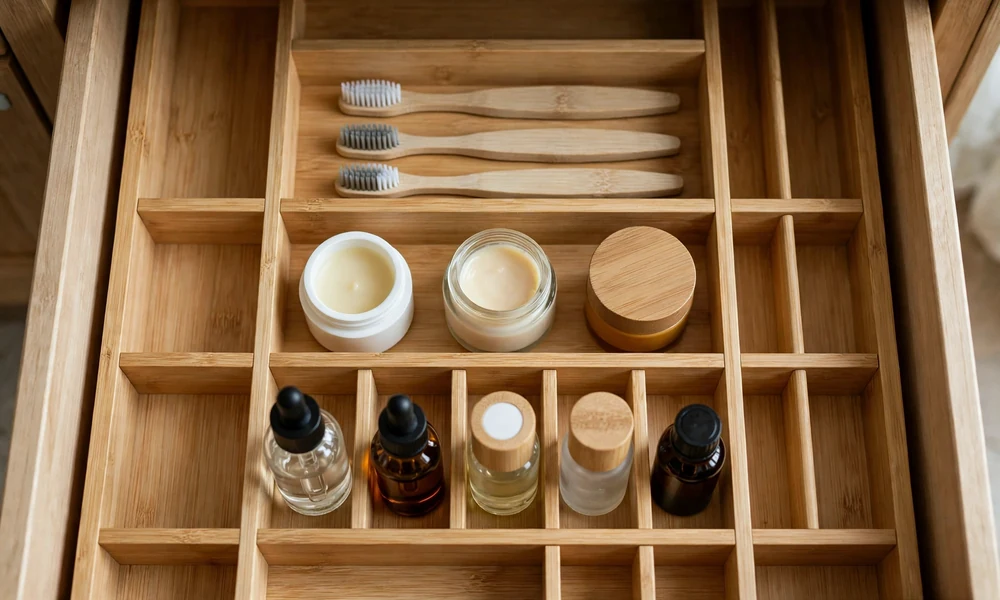
Drawer dividers are the quiet heroes of a tidy bathroom. A bamboo or plastic divider turns one deep drawer into a grid of small compartments, so toothbrushes, cotton pads, tweezers and creams stop migrating into a single jumble. Adjustable dividers are worth the small premium, because drawer sizes vary and a fixed grid rarely fits two bathrooms the same way.
Under-sink racks tackle the hardest space in the room. The area beneath a basin is awkward, full of pipes and usually wasted, but a two-tier sliding rack fits around the plumbing and pulls out like a drawer, so bottles at the back are no longer forgotten. Measure the pipe positions and the door opening before ordering, because a rack that cannot slide past the trap is just an expensive obstacle.
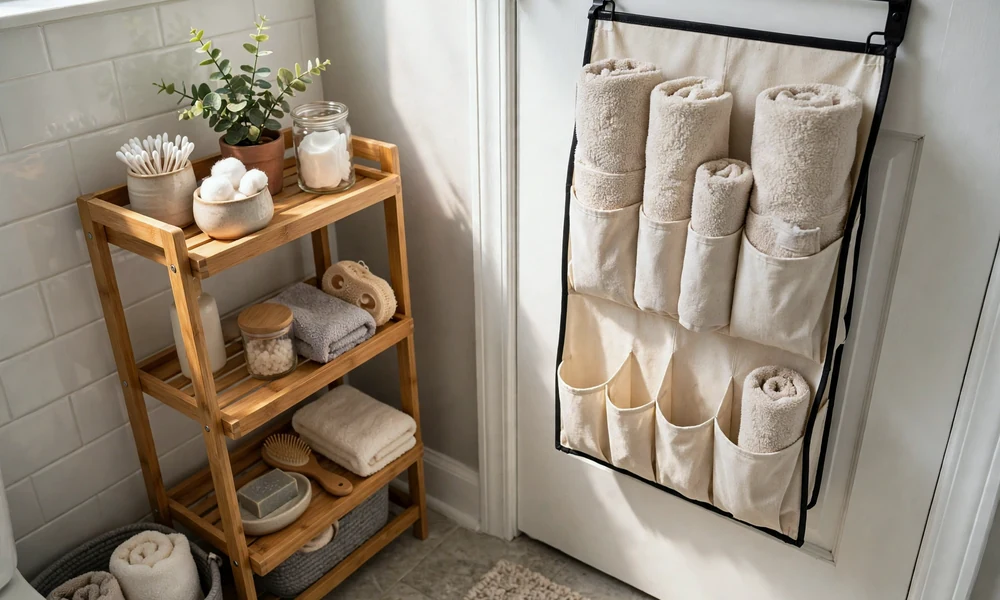
Over-door and over-toilet organizers suit small bathrooms where the floor is already full. A fabric hanging organizer with clear or canvas pockets holds rolled towels, spare toilet paper and hair tools on the back of a door, while a freestanding unit above the toilet uses the dead space over the cistern. Both need a sturdy hook or frame, so check the door thickness and the weight rating before you load them up.
Tiered freestanding units work well for families and shared bathrooms. A three-tier bamboo or metal stand beside the bath holds folded towels on one shelf, toiletries on another and spare rolls below, so each person can see their own things at a glance. Keep the bottom tier for items that do not mind a splash, and the top tier for the things you reach for with wet hands.
Shower caddies and hanging baskets are organizers too, even though they live in the wettest part of the room. A rust-proof caddy that hangs from the shower head or sticks to the tiles keeps shampoo and soap off the bath edge, where bottles fall over and soap dishes go slimy. Our guide to the best shower caddies of 2026 covers the hanging and suction styles that hold up best in small showers.
Measure First, Then Buy
Every organizer failure starts with a measurement that was never taken. Drawers look bigger empty than they are once dividers go in, cabinet doors swing into racks that looked fine in the photograph, and a tray that fits the counter perfectly still fails if the tap handle hits it. Take a tape measure to the drawer, the shelf and the space under the sink, and write the numbers down before you shop.
Organizing the Countertop
The countertop is where a bathroom succeeds or fails, because it is the surface you see every time you walk in. The rule is simple: only daily items live on the counter, and everything on the counter lives inside something. A tray, a cup for toothbrushes and a small lidded jar for cotton pads are usually enough. If the tray is full, something needs to move to a drawer.
Group by routine rather than by product type. Morning items together, evening items together, and shared items in the middle, so nobody has to move three things to reach the one they want. Keep the toothbrush cup away from the tap splash zone, and keep anything in glass away from the edge, where a wet hand can knock it onto a hard floor.

Organizing Drawers and Cabinets
Drawers work best when each one has a single job. One drawer for dental care, one for skincare, one for hair tools, and the rest for spares and medicines, so you open the right drawer first time instead of rummaging through all of them. Label the dividers if you share the bathroom, because a system only one person understands is a system that falls apart in a week.
Medicine and first-aid supplies deserve their own closed home, away from steam and out of the reach of small children. A mirrored cabinet above the sink is the classic answer, and our guide to the best medicine cabinets of 2026 covers the sizes and fittings that hide clutter best. Inside it, small dividers and labelled boxes matter just as much as they do in a drawer, because a jumbled medicine cabinet is where out-of-date packets hide.
Small Bathrooms, Shared Bathrooms
Small bathrooms reward vertical thinking. The wall above the toilet, the back of the door, the inside of a cabinet door and the narrow gap beside the bath are all storage waiting to happen, and organizers designed for those spots add capacity without shrinking the floor. A narrow rolling cart that fits between the toilet and the wall can hold more than a wide basket that blocks the door.
Shared bathrooms need one system per person, not one big shared pile. Give each person a basket, a shelf or a set of pockets, and keep shared items like hand soap and spare towels in a separate, clearly shared spot. Colour coding helps in a family bathroom, and it stops the daily argument about whose shampoo is whose.
Mistakes That Undo Good Organizing
The most common mistake is buying storage before decluttering. An organizer cannot fix a drawer full of expired creams, dried-up nail polish and hotel samples you will never use. Empty the space first, throw away what is out of date or empty, and only then measure what is left. Most bathrooms lose a third of their clutter at this step alone.
Another mistake is choosing looks over cleaning. White fabric baskets, open-weave trays and organizers with dozens of tiny corners look lovely in a photograph and trap dust, hair and dried toothpaste in real life. Pick designs you can wipe, rinse or wash in under a minute, because an organizer you dread cleaning will be a dirty organizer within a month.
How to Choose the Right Set
Start with the worst spot in your bathroom, not the prettiest one. If the counter is the problem, buy the tray set first. If the drawer is the problem, buy the dividers first. If the cabinet under the sink is a black hole, buy the sliding rack first. One good organizer in the worst spot makes more difference than five pretty baskets spread around a room that still has nowhere for the toothpaste.
Buy a set rather than single pieces when you can, because matching trays, dividers and baskets look calmer and usually cost less than buying each one separately. Check that the pieces in a set are genuinely useful rather than decorative extras, and do not pay for a piece you have no space for simply because it came in the box.
Think about who uses the bathroom and how. A single person needs far less storage than a family of four, a household with small children needs lockable or high storage for medicines, and a bathroom used by guests needs a clear, obvious spot for their things. The best organizer is the one that fits the people, not just the room.
The Bottom Line
The best bathroom organizers of 2026 are not the biggest or the most expensive. They are the ones that fit the space you actually have, hold the things you actually own, and survive the steam, splashes and daily use of a real bathroom. Measure first, sort before you buy, and start with the worst spot in the room.
A tidy bathroom is not about owning more storage. It is about giving every bottle, brush and towel a fixed home, and keeping the counter clear enough to clean in seconds. Choose the tray, the dividers and the rack that do that for your bathroom, and the room will stay calm long after the initial tidy-up is forgotten.