The best shower caddies for small bathrooms in 2026 are the ones you stop noticing. They hang in the wettest corner of your home, hold the bottles you reach for half asleep, and either quietly do their job for years or slowly become the rust-streaked, sagging embarrassment you pretend not to see. The difference is not luck. It is material, design, and a handful of details that are easy to miss in a shop and impossible to ignore once the caddy is installed. In a small bathroom, where there is nowhere to hide a bad buy, those details matter even more.
This guide looks at the shower caddies that work in tight spaces: the ones that stay put, drain properly, resist rust, and make a cramped shower feel organised. No single type suits every shower. Smooth glazed tile, textured tile, a glass screen, and a rented flat each point to a different answer. What follows is how to judge a caddy before you buy it, which mounting types suit which shower, and how to keep one clean and rust-free.
Key Takeaways
- A shower caddy is only as good as its mounting, so match it to your wall surface.
- Open wire or slatted shelves drain properly, while solid trays hold puddles that turn soap soft and breed mould.
- Stainless steel, aluminium, and good plastic never rust, while cheap chrome-plated steel starts spotting within weeks.
- A caddy must hold what your household actually uses: two or three tall bottles, a bar of soap, and a razor at minimum.
- In a small bathroom, a tension pole or a hanging caddy uses dead vertical space.
Shower Caddies at a Glance
The trade-off in one place:
| Type | Mounting | Best surface | Capacity | Rust risk | Install | Renter friendly |
|---|---|---|---|---|---|---|
| Hanging caddy | Hook over shower arm | Any shower with an arm | Two shelves, good | Low in stainless steel | Seconds | Yes |
| Tension pole | Pole wedged floor to ceiling | Corner showers | Four shelves, best | Low in stainless steel | Minutes | Yes |
| Suction shelf | Suction cups on tile | Smooth glazed tile | One shelf, small | Low | Seconds | Yes |
| Adhesive caddy | Sticky pads on tile | Flat, clean tile or glass | One or two shelves | Low | Minutes, plus curing time | Mostly |
| Over-door caddy | Hooks over the door | Shower doors and screens | Two shelves, good | Low in stainless steel | Seconds | Yes |
| Freestanding corner unit | Stands on the floor | Walk-in showers | Three shelves, good | Low | None | Yes |

What Makes a Good Shower Caddy
A good shower caddy is judged on four things, and every failure traces back to at least one of them.
Mounting That Holds
A caddy is only as good as the thing keeping it on the wall. Suction cups, tension poles, adhesive pads, and over-the-door hooks all work, but only when matched to the surface. Smooth glazed tile loves suction. Textured tile hates it. A tension pole needs a ceiling it can press against. Adhesive needs a clean, dry, flat surface and a day to cure. Most caddies fail here first, and the failure is dramatic: the whole shelf, bottles and all, crashing down mid-shower. Before buying, check your wall: rough or ridged tile rules out suction, and no ceiling above the shower rules out a tension pole.
Drainage
A shower caddy lives under running water. If its shelves hold puddles, everything on them sits in dirty water. Soap goes soft, bottle labels peel, and the shelf becomes a breeding ground for mould. The best caddies are mostly open wire or slatted, so water falls straight through. The worst are solid trays with no drainage holes, or wire so tightly woven that water pools in the mesh. Look at the shelf from below: if you can see daylight through it, water can get through too.
Rust Resistance
Rust is the slow killer. Cheap chrome-plated steel looks bright in the packet and starts spotting within weeks. Stainless steel, aluminium, and good-quality plastic do not rust at all, and that is worth paying for. Once rust starts on a wire caddy, it spreads along every weld, stains the grout below orange, and weakens the frame until a shelf bends. Check the product description for the actual material, not just the finish: chrome-look and chrome-plated are warnings, not features.
Capacity That Matches Reality
A caddy must hold what your household actually uses: two or three tall bottles, a bar of soap or a loofah, and a razor, at minimum. A caddy designed for one bottle and a sponge is a decoration, not storage. Equally, a caddy so deep that bottles vanish into the back is no help either. The best designs put tall bottles at the back and give the razor its own hook. Count your bottles before you buy: a family of four needs a tension pole with four shelves.
The Best Shower Caddies for Small Bathrooms in 2026
The best caddies share one trait: they were designed by people who seem to have actually used a shower. They hold, they drain, they stay clean, and they disappear into the background of a good morning routine.
Stainless Steel Hanging Caddies
The classic over-the-shower-head hanging caddy remains the best all-rounder for most bathrooms, provided it is made from genuine stainless steel rather than chrome-plated wire. A good one hooks firmly over the shower arm or the riser rail, holds two shelves of bottles plus a soap dish and razor hooks, and lifts off in seconds for cleaning. It uses dead space above the shower head, which is exactly the space a small bathroom wastes. Check the hook grips the arm tightly, and measure first if your shower head is on a long arm or a rail.
Tension Pole Corner Caddies
For a family, or anyone with more than a few bottles, a tension pole is the best answer in a small bathroom. A spring-loaded pole wedges between the floor and the ceiling in the corner of the shower, carrying three or four shelves without a single screw or suction cup. It turns an unused corner into the whole storage system, and it holds far more than any wall-mounted caddy. The catch is the ceiling: the pole needs something solid to press against, and it must be truly vertical. Check the height range before buying, and tighten it properly.
Suction Cup Shelves
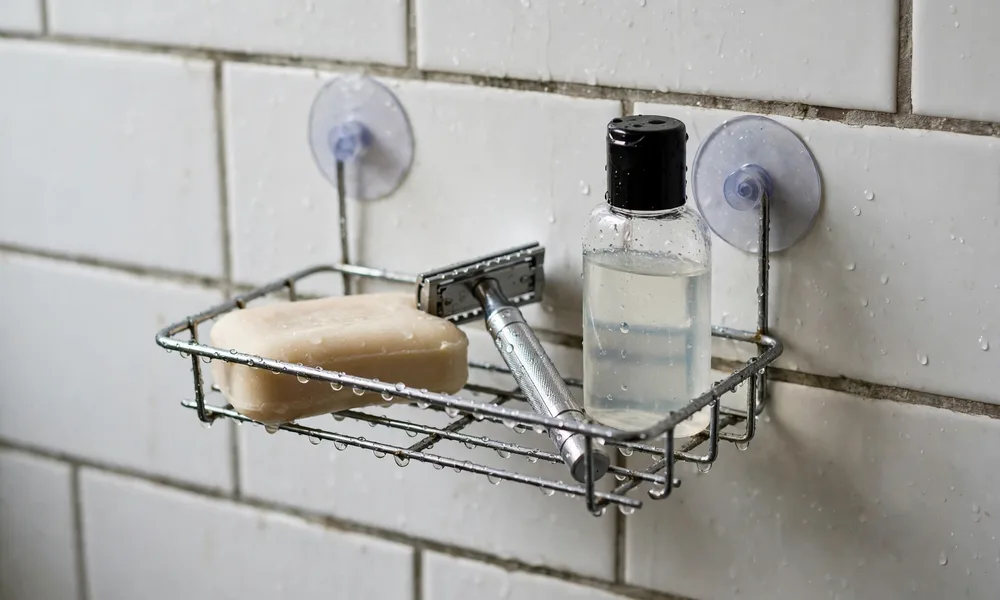
A suction shelf is the simplest caddy there is, and in the right shower it is all you need. Two strong suction cups hold a small wire shelf to smooth glazed tile, keeping one or two bottles and a bar of soap exactly where your hand expects them. It costs little, installs in seconds, and leaves no marks. The catch is the tile: suction only works on smooth, flat, non-porous surfaces. Textured tile, natural stone, and grout lines all break the seal. Test your tile first: press a suction cup to it dry, and if it does not hold firmly, do not buy a suction caddy. For renters with smooth tile, it is the easiest win in the bathroom.
Adhesive Caddies
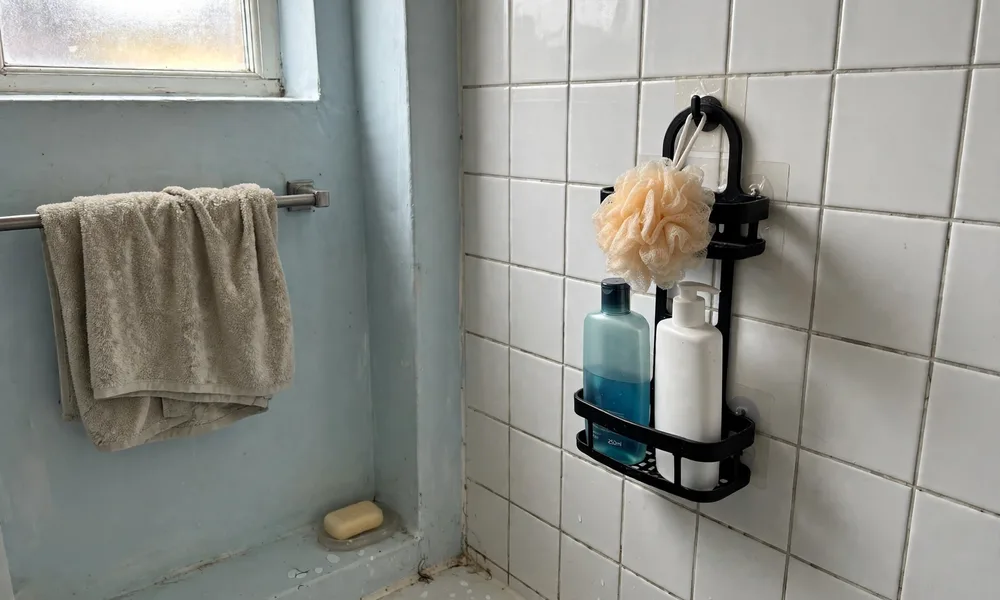
Adhesive caddies stick to the wall with strong pads or a glue strip, and they are the best choice when suction will not hold and there is no ceiling for a tension pole. They sit flat against the tile, hold one or two shelves, and look tidier than a hanging caddy because nothing dangles. The trick is the cure time: clean the tile properly, press the pads on firmly, and leave the caddy empty for a full day before loading it. Load it too soon and the pads will peel away under the weight. They are also the hardest to move, so be sure about the height before you stick it down.
Matching the Caddy to Your Shower
Start with the shower, not the catalogue. A shower over a bath with a fixed head suits a hanging caddy over the arm. A walk-in shower with a corner suits a tension pole. A glass-screened shower with smooth tile suits a suction shelf or an adhesive caddy. Every type in this guide is drill-free. Families need capacity first, so a tension pole wins. Single people need one good shelf, so a hanging caddy or a suction shelf is plenty. If the shower head itself is part of the problem, a better head changes how water hits the caddy too. Our guide to the best shower heads for small bathrooms covers pressure, spray patterns, and heads that work in tight spaces. And if you are comparing the whole field before deciding, the best vs worst shower caddies head-to-head shows what the worst ones get wrong, which is often more useful than another list of good ones.
Keeping a Caddy Clean and Rust-Free
A caddy stays clean if water drains off it and it gets wiped down now and then. Once a week, lift the bottles off and wipe the shelves with a cloth. Check the suction cups or adhesive pads monthly: if a cup is losing grip, clean it and the tile underneath and press it back on. If rust spots appear on a chrome caddy, replace it rather than scrubbing, because rust always comes back. Water that drips off a caddy lands on the floor, and a good mat catches it. The best bath mats for small bathrooms round up the ones that absorb properly and dry fast instead of staying soggy underfoot.
Checklist: Buying a Shower Caddy in 2026
- Check your wall first: smooth tile takes suction, textured tile needs adhesive or a pole.
- Count your bottles honestly, and buy a caddy with room for all of them plus soap and a razor.
- Choose stainless steel, aluminium, or good plastic, and avoid chrome-plated steel.
- Make sure the shelves are open wire or slatted, so water drains straight through.
- Measure the space: the shower arm for a hanging caddy, the ceiling height for a pole.
- Plan to wipe the shelves weekly, and check suction cups or pads once a month.
Frequently Asked Questions
What is the best shower caddy for a small bathroom?
For most small bathrooms, a stainless steel hanging caddy is the best starting point: it uses dead space above the shower head and holds two shelves. For a family, a tension pole corner caddy holds far more.
Do suction cup shower caddies actually work?
Yes, but only on smooth, flat, glazed tile. On textured tile, natural stone, or grout lines the seal fails and the shelf falls. Test your tile with one cup first.
How do I stop my shower caddy from rusting?
Buy stainless steel, aluminium, or good plastic, and avoid chrome-plated steel. Wipe the shelves dry once a week, and keep soap out of puddles. Once rust starts on cheap chrome, replace the caddy.
How much weight can a tension pole caddy hold?
A properly fitted tension pole holds several full bottles per shelf. The key is fitting: it must be truly vertical and wedged firmly against a solid ceiling. A pole only just wedged will creep down over time.
Can I use a shower caddy in a rented flat?
Yes. Every type in this guide is drill-free. Hanging, suction, adhesive, and tension pole caddies all come down without damage, though adhesive pads may need a wipe of the tile when removed.
Where should a shower caddy sit in the shower?
At chest height, within easy reach but out of the direct spray if possible. Bottles last longer when they are not being blasted every morning, and the caddy itself stays cleaner.
The Bottom Line
The best shower caddy for a small bathroom in 2026 is the one that matches your shower: stainless steel, open wire shelves that drain, and a mounting that suits your walls. A hanging caddy suits most people, a tension pole suits families, and a suction or adhesive shelf suits smooth tile. Measure first, buy the material not the finish, and wipe it down weekly. Get those few things right, and the smallest buy in the bathroom is one you never have to think about again.