A shower caddy is one of the smallest things you will ever buy for a bathroom, and one of the most judged. It hangs in the wettest corner of your home, holds the bottles you reach for half asleep, and either quietly does its job for years or slowly becomes the rust-streaked, sagging embarrassment you pretend not to see. The difference between the two is not luck. It is material, design, and a handful of details that are easy to miss in a shop and impossible to ignore once the caddy is installed.
This is a head-to-head comparison. On one side, the best shower caddies of 2026: the ones that stay put, drain properly, resist rust, and make a cramped shower feel organised. On the other side, the worst: the ones that slide down the wall at 6 a.m., trap standing water, stain your tiles orange, and drop a full bottle of shampoo onto your foot. We tested the idea of each type against real bathrooms, real water, and real habits, and the gap between the two sides is wider than the price tags suggest.
What Actually Makes a Shower Caddy Good
Before picking winners and losers, it helps to know what you are judging. A good shower caddy is judged on five things, and every failure in this article traces back to at least one of them.
Mounting that holds. A caddy is only as good as the thing keeping it on the wall. Suction cups, tension poles, adhesive pads, and over-the-door hooks all work, but only when matched to the surface. Smooth glazed tile loves suction. Textured tile hates it. A tension pole needs a ceiling it can press against. Adhesive needs a clean, dry, flat surface and a day to cure. Most caddies fail here first, and the failure is dramatic: the whole shelf, bottles and all, crashing down in the middle of a shower.
Drainage. A shower caddy lives under running water. If its shelves hold puddles, everything sitting on them sits in dirty water. Soap goes soft, bottle labels peel, and the shelf itself becomes a breeding ground for mould. The best caddies are mostly open wire or slatted, so water falls straight through. The worst are solid trays with no drainage holes, or wire so tightly woven that water pools in the mesh.
Rust resistance. Rust is the slow killer. Cheap chrome-plated steel looks bright in the packet and starts spotting within weeks. Stainless steel, aluminium, and good-quality plastic do not rust at all, and that is worth paying for. Once rust starts on a wire caddy, it spreads along every weld, stains the grout below, and eventually weakens the frame until a shelf bends.
Capacity that matches reality. A caddy must hold what your household actually uses: two or three tall bottles, a bar of soap or a loofah, and a razor, at minimum. A caddy designed for one bottle and a sponge is a decoration, not storage. Equally, a caddy so deep that bottles vanish into the back is no help either. The best designs put tall bottles at the back, small items at the front, and give the razor its own hook or slot.
The Best Shower Caddies of 2026
The best caddies share one trait: they were designed by people who seem to have actually used a shower. Nothing about them is clever for its own sake. They hold, they drain, they stay clean, and they disappear into the background of a good morning routine.
Stainless Steel Hanging Caddies
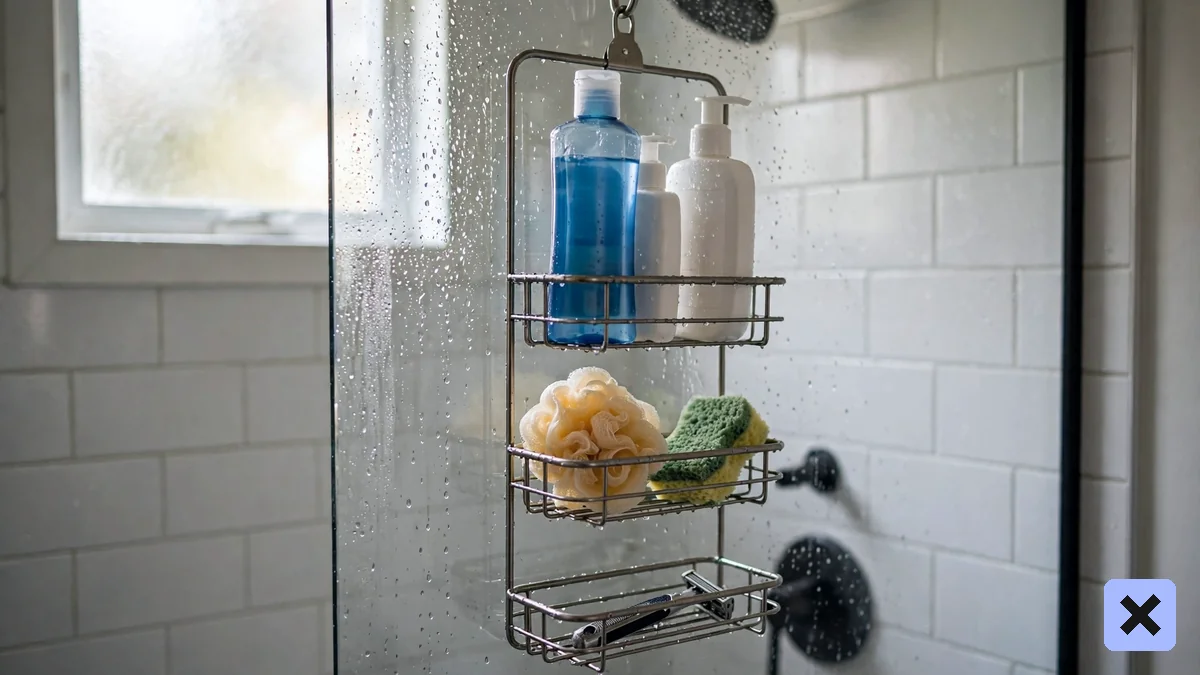
The classic over-the-shower-head hanging caddy remains the best all-rounder for most bathrooms, provided it is made from genuine stainless steel rather than chrome-plated wire. A good one hooks firmly over the shower arm or the glass door, carries two or three generous shelves, and has a bottom rail for a razor and a couple of hooks for a loofah or a washcloth. The open wire shelves drain instantly, the steel does not rust, and the whole thing lifts off for a rinse in the sink whenever it needs one.
Corner Tension Pole Caddies
For households with more bottles than a hanging caddy can hold, the corner tension pole is the best upgrade. A spring-loaded pole wedges between the floor of the shower tray and the ceiling, carrying four shelves up the corner of the shower where nothing else fits. The best versions have adjustable shelf heights, so a tall shampoo bottle and a short jar of face cream can live on different shelves, and each shelf is a wire basket rather than a flat tray, so water never pools.
Suction Cup Corner Baskets
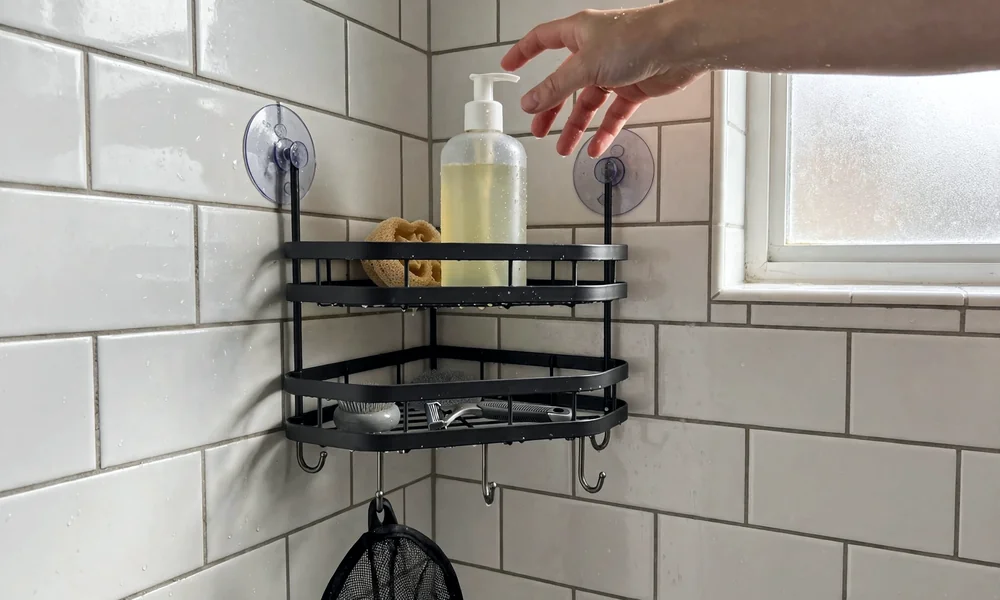
The surprise winner for small showers is the humble suction cup corner basket. Two strong suction cups, one triangular basket, no pole, no hook, no fuss. The best ones use large, lever-locked suction cups that you can see and test, rather than the small push-on cups that fail silently. On smooth glazed tile they hold an impressive amount of weight, and because the basket is small, you are forced to keep only what you actually use in the shower, which is a feature, not a flaw.
The Worst Shower Caddies of 2026
The worst caddies are not always the cheapest. Some of the most disappointing ones cost real money and look wonderful in the packet. What unites them is a design that ignores how showers actually work: constant water, steam, soap, weight, and hands reaching blindly for bottles.
Chrome-Plated Wire Caddies
Chrome-plated steel is the worst material a shower caddy can be made from, and it is also one of the most common, because it looks expensive on a shelf. The thin chrome layer is only a coating. The moment it is scratched, chipped, or worn at a weld, and it will be, water reaches the steel underneath and rust begins. Within a month you will see brown spots at the joints. Within three, the caddy is staining your tiles and the shelves are flaking.
Suction Caddies on Textured Tile
This is less a bad product than a bad pairing, but it causes so many ruined mornings that it earns its place on the worst list. Suction cups need a smooth, non-porous surface to form a seal. Textured tile, stone-effect tile, and matt-finish tile all have microscopic ridges and pores that let air creep under the cup. The cup holds for a day, or a week, and then lets go without warning, usually in the middle of a shower, usually onto a bare foot.

Solid-Tray Caddies With No Drainage
Some caddies look like they were designed for a dry shelf and then moved into a shower by mistake. Solid plastic or bamboo trays with raised lips and no drainage holes collect water every single shower. The water sits, mixed with shampoo drips and soap residue, and turns into a grey, slippery soup. Bars of soap dissolve into mush. Bottle bases sit in a puddle and grow a ring of mould. The tray itself becomes harder and harder to clean, because the standing water leaves a film every time it finally evaporates.
Overloaded Single-Hook Caddies
The last worst offender is the caddy that promises everything from a single point of contact: one hook over the shower head, four shelves, hooks for razors and sponges, and a basket on the side. Physics disagrees. A single hook can hold a certain amount of weight before it starts to slide, tilt, or rotate, and a fully loaded four-shelf caddy exceeds that weight the moment you add a full bottle of conditioner. The result is a caddy that lists to one side, dumps bottles off its lowest shelf, and needs constant straightening.
Best vs Worst: The Head-to-Head
Put the two sides together and the pattern is clear. The best caddies respect water. They are made from materials that do not rust, shaped so water drains away, and fixed to the wall in a way that suits the surface they are fixed to. The worst caddies fight water and lose: chrome coatings that fail, solid trays that hold puddles, suction cups on tile that cannot seal, and hooks that cannot carry the load.
Price is a poor guide. A good stainless hanging caddy and a bad chrome one can cost almost the same amount, and the difference only shows up after a few weeks of daily showers. The real tells are in the listing: “stainless steel” beats “chrome finish” every time, open wire beats solid trays, and a second fixing point, a suction cup, a rubber-lined hook, a tension foot, beats a single hook on its own. If a caddy has none of those tells, it is a gamble, and the stakes are a rust stain on your grout and a shampoo bottle on your toes.
Durability is where the gap becomes a chasm. A good caddy lasts years and looks almost new after a quick rinse. A bad one looks tired in a month and is in the bin within a year, which means you buy it twice and pay more in the end than the good one cost in the first place. The cheapest caddy is often the most expensive one you will ever own.
The Verdict
The verdict is straightforward: buy a stainless steel hanging caddy with a rubber-lined hook and a base suction cup, or a tension pole caddy if your household needs four shelves, or a lever-locked suction corner basket if your shower is small and your tiles are smooth. Spend the small premium for stainless over chrome, check that the shelves are open wire, and match the mounting to your wall. Do that, and your caddy will outlast your shampoo brand loyalty.
Avoid chrome-plated wire, solid trays without drainage, bamboo in the shower, and any caddy that hangs everything from one thin hook. Avoid suction on textured tile. These are not minor flaws. They are the exact failures that turn a useful object into a daily annoyance, and there is no reason to live with them when the good versions cost so little more.

Who Each Side Is For
The best caddies are for anyone who showers every day and wants to stop thinking about where the shampoo is. They suit renters, because the best mounting options need no drilling. They suit families, because a tension pole holds everyone’s bottles in one corner. They suit small bathrooms, because a corner basket uses dead space. And they suit anyone who has ever cleaned a rust stain off grout and sworn never again.
The worst caddies are for nobody, really, though they do suit one narrow case: a guest bathroom that is used twice a year, where a cheap caddy will never face enough water to fail. Even there, a good suction basket costs little more and will not embarrass you in front of a guest. The honest summary is that the worst caddies are not a budget option. They are a repeat purchase waiting to happen, and the second purchase is usually the good caddy you should have bought first.
If you only remember one thing, remember this: in a shower, water wins every argument. Buy the caddy that was built knowing that, and the small corner of your bathroom where you start every day will take care of itself. For more bathroom storage ideas, see our guide to the best shower heads for small bathrooms, our picks for the best bath mats, and the best bath towels for small bathrooms.


