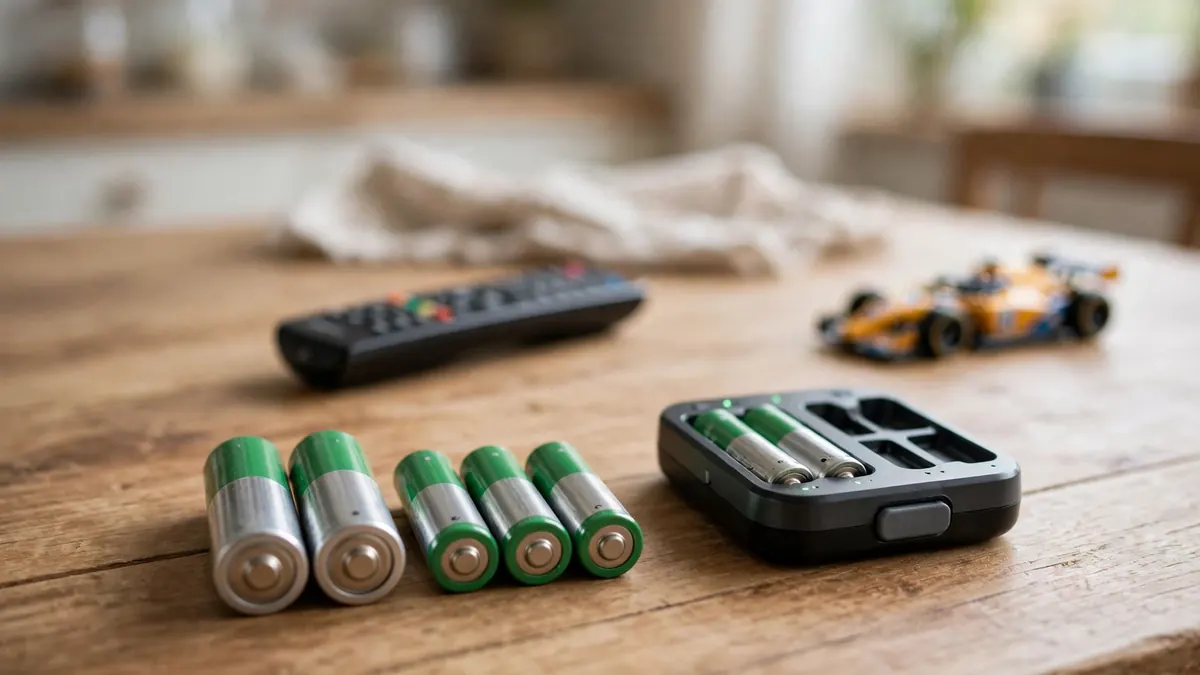
A Guide to Rechargeable Batteries in 2026
Rechargeable batteries in 2026 are the quiet workhorses of the modern home. They sit inside the game controller that gets played every evening, the torch that lives by the back door, the toy car that races across the living room floor, and the wireless mouse that never seems to rest. A good set of rechargeables can replace hundreds of single-use batteries over its life, saving real money and cutting a surprising amount of waste.
Key takeaways
- Low-self-discharge NiMH cells are the best all-round rechargeable batteries for most homes in 2026, holding most of their charge for a year on the shelf.
- Rechargeable batteries pay for themselves fastest in hungry devices such as toys, game controllers and torches, and slowest in remotes and clocks that sip power.
- A 1.2-volt NiMH cell is not a fault: most devices are designed for it, but a few fussy gadgets need the steady 1.5 volts of a lithium rechargeable AA.
- Capacity in milliamp-hours matters, but only when you compare cells of the same size and chemistry; a bigger number on a cheap cell is often wishful thinking.
- A smart charger with independent channels protects your batteries far better than a cheap timer charger, and it is the single best upgrade you can buy.
How rechargeable batteries actually work
A rechargeable battery stores energy in a chemical reaction that can be run in reverse. When you use the battery, the reaction releases electricity. When you charge it, the charger pushes electricity back in and reverses the reaction, ready for the next round. Every cell can only survive a certain number of these round trips before its capacity starts to fade, and that number is called its cycle life. A good NiMH AA cell is typically rated for five hundred to a thousand cycles, which means a set used once a week could in theory last a decade. In practice, heat, overcharging and long periods left flat wear cells out long before the rated cycle count, which is why how you charge matters almost as much as what you buy.
The voltage story is the part that confuses most buyers. A fresh alkaline AA delivers about 1.5 volts, while a NiMH rechargeable AA delivers about 1.2 volts. That sounds like a serious shortfall, but most devices are built to cope with it, because even an alkaline drops towards 1.2 volts fairly quickly once it starts working. Torches, toys, controllers and radios all run happily on NiMH cells. The exceptions are a small group of fussy devices, often older cameras, some blood pressure monitors and a few gadgets with low-battery warnings set too high, which read 1.2 volts as nearly empty and complain or shut down early. If a device misbehaves on NiMH cells, that is the first thing to suspect, and it is the one case where a 1.5-volt lithium rechargeable is the right answer.
NiMH, lithium rechargeable and the other chemistries
Nickel-metal hydride, or NiMH, is the standard rechargeable chemistry for AA and AAA cells, and it is the right default for almost every household. Modern NiMH cells are far better than the ones sold fifteen years ago. The old complaint was self-discharge: a charged cell left in a drawer would go flat within weeks. Low-self-discharge NiMH, the kind sold ready-charged in the packet, solved that problem, and a good set now keeps roughly seventy to eighty-five per cent of its charge after a year on the shelf. NiMH cells are also forgiving. They tolerate being topped up, they do not mind partial charges, and they are safe to handle and store. Their main weakness, apart from the 1.2-volt output, is that their capacity fades gradually with every cycle, so after a few hundred charges a cell that once held 2,500 milliamp-hours may hold noticeably less.
Lithium rechargeable AA and AAA cells are the newer alternative, and they solve the voltage problem by holding a steady 1.5 volts until they are nearly empty, then dropping off sharply. That makes them ideal for devices that demand a full 1.5 volts, and they are also lighter than NiMH and hold their charge well in storage. The trade-offs are real, though. They cost several times more per cell, they need their own charger or a built-in USB charging port, and they contain a small circuit that regulates the voltage, which adds a point of failure. Some also behave oddly in devices that measure remaining charge from voltage, because the voltage stays high until the cell suddenly dies. For most homes, lithium rechargeables are a specialist tool for one or two awkward devices, not a replacement for a drawer full of NiMH.

What the numbers on the packet actually mean
Capacity is measured in milliamp-hours, written as mAh, and it tells you how much charge a cell holds. A typical NiMH AA holds between 2,000 and 2,500 mAh, while a NiMH AAA holds between 750 and 1,000 mAh. Bigger is generally better, but only when you compare like with like. A no-name AA claiming 3,000 mAh is almost certainly exaggerating, because the physical size of an AA cell sets a hard limit on how much chemistry can fit inside it. Trusted brands cluster around the same honest figures, and a cell that promises far more than the rest is a warning sign, not a bargain. For AAA cells, anything above about 1,100 mAh deserves the same scepticism.
Rechargeable batteries at a glance
| Type | Voltage | Typical AA capacity | Best for | Watch out for |
|---|---|---|---|---|
| Low-self-discharge NiMH | 1.2 V | 2,000–2,500 mAh | Toys, controllers, torches, everyday use | 1.2 V confuses a few fussy devices |
| Standard NiMH | 1.2 V | 2,300–2,800 mAh | Devices charged and used daily | Goes flat in storage within weeks |
| Lithium rechargeable AA | 1.5 V | About 1,700 mAh equivalent | Devices that demand a full 1.5 V | Costs more, needs its own charging |
| NiMH AAA | 1.2 V | 750–1,000 mAh | Small remotes, scales, toothbrushes | Lower capacity, easy to mix up with AA |
| Rechargeable C and D | 1.2 V | 4,000–10,000 mAh | Large torches, radios, lanterns | Heavy, slow to charge, rarely needed |
| Rechargeable 9V NiMH | 8.4–9.6 V | 200–300 mAh | Microphones, some toys and meters | Low capacity, never for smoke alarms |
Matching rechargeable batteries to your devices
Toys are where rechargeable batteries earn their keep. A motorised toy can drain a set of single-use batteries in a single afternoon, and a house with young children can burn through a startling amount of money and waste in a year. A set of four NiMH AA cells, recharged hundreds of times, replaces all of that. Keep two sets for the busiest toys, one in the toy and one on the charger, so play never has to wait. The same logic applies to game controllers, which are used for hours at a time and are easy to swap cells in. A controller that gets played every evening will pay for a set of rechargeables within a month or two, and the swap takes seconds. Our guide to the best batteries explains which single-use cells last longest in gentle devices like remotes and clocks.
Chargers: the part most people get wrong
A rechargeable battery is only as good as its charger, and this is where most households quietly lose money. A cheap charger treats four batteries as one unit, pushing the same current into all of them and stopping when the strongest cell is full. That leaves weaker cells half-charged and the strongest one overcharged, and over months that uneven treatment kills the whole set. The household blames the batteries, but the charger was the problem all along. A smart charger does the opposite: each slot has its own circuit, so it charges a nearly full battery gently and a flat one firmly, and stops each one the moment it is done. Cells charged on a smart charger hold their capacity for hundreds more cycles than cells cooked on a timer charger. Our guide to the best battery chargers covers which models are worth a drawer slot.

The money maths and looking after your cells
A set of four good NiMH AA cells plus a smart charger costs roughly what several packs of single-use batteries cost, and each cell can be used hundreds of times. In a toy that eats a set of single-use batteries every week, that investment pays for itself in a month or two. In a game controller used every evening, the payback is similarly quick. In a remote that needs new batteries once a year, it never pays at all. A family with two children, two controllers and a couple of torches can easily save the cost of a weekly shop over a year by switching the hungry devices to rechargeables. There is also a waste argument: a single rechargeable cell can replace hundreds of single-use batteries over its life, and that means hundreds fewer batteries in the bin.
Checklist: before you buy rechargeable batteries
- Check the size first by opening the battery compartment and reading the size printed inside the lid or on the old battery.
- Choose low-self-discharge NiMH for general use, and lithium rechargeable only for devices that demand a full 1.5 volts.
- Buy a smart charger with independent channels, or check that the charger you already own is a smart one before buying cells.
- Count how many cells your hungriest devices need, then buy two sets for the busiest ones so one set is always charged.
- Check the capacity and cycle rating, and be sceptical of any AA claiming far more than 2,500 mAh.
- Recycle dead cells at a proper collection point, and never put batteries of any kind in the general bin.
Frequently asked questions
Are rechargeable batteries good for toys?
Yes, toys are the best case for rechargeables. A toy motor drains single-use batteries quickly, while a NiMH set can be used hundreds of times. Keep a second set charged so the toy never has to wait for a charger.
Why do my rechargeable batteries go flat in the drawer?
They are probably standard NiMH cells rather than low-self-discharge ones, and standard NiMH can lose a fifth of its charge in a month. Switch to low-self-discharge cells, which hold most of their charge for a year, and store them at room temperature.
Can I use rechargeable batteries in any device?
Almost any device that takes AA or AAA cells will run on NiMH rechargeables, but a few fussy devices read the 1.2 volts as nearly empty and complain. For those devices, try a 1.5-volt lithium rechargeable AA instead.
How long do rechargeable batteries last?
A good NiMH cell lasts for five hundred to a thousand charge cycles, which is several years of normal household use. Heat, overcharging and long periods left flat shorten that life, so a smart charger and cool storage make a real difference.
Is it worth buying a smart charger?
Yes. A smart charger charges each cell on its own circuit and stops when each one is full, which keeps cells healthy for hundreds more cycles than a cheap timer charger. It is the single best upgrade for anyone who already owns rechargeables.
What should I do with dead rechargeable batteries?
Take them to a battery recycling point, usually found in supermarkets and electronics shops. Never put them in the general bin, and never try to recharge a cell that is swollen, cracked or leaking. A power bank is a better choice than spare batteries for keeping a phone alive on the move, since it recharges from a wall socket and does not need loose cells at all.
The bottom line
Rechargeable batteries in 2026 are a simple deal: spend a little more up front on low-self-discharge NiMH cells and a smart charger, and the hungry devices in your home stop eating money. Toys, game controllers and everyday torches are where the saving lives, while remotes and clocks can happily stay on single-use cells.


