
Chest freezers win in 2026 for one simple reason: they hold more food for less money and less electricity than almost any other way of storing it frozen. A chest freezer is a wide, low box with a lid on top, and that plain shape is exactly why it works. Cold air sinks, so very little escapes when you lift the lid, and the deep, open space swallows whole joints, bulk buys, and a month of batch cooking without the shelves and drawers of an upright getting in the way.
This guide compares chest freezers with upright freezers head to head — capacity, garage use, defrosting, energy, and floor space — and then picks the best chest freezers of 2026 for different homes.
Key takeaways
- Chest freezers hold more usable space per cubic foot than uprights, and they use less electricity because cold air stays inside when the lid opens.
- Buy a garage-ready model if the freezer will live outside the kitchen — ordinary freezers can stop working in cold or hot garages.
- A 7 cubic foot chest freezer suits most families; 5 cubic feet suits a couple, and 14 cubic feet or more suits bulk buyers.
- Manual defrost is normal for chest freezers and keeps food better, but plan to defrost once or twice a year.
- Baskets, labels, and a simple map of what is inside matter more than any extra feature — without them, food gets forgotten at the bottom.
Chest Freezers vs Upright Freezers: How They Differ
The difference starts with the shape. A chest freezer opens from the top, so cold air, which is heavier than warm air, stays inside when you lift the lid. An upright freezer opens from the front, like a fridge, so a wave of cold air falls out every time the door opens and warm air rushes in. That is why chest freezers are cheaper to run and keep food frozen longer during a power cut — often for two days or more if the lid stays shut, against a day or so for an upright.
Uprights win on organisation. Shelves and drawers let you see everything at a glance, and nothing gets buried. Chest freezers win on capacity and price: for the same money you get more storage, and for the same storage you pay less, both to buy and to run. If you open the freezer every day for a few items, an upright is easier to live with. If you load it once a week with bulk shopping and batch cooking, a chest freezer is the better tool.
The 7 Best Chest Freezers of 2026
These seven chest freezers cover the sizes and situations most homes need, from a small second freezer to a large garage workhorse.
1. Best Overall: 7 Cubic Foot Chest Freezer
A 7 cubic foot chest freezer is the sweet spot for most families. It holds roughly a fortnight of frozen food for four people — bulk meat, batch-cooked meals, frozen vegetables, and ice cream — without dominating the garage. It is small enough to fit through a standard door, light enough to move with two people, and cheap enough to run that the electricity barely registers.
2. Best Small: 5 Cubic Foot Chest Freezer
A 5 cubic foot chest freezer suits a couple, a small household, or anyone who wants a second freezer for overflow. It tucks into a corner of a garage or utility room, holds a week or two of food, and costs very little to buy and run.
3. Best Large: 14 Cubic Foot Chest Freezer
A 14 cubic foot chest freezer is the pick for bulk buyers, hunters, and large families. It swallows a side of beef, a season of garden vegetables, and months of batch cooking in one load. Buy it only if you genuinely fill it — a half-empty large freezer wastes electricity and hides food at the bottom.
4. Best Garage-Ready: Garage-Ready 9 Cubic Foot Chest Freezer
A garage-ready chest freezer is built to keep working when the room around it is freezing cold in winter or baking hot in summer. Ordinary freezers can stop cooling in a cold garage, because their thermostats think the room is already cold enough, and they can struggle in extreme heat.
5. Best Budget: Basic 6 Cubic Foot Chest Freezer
A basic 6 cubic foot chest freezer does the job with no extras: one basket, a manual defrost, a simple dial, and a lid that stays open while you load it. It is the cheapest way to add serious frozen storage, and because there is so little to go wrong, it tends to last for years.
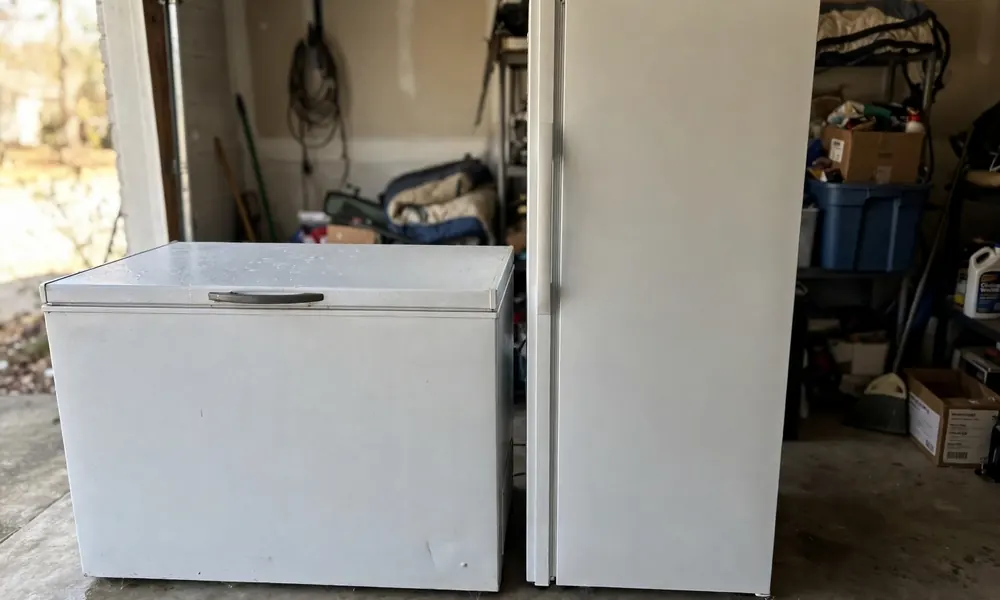
6. Best for Bulk Meat: 16 Cubic Foot Chest Freezer With a Lock
A 16 cubic foot chest freezer with a lock is the pick for anyone storing a large amount of meat — a whole animal from a local farm, a hunting season, or a serious bulk buy. The lock matters when the freezer sits in a shared garage or outbuilding, and the size means whole cuts can go in without being divided first.
7. Best for Organisation: 10 Cubic Foot Chest Freezer With Three Baskets
A 10 cubic foot chest freezer with three sliding baskets is the pick for people who hate digging. The baskets hold the food you use most — bread, vegetables, and ready meals — at the top, while bulk food sits underneath. Three baskets beat one, because you can sort by type instead of piling everything into a single basket.
Chest Freezers Compared
The table below compares all seven freezers on the details that matter when you are choosing.
| Freezer | Size | Best For | Garage-Ready | Defrost |
|---|---|---|---|---|
| 7 cubic foot overall | 7 cu ft | Most families | Check model | Manual |
| 5 cubic foot small | 5 cu ft | Couples, overflow | Check model | Manual |
| 14 cubic foot large | 14 cu ft | Bulk buyers | Often | Manual |
| 9 cubic foot garage-ready | 9 cu ft | Garages | Yes | Manual |
| 6 cubic foot budget | 6 cu ft | Low cost | Check model | Manual |
| 16 cubic foot with lock | 16 cu ft | Bulk meat | Often | Manual |
| 10 cubic foot, three baskets | 10 cu ft | Easy organisation | Check model | Manual |
What Size Chest Freezer Do You Need?
Size is the decision to get right first, because a freezer that is too small is useless and one that is too big wastes money and hides food. A rough rule is 1.5 cubic feet per person for a household that freezes regularly, so a couple needs around 5 cubic feet, a family of four needs around 7, and a family of six needs around 9 or 10. Add more if you buy meat in bulk, grow vegetables, or batch cook for the month. Measure the doorways too — a large chest freezer will not fit through a narrow internal door, and it is a miserable job to discover that on delivery day.
Garage-Ready, Defrosting, and Energy
Garage-ready is the feature to check before anything else if the freezer will live outside the kitchen. A standard freezer is designed for a room that stays between about 10 and 32 degrees, and in an unheated garage in winter it can stop cooling altogether, because the thermostat reads the cold room and decides the freezer does not need to run. A garage-ready model is tested to keep working from well below freezing to high summer heat, so food stays safely frozen all year.
Defrosting is the chore that comes with a chest freezer. Almost all chest freezers are manual defrost, which means frost builds up on the walls over months and you need to empty the freezer, switch it off, and let the ice melt once or twice a year. It sounds like a drawback, but manual defrost freezers hold a steadier temperature and keep food better than frost-free uprights, which warm up slightly every time they run a defrost cycle. Energy use is the good news: chest freezers are among the cheapest appliances to run, often costing less per year than a light bulb left on,

How to Organise a Chest Freezer So Food Gets Eaten
A chest freezer without a system becomes a tomb for food, so set the system up on day one. Use the wire baskets for the food you reach for most, and stack the rest in flat, labelled layers underneath. Our guide to the best meal prep containers for freezing covers the containers that stack best, and flat bags work even better for soups and stews: freeze them flat, then stand them upright like files. For longer storage, a vacuum sealer keeps meat and fish free of freezer burn for months, and good freezer bags are the cheap alternative for everything else.
Chest Freezer Checklist
Use this checklist before you buy.
- Measure the floor space, the lid clearance above it, and every doorway the freezer must pass through.
- Choose the size by the people you feed: about 1.5 cubic feet per person, more if you buy in bulk.
- Buy garage-ready if the freezer will live in a garage, shed, or outbuilding.
- Check for a front drain, a lid that stays open, and at least one wire basket.
- Look for a lock and a temperature alarm if the freezer will hold a lot of valuable food.
- Plan your organisation on day one: baskets, flat labelled bags, and a list on the lid.
Frequently Asked Questions
Are chest freezers better than upright freezers?
Chest freezers are better for capacity, price, and running costs, and they keep food frozen longer in a power cut. Upright freezers are better for everyday access and organisation.
What size chest freezer do I need?
Allow about 1.5 cubic feet per person: 5 cubic feet for a couple, 7 for a family of four, and 9 or 10 for a family of six. Add more if you buy meat in bulk or batch cook. A freezer that is too big wastes electricity and hides food, so do not buy far more space than you will fill.
Can I put a chest freezer in the garage?
Yes, but only a garage-ready model is safe to put in an unheated garage. Ordinary freezers can stop cooling in cold weather and struggle in extreme heat.
How often do chest freezers need defrosting?
Most chest freezers need defrosting once or twice a year, when frost on the walls reaches about half an inch thick. Empty the freezer into cool bags, switch it off, let the ice melt, and wipe it dry before switching it back on. A front drain makes the job much easier.
Do chest freezers use a lot of electricity?
No — chest freezers are among the cheapest appliances to run, because cold air stays inside when the lid opens and the insulation is thick.
How long does food last in a chest freezer?
Most frozen food keeps its best quality for three to six months, and meat and fish for longer if vacuum sealed. Label everything with the date it went in, eat the oldest food first, and do not refreeze food that has fully thawed.
The Bottom Line
Chest freezers win in 2026 because they do the simple job best: more space, less electricity, and food that stays frozen longer, for less money than an upright. The best choice for most homes is a 7 cubic foot garage-ready chest freezer with two baskets, a front drain, and a lock.


