The Battery Chargers Worth Keeping in a Drawer in 2026
A battery charger is the kind of purchase nobody thinks about until the remote dies, the camera flashes its low-battery warning, or the torch gives up halfway through a power cut. Then the drawer gets opened, and what comes out is usually a slow, single-purpose charger that came free with a pack of batteries years ago. A good battery charger is worth more than that. The right one charges each cell on its own, stops when the cell is full, tells you what it is doing, and handles the AA, AAA and camera batteries a household actually uses, day after day, without fuss. This guide explains which battery chargers are worth a drawer slot in 2026, and which ones belong in the recycling.
Key Takeaways
- Buy a smart charger with independent channels: each battery gets its own circuit, its own charge rate and its own shut-off, so a weak cell never holds back a good one.
- Match the charger to your batteries: a charger for AA and AAA NiMH cells is a different tool from one for lithium-ion camera packs, and a good drawer holds one of each.
- A display that shows voltage, capacity or charge progress is worth paying for, because it turns guessing into knowing.
- Slow and steady beats fast and hot: a charger that finishes in an hour runs hotter and shortens battery life, while an overnight-rate charger keeps cells healthy for years.
- Keep one charged set ready at all times, store the charger somewhere dry and cool, and retire any charger that smells hot, swells batteries or leaves cells warm for hours.

Why the Charger in the Drawer Matters
Rechargeable batteries only save money if they are charged well. A cheap charger treats four batteries as one unit: it pushes the same current into all of them and stops when the strongest one is full, which leaves the weaker ones half-charged and the strongest one overcharged. Over months, that uneven treatment is what kills rechargeable cells, and the household blames the batteries when the charger was the problem all along.
A smart charger does the opposite. Each slot has its own circuit, so it can charge a nearly full battery gently and a flat one firmly, and stop each one the moment it is done. The difference shows up in the numbers: cells charged on a smart charger hold their capacity for hundreds more cycles than cells cooked on a timer-based charger. For a household that runs remotes, torches, game controllers, cameras and children’s toys on rechargeables, that difference pays for the charger within a year.
NiMH, Lithium-Ion and the Chemistry Problem
The first thing to check is chemistry. AA and AAA rechargeables are almost always NiMH, which charges at a low, steady voltage and tolerates being topped up. Camera batteries and many torch batteries are lithium-ion, which needs a completely different charging profile and a charger that knows the difference. A charger built for one chemistry will not safely charge the other, and some cheap universal chargers do a poor job of both. Buy a charger that names your battery type on the box, and if you use both chemistries, buy two chargers rather than one compromise.
What Makes a Good Battery Charger
Start with the slots. Four independent bays cover most households, and eight bays suit a family with many devices. Each bay should accept both AA and AAA, and the better chargers also take C and D cells with adapters. Look for a charger that charges each bay independently, with its own indicator light or display segment, because that is the single feature that separates a smart charger from a dumb one.
Speed is the next question, and slower is usually better. A charger that refills a pair of AA cells in one hour sounds convenient, but fast charging generates heat, and heat is what ages NiMH cells. A two-to-four-hour charge keeps cells cool and extends their life noticeably. The exception is a charger with a selectable rate: a slow setting for everyday use and a fast setting for the morning the camera is needed in an hour. That flexibility is worth having, as long as fast is the exception rather than the habit.
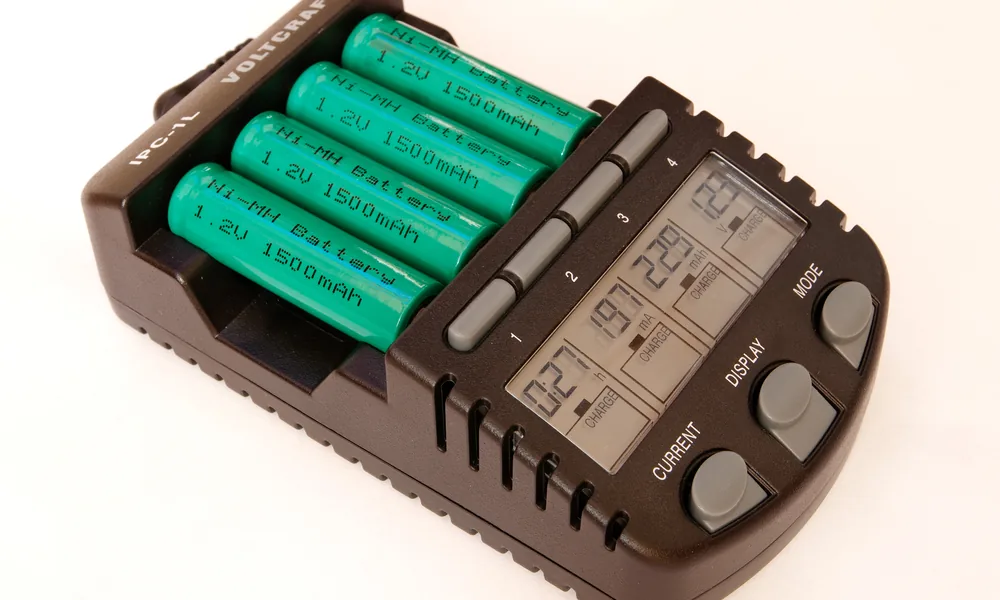
A display is the feature most people skip and most owners later wish they had. A simple LED tells you a battery is charging; a display tells you how far along it is, what voltage it has reached, and sometimes how much capacity the cell still holds. That last number is genuinely useful: a cell that only ever reaches half its rated capacity is a cell ready for retirement, and the display is what tells you. The real Voltcraft-style smart chargers with per-bay readouts are the template here, and the photograph below shows exactly that kind of unit doing its job.

Comparison: The Battery Chargers Worth Keeping in 2026
| Charger type | Bays | Battery types | Best for | Typical price |
|---|---|---|---|---|
| Smart 4-bay NiMH | 4 | AA, AAA NiMH | Remotes, toys, torches | $20–$35 |
| Smart 8-bay NiMH | 8 | AA, AAA, C, D NiMH | Busy households, many devices | $30–$50 |
| Display charger | 4 | AA, AAA NiMH | People who want capacity readouts | $35–$55 |
| USB-powered travel charger | 2–4 | AA, AAA NiMH | Travel, car, desk drawer | $15–$25 |
| Camera battery charger | 1–2 | Lithium-ion camera packs | Photographers, one battery type | $15–$40 |
| Universal smart charger | 4 | NiMH and lithium-ion | Mixed households, one device | $40–$65 |
Camera Batteries Need Their Own Charger
Camera batteries deserve a short section of their own, because they are the most expensive cells in the drawer and the most often mistreated. A camera battery is a lithium-ion pack with its own shape, contacts and voltage, and it needs a charger made for that exact pack. Third-party chargers exist for most camera models and usually work well, but the cheapest ones often skip the temperature monitoring that stops a charge when a pack gets hot, and that is the feature that matters most.
Keep a second camera battery charged and ready, and rotate the two so neither sits flat for months. Lithium-ion cells dislike being stored empty and dislike being stored full; around half charge is the sweet spot for long storage. If the camera is going away for the winter, charge the spare to about half, put it in a cool drawer, and check it in spring. A battery left flat in a drawer all winter often never comes back.
What About Laptop Chargers?
It is worth drawing a line here: a battery charger for AA cells and camera packs is a different device from a laptop charger, which is a high-wattage power brick that feeds a whole computer. If the laptop brick is what needs replacing, the buying questions are wattage, connector and gallium nitride efficiency, not battery bays. Our guide to the best laptop chargers of 2026 covers that ground properly, and it is the right read for anyone whose problem is a dead laptop rather than a dead remote.
Keeping Batteries Alive Between Charges
A charger is only half the system; the batteries themselves need a little care. Keep rechargeables in pairs or sets that always charge together, and mark the sets so a strong cell never gets paired with a weak one. Store spares in a cool, dry place, out of direct sun and away from radiators, because heat drains a charged battery even when it is doing nothing. A kitchen drawer is usually fine; a windowsill in summer is not. And keep batteries away from loose metal in a drawer: a bare cell rolling against keys or coins can short, heat up, and leak.
The batteries themselves are worth choosing well, because a good charger cannot rescue a poor cell. Modern low-self-discharge NiMH batteries hold most of their charge for a year on the shelf, which is what makes them practical for remotes and emergency torches that sit unused for months. Our guide to batteries that actually last in remotes and toys in 2026 explains which cells hold up and which ones fade fast, and pairing good cells with a smart charger is the combination that actually saves money.
Battery Charger Checklist
- Choose a smart charger with independent channels, so each battery charges and stops on its own.
- Match the charger to your chemistry: NiMH for AA and AAA, lithium-ion for camera packs, or a genuine universal charger for both.
- Prefer a display or per-bay indicators over a single blinking light.
- Use the slow setting for everyday charging and save fast charging for genuine emergencies.
- Keep a charged spare set ready, store batteries cool and dry, and keep loose cells away from metal.
- Retire any charger that smells hot, swells batteries, leaves cells warm for hours, or has a damaged cable.
Frequently Asked Questions
Can I leave batteries in the charger overnight?
On a smart charger, yes: it stops each bay when the cell is full, so an overnight charge is safe. On a cheap timer charger, no: it keeps pushing current after the battery is full, which heats the cell and shortens its life. If you do not know which kind you own, assume it is the cheap kind.
How long do rechargeable AA batteries last?
A good NiMH cell lasts 500 to 1,000 charge cycles when treated well, which is several years of normal household use. Cells charged hot and fast, stored flat, or mixed with weaker partners fade much sooner, often within a year or two.
Can one charger handle AA, AAA and camera batteries?
Some universal chargers can, but check the specification carefully: the charger must list both NiMH and lithium-ion support, with separate bays or modes for each. A charger that only mentions AA and AAA will not charge a camera pack, whatever its shape.
Why do my rechargeable batteries die so quickly in a torch?
Torches draw high current, which exposes weak cells fast. The usual causes are old cells, cells charged on a dumb charger that left them half-full, or a mixed set where one weak cell drags the rest down. Charge the set together on a smart charger and replace any cell the display flags as low capacity.
Is a USB-powered charger as good as a plug-in one?
For travel and desk use, yes: a USB-powered charger is convenient and charges at a gentle rate, which is good for battery life. For a household charging eight cells at a time, a plug-in charger with its own power supply is faster and more practical.
What should I do with dead rechargeable batteries?
Take them to a battery recycling point rather than putting them in household waste. Most electronics shops and supermarkets have a collection box. Never throw a swollen or leaking battery in the bin, and never try to charge a swollen battery.
The Bottom Line
The battery charger worth keeping in a drawer is a smart, four-bay charger with independent channels, a display you can actually read, and a slow setting you will use most of the time, plus a dedicated charger for any camera batteries you own. Buy good low-self-discharge cells to go with it, keep a charged set ready, and the drawer stops being a graveyard of half-dead batteries. For the other half of staying powered, our guides to the best power banks of 2026 and the batteries themselves will round out a setup that keeps remotes, torches and cameras running without a last-minute dash to the shops.