Sheds That Hold the Garden Tools Without the Mess in 2026
A garden shed is the difference between a garden that works and one that fights you. Without one, tools lean against the back door, tangle in the garage, or rust behind the bins, and every job starts with ten minutes hunting for the spade. A good shed changes that: every tool gets a home, the rain stays off, and tidying takes a minute instead of an afternoon.
Size, material, doors, ventilation and layout decide whether the shed becomes the hardest-working corner of the garden or just another place where clutter hides. This guide explains the main types, how to size one properly, and how to set it up so the tools stay dry, visible and easy to grab.
Key takeaways
- Measure your tools first: long-handled tools, the mower and the wheelbarrow decide the footprint, not the catalogue.
- Wood looks best and adapts easiest, metal is cheapest and toughest against pests, and plastic needs the least maintenance but is hardest to fix.
- A solid, level base matters more than the shed: one on a wonky base will leak, stick and rot, however well built.
- Ventilation stops condensation, which rusts tools and rots timber from the inside out.
- Storage inside beats volume: hooks, shelves and a pegboard hold more than a bigger empty shed ever will.
Why a shed beats a pile in the garage
Gardens generate tools faster than houses generate cupboard space: spades, forks, rakes, shears, cans, hoses, pots and a mower add up to a surprising amount of kit. A shed puts it all within a few steps of where it is used. Tools that live in the garden get used; tools that live in the garage get forgotten.
A shed also keeps tools dry and out of sight, slowing rust, stopping handles from swelling and cracking, and keeping sharp tools away from children and pets. It pays for itself: replacing rusted tools every couple of years costs far more than the shed.
The main shed types, compared
Sheds fall into a few clear families. Apex sheds have a pitched roof with the ridge along the middle, giving the most headroom and shedding rain well. Pent sheds have a single sloping roof, handy tight against a fence or wall. Metal sheds use galvanised steel, plastic sheds use thick resin, and wooden sheds use tongue-and-groove or overlap boards. Each has a weakness worth knowing before you buy.
| Type | Best for | Strengths | Watch out for |
|---|---|---|---|
| Apex wood | General storage, workshops | Good headroom, easy to shelve | Needs treating every few years |
| Pent wood | Tight spots, against fences | Simple roof, rain runs off | Less headroom at the low side |
| Metal | Budget storage, security | Cheap, fire- and pest-proof | Condensation inside; dents easily |
| Plastic / resin | Low-maintenance storage | Never rots or needs painting | Hard to repair or modify |
| Lean-to | Small gardens, against the house | Uses a wall, tiny footprint | Needs a sound wall, good flashing |
| Tool store | Hand tools only, tiny gardens | Cheapest of all, fits in a corner | No room for a mower or wheelbarrow |
No single type suits every garden. The right choice depends on how much you need to store, how much maintenance you are willing to do, and how the shed has to look next to the house.
Sizing it right: measure the tools first
The most common shed mistake is buying one too small; the second is buying one too big. Both come from choosing by the size of the garden instead of the tools. Before looking at a catalogue, lay out everything the shed must hold on the lawn: long-handled tools need about two metres of wall, a mower needs its footprint plus walking room, and a wheelbarrow needs a clear run to the door.
As a rough guide, a 6 by 4 foot shed holds hand tools, a mower and a few pots for a small garden. An 8 by 6 foot shed is the sweet spot for most family gardens, with room for tools, a mower, a wheelbarrow and shelves. A 10 by 8 foot shed works as a potting shed or small workshop; bigger than that, you are building a garden room, which needs planning checks and a proper foundation.
Double doors make life far easier, because the mower and wheelbarrow go in and out without a struggle; a single narrow door turns every mowing day into a wrestling match. Leave a clear path to the door: a shed you have to climb over pots to reach is one you will stop using.
Wood, metal or plastic: what actually lasts
Wood is the classic choice and still the best for most gardens. It looks right next to plants, takes shelves and hooks easily, and can be repaired board by board. Overlap boards are cheaper and fine for basic storage, while tongue-and-groove boards fit tighter and last longer. The trade-off is maintenance: wood needs preservative every two or three years, and a neglected shed rots from the bottom up. Look for a raised floor and pressure-treated bearers.
Metal sheds are the cheapest lockable, weatherproof box, and genuinely tough against pests and fire. Their weakness is condensation: on a cold morning the inside of a steel shed can run with water, rusting tools just as surely as rain. Ventilation helps, but a metal shed is never as kind to tools as a wooden one, and dented panels are hard to straighten.
Plastic sheds sit in the middle: they never rot, never need painting, and go up in an afternoon. The downside is that they are hard to modify: you cannot easily screw a heavy shelf into a resin wall, and a cracked panel is usually a replacement job. They can flex in high wind unless anchored properly to the base.
Keeping tools organised inside
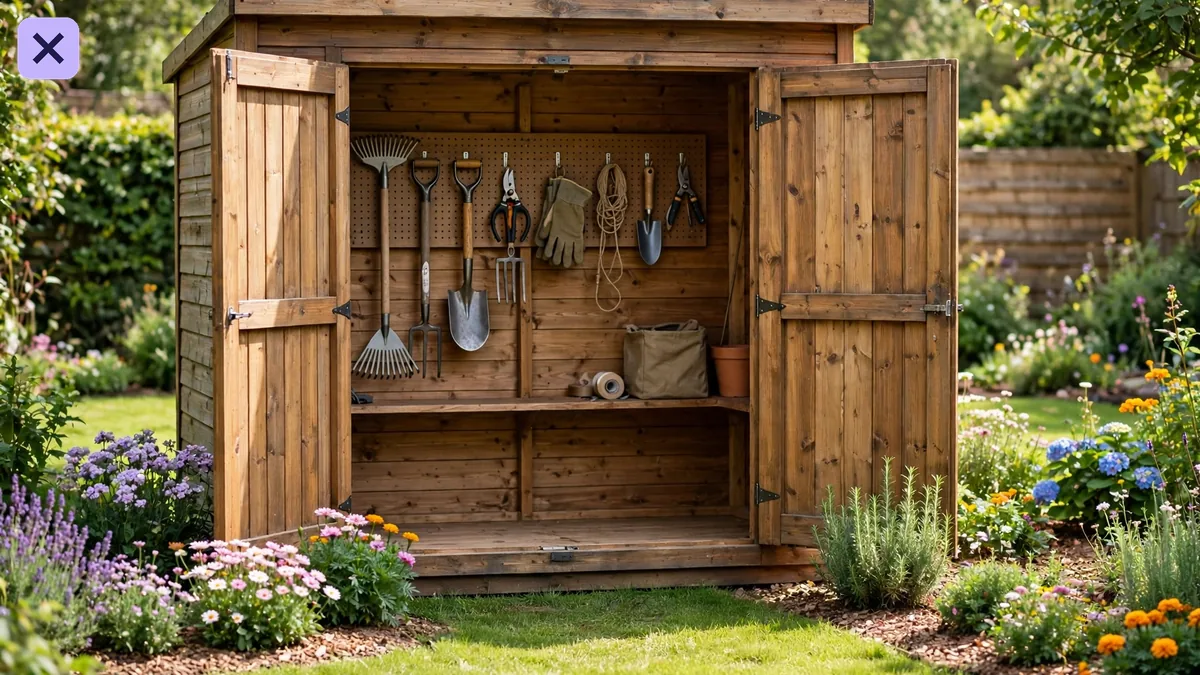
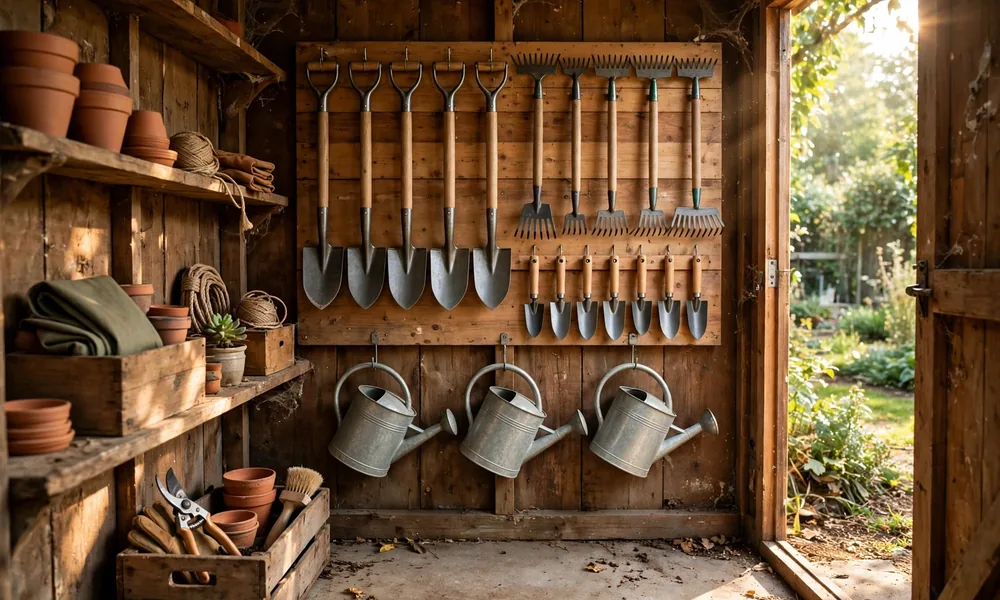
A shed is only as good as its layout: an empty shed fills up with piles, and piles are where tools go to be lost. The fix is simple: get the tools off the floor and onto the walls. A pegboard or sturdy hooks hold spades, forks, rakes and hoes upright, handles up, where they can be seen and grabbed in seconds. Short tools belong on a shelf or in a bucket by the door, and small things like twine and seed packets belong in labelled boxes.
Think in zones: one wall for long tools, one shelf for pots and trays, one corner for the mower, and a shelf at waist height for potting. Keep the floor clear enough to walk in and get the mower out without moving three other things first. A clear floor is the difference between a shed and a cupboard.
Think about what lives near the shed too. A good garden bench nearby gives you somewhere to sit and clean tools after a session, and a spot for pots and trays while you work. The shed holds the tools; the garden around it should make using them easy.

Base, ventilation and weatherproofing
Every shed needs a base, and the base decides whether it lasts five years or fifteen: flat, level, slightly larger than the shed, with the shed sitting above the ground so rain runs away. Concrete slabs are most durable; a timber frame filled with gravel is cheaper and easier. What never works is putting a shed straight onto grass or soil: the bottom boards will rot within a couple of winters.
Ventilation is the part most people forget. A sealed shed traps damp air, which condenses overnight; that is how tools rust and timber rots even in a shed that never leaks. Most good sheds have small roof vents: leave them open. If yours has none, a couple of small louvre vents are a cheap afternoon job.
Weatherproofing is mostly about the roof and the bottom boards. Felt roofs are standard but need checking yearly and replacing every few years; rubber or shingle roofs last longer and are worth the extra cost. Treat the bottom boards before assembly, when they are still easy to reach, and treat the shed before you fill it, not after.
The mistakes that turn sheds into junk rooms
The first mistake is buying on price alone. The cheapest shed is cheap for a reason: thin boards, a flimsy roof and a door that sags within a year. A shed is a twenty-year purchase, and the gap between the cheapest and a decent one is usually less than the cost of the tools it will ruin.
The second mistake is no plan for the inside. A shed with no hooks and no shelves becomes a pile within a month, and once it is a pile nobody wants to sort it out. Put the storage in on day one, before the tools go in. Keep sharp tools in good order too: a pair of sharp pruning shears hung on a hook stays sharp, while the same shears at the bottom of a pile will blunt and rust.
The third mistake is forgetting access. A shed hidden behind a hedge, up a muddy slope, or blocked by the bins gets used twice a year. Put it somewhere reachable in all weathers, with a firm path to the door, and it will earn its keep every week.
A shed also works best as part of a plan: if you grow your own plants, a greenhouse kit next to the shed makes a natural working corner, with a tap or water butt nearby for refills.

Choosing well: a quick checklist
- Lay out every tool first, then choose the size from that pile, not the catalogue photo.
- Pick double doors if a mower or wheelbarrow goes in and out, and check the width before you buy.
- Build a level base first, slightly larger than the shed and raised so rain runs away.
- Choose the material honestly: wood for looks and adaptability, metal for budget and security, plastic for zero maintenance.
- Fit hooks, a pegboard and shelves on day one, before the first tool goes in.
- Leave the vents open, treat the timber every few years, and check the roof felt each spring.
Frequently asked questions
What size shed do I need for a mower and garden tools?
An 8 by 6 foot shed is the usual sweet spot: mower, wheelbarrow, long-handled tools and shelves for pots. A 6 by 4 foot shed works for hand tools and a small mower, but fills up fast.
Is a wooden shed better than a metal shed?
Wood: easier to adapt, kinder to tools and better looking, though it needs treating every few years. Metal is cheaper and tougher against pests, but suffers from condensation and dents.
Do I need a base for a garden shed?
Yes: a flat, level base of slabs or paving, raised slightly above the ground. A shed on grass or soil rots at the bottom within a couple of winters.
How do I stop my shed from getting damp inside?
Keep the roof vents open, raise the shed on bearers, and never store wet tools inside. A small vent under the eaves usually stops condensation.
Do I need planning permission for a garden shed?
Most fall under permitted development: single storey, below the height limit and not in front of the house. Check with your council if the shed is large or close to a boundary.
How often should I treat a wooden shed?
Every two to three years, or when water stops beading on the surface. Treat the bottom boards and roof edges first: those fail earliest.
The bottom line
The best shed in 2026 is not the biggest or the cheapest one, but the one sized around the tools you own, built on a level base, ventilated properly, and fitted out with hooks and shelves from day one. Wood suits most gardens, metal suits tight budgets, and plastic suits anyone who never wants to paint a shed again. Measure the tools, build the base properly, and organise the inside before the clutter moves in.


