A greenhouse changes what a garden can do. It stretches the season at both ends, keeps a sudden frost from undoing weeks of work, and turns a patch of ordinary backyard into a place where tomatoes ripen in October and seedlings start in February. The catch is that a greenhouse used to mean a builder, a foundation and a serious budget. In 2026 that is no longer true. The best greenhouse kits arrive in a box, go up over a weekend with ordinary tools, and cost less than a season of buying the same vegetables at the market.
What a greenhouse kit actually is
A kit is a complete structure sold as a set of parts: frame, covering, door, vents and fixings, with instructions. The frame is usually aluminium, galvanised steel or wood, and the covering is polycarbonate panels, glass, or a reinforced plastic film. Polycarbonate is the most common choice in 2026 because it is light, tough and diffuses sunlight so plants do not scorch. Glass looks better and lasts longer but is heavier, more fragile and needs a stronger frame. Film covers are the cheapest and lightest, and they suit small or seasonal kits, but they wear out fastest and need replacing every few years.
Size matters more than most buyers expect. A kit that looks generous in a photograph can feel cramped once shelving, a path and a watering can are inside. As a rough guide, a walk-in kit needs at least six feet by four feet to hold beds and a person comfortably, and eight by six is the sweet spot for a household that grows its own vegetables. Smaller kits work well for starting seeds and overwintering pots, but they are not a substitute for a walk-in house, and buying one expecting the other is the most common disappointment in this category.
The best walk-in greenhouse kit
The strongest all-round choice in 2026 is a walk-in kit with an aluminium frame and twin-wall polycarbonate panels. Aluminium does not rust, it is light enough to move during assembly, and it holds its shape in wind that would bend a cheaper steel tube frame. Twin-wall panels trap a layer of air between two sheets, which insulates far better than a single sheet and keeps night temperatures several degrees higher, enough to matter in spring and autumn.

The best mini greenhouse kit for small spaces
Not everyone has a garden. For a balcony, a patio or a small courtyard, a mini kit is the right answer, and the best of them are genuinely useful rather than decorative. The usual design is a light metal frame with shelves and a clear cover that zips or rolls up at the front. It holds seed trays, small pots and a few herbs, and it protects them from wind, heavy rain and the cold nights of early spring.
The details to check are the cover and the fixings. A cover made from reinforced, UV-stabilised plastic will last several seasons; a thin, unreinforced one can split within months. Roll-up doors matter because a mini kit overheats even faster than a big one, and being able to open the whole front on a warm day is the simplest form of ventilation. Weight matters too: a light kit on a windy balcony needs to be tied or weighted down, so look for anchor points or a design that accepts a couple of bricks on the base shelf.

What grows well in a mini kit is narrower than in a walk-in house, and that is fine. Herbs are the natural fit: basil, parsley, chives and coriander all do well in pots under cover, and a small kit can keep a kitchen supplied for months. Our guide to the best herb gardens for the kitchen covers which herbs earn their space and how to keep them productive. Leafy salads, chillies and a single dwarf tomato plant are also realistic; a full vegetable patch is not, and no honest kit claims otherwise.
The best lean-to greenhouse kit
A lean-to kit fixes to the wall of a house, garage or garden wall, using the building as its fourth side. That sounds like a compromise, and in some ways it is, but it has real advantages. The wall stores heat during the day and releases it at night, which keeps the space warmer than a freestanding kit of the same size. It also needs less ground, which makes it the best option for a narrow side return or a small walled garden.
The trade-off is light. A lean-to gets sun from one side only, so it suits plants that tolerate some shade and a gardener who rotates pots regularly. It also needs a sound wall and a fixing method that does not damage it, so check the fixings before ordering and be honest about the state of the brickwork. The best lean-to kits come with proper wall brackets and a flashing strip that keeps rain from running down the wall and into the structure.
The best hoop house and cold frame kits
At the simple end of the range sit hoop houses and cold frames, and they deserve more respect than they get. A hoop house is a series of curved hoops covered in film, low enough to step over but tall enough to cover a bed. A cold frame is a bottomless box with a sloping glazed lid that sits over a bed or a set of pots. Neither is a building you walk into, and both are far cheaper than any walk-in kit.
Their strength is season extension for crops already in the ground. A hoop house over a salad bed can keep leaves coming weeks past the first frost, and a cold frame is the classic way to harden off seedlings before they go outside. They are also the easiest kits to move: a hoop house can be lifted off one bed and put on another in minutes, which suits a vegetable garden that rotates crops.
The best premium greenhouse kit
At the top of the range are cedar-framed kits with glass panels, and they are a different kind of purchase. Cedar weathers to a soft grey, it does not need painting, and it insulates better than metal, so a cedar house holds its temperature more steadily. Glass transmits light more cleanly than polycarbonate and does not yellow with age, which matters if the greenhouse is also a garden feature rather than a purely working space.
What to look for before you buy
Frame material comes first. Aluminium is light and rust-proof, galvanised steel is strong and cheaper but heavier, wood is beautiful and insulating but needs care. In most gardens aluminium wins on balance, and it is what most of the best-selling kits in 2026 use. Whatever the material, check the thickness of the sections: thin, flimsy framing is the single best predictor of a kit that will not survive its second winter.
Covering comes second. Twin-wall polycarbonate is the best all-round choice for a walk-in kit, single-wall suits a small or seasonal kit, and glass suits a permanent premium house. Film covers belong on mini kits, hoop houses and cold frames, where their lightness is an advantage and replacement is cheap. Ask how the covering is held in: channels and proper glazing bars beat clips and tape every time.
Ventilation comes third, and it is where cheap kits cut corners. A walk-in kit needs a roof vent and a door that opens wide; a mini kit needs a roll-up front. Automatic vent openers are worth the small extra cost because they work when nobody is home, which is exactly when a greenhouse overheats. Shade is the companion question: on the hottest days, a simple shade cloth over the roof does more than any vent, and the best kits leave room to fit one.
Size, base and anchoring come next. Measure the ground twice, including space to walk around the outside for cleaning and repairs, and remember that a greenhouse needs a level base. Most kits include ground anchors or fixing points; use them. A greenhouse is a sail in a storm, and an unanchored kit is a neighbour’s problem as well as yours. Finally, check the guarantee and the availability of spare panels. A company that sells replacement panels is a company that expects its kits to last.
Setting it up and getting the first season right
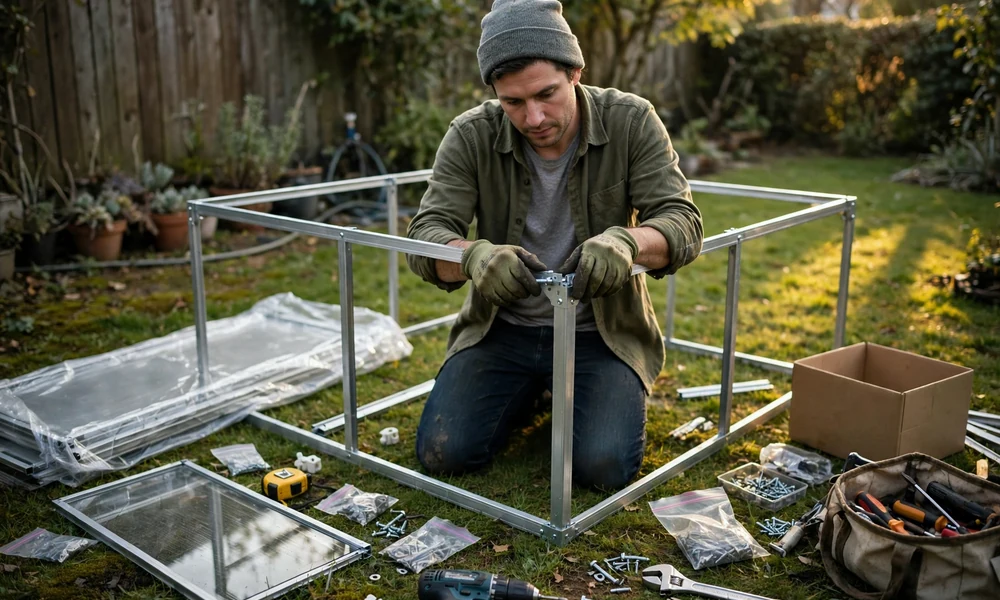
Assembly is where a good kit earns its price. Clear instructions, parts that are labelled, and fixings that fit without force are the marks of a kit designed by people who have actually built one. Give yourself a full day for a walk-in kit, start early, and do not try to fit panels on a windy day. A second person helps enormously, not just for lifting but for holding a panel square while the other fixes it.
Inside, growing in the ground or in beds gives the best results for tomatoes, cucumbers and peppers, because the soil holds moisture and warmth. Pots and containers suit herbs, salads and anything that needs moving, and they let you rearrange the space through the season. Our guide to the best and worst plant pots is a useful companion here, since the wrong pot in a greenhouse dries out fast and the right one holds moisture through a hot afternoon. Whatever you grow, give plants room: a crowded greenhouse is a humid one, and humidity is where most first-season problems start.
Mistakes to avoid
The most common mistake is buying too small. A kit that fits the garden perfectly on paper feels tight once shelving and a path are in, and upgrading means starting over. If the budget and the ground allow, buy one size larger than you think you need. The second mistake is the opposite: buying a big kit for a shaded spot. A greenhouse in shade is a damp shed, so pick the sunniest available ground, ideally with morning sun to warm it early and some shelter from the prevailing wind.
The verdict
For most gardens in 2026, the best greenhouse kit is a walk-in aluminium kit with twin-wall polycarbonate panels, a roof vent and a proper door: tough enough to last, warm enough to extend the season, and simple enough to build in a weekend. If space is tight, a well-made mini kit with a roll-up cover does real work on a balcony or patio, and a lean-to suits a narrow garden with a sunny wall. The premium cedar and glass houses are for gardeners who want a permanent feature and are willing to pay for it.
Whichever size fits your ground, the same rules decide whether it lasts: a solid frame, a covering held properly, ventilation that works, a level base and anchors that hold. Get those right and the kit will pay for itself in fresh food, earlier salads and seedlings that actually survive spring. A greenhouse does not make a gardener, but it gives a good gardener a longer season, and in 2026 there has never been a better time to start. Pair it with good beds outside, too: our guide to raised garden beds that grow better vegetables covers the outside half of the same garden.