
How to Choose Book Lights That Won’t Disturb Your Partner in 2026
The best book lights in 2026 solve a small, nightly problem: how to keep reading when the person beside you is trying to sleep. A good book light puts a small pool of warm light on the page and nowhere else, so you can finish the chapter while your partner stays asleep. A bad one leaks light across the bed, glows cold and blue, or clicks and buzzes just loudly enough to matter.
This guide explains how to choose book lights that will not disturb your partner in 2026. It covers clip-on lights, neck lights, and bookmark lights, and it explains what actually matters when you are buying: the colour of the light, how narrow the beam is, how dim it can go, how long the battery lasts, and how comfortable it is to wear or clip on for an hour.
Key Takeaways
- Warm amber light between 2700K and 3000K disturbs a sleeping partner far less than cool white light, and it is easier on your own eyes at night.
- A narrow, focused beam is the single most important feature: the light should fall on the page, not on the ceiling, the wall, or your partner’s face.
- Stepless dimming matters more than maximum brightness, because the right level at nine in the evening is too bright at midnight.
- Clip-on lights suit most readers best, neck lights suit people who change position, and bookmark lights suit travellers and small books.
- Test the light in the dark before you commit: if you can see the bulb from your partner’s side of the bed, the light is in the wrong place.
Why a Book Light Is Different From a Lamp
A bedside lamp lights a room. A book light lights a page. That sounds like a small difference, but it changes everything about the design. A lamp sits on a table and throws light in every direction, which is why even a dim lamp can wake a partner: the glow reaches the pillows, the ceiling, and the far wall. A book light is attached to the book or to you, and its beam points down at the words. Done well, your partner sees almost nothing at all.
That is also why a full reading lamp is not the answer to this problem. Reading lamps are wonderful for an armchair, where the light can spread a little without bothering anyone. Our guide to the best reading lamps for night reading covers those properly, from floor lamps to table lamps. But in a shared bed, a lamp is the wrong tool: it is too big, too bright, and too far from the page. A book light is the tool built for exactly this job.
Bedside lamps built for waking up are a different thing again: our guide to the best bedside lamps for waking up easier covers those for mornings. For reading after lights-out, a clip-on or neck book light is the right choice.
The Three Types of Book Light
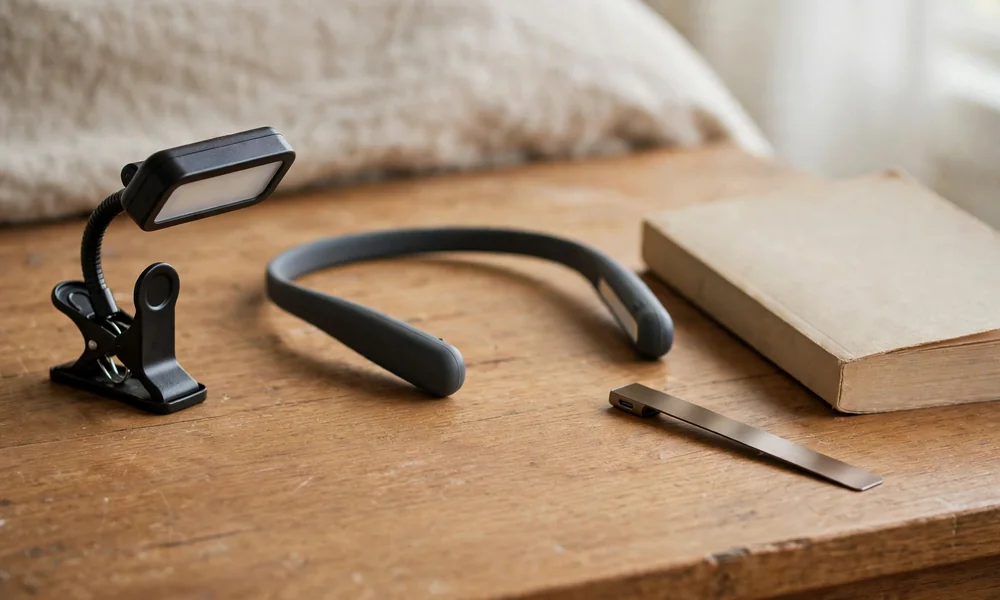
Clip-On Book Lights
A clip-on book light fastens to the top of the book, the cover, or a headboard, and a short flexible neck aims the light down at the page. It is the most popular type, and for most readers it is the best. The clip keeps the light exactly where it belongs, the gooseneck lets you angle the beam away from your partner, and the light stays put when you turn the page. Look for a clip that grips firmly without marking the cover, and a neck that holds its position rather than slowly drooping toward the page.
Neck Book Lights
A neck book light hangs around your neck like a pair of headphones, with a flexible arm on each side pointing down at the book. It suits people who change position while they read, because the light moves with you rather than with the book. It also suits readers who hold the book in their hands rather than propping it up, since there is nothing to clip on. The trade-off is comfort: a heavy neck light pulls after half an hour, and a light that sits too high shines into your own eyes.
Colour, Brightness, and the Beam
Colour temperature is the first number to check, and it matters more than brightness. Light is measured in Kelvin, with lower numbers meaning warmer light. Amber light around 2700K looks like candlelight: soft, golden, and relaxing. Light above 5000K looks like daylight and feels alert and cold. For reading beside a sleeping partner, warm light wins twice over. It is easier on your tired eyes, and it is far less likely to wake the person next to you, because warm light does not trigger the alertness that cool light does.

Brightness is the second number, and more is not better. Around 100 to 200 lumens on the page is comfortable for most readers, which is far less than a bedside lamp gives. What matters is the dimmer. A light with three fixed brightness levels will be too bright for late reading or too dim for small print, because the right level changes as the evening goes on. Stepless dimming, where the brightness slides smoothly rather than jumping between settings, is the most comfortable, and it is the feature that most separates a good book light from a cheap one.
The beam is the third thing, and it is the one that decides whether your partner sleeps. A good book light has a narrow, focused beam that falls on the page and stops there. A bad one spills light sideways, onto the pillow, the wall, and your partner’s face. You can test this before you buy: switch the light on in a dark room and look at it from the side, from where your partner’s head would be. If you can see the glowing bulb, the beam is too wide or the light is aimed wrong.
Battery Life and Charging
A book light that dies mid-chapter is worse than no book light at all, so battery life deserves a proper look. A good clip-on light runs for twenty to thirty hours on its lowest setting, which is several weeks of nightly reading, and eight to twelve hours on its brightest. Neck lights usually run a little shorter, because they power two heads, while bookmark lights run longest of all, because their panel draws so little power.
Rechargeable lights have almost entirely replaced battery-powered ones, and that is a good thing: a USB-C rechargeable light costs nothing to run and never leaves you hunting for coin batteries at midnight. Check the charging port before you buy, because older lights still use micro-USB, which means carrying a second cable. Check the charging time too: most good lights recharge fully in two to three hours, so plugging one in during the day covers the night.
Comfort, Clips, and Living With the Light
Comfort decides whether a book light gets used or ends up in a drawer. A clip-on light should be light enough that it does not pull the book over, and the clip should be padded, so it does not dent the cover or scratch a tablet. A neck light should sit without pressing on the collarbone, and its arms should be soft where they touch the neck. Try the light for a full chapter before you judge it: a light that feels fine for five minutes can ache after forty.
Book Lights Compared
| Book Light Type | Best For | Typical Battery Life | Light Spread | Watch Out For |
|---|---|---|---|---|
| Clip-on, dual head | Most readers, hardbacks | 20–30 hours | Both pages evenly | Heavy clips pull thin books over |
| Clip-on, single head | Paperbacks, travel | 25–40 hours | One page well | Uneven light across two pages |
| Neck light | Readers who move around | 12–20 hours | Moves with you | Heavy models ache after 30 minutes |
| Bookmark light | Travellers, small books | 30–60 hours | One page, soft | Too dim for small print |
| Clip-on with amber mode | Shared beds, late reading | 15–25 hours | Warm, narrow beam | Amber mode can be dimmer overall |
| Rechargeable flat panel | E-readers, tablets | 20–35 hours | Even, glare-free | Needs a flat surface to rest on |

Setting Up So Your Partner Stays Asleep
The light itself is only half the answer. The other half is how you use it. Position the book low, on your lap or on a pillow, rather than holding it up, because a low book keeps the beam pointing down and away from your partner. Angle the light so it falls on the page from your side, not from the middle of the bed, and keep the brightness as low as you can still read comfortably: your eyes adjust within a minute, and the lower setting disturbs nobody.
Keep a night light in the hallway rather than the bedroom: our guide to the best night lights for kids, hallways and late-night trips covers the ones that glow without waking anyone.
Book Light Buying Checklist
- Choose warm amber light, 2700K to 3000K, and avoid cool white for late-night reading.
- Check the beam is narrow and focused: the page should glow, but the bulb should be invisible from your partner’s side of the bed.
- Pick stepless dimming over fixed brightness levels, so you can turn the light down as the night goes on.
- Test the clip on your own books: it should grip firmly without marking the cover or pulling a paperback over.
- Check the battery lasts at least twenty hours on low, and that it charges over USB-C.
- Listen for clicks and buzzes: a good light changes brightness silently.
Frequently Asked Questions
What is the best type of book light for a shared bed?
A clip-on light with two heads and an amber mode is the best choice for most shared beds. It fastens to the book, aims a narrow warm beam at the page, and stays put when you turn over.
Will a book light disturb my partner?
A good one will not, as long as it has a narrow beam, warm amber light, and a dimmer you can turn down. Keep the book low, aim the light from your side, and check from your partner’s pillow that you cannot see the bulb.
Is amber light really better than white light at night?
Yes. Warm amber light around 2700K is easier on tired eyes and less likely to disturb sleep than cool white light, which signals alertness to the brain.
How long does a rechargeable book light last?
Most rechargeable clip-on lights run for twenty to thirty hours on their lowest setting and eight to twelve hours on their brightest.
Are neck book lights comfortable to wear?
Light ones are, heavy ones are not. Look for a neck light under 100 grams, with flexible arms that stay where you put them and soft ends where they touch your skin.
Can I use a book light with an e-reader?
Yes, and most clip-on lights grip an e-reader as well as a paper book. If you read on a tablet, a flat panel light or a clip-on with a wide, padded clip works best, because a narrow clip can press on the screen.
The Bottom Line
The best book light for a shared bed is not the brightest one or the cheapest one. It is the one with a narrow, warm beam, a dimmer that slides smoothly down to almost nothing, and a clip or a neckband that stays comfortable for a whole chapter. Buy a clip-on with an amber mode for most readers, a neck light if you move around, and a bookmark light if you travel. Keep the book low, keep the light dim, and check from your partner’s side of the bed that the bulb is invisible. Do those things, and you can finish the chapter while the person beside you sleeps straight through it.


