
The Reading Lamps That Make Night Reading Easy in 2026
The best reading lamps for night reading in 2026 do one simple job well: they put a small pool of warm, steady light on the page and nowhere else. Most lamps fail at this. Overhead lights are too bright and too far away, phone screens tire the eyes, and a lamp that is too cool or too harsh turns a relaxing chapter into a headache. A good reading lamp lets you read for an hour after dark without squinting, without glare, and without waking anyone else in the room. This guide covers the types that work at night, how bright they should be, which colour of light suits tired eyes, and how to choose one for a bed, an armchair, or a journey.
Key Takeaways
- Warm light between 2700K and 3000K is easiest on tired eyes at night, and kinder to sleep than cool white light.
- A reading lamp should light the page, not the room: 200 to 400 lumens is usually enough for a book at normal distance.
- A dimmer matters more than a high maximum brightness, because the right level at nine in the evening is too bright at midnight.
- Clip-on and neck lights suit a shared bed best, since they keep the light on the page alone.
- Buy for the place you actually read: a floor lamp suits an armchair, a clip-on suits a bed, a small rechargeable light suits travel.
Why Night Reading Light Is Different
Reading at night asks more of your eyes than reading in the day. The pupil opens wider in the dark, so glare feels stronger, and the contrast between a bright page and a dark room tires the eyes faster. A reading lamp should sit between you and the page, or just over your shoulder, so light falls on the words without shining into your eyes. If you can see the bulb while you read, the lamp is in the wrong place.
Colour temperature matters most after position, measured in Kelvin, with lower numbers meaning warmer light. Light around 2700K to 3000K looks like late evening sun: soft, golden, and relaxing. Light above 5000K looks like daylight and feels alert and cold. For night reading, warm light wins, and many good lamps now let you change the colour temperature.
Brightness is the second number to watch, and more is not better. Around 200 to 400 lumens on the page is comfortable for most readers, and a dimmer lets you turn it down as the evening goes on. A lamp with only one setting will be too bright for late reading or too dim for small print. Stepless dimming, where brightness slides smoothly rather than jumping between fixed levels, is the most comfortable.
Before you settle on a lamp, test it the way you will actually use it: in the dark, in your usual chair, with the book you are reading now. A lamp that feels right under shop lights can feel very different at half past ten, when the room is dark and your eyes are tired. Give it a full evening before you decide, and keep the receipt. The right lamp should feel unnoticeable within a few minutes, leaving you aware only of the story.
The Main Types of Reading Lamp, Compared
There is no single best shape, because the right shape depends on where you sit. A floor lamp is wonderful beside an armchair and useless in a bed, while a clip-on light is perfect for a shared bed and hopeless for a sofa with nothing to clip it to.
| Type | Best For | Light | Watch Out For |
|---|---|---|---|
| Clip-on book light | Bed, travel | Narrow, focused | Short battery on cheap models |
| Neck reading light | Bed, shared rooms | Two small beams | Can feel heavy after an hour |
| Adjustable arm lamp | Armchair, desk | Aimed, dimmable | Needs a stable, heavy base |
| Floor reading lamp | Armchair corner | Wide, warm pool | Takes up floor space |
| Gooseneck bedside lamp | Bed, small rooms | Flexible, dimmable | Wobbles if the base is light |
Clip-On Book Lights
A clip-on book light is the smallest reading lamp you can buy, and for many night readers it is the only one they need. It clips to the book or a headboard, bends on a short gooseneck, and throws a small pool of warm light across both pages. The best ones run for twenty hours or more on a charge and weigh almost nothing. They are the natural choice when you share a bed, because the light stays on the page. Buy one with a warm setting and a padded clip that will not mark a paperback cover.

Neck Reading Lights
A neck reading light hangs around your neck, with a small light on each side aimed down at the page. Readers who share a bed swear by it, because the light moves with you and never shines at a partner, and most models let you dim each side separately. The trade-off is comfort: a heavy model presses on the neck after an hour. Choose a light, flexible model with warm LEDs and a battery that lasts a full evening.
Adjustable Arm and Floor Lamps
For reading in an armchair, nothing beats a lamp with an adjustable arm or a tall floor lamp with a good shade. An adjustable arm lamp lets you aim the light exactly at the page, and a heavy base keeps it steady when you reach for it in the dark. A floor lamp with a linen shade gives a wider, softer pool of light. The shade matters as much as the bulb: a pale lining reflects light down onto the page, while a dark shade traps it.

Choosing Brightness and Colour for Tired Eyes
Tired eyes need less light than you think, but they need it in the right place. The most common mistake is buying the brightest lamp in the shop and reading under a glare that makes the eyes water. Start dim and turn the light up only until the words are clear without effort. If you squint, the problem is usually glare or position, not brightness: move the lamp closer to the page and further from your eyes.
Glare comes from a bare bulb in your line of sight and from light reflecting off glossy pages or a screen. A shade that hides the bulb and a lamp head that aims down both help. Reading glasses that do not hurt your eyes can help too, but glasses cannot fix a lamp that glares. Fix the light first.
Flicker is a quieter problem worth checking for. Cheap lamps sometimes flicker so fast you cannot see it, yet your eyes still tire after half an hour. A good lamp gives steady light with no buzz and no visible pulsing, even on its lowest setting. If a lamp hums or strains your eyes within minutes, return it.
Reading in Bed Without Waking Anyone
Reading in bed is the hardest test for a lamp, because the person beside you is trying to sleep a few feet away. Keep the light on the page, keep it warm, and keep it dim. A clip-on or neck light does this best, because the beam is narrow and aimed down. A gooseneck lamp bent low can work too, but a tall table lamp will spill light across the whole bed. If you read in bed every night, our guide to bedside lamps made for reading covers the bedside-only choices in detail.
Position matters as much as the lamp. Sit up with a pillow behind you and aim the light at the centre of the page rather than at your face. Avoid reading lying flat with a light above you, because the book falls into shadow and the light shines into your eyes. When the chapter ends, turn the lamp off: even a small light in a dark room can keep you awake.
Paper Books, E-Readers, and Screens
The lamp you need depends on what you read. A paper book needs a lamp, and warm focused light suits it best. An e-reader with a built-in front light needs far less help, and often none at all. A tablet is hardest at night, because its screen is a light source itself, and a bright lamp on top only increases glare. If you read on a tablet, dim the screen and turn on its warm night mode.
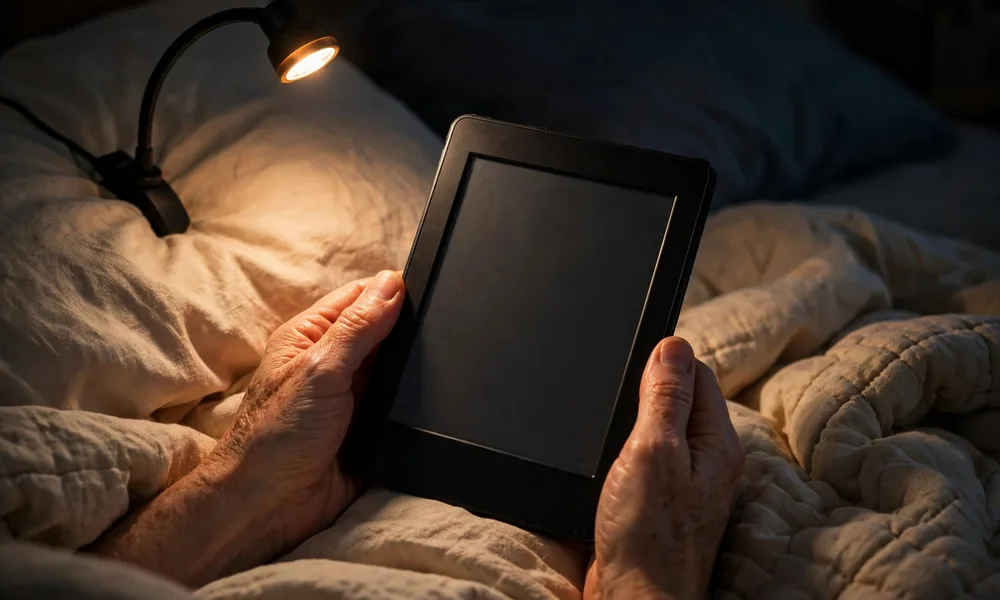
If you are choosing between paper and screen, the best e-readers are worth a look, because their front-lit screens are far gentler at night than a tablet. The less light you need to see the words clearly, the better you will sleep afterwards. A paper book and a warm clip-on light lets many readers read longest and fall asleep fastest, and it is the cheapest combination to get right.
Reading Lamp Checklist
- Warm light, 2700K to 3000K, with a dimmer that goes genuinely low.
- A focused beam that lights the page without shining into your eyes.
- A stable base or a firm clip, so the lamp stays where you put it.
- Steady light with no flicker, buzz, or visible pulsing on low settings.
- A battery that lasts a full evening if the lamp is rechargeable.
- The right shape for where you read: bed, armchair, desk, or travel.
Frequently Asked Questions
How bright should a reading lamp be?
For most readers, 200 to 400 lumens on the page is comfortable at night. Start dim and turn the light up only until the words are clear without squinting. If the lamp has no dimmer, it is probably too bright or too dim for late reading.
Is warm or cool light better for reading at night?
Warm light between 2700K and 3000K is better at night. It feels calm, is easier on tired eyes, and interferes less with sleep. Cool white light above 5000K feels alert and clinical, and suits daytime work better than a bedtime chapter.
Can a reading lamp damage your eyes?
A normal reading lamp will not damage your eyes, but a glaring or flickering lamp can tire them quickly and give you a headache. Keep the bulb out of your line of sight, use warm dimmable light, and take a short break if your eyes feel sore or dry.
What is the best reading lamp for a shared bed?
A clip-on book light or a neck reading light is best, because both keep a narrow beam on the page and spill almost no light onto the person beside you. A dimmed gooseneck lamp bent low over the book is the next best choice.
Do I need a reading lamp for an e-reader?
Usually not, because most e-readers have a built-in front light. A small warm light can still help in a completely dark room, but keep it dim and warm, and turn the e-reader brightness down to match.
How long should a rechargeable reading light last?
Look for at least fifteen to twenty hours on a low or medium setting, which covers a week of bedtime reading for most people. Anything under five hours will need charging too often and will run out mid-chapter.
The Bottom Line
The reading lamps that make night reading easy in 2026 are not the brightest or the cleverest lamps you can buy. They are the warm, dimmable, well-aimed ones that put light on the page and nowhere else, whether that is a clip-on light in a shared bed, a floor lamp beside a favourite chair, or a small rechargeable light in a suitcase. Choose the shape for the place you actually read, keep the light warm and low, and hide the bulb from your eyes. Get those three things right, and the lamp disappears into the evening, leaving only the book.


