
Cabinet hinges that close softly every time in 2026 are the small pieces of hardware that decide whether a kitchen feels calm or chaotic. The best pull the door shut in the last few centimetres, settle it gently against the frame, and hold it there without a rattle or a bang. A bad one does the opposite: the door slams, sags, or drifts open again the moment you walk away.
Choosing the best cabinet hinge is about matching the hinge to the door and the cabinet: a light bathroom door, a heavy oak kitchen door and a frameless flat-panel door all need different hinges. This guide explains how they work and helps you pick hinges that close softly for years.
Key Takeaways
- A cabinet hinge carries the full weight of the door, so it must match the door’s weight, size and thickness.
- Concealed hinges suit modern frameless cabinets; butt hinges suit traditional framed cabinets.
- Soft-close matters most for daily use, because it stops slamming and keeps doors shut.
- Measure the overlay first: the wrong one leaves a gap or a door that will not close.
- Solid steel and brass last longest; thin stamped hinges bend and pull loose within a year.
How a Cabinet Hinge Actually Works
A cabinet hinge is a pivot: two plates joined by a knuckle or a cup mechanism, one fixed to the door and one to the cabinet. It carries the full weight of the door while letting it swing, thousands of times a year. When the hinge is wrong, the top hinge pulls out, the door drops, and the gap around it goes uneven.
Soft-close hinges add a small damper to that pivot. As the door swings shut, the damper catches it and pulls it gently home, so the door closes itself without a sound. It is the single biggest difference between a kitchen that feels expensive and one that feels cheap, and it costs only a few pounds per hinge.
The hinge holds the door up and moves it; the knob is the part your hand grabs, and our guide to door knobs that feel solid every time covers it. The drawer slide carries a drawer in and out, and our guide to drawer slides that glide without sticking covers that. Get the hinge right and the rest follows.
The Main Types of Cabinet Hinge
Concealed Hinges
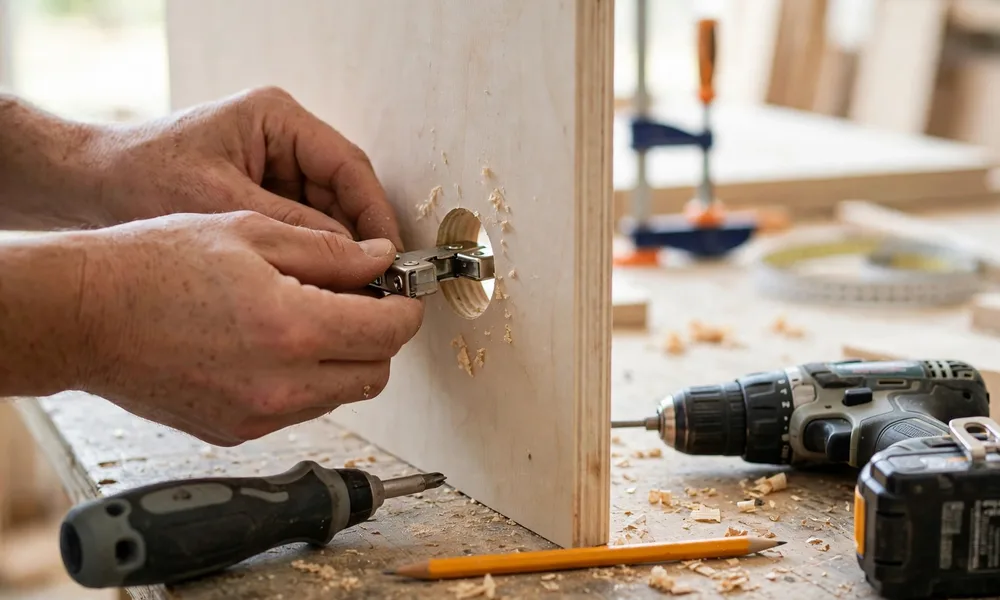
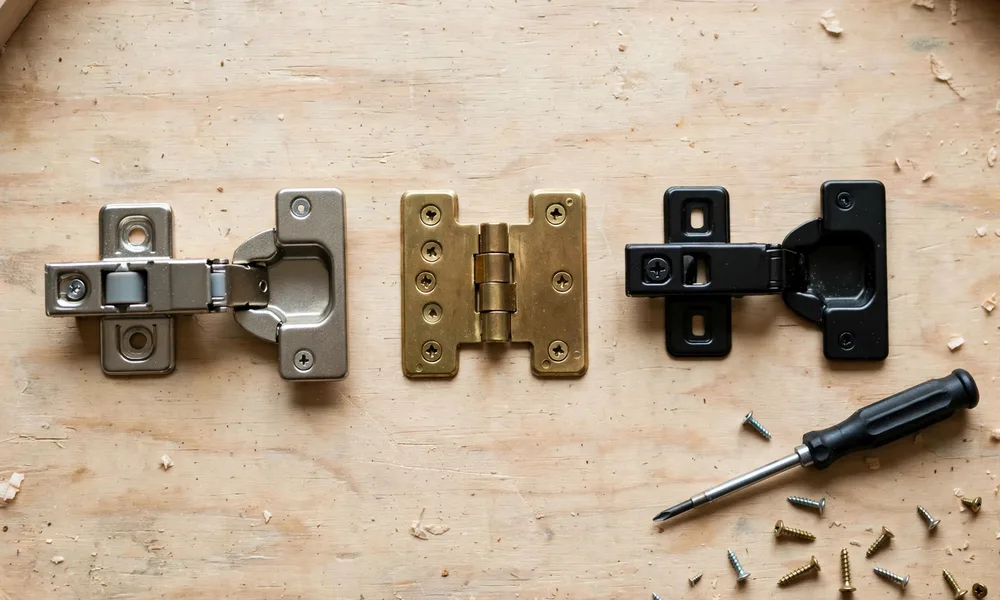
Concealed hinges hide inside a cup drilled into the back of the door, so nothing shows when it is closed. They suit frameless cabinets and modern kitchens, and they adjust in three directions. Most come with soft-close built in. Their weakness is the cup: you need a 35-millimetre hole drilled to the right depth, so they are harder to retrofit.
Soft-Close Hinges
Soft-close is less a type than a feature. A soft-close hinge has a damper that catches the door and closes it gently, stopping slams and keeping doors shut. It is worth having on every kitchen and bathroom door. The damper adds a little to the price and is worth it every time.
Butt Hinges
Butt hinges are the traditional choice: two rectangular leaves, one screwed to the door edge and one to the frame, joined by a pin. They suit framed cabinets and period kitchens, and they show, so the finish matters. For a standard cabinet door, a solid brass or stainless steel butt hinge is the right starting point. Hollow stamped butt hinges bend and pull loose, so avoid them.
Overlay and Inset Hinges
Overlay describes how the door sits on the cabinet. A full-overlay door covers the whole front, a half-overlay door covers half the side panel, and an inset door sits flush inside the frame. Each needs a different hinge, and buying the wrong one leaves a door that will not close or a gap at the edge. Check before you order, and measure twice.
Corner and Specialty Hinges
Corner cabinets need hinges that open wider than standard, usually 165 degrees instead of 110, so you can reach into the back. Blind-corner hinges do the same job for cabinets that meet at an angle. Glass-door hinges clamp onto the glass instead of screwing into it. These are niche, but when you need one, nothing else will do.
The Best Cabinet Hinges of 2026
We judged every hinge on closing action, strength, adjustment, finish and value, fitting each one to a real cabinet door and opening it a hundred times.
Best Overall: Blum Blumotion 110°
The Blum Blumotion 110-degree hinge is the best cabinet hinge for most people in 2026. Its soft-close damper is the smoothest we tested: the door glides shut and settles without a sound, every time, with no bounce and no rattle. The three-way adjustment is precise and easy, and the clip-on fitting means the door lifts off in seconds for cleaning. At around six pounds per hinge it is not the cheapest, but it is the one every kitchen fitter we know recommends.
Best Budget: Hettich Sensys 8645i
The Hettich Sensys 8645i proves a budget hinge can close softly too. Its damper is quiet and consistent, the adjustment is simple, and the finish resists fingerprints and tarnish. It is slightly less smooth than the Blum on very heavy doors, but for standard kitchen doors it is genuinely excellent value at around three pounds per hinge.
Best for Heavy Doors: Grass Tiomos 110°
The Grass Tiomos is the best hinge for heavy doors. Its thick steel arm and oversized cup carry doors up to 25 kilograms without sagging, and the damper stays smooth even under load, where cheaper hinges slam or stall. It costs more than the standard picks, but for oak and solid-wood doors it is worth it.
Best Traditional: Solid Brass Butt Hinge
A solid brass butt hinge is the best choice for framed and period cabinets. It shows, so it should look good, and solid brass does: warm, heavy, and it ages gracefully instead of flaking like plated copies. Ball-bearing versions swing smoother and last longer. Buy solid, not hollow, and match the size to the door: 75 millimetres for small doors, 100 millimetres for tall ones.
Best Wide-Angle: Blum Blumotion 155°
The Blum Blumotion 155-degree hinge is the best wide-angle hinge for corner cabinets. It opens far enough to reach the back of a corner cupboard without the door blocking your arm, and the soft-close damper works just as smoothly at the wider angle. It costs a little more, but a corner cabinet you cannot reach into is wasted space.
Best for Glass Doors: Sugatsune Glass Hinge
The Sugatsune glass-door hinge is the best choice for glass cabinet doors. It clamps onto the glass with a rubber-lined grip, so there is no drilling and no risk of cracking, and the soft-close damper closes the door gently despite the weight of the glass. It is a specialist hinge at a specialist price, but for glass doors nothing else works as well.
Cabinet Hinges Compared
| Hinge | Type | Opening angle | Soft-close | Best for |
|---|---|---|---|---|
| Blum Blumotion 110° | Concealed | 110° | Yes | Most kitchens |
| Hettich Sensys 8645i | Concealed | 110° | Yes | Budget kitchens |
| Grass Tiomos 110° | Concealed | 110° | Yes | Heavy doors |
| Solid brass butt hinge | Butt | 180° | No | Period cabinets |
| Blum Blumotion 155° | Concealed | 155° | Yes | Corner cabinets |
| Sugatsune glass hinge | Clamp-on | 110° | Yes | Glass doors |
What to Avoid
The worst cabinet hinges share the same faults. The first is thin stamped steel: if a hinge feels light and bends between your fingers, it will bend on the door too, and the door will sag within months. The second is a soft-close damper that fades: cheap dampers work for a few weeks, then the door starts slamming again. The third is a hinge with no adjustment, because a door that cannot be aligned will never sit straight.
Unbranded multi-packs are the worst offenders. They often mix hinge types in one box, use screws too soft to hold, and arrive with finishes that flake within a year. A hinge is a small purchase, but it carries your door every day, and replacing a failed one means re-drilling the cup and re-aligning the door. Buy from a known maker, buy the right overlay, and buy one extra as a spare. A room door uses the same idea at a bigger scale, and our guide to door hinges that make doors swing smoothly covers full-size door hinges.
How to Fit and Adjust a Cabinet Hinge
Fitting a concealed hinge starts with the cup: a 35-millimetre hole, 13 millimetres deep, about 22 millimetres from the door edge. Use a Forstner bit, because a wandering hole means a hinge that sits crooked. Screw the hinge into the cup, clip the arm onto the mounting plate, and the door is on.
Adjustment is where a good hinge earns its price. Three screws move the door in three directions: left and right, up and down, and in and out. Adjust a quarter-turn at a time, and check the gaps after each one: they should be even, about two millimetres all round. A door that rubs at the top needs the top hinge moved out; a door that sags needs longer screws or a hardwood plug in worn holes.
Buying Checklist
- Check the overlay and buy the hinge that matches it.
- Count the hinges: two for a light door, three for a tall or heavy one.
- Choose soft-close for every kitchen and bathroom door.
- Buy solid steel or brass, never thin stamped hinges.
- Check the cup size before you order.
- Buy one spare hinge.
Frequently Asked Questions
How many hinges does a cabinet door need?
Two hinges carry a standard cabinet door, but it depends on weight and height. A light door under 60 centimetres tall is happy on two. A tall door, a solid-wood door, or any door over about 10 kilograms needs three, top, bottom and middle, to share the load.
Can I add soft-close to my existing hinges?
Sometimes. Some makers sell clip-on dampers for their own hinges, and some sell adapters that screw to the cabinet frame. If your hinges are a standard 35-millimetre concealed type, an adapter often works. If they are butt hinges or an unusual brand, replacing the hinge is usually easier.
What is the difference between overlay and inset hinges?
Overlay describes how the door sits on the cabinet. A full-overlay door covers the whole front, a half-overlay door covers half the side panel, and an inset door sits flush inside the frame. Each needs a different hinge. Buying the wrong one leaves a door that will not close or a gap at the edge, so check before you order.
Why does my cabinet door keep opening on its own?
A door that drifts open is usually misaligned or the cabinet is not level. Check the gaps first: if they are uneven, adjust the hinges until they are even. If the gaps are even and the door still drifts, the cabinet itself may lean forward, and a stronger damper will hold it shut.
Do cabinet hinges wear out?
Yes, but slowly. A good steel hinge lasts for decades, while a cheap stamped hinge can fail within a year. The damper usually fades first: if the door starts slamming again, the damper has worn out.
Can I fit cabinet hinges myself?
Yes, if you can drill a clean 35-millimetre hole. A Forstner bit, a drill and a simple jig make the cup hole straightforward. Butt hinges are even easier: mark, chisel a shallow mortise, and screw them on. If the doors are heavy, a fitter is worth the cost.
The Bottom Line
The best cabinet hinge is one you never notice: the door closes softly, sits straight, and stays shut. For most kitchens, that is the Blum Blumotion 110-degree hinge. Heavy doors need the Grass Tiomos, corner cabinets need the wide-angle Blum, and period cabinets need solid brass butt hinges. Match the overlay, buy solid metal, and fit three hinges on tall doors.


