
Cabinet knobs that finish a kitchen in 2026 are the smallest pieces of hardware in the room, and the ones your hand meets every time you cook, clean, or make a cup of tea. A good knob disappears into the routine: you pinch it, pull, and the door opens. A bad one nags at you daily, wobbling on its screw, spinning in your fingers, or catching on a sleeve as you pass. Choosing the best cabinet knob is not about picking the prettiest shape in the shop. It is about matching the knob to the door, the finish, and the way your household uses the kitchen.
This guide explains how cabinet knobs work, which shapes suit which doors, and how to measure and fit them, so a kitchen that cost thousands to build is not let down by hardware that cost pennies. The right knob makes plain doors look considered; the wrong one makes even a new kitchen feel cheap within months.
Key Takeaways
- A cabinet knob is a single-point pull: one screw, one grip, and no latch to turn, which is what separates it from a door knob.
- Round knobs suit almost every kitchen; mushroom knobs suit traditional doors, and glass knobs suit quiet rooms, not busy family kitchens.
- Solid brass and stainless steel last longest; hollow knobs feel light, loosen fastest, and are the first thing to replace.
- Measure the screw length before you buy: a screw that is too short will not hold, and one that is too long will poke through the door.
- Match the finish across the kitchen, and keep it consistent with the hinges and the tap, or the room will look assembled from leftovers.
What a Cabinet Knob Actually Does
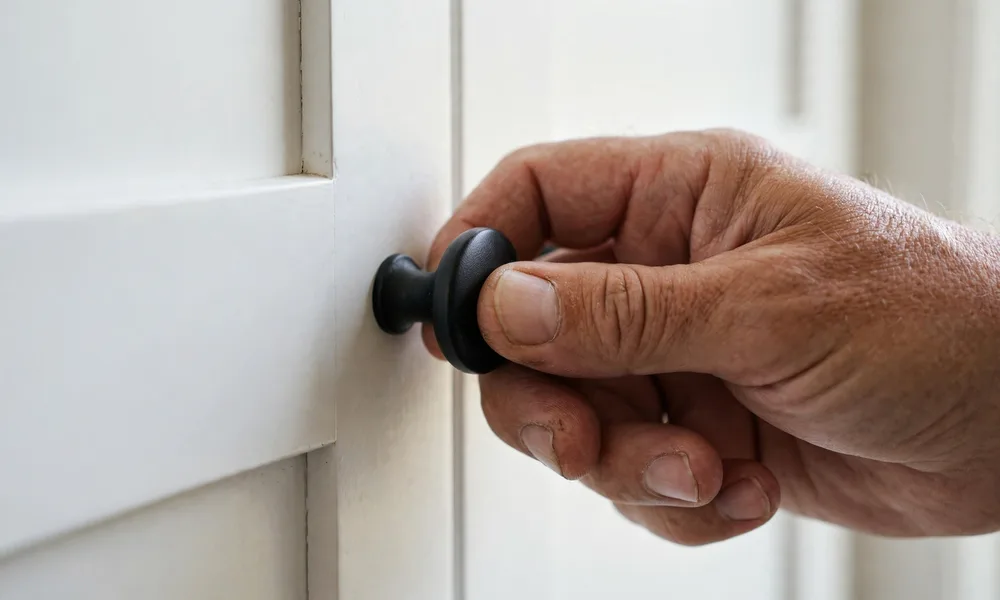
A cabinet knob is a single point of grip fixed to a door or drawer front with one screw through the wood. It does not turn a latch or lock anything; its whole job is to give your fingers something to hold so you can pull a door open without touching the painted surface. That simplicity is its strength: there is almost nothing to go wrong, and a good knob will outlast the door it is screwed to.
The difference between a good knob and a bad one shows up in the hand, not on the shelf. A good knob has real weight, a shape your fingers can find without looking, and a base that sits flat against the door. A bad knob feels light and hollow, spins on its screw the first week, and leaves a dark ring on the paint where it has worked loose. The hinge carries the door and moves it, and our guide to cabinet hinges that close softly every time covers that half of the job. The knob is the half you touch, and it deserves the same care.
Knobs are often confused with two other pieces of hardware, and the confusion costs people money. A door knob turns a latch and opens a room door, and our guide to door knobs that feel solid every time covers those. A cabinet pull is the knob’s closest relative: a bar or cup handle fixed with two screws instead of one, which spreads the load across a wider grip. Pulls suit wide drawers and heavy doors, where a single screw would work loose; knobs suit doors and small drawers, where one fixing is plenty and the smaller shape keeps the front looking calm. Pick the knob when the door is light and the look is quiet; pick the pull when the drawer is wide, heavy, or opened fifty times a day.
The Main Types of Cabinet Knob
The Round Knob: Best All-Rounder
The round knob is the strongest all-round choice, and the one most kitchens should start with. Its familiar ball shape fits any hand, suits any door from plain white slab to panelled shaker, and comes in every finish from polished brass to matte black. The best are solid brass or stainless steel, heavy enough to tell you the metal is real. They are easy to clean, never snag clothing, and look right anywhere. A round knob that feels light and hollow is a cheap copy, and it will loosen within a year.
The Mushroom Knob: Best for Traditional Kitchens
The mushroom knob, with its wide, flat cap and short stem, is the best choice for traditional and period kitchens. Its broad face spreads the pressure across the fingertips, so it feels gentle even on a stiff door, and its classic silhouette suits panelled doors, painted wood, and farmhouse kitchens. The best are solid brass with a lacquered finish, or ceramic with a brass base. They suit period doors best, and look out of place in very modern kitchens. Choose one with a solid screw and a firm base, because a cheap mushroom knob wobbles more visibly than any other shape.
The Egg Knob: Best for Comfort
The egg knob is the best choice for comfort, because its elongated shape gives fingers more to hold than a perfect sphere. It suits older hands and stiff fingers well, since the grip is natural and the pull needs less force. The best come in solid brass and bronze, with a warm look that suits cottage kitchens. They also work well on heavier doors, where the extra grip helps pull the door closed. They cost a little more than a plain round knob, and in a kitchen used every day, the comfort is worth it.
Glass and Crystal Knobs: Best for Quiet Rooms
Glass and crystal knobs are the best choice for bedrooms, dressing rooms, and display cabinets, where their sparkle catches the light and turns an ordinary door into a feature. A good crystal knob is cut from solid glass, feels cool and heavy, and sits on a solid brass base, which gives it the weight glass alone cannot provide. They are not right for a busy family kitchen, where wet hands and hard knocks can chip the glass. But for a quiet room, nothing else looks quite so elegant.
Ceramic and Porcelain Knobs: Best for Character
Ceramic and porcelain knobs are the best choice for character, because they come in colours and patterns metal never can, from plain cream to hand-painted blue. A good ceramic knob feels smooth and cool, and adds craft to a plain painted door. The best have a solid brass or steel screw and a metal base that stops the ceramic cracking at the fixing. They suit country kitchens and furniture that wants a handmade feel, but check the fixing on heavy doors, where the single screw can work loose.

Cabinet Knobs Compared
| Knob | Shape | Best material | Best for | Watch out for |
|---|---|---|---|---|
| Round knob | Ball | Solid brass | Most kitchens | Hollow copies that loosen |
| Mushroom knob | Flat cap | Lacquered brass | Traditional kitchens | Wobble on cheap fixings |
| Egg knob | Elongated | Bronze | Comfort and older hands | Higher price |
| Glass knob | Faceted | Solid glass on brass | Bedrooms and display cabinets | Chips in busy kitchens |
| Ceramic knob | Varied | Porcelain on metal base | Character and colour | Cracks at the fixing |
What to Avoid
The worst cabinet knobs share the same faults. The first is hollow metal: if a knob feels light and rings when you tap it, it is a thin shell, and it will dent and loosen within months. The second is a short or soft screw, because the screw is what holds the knob to the door, and a screw that strips leaves a knob that turns uselessly in your hand. The third is a base that does not sit flat, which rocks on the door and marks the paint.
Unbranded multi-packs are the worst offenders: mixed sizes, screws too soft to hold, and finishes that flake within a year. A knob is touched dozens of times a day, and replacing a failed one means filling the hole and re-drilling the door. Buy from a known maker, buy solid metal, and buy one spare. The drawer below the door moves on different hardware, and our guide to drawer slides that glide without sticking covers the runners that carry it.
How to Measure and Fit a Cabinet Knob
Fitting a cabinet knob is a ten-minute job, but measuring first saves a second trip to the shop. Measure the thickness of the door, because the screw must pass through the door and bite into the knob without poking out the front. Most cabinet doors are between 16 and 22 millimetres thick, and most knobs come with a screw to suit, but thick solid-wood doors need a longer one.
Mark the position before you drill. On a door, the knob sits near the corner opposite the hinge, about 50 to 75 millimetres from the edge. On a drawer front, it sits dead centre, or in a pair on a wide drawer. Drill a clean pilot hole from the front so the back does not splinter, then tighten the screw from behind. Stop as soon as the base sits flat: over-tightening cracks ceramic knobs and dents softwood doors. Check the knob after a week, and again after a month, because new screws settle and a quarter-turn then keeps them tight for years.

Buying Checklist
- Choose solid brass or stainless steel, never hollow knobs.
- Measure the door thickness and buy the right screw length.
- Match the finish to the hinges and the tap.
- Pick round knobs for most kitchens and glass only for quiet rooms.
- Check the base sits flat before you tighten the screw.
- Buy one spare knob and two spare screws.
Frequently Asked Questions
Are cabinet knobs or pulls better?
Neither is better in general; they suit different doors. A knob uses one screw and suits doors and small drawers, where the load is light. A pull uses two screws and suits wide, heavy drawers, where the load needs spreading. Many kitchens mix them: knobs on doors, pulls on drawers.
What size cabinet knob should I buy?
Most cabinet knobs are between 25 and 40 millimetres across. A 30-millimetre knob suits a standard kitchen door, while a 40-millimetre knob suits a tall pantry door. Small knobs look lost on big doors, and oversized knobs overwhelm small drawers, so match the knob to the door.
How do I stop cabinet knobs coming loose?
Knobs loosen when the screw is too short or the hole has worn wide. Use a screw that bites at least 10 millimetres into the knob, and check it after a week. If the hole is worn, fill it with a hardwood plug and re-drill it, or use a slightly longer screw.
Can I mix knob finishes in one kitchen?
You can, but keep it deliberate. One finish for the kitchen, with a second on a single feature piece, looks considered. Three or four finishes scattered across the room look accidental. Match the knobs to the hinges and the tap first.
Do cabinet knobs work on drawers?
Yes, on small and medium drawers. A single knob centred on a drawer front works well up to about 450 millimetres wide. Wider drawers need two knobs or a pull, because one central fixing cannot spread the load.
How do I clean brass cabinet knobs?
Wipe lacquered brass with a damp cloth and dry it straight away; never use abrasive cleaner, which strips the lacquer. Unlacquered brass will tarnish: polish it with a gentle brass cleaner if you want it bright, or leave it to age into a soft, darker patina.
The Bottom Line
The best cabinet knob is one you never think about: it feels solid, sits flat, and opens the door first time, every time. For most kitchens, that is a solid brass round knob. Traditional kitchens suit the mushroom knob, older hands suit the egg knob, and quiet rooms suit glass. Buy solid metal, measure the screw, and match the finish.


