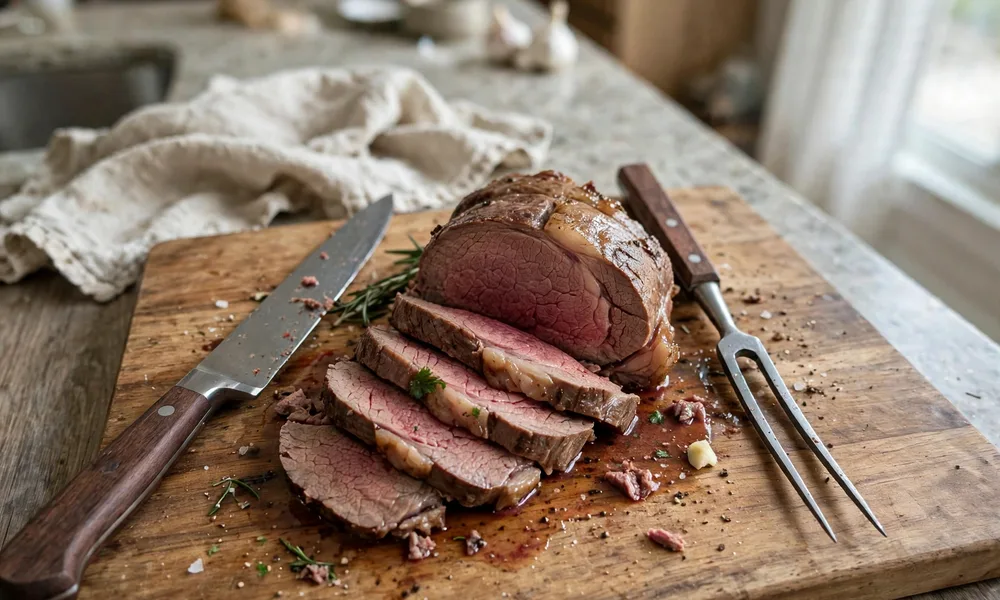
A roast carved with the wrong knife ends up looking like it lost a fight. The slices tear, the juices run across the board, and the crust you spent hours building crumbles into shreds. The best carving knives of 2026 fix all of that with one long, smooth stroke: a thin blade that glides through a rested roast, leaving clean faces on every slice and the juices where they belong, inside the meat. This guide explains how to choose carving knives that earn their place at the table.
Key Takeaways
- A carving knife needs a long, thin blade of 20 to 30 centimetres, so one stroke covers the full width of a roast without sawing.
- A straight, fine edge slices cleanest on rested meat, while a Granton edge with shallow dimples stops thin slices from sticking.
- High-carbon stainless steel at 56 to 58 on the Rockwell scale holds an edge well and resists rust.
- Balance matters more than weight: a knife that sits level on your finger at the bolster will feel steady through a whole joint.
- Hone the edge before every roast and sharpen it once or twice a year, and a good carving knife will last decades.
What Makes a Carving Knife Different
A carving knife is not a chef knife with a longer blade, and it is not a steak knife scaled up. It is a specialist built for one job: turning a whole cooked joint into neat, even slices. The blade is long and narrow, usually 20 to 30 centimetres, so a single forward stroke travels the full width of a turkey breast or a leg of lamb. The edge is fine and straight, ground to part cooked fibres cleanly rather than crush them.
A chef knife does a different job. Its broad, curved blade is made for rocking through raw vegetables on a board, and its 20-centimetre length is too short to cross a wide roast in one stroke, which forces a sawing motion that shreds the surface. If your kitchen has only one good knife, our guide to the best chef knives of 2026 will help you pick it, but for carving a roast it is the wrong tool. A steak knife is different again: a short table knife for cutting a single portion on a plate. Our guide to the best steak knives of 2026 covers those in detail.
Blade Length: How Long Is Long Enough
Blade length is the first decision, and it matters more than brand. Too short, and you saw; too long, and the tip wanders. For a chicken or a small leg of lamb, a 20-centimetre blade is enough. For a turkey, a ham, or a rolled rib of beef, you want 25 to 30 centimetres, so the blade spans the widest part of the joint in a single stroke.
Length also affects the cut itself. A long blade lets you use the whole edge in one smooth draw, which produces a clean face. A short blade forces two or three strokes across the same cut, and each extra stroke is another chance to tear the surface.
Blade Shapes Compared
| Blade style | How it cuts | Best for | Watch out for |
|---|---|---|---|
| Straight edge | Cleanest single-stroke cut | Rested roasts, turkey, beef | Needs honing before use |
| Granton edge | Dimples stop slices sticking | Thin slices, ham, salmon | Harder to sharpen at home |
| Serrated edge | Teeth bite through crust | Crusty roasts | Tears soft meat |
| Flexible blade | Bends to follow bones | Fish, boning out joints | Too bendy for roasts |
The straight edge is the classic and still the best choice for most roasts. Its fine, even edge parts cooked meat in a single draw, leaving a smooth face that holds its juices, and it needs only a quick hone before each use. The Granton edge is the clever alternative: shallow oval dimples in the sides of the blade create tiny air pockets, so thin slices of ham or smoked salmon release instead of clinging.
Serrated carving knives look useful and usually disappoint: the teeth saw through a hard crust well enough, but on soft, rested meat they tear the fibres and leave a ragged face. A flexible blade has a real job too, but it is a different one: its thin, bendy blade follows the curve of a bone when you are boning out a joint, and it is too flexible to hold a straight line through a large roast.
Steel and Hardness
Most good carving knives are made from high-carbon stainless steel, a blend that takes a keen edge and resists rust. The number that matters is hardness, measured on the Rockwell scale. Blades around 56 to 58 HRC are the sweet spot: hard enough to hold an edge through a whole turkey, tough enough not to chip on bone. Harder blades stay sharp longer but can chip; softer blades go dull halfway through a large joint.
Forged versus stamped is the other question people ask. Forged blades are shaped from a single piece of heated steel, so they tend to have a bolster, a thicker spine, and better balance. Stamped blades are cut from a sheet of steel, so they are lighter, thinner, and cheaper. Judge the knife in your hand, not the word on the box. Check the tang too: a full tang, where the steel runs the whole length of the handle, is the strongest construction.
Handles: Grip, Balance and Weight
A carving knife spends its working life in a hand that may be greasy and hurried, so the handle matters as much as the blade. The classic test is the balance point: rest the knife across your finger at the bolster, where blade meets handle. A well-balanced knife sits level or tips very slightly toward the blade.
Handle materials each have their character. Wood handles, especially walnut and pakkawood, feel warm and grippy and look better with age, but they need hand washing and occasional oiling. Resin and composite handles are nearly indestructible and stay grippy when wet. Metal handles are hygienic and beautifully made, but they can be cold and slippery in smaller hands. A 25-centimetre carving knife should weigh roughly 150 to 220 grams: heavy enough that the blade does the work, light enough that your wrist stays fresh.
Carving Sets Versus Single Knives
Carving knives are sold alone and in sets, usually with a two-pronged carving fork and sometimes a honing steel. A set is worth it if you carve roasts regularly, because the fork is not an accessory: it pins the joint while you slice, keeping your fingers clear of the blade and the joint still. A good carving fork has long, straight prongs and a guard between the prongs and the handle.
Some sets add a honing steel, which is genuinely useful, and some add a carving board with a juice groove, which is worth having if your board is flat and your roasts are juicy. Watch out for sets padded out with pieces you will never use: a set with a knife, a fork, and a steel is a working set. Electric carving knives deserve a mention too. They cut fast and need no skill, but they tear more than they slice and their serrated blades leave ragged faces.
How to Carve Without Tearing
The knife is only half the story. A roast carved too soon, or carved against the grain, will tear no matter how good the blade is. Rest the joint first: ten minutes for a chicken, twenty for a turkey or a leg of lamb, thirty for a large rib of beef. Resting lets the juices settle back into the fibres. A good roasting pan helps here too, since the joint can rest in the pan and the juices can be collected for gravy, and our guide to the best roasting pans of 2026 covers pans that brown evenly and hold a large bird without buckling.
Carve with the grain in mind. For most roasts, slice across the grain in even, thin cuts, using one long draw stroke per slice and letting the weight of the blade do the work. Do not press down: pressure compresses the meat before it cuts, and the juices escape. Do not saw: a sawing motion means the blade is dull, so hone it and try again. For a turkey, remove the legs first, then slice the breast in long, even cuts from the top down.

Keeping the Edge
A carving knife is used rarely and hard, which is the worst combination for an edge: it sits in a drawer for weeks, then has to cut a whole turkey. The habit that saves it is honing before every roast. A honing steel does not sharpen the blade; it straightens the microscopic edge, which folds over in storage and use. Hold the steel vertically with its tip on a folded cloth, place the heel of the blade against the top of the steel at about fifteen degrees, and draw the blade down in a smooth arc, alternating sides.
Sharpening is different from honing, and a carving knife needs it once or twice a year. A whetstone gives the best result: soak it, hold the blade at fifteen degrees, and work each side in smooth strokes until a burr forms, then remove the burr with a few light strokes. Never put a good carving knife in the dishwasher. Wash it by hand, dry it at once, and store it in a block, a sheath, or a magnetic strip.
Checklist: Before You Buy a Carving Knife
- Measure your largest joint and add five centimetres: that is your minimum blade length, usually 25 centimetres.
- Choose a straight edge for roasts, or a Granton edge if you carve a lot of ham or fish.
- Check the steel: high-carbon stainless at 56 to 58 HRC, with a full tang.
- Test the balance: rest the knife on your finger at the bolster and it should sit level.
- Hold the handle: it should fill your palm and stay grippy when wet.
- Plan the care: buy a honing steel if you do not own one, and store the knife sheathed or on a strip.

Frequently Asked Questions
What size carving knife should I buy?
A 25-centimetre blade suits most households: long enough for a turkey, short enough to control at the table. Go to 30 centimetres only if you regularly carve very large joints.
Can I use a chef knife to carve a roast?
You can, but the result is worse. A chef knife is too short to cross a wide joint in one stroke, so you saw, and sawing tears the surface and squeezes out juice.
What is a Granton edge, and do I need one?
A Granton edge has shallow dimples ground into the sides of the blade, which stop thin slices from sticking. It helps most with ham, smoked salmon, and very thin slicing. For ordinary roasts a straight edge is just as good.
How do I keep a carving knife sharp?
Hone it on a steel before every roast, sharpen it on a whetstone once or twice a year, wash it by hand, and store it sheathed or on a magnetic strip.
Are electric carving knives any good?
They are fast and need no skill, but their serrated blades tear more than they slice, they are noisy, and the cut faces are ragged. A sharp manual carving knife gives a cleaner result.
Do I need a carving fork as well?
Yes, if you carve roasts more than a couple of times a year. The fork pins the joint while you slice, keeps your fingers clear of the blade, and stops the joint sliding across the board.
The Bottom Line
Buy a 25-centimetre carving knife with a straight, fine edge in high-carbon stainless steel at 56 to 58 HRC, with a full tang and a handle that balances level at the bolster. Hone it before every roast, rest the joint before you carve, and let one long draw stroke do the work.