The Coffee Scoops That Dose Your Morning Right in 2026
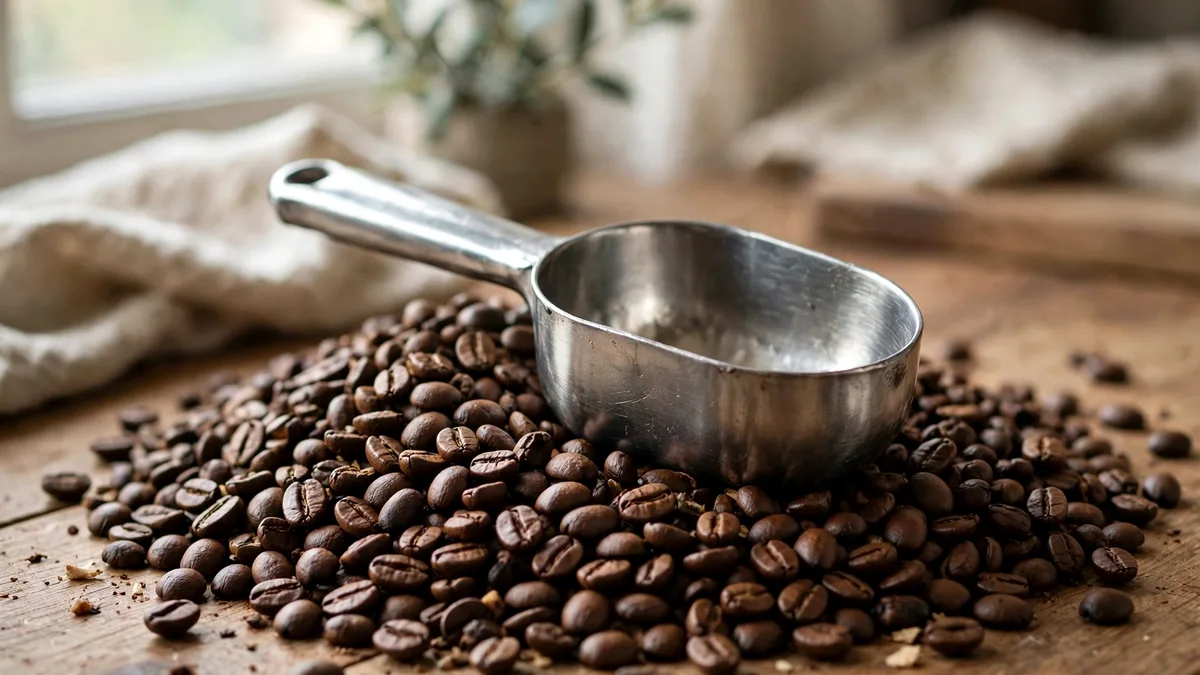
The best coffee scoops do one small job perfectly: they give you the same amount of coffee every morning. No guessing, no heaped spoon that changes with your mood, no weak cup on Monday and bitter cup on Tuesday. A good scoop holds a known dose, levels cleanly, and reaches the bottom of the bag. It sounds trivial until you have brewed with one for a week, and then a random spoon feels like cooking without measuring at all.
Coffee scoops matter because coffee is a ratio, not a feeling. Most guides call for about two tablespoons of ground coffee per 180 millilitres of water, and the difference between a level scoop and a heaped one can be a quarter more coffee in the pot. That is the difference between bright and muddy. A scoop does not need to be expensive or clever. It needs to hold its stated amount and feel good in your hand.
This guide compares the coffee scoops worth buying in 2026, from stainless steel workhorses to warm wooden scoops and clip-topped designs that seal the bag. Every scoop was judged on dose accuracy, levelling, reach, material, cleaning, and value. Pick the one that matches how you brew, and your mornings get more consistent.
Key Takeaways
- A standard coffee scoop holds about two tablespoons, or roughly 10 grams of ground coffee, which suits one 180-millilitre cup.
- Stainless steel scoops are the most durable and easiest to clean, and they never take on stale coffee smells.
- Long handles reach the bottom of deep bags and tall canisters without your hand touching the beans.
- A flat edge or a built-in leveller matters more than a pretty shape, because a level scoop is a repeatable dose.
- Scoop-and-clip designs seal the bag and replace a separate bag clip, which is genuinely useful in a small kitchen.
What a Coffee Scoop Actually Does
A coffee scoop is a measuring tool, not a serving spoon. Its bowl is sized to a known dose, usually two tablespoons, and its job is to repeat that dose exactly, cup after cup. When the dose is fixed, the only thing you change is the grind or the water, and you can finally tell which change made the coffee better.
The classic standard is one scoop per cup, and most scoops sold today follow it. A level scoop of medium-ground coffee weighs around 10 grams, which brews a balanced cup at the usual ratio of about 60 grams per litre. Whole beans weigh a little less per scoop than fine grounds because of the air between them. The exact number matters less than the consistency: same scoop, same level, same cup, every day.
Scoops also protect the coffee itself. Dipping a hand into the bag warms the beans and leaves oils on them, and a long-handled scoop keeps your fingers out entirely. A scoop that lives in the bag is always where you need it. If you want to go deeper into the brewing side, our guide to the best coffee makers shows which brewers reward a careful dose most.
The Main Types of Coffee Scoop
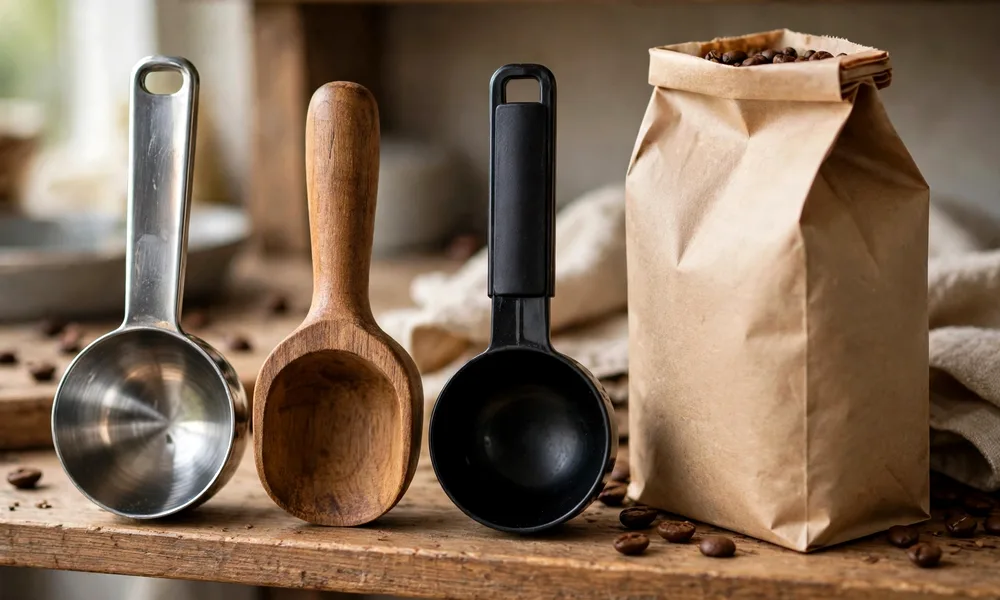
Stainless Steel Scoops
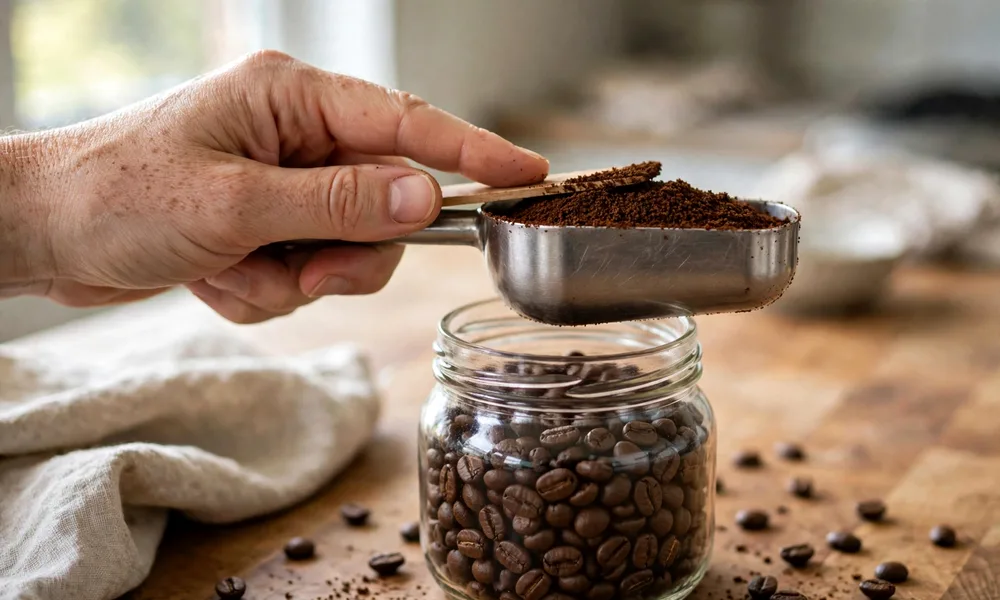
Stainless steel is the default for a reason. It does not absorb smells, it does not stain, it survives the dishwasher, and a well-made steel scoop will still be scooping in ten years. The best ones are a single piece of metal with a smooth bowl and a handle that does not flex. Cheaper steel scoops can bend at the neck, and a bent scoop never levels properly again, so check the thickness before you buy.
Wooden Scoops
Wooden scoops feel warmer and quieter than steel, and they look at home beside a bag of beans on an open shelf. Beech, walnut, and acacia are the usual woods, and each takes on a deeper colour with use. Wood needs a little care: never put it in the dishwasher, and rub it with food-safe oil now and then so it does not dry out. It is a poor choice if you brew very oily dark roasts and never wash it, because the wood will eventually hold the smell.
Plastic and Melamine Scoops
Plastic scoops are light, cheap, and often sold in sets of different sizes, which suits a household where one person brews a single cup and another makes a full pot. The downside is durability and smell: thin plastic warps in hot water and can hold stale coffee odours after a few months. Thick melamine is better. Treat plastic scoops as practical and replaceable rather than buy-it-once tools.
Adjustable and Multi-Size Scoops
Some scoops slide or twist to change their capacity, giving you one scoop for a single cup and a double for a full pot. The idea is sound, but the mechanism is the weak point: sliding parts trap grounds, and a scoop that drifts between settings is worse than a fixed one. If you only ever brew one size of pot, a fixed scoop is simpler and more reliable.
Scoop-and-Clip Designs
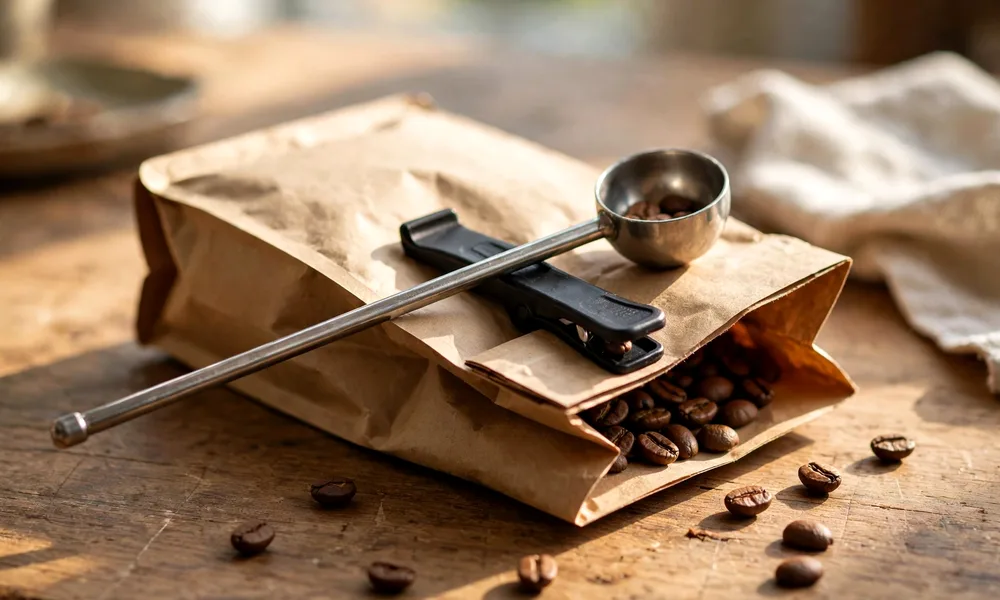
The cleverest scoops do two jobs: one end measures the coffee and the other end clips the bag shut. The clip keeps the bag sealed between brews, which keeps the beans fresher for longer, and the scoop is always attached to the coffee instead of lost in a drawer. Check that the clip grips firmly and that the scoop end is a true two-tablespoon measure. A weak clip that pops off the bag is just a scoop with a useless handle.
Coffee Scoops Compared
| Scoop Type | Best For | Dose | Cleaning | Durability |
|---|---|---|---|---|
| Stainless steel | Everyday brewing | 2 tbsp, fixed | Dishwasher safe | Excellent |
| Wooden | Slow mornings, display | 2 tbsp, fixed | Hand wash only | Good with oiling |
| Plastic or melamine | Sets and small budgets | Often sized sets | Dishwasher safe | Fair |
| Adjustable | Single cups and full pots | 1–2 tbsp | Hand wash, check joints | Fair to good |
| Scoop and clip | Bag storage and freshness | 2 tbsp, fixed | Hand wash usually | Good if the clip is strong |
The stainless steel scoop wins on durability and cleaning, the wooden scoop wins on feel, and the scoop-and-clip wins on freshness.
How to Choose the Best Coffee Scoop for You
Check the Dose First
A scoop that does not state its capacity is a decoration, not a measuring tool. Look for a stated dose of two tablespoons or about 10 grams, and check reviews for anyone who has actually weighed a level scoop. Some scoops sold as coffee scoops hold closer to one tablespoon, which leaves every cup under-dosed and weak.
Mind the Handle Length
Short handles are fine for jars and shallow bags, but a deep bag of beans needs a long handle. The best scoops have handles of 15 centimetres or more, long enough to reach the bottom of a tall bag without your knuckles brushing the beans. A handle that is too long will not fit inside a canister with the lid on, so measure your storage before you buy.
Look for a Level Edge
The top rim of the bowl is your levelling tool. A scoop with a flat, straight rim lets you sweep a finger or a knife across the top and leave a perfectly level dose. A scoop with a rolled or rounded rim makes levelling a guess, and a heaped scoop can hold a third more coffee than a level one.
Match the Material to Your Routine
If the scoop goes in the dishwasher every week, buy steel. If it lives on display and gets hand-washed, wood is lovely. Grind size matters too: a fine espresso grind packs tighter and weighs more per scoop than a coarse French press grind, so if you switch between brewers, weigh a scoop of each grind once. Our guide to the best coffee grinders explains how grind size changes the dose.
Getting the Dose Right
Start with the standard ratio and adjust from there. One level scoop per 180 millilitres of water suits most drip and pour-over brewing, and two scoops suit a large mug. If the coffee tastes sour and thin, add half a scoop before you change anything else. If it tastes bitter and heavy, take half a scoop away. Change one thing at a time, and give each change two or three mornings before you judge it.
Weighing is the gold standard, but a scoop gets you most of the way there with none of the fuss. Weigh a level scoop once when it is new and note the number inside the cupboard, then trust the scoop day to day. That single weighing tells you whether your scoop holds 8 grams or 12, and stops you blaming the beans for a dosing error. For measuring anything else in the kitchen, our guide to the best measuring cups covers the cups that pair well with a scoop.
Care and Cleaning
Coffee oils go stale, and a scoop that is never washed passes that staleness into every cup. Steel scoops can go in the dishwasher at least once a week. Wooden scoops need a hand wash with warm soapy water, a thorough dry, and no soaking, which swells the grain. Plastic scoops should be replaced when they smell even after washing.
Your Coffee Scoop Checklist
- Stated dose of two tablespoons or about 10 grams, confirmed by weighing once.
- Flat rim for easy levelling, so every scoop matches the last.
- Handle long enough to reach the bottom of your usual bag or canister.
- Material that suits your washing routine: steel for the dishwasher, wood for hand washing.
- Storage that keeps it beside the coffee: a clip, a hanging hole, or a magnet.
- No flex at the neck and no trapped-grounds joints that are hard to clean.
Frequently Asked Questions
How many grams is one coffee scoop?
A level scoop of medium-ground coffee is usually about 10 grams, roughly two tablespoons. Whole beans weigh a little less per scoop, around 8 to 9 grams, because of the air between them. Weigh your own scoop once to know its true dose.
Is a coffee scoop the same as a tablespoon?
Almost, but not quite. A standard coffee scoop holds two tablespoons of ground coffee, so a single tablespoon is half a scoop. A scoop removes the counting entirely.
Do I need a scoop if I weigh my coffee?
Not strictly, but a scoop still speeds things up. Use it to get close to your target weight quickly, then add or remove a pinch to hit the number. It is faster than pouring from the bag and far less messy.
Are wooden coffee scoops hygienic?
Yes, if they are washed and dried properly. Wood resists bacteria when kept dry, and a food-safe oil finish protects the surface. Never soak a wooden scoop or put it in the dishwasher, and replace it if it cracks deeply or holds a stale smell.
What size scoop do I need for a French press?
The same two-tablespoon scoop works, but you will use more of them. A French press usually takes about one scoop per 180 millilitres, so a one-litre press needs five or six level scoops. A coarse grind weighs less per scoop, so weigh once and adjust.
Can I use a coffee scoop for other things?
Yes, within reason. A clean steel scoop measures flour, sugar, protein powder, and pet food just as well as coffee. Keep a separate scoop for anything strongly flavoured, though, because coffee oils transfer to delicate ingredients.
The Bottom Line
The best coffee scoop doses the same amount every morning, levels cleanly, reaches the bottom of the bag, and survives your washing routine. Stainless steel is the safest all-round choice, wood is the nicest to use, and a scoop-and-clip keeps the bag fresh as a bonus. Pick a scoop with a stated two-tablespoon dose and a flat rim, weigh it once, and your coffee will taste the same on Friday as it did on Monday.