
Command Strips That Hold Without Holes in 2026
Command strips that hold without holes are the simplest way to hang pictures, hooks and light decor where drilling is not an option. A good strip grips the wall with a foam adhesive pad, carries a surprising amount of weight, and peels away cleanly when you pull the tab, leaving the paint as it was. Four things decide whether command strips hold: the type of strip, the weight it carries, the wall it sticks to, and the way it is put on.
Key Takeaways
- Match the strip to the weight: small for under half a kilogram, medium for most pictures, large for over two kilograms.
- The wall matters more than the strip: best on smooth, clean, painted plaster; worst on textured, dusty, damp or freshly painted walls.
- Press each strip firmly for thirty seconds and wait a full hour before hanging anything on it.
- Use two strips for a small frame and four for anything wide or heavy, so the load is shared.
- Remove a strip by pulling its tab slowly straight down along the wall, never outwards.
How Command Strips Actually Hold
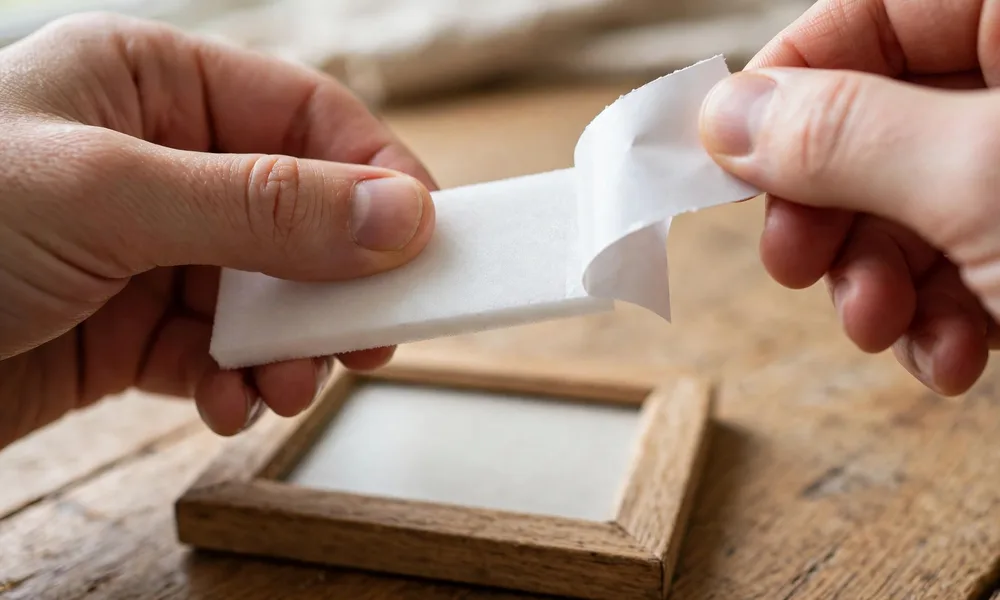
A command strip is a small pad of foam tape with strong adhesive on both faces. One face sticks to the wall and the other to the frame or hook. The foam core flexes as the wall and frame expand and contract with temperature, so the bond does not crack the way a rigid glue would. The adhesive grips hard under a steady downward pull but releases when the tab is stretched, drawing the adhesive into a long, thin line that lets go of the paint gradually.
Weight ratings on the packet are measured in ideal conditions: a smooth, clean wall at room temperature, with the strip pressed on properly and left to bond. A wall that looks smooth may carry fine dust, a coat of paint still curing, or a slight texture that stops the pad making full contact. Each of those cuts the real holding power, sometimes by half.
The Main Types of Command Strip Compared
The range falls into a few families. Small picture strips are thin and discreet, made for light frames, small prints and cards,. Medium picture strips are the workhorse of the range: strong enough for most framed prints, small mirrors and canvases, and still slim enough to hide. Large picture strips are wider and thicker, built for heavy frames, large canvases and mirrors,.
Hook strips carry a small plastic hook instead of a flat pad, and they suit keys, lanyards, cables and Christmas lights. Outdoor strips use an adhesive that copes with damp and temperature swings, and they are the only type worth using on a porch or in a bathroom.
| Strip type | Weight limit | Best for | Watch out for |
|---|---|---|---|
| Small picture strips | Up to 0.5 kg per pair | Small prints and light frames | Too weak for glass |
| Medium picture strips | Up to 1.5 kg per pair | Most prints and canvases | Needs a flat frame back |
| Large picture strips | Up to 3.5 kg per pair | Heavy frames and mirrors | Visible on thin frames |
| Hook strips | Up to 1 kg | Keys, cables, light decor | Load on one point |
| Outdoor strips | Up to 2 kg per pair | Porches and bathrooms | Fails on rough walls |
| Decorating clips | Up to 0.25 kg | Lights and bunting | Not for anything heavy |
Matching the Strip to the Weight and the Wall
Weigh the frame before you choose the strip. A small print in a light wooden frame may weigh less than half a kilogram, while the same print behind glass can weigh twice as much, because glass is heavy. A mirror is the hardest test: even a small mirror is dense, and its weight pulls straight down on the adhesive. For a frame over three kilograms, a drilled fixing is the honest choice, and our guide to drywall anchors that hold heavy frames explains which anchor suits a heavy picture and how to fit it.
The wall decides almost as much as the weight. Smooth painted plasterboard is the best surface: the pad makes full contact and the adhesive bonds evenly. Fresh paint is a trap: the strip bonds to paint that has not yet hardened, and the soft paint comes away when the strip is removed. Textured wallpaper, rough plaster, brick and bare wood are poor surfaces, because the pad only touches the high points.
Where Command Strips Work Best
Command strips are at their best in rented homes, student rooms and freshly decorated spaces, where holes are forbidden or unwelcome. They suit picture frames, small mirrors, canvases, calendars and hooks for keys and cables, and they are ideal for seasonal decorating: Christmas lights, bunting, wreaths and garlands go up in minutes and come down without a trace.
Where Command Strips Fail
The failures are predictable, and almost all come from asking a strip to do a job it was never designed for. Heavy coats are the classic example: a wet winter coat weighs several kilograms and swings every time the door opens, and no adhesive pad is meant to carry that repeated, moving load. If you need a hook for heavy coats, our guide to wall hooks for heavy coats explains why a screwed hook into solid timber is the only reliable answer.
Heat is another failure point. A strip above a radiator, behind a hot television, or in a sunny conservatory can soften and creep slowly down the wall over days. Damp is worse: steam from a shower or condensation on a cold wall weakens the bond from the edges inwards. Rough and dirty walls fail because the pad only touches the high points, and very cold walls can make the adhesive brittle.

Hanging a Frame Step by Step
Start by weighing the frame and choosing the strip size from the table above, then decide how many strips you need: two for a small frame, four for a wide or heavy one, spread across the top and bottom so the load is shared. Peel the backing from one side of each strip and press it firmly onto the back of the frame, holding each one for thirty seconds. Then peel the other backing, line the frame up on the wall, and press the whole frame firmly against the wall for another thirty seconds, pressing directly over each strip.
Now comes the part most people skip: wait. Leave the frame alone for a full hour before you trust it, and do not hang anything heavy on a hook strip for the same period. The adhesive bonds over that hour as it flows into the microscopic texture of the paint, and a frame loaded after five minutes is hanging on half a bond.
Removing a Strip Without Damage
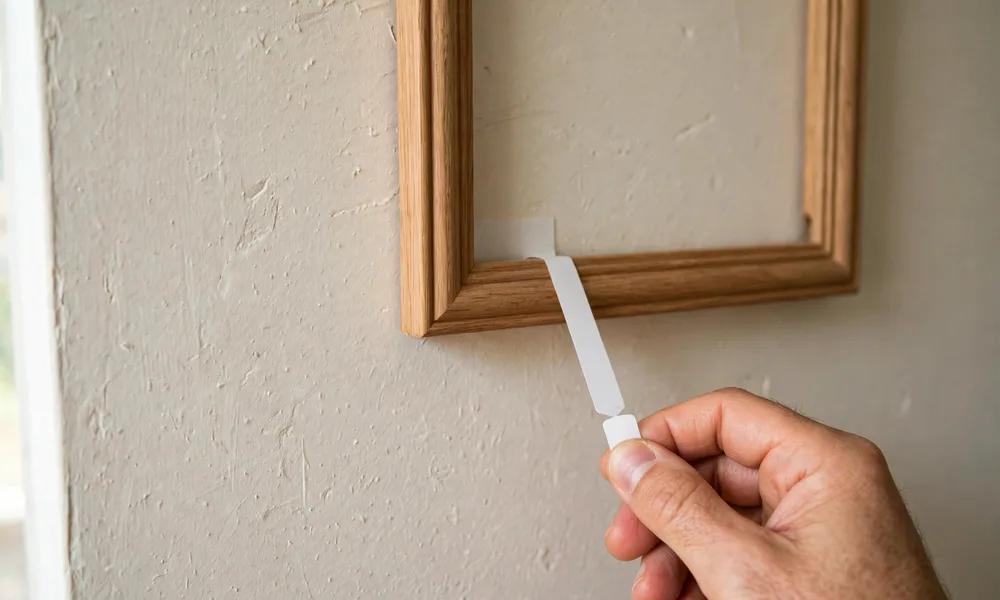
Removal is where command strips earn their reputation, but only if the tab is used properly. Pull the frame gently away from the wall until you can see the tab, then hold the frame steady and pull the tab slowly straight down along the wall, keeping it close to the surface. The adhesive stretches into a long, thin strand and releases gradually. Never pull the tab outwards, away from the wall, because that is the direction that tears paint, and never yank it fast, because a fast pull concentrates the force in one spot.
On a sound, cured wall the paint should be untouched. On a wall with old, flaking paint, a strip can still lift a flake, because the paint itself was already loose. That is not the strip failing so much as the wall. Test a strip in a hidden spot first if the wall is old or the paint is chalky, and if the paint is in poor condition, use a picture rail, a leaning frame or a freestanding easel instead.
Mistakes That Cause Falls
The most common mistake is hanging the frame immediately after pressing the strip on, before the adhesive has bonded. The second is using too few strips: one pair on a wide frame lets it tilt, and a tilted frame puts most of its weight on one strip. The third is sticking strips to a dusty or damp wall, which is the same as sticking them to nothing at all. The fourth is reusing a strip. Once a strip has been peeled off, its adhesive has stretched and its foam has compressed, and it will never hold the same weight again, so always use fresh strips.
Before You Hang Anything Checklist
- Weigh the frame and check it against the strip rating.
- Wipe the wall and the back of the frame clean and let both dry completely.
- Use two strips for a small frame and four for a wide or heavy one.
- Press each strip firmly for thirty seconds, then press the frame to the wall for thirty seconds.
- Wait a full hour before trusting the hang, and check it again the next morning.
- Make sure every removal tab is reachable before you walk away.
Frequently Asked Questions
How much weight can command strips really hold?
A pair of medium picture strips is typically rated to about one and a half kilograms, and large strips to about three and a half, but those ratings assume a smooth, clean wall at room temperature. On a real wall, keep the load well under the rating.
Do command strips damage paint when removed?
On sound, fully cured paint they should not, provided the tab is pulled slowly straight down along the wall. Fresh paint, old flaking paint and chalky matt finishes are the exceptions, because the paint itself is weak, so test a strip in a hidden spot first.
Can command strips hold a mirror?
A small, light mirror can work with large strips, but a heavy mirror should not rely on adhesive alone. Glass is dense, and a mirror that falls breaks dangerously, so use a drilled anchor over two kilograms.
How long do command strips last on the wall?
On a good surface indoors, a picture strip can hold for years without moving. Heat, damp, sunlight and temperature swings shorten that life, so check the hang every few months, especially in bathrooms, conservatories and rooms above radiators.
Can you reuse command strips?
No. Once a strip has been peeled off, the adhesive has stretched and the foam has compressed, and it will not hold the same weight again. Always use fresh strips, and replace them whenever a frame is moved to a new spot.
Do command strips work on brick or textured walls?
Not reliably. The pad only touches the high points of a rough surface, so the bond is patchy and weak. On brick or textured plaster, a drilled fixing is the answer, and finding the solid part of the wall first helps: our guide to stud finders that hit the stud first time shows how to locate solid timber behind plasterboard before you drill.
The Bottom Line
Command strips that hold without holes are a genuinely good product when used inside their limits: light frames, smooth clean walls, the right size of strip, a firm press and a full hour to bond. Used outside those limits, on heavy frames, dusty walls or hot damp rooms, they are a frame waiting to fall. Weigh the frame, clean the wall, use enough strips, wait the hour, and pull the tab slowly when the time comes to take it down.


