
Dips are the most underrated upper-body exercise you can do at home, and the best dip bars are the tool that makes them possible. A dip works the triceps, chest, and shoulders in a single movement, using nothing but your own body weight, and it builds pressing strength that carries over to everything else you lift. Done on a chair or a bench edge, dips are awkward and hard on the shoulders. Done on proper dip bars, with parallel grips at the right height and a stable base under you, they feel natural, controlled, and safe. This guide covers the dip bars worth buying in 2026, the station types that suit different homes, and how to choose bars that will still be standing after years of daily use.

Key Takeaways
- Dip bars are parallel bars for dips: a different exercise and a different tool from pull-up bars and push-up bars, which train different movements.
- Freestanding dip stations are the best choice for most homes: stable, no drilling, and tall enough for a full dip without your knees touching the floor.
- Choose bars rated for at least 50 kg more than your body weight, with thick steel tubing and solid welds rather than thin bolted joints.
- Bar width matters: grips around 55 to 65 cm apart suit most shoulders, and adjustable-width bars suit households with more than one user.
- Test stability before you commit: a bar that rocks, slides, or flexes under load is worse than no bar at all.
What Dip Bars Are, and What They Are Not
A dip bar is a pair of parallel bars, set at about hip height, that you grip with one hand on each bar and lower your body between. The movement is a vertical press: you bend the elbows, lower the chest between the bars, and push back up. It is not a pull-up, which hangs you from a single bar above your head and trains the back, and it is not a push-up, which puts your hands on the floor and trains the chest from a horizontal position. Our guide to the best pull-up bars of 2026 covers doorway, wall-mounted, and freestanding bars for hanging work, and our guide to the best push-up bars of 2026 covers low floor bars that keep the wrists straight. Dip bars are the third piece of that home bodyweight kit, and they train the pressing muscles the other two do not reach in the same way.
The confusion usually comes from parallettes, which our push-up bar guide mentions as the taller cousins of push-up bars. A parallette is a low, long-footed bar built mainly for push-ups, L-sits, and handstand practice, and it can be used for dips in a pinch. But a parallette is low to the floor, usually only 30 to 40 cm high, so your knees bend or your feet drag during a dip, and it is built for a different range of motion. A dedicated dip bar stands 90 to 120 cm tall, so you can hang freely between the bars with straight legs, and it is weight-rated for the full force of a dip, including weighted dips with a belt. If dips are a core part of your training rather than an occasional extra, a dedicated dip station is the right tool, and parallettes are the companion, not the substitute.
The Main Dip Bar Types Compared
Every dip bar on the market in 2026 falls into one of a few families, and the differences are practical: they decide how stable the bars feel, how much space they need, and whether they suit a renter, a homeowner, or a garage gym. The table below compares them on the factors that matter.
| Bar type | Weight capacity | Installation | Space needed | Price range | Best for |
|---|---|---|---|---|---|
| Freestanding dip station | 150–300 kg | Assembly, 20 min | About 1 sq m | $80–$250 | Most home trainers |
| Wall-mounted dip bars | 200 kg or more | Drilling, 1 hour | Wall space | $60–$150 | Serious and weighted dips |
| Doorway dip bars | Up to 120 kg | None, seconds | One doorway | $40–$90 | Small flats, renters |
| Power tower (dip handles) | Up to 150 kg | Assembly, 30 min | About 2 sq m | $100–$250 | All-in-one home gyms |
| Portable folding bars | Up to 120 kg | None | Under a bed | $50–$120 | Travel, tiny spaces |
What Makes a Great Dip Bar
A dip bar is a simple tool, but the details decide whether it feels like gym equipment or a hazard. Weight capacity is the first number to check, and the one to be most sceptical about. Cheap bars often quote generous limits, so look for thick steel tubing, solid welds rather than thin bolted joints, and a capacity rated at least 50 kg above your body weight. That margin matters twice over on dips: the load is your whole body weight plus momentum at the bottom of the movement, and it rises further if you add a weight belt later. A bar rated for 150 kg when you weigh 90 kg is a reasonable margin; a bar rated for 100 kg when you weigh 90 kg is not.
Stability is the second thing, and it is the one you feel on the first rep. A dip bar takes your full weight in a quick, shifting motion, and it must not slide, rock, or tip. The base should sit flat on the floor, with rubber feet or a wide footprint that grips hard surfaces and carpet alike. Test a bar by pressing down hard on one side before you buy: it should stay planted. A bar that creeps forward with every rep is worse than no bar at all, because you spend the whole set fighting the equipment instead of the exercise.

Bar Width, Height, and Grip
Bar width decides whether the dip feels natural or strains your shoulders. Grips around 55 to 65 cm apart suit most shoulders: narrow enough to keep the elbows tracking properly, wide enough to work the chest as well as the triceps. Bars wider than 70 cm force the shoulders into an awkward angle and load the joints badly, while bars narrower than 50 cm turn the dip into a pure tricep movement with little chest involvement. Adjustable-width bars suit households with more than one user, because a 60 cm width that suits one person may not suit a partner with broader shoulders. If the bars are fixed, measure your shoulder width and choose accordingly.
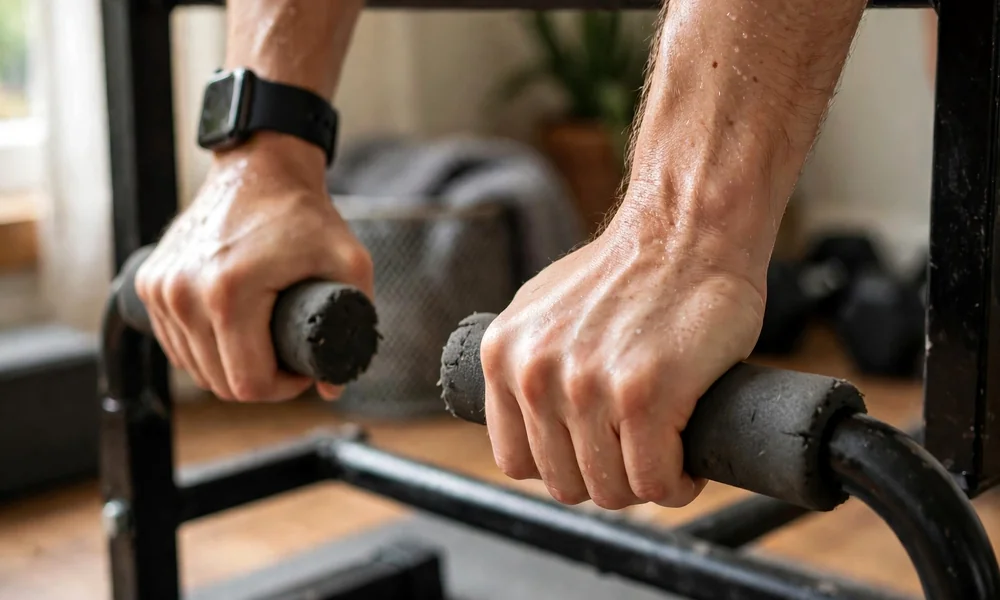
Height is the most overlooked part of buying dip bars. A station 90 to 120 cm tall lets most people hang freely with straight legs, which is the correct dip position. A station shorter than 80 cm forces you to bend your knees or cross your ankles, which changes the movement and makes it harder to control. If you are tall, check the height before you order, and remember that weighted dips need even more clearance, because the weight belt hangs below you. The grip matters too: foam-padded grips are comfortable and absorb sweat, but they wear out faster than knurled steel or textured rubber. A handle that is too thin digs into the palm, while one that is too thick tires the forearms before the chest has had a workout.
How to Choose the Right Dip Bars
Start with your space and your living situation. If you rent, or your door frames will not take a bar, a freestanding station is the answer: it needs no drilling, no doorway, and no landlord approval, and it simply stands on the floor. If you own your home and you do weighted dips, wall-mounted bars are the most stable option, bolted into studs or solid masonry, holding 200 kg or more without flexing. If you are building a wider home setup, think about what pairs with dip bars: a bench for step-ups and rows, and a pull-up bar for the back work that balances the pressing. Our guide to the best weight benches of 2026 covers the benches that pair best with a dip station in a small home gym.
Using Dip Bars Safely
Dips are a demanding exercise, and the shoulders take the load, so form matters more than volume. Keep the elbows tracking back rather than flaring wide, lower yourself under control until the upper arms are roughly parallel to the floor, and push back up without bouncing at the bottom. Do not drop into the bottom position: the momentum loads the shoulder joints suddenly, and that is how strains happen. If you cannot do a full dip yet, start with negatives, lowering slowly from the top and stepping back up, or use a resistance band looped under your knees for assistance. Build up gradually, a rep or two per week, and stop the set when your form breaks down rather than grinding out sloppy reps.
Dip Bar Buying Checklist
- Weight capacity at least 50 kg above your body weight, with thick steel tubing and solid welds.
- Stable base that stays planted: wide footprint, rubber feet, no rocking when you press one side hard.
- Bar width 55 to 65 cm apart, or adjustable, to suit your shoulder width.
- Height 90 to 120 cm, so you can dip with straight legs and room for a weight belt.
- Grip that feels secure without gloves and never slippery when your hands get damp.
- Space and mounting that fit your home: freestanding for renters, wall-mounted for serious weighted dips.
Frequently Asked Questions
Are dip bars different from pull-up bars?
Yes. Dip bars are two parallel bars at hip height for a vertical pressing movement that trains the triceps, chest, and shoulders. Pull-up bars are a single bar above your head for a hanging pulling movement that trains the back and biceps. They are complementary tools, not substitutes.
Can I do dips on push-up bars or parallettes?
You can, but it is a compromise. Push-up bars are low floor bars built for push-ups, and parallettes are taller bars built for push-ups, L-sits, and handstands. Both are too low for a proper dip with straight legs, and neither is weight-rated for dips the way a dedicated station is.
How much weight should dip bars hold?
Choose bars rated for at least 50 kg more than your body weight. That margin covers the momentum at the bottom of the dip and leaves room for a weight belt later. A bar rated exactly at your body weight has no safety margin at all.
Are freestanding dip stations stable enough?
A good one is. Look for a wide, heavy base with rubber feet and a steel frame that does not rock when you press down hard on one side. Cheap stations with narrow bases and bolted joints flex and slide, so test stability before you commit.
Do I need a power tower or standalone dip bars?
Choose a power tower when space is tight and you want pull-ups, dips, and leg raises in one station. Choose standalone dip bars when dips are your priority: they offer adjustable width, a wider stance, and nothing overhead to limit a deep dip.
How often should I train on dip bars?
Two to three times a week is enough for most people. Start with three sets of as many clean reps as you can do, rest two minutes between sets, and add a rep or two per week. Stop the set when your form breaks down rather than grinding out sloppy reps.
Bottom Line
Buy a freestanding dip station rated for at least 50 kg more than your body weight, with bars 55 to 65 cm apart, 90 to 120 cm tall, and a wide stable base that never rocks. Keep your elbows tracking back, lower under control, and build up a rep or two per week. Dips are the simplest pressing exercise you can do at home, and the right bars make them safe, comfortable, and effective for years.


