Best Dog Houses 2026
A dog house is not a garden ornament. It is the one place in the garden that belongs entirely to the dog: somewhere dry to lie down when the rain starts, somewhere shaded when the sun is high, and somewhere out of the wind on a cold evening. A good one gets used every single day. A bad one gets ignored, and the dog ends up pressed against the back door instead, which tells you everything you need to know about the house you bought.
The best dog houses of 2026 are the ones that stay dry in real rain, keep their shape through a winter, and fit the dog that actually has to sleep in them. They are not the prettiest houses in the catalogue. They are the ones with a sound roof, a raised floor, a doorway the dog can walk through without ducking, and enough room to turn around and lie flat. This guide covers the types that work, the sizes that matter, and the mistakes that send most dog houses to the back of the shed within a year.
Key Takeaways
- Measure the dog, not the garden: the house should be tall enough for the dog to stand in and long enough for the dog to lie flat on its side.
- A raised floor matters more than a fancy roof, because damp ground is what makes a dog house cold, and cold is what keeps a dog out of it.
- Wood insulates better than thin plastic, while thick moulded plastic is easier to clean and never rots, so the right material depends on your climate.
- The doorway should be just big enough for the dog, since a wide opening lets in rain and wind and lets out the warmth the dog brings in.
- Place the house where the dog can see the back door, because a dog that cannot see its people will not settle in a house at the far end of the garden.
Dog Houses 2026 at a Glance
| Best for | House type | Material | Standout strength |
|---|---|---|---|
| Best overall | Pitched-roof wooden house | Solid timber | Warm, sturdy, and easy to repair |
| Best for rain | Insulated moulded house | Thick plastic | Sheds water and hoses clean in minutes |
| Best for large dogs | Extra-large timber house | Solid timber | Room to stretch flat without touching the walls |
| Best for small dogs | Compact cottage house | Timber or plastic | Snug enough to hold the dog’s warmth |
| Best for hot summers | Open-front shelter | Timber with wide overhang | Shade and airflow on still, warm days |
| Best for cold winters | Double-wall insulated house | Timber with insulation | Holds heat through frosty nights |
What a Dog House Is Really For
A dog house does three jobs at once. First, it keeps the dog dry, which means a roof that does not leak and a floor that does not sit in a puddle. Second, it breaks the wind, which means solid walls and a doorway that faces away from the prevailing wind. Third, it gives the dog a place of its own, a den it can retreat to when the garden is busy or the house is full of visitors.
That third job is the one people forget. Dogs are den animals by instinct, and most of them want a small, enclosed space that feels safe. The difference between a dog house and the indoor den is the weather: a house has to stand up to rain, sun, frost, and mud, and it has to do it without any help from you for weeks at a time. An indoor crate is a different answer to the same instinct, and our guide to the best dog crates of 2026 covers the indoor side in detail. Outside, the house is the den, and it has to earn the dog’s trust the same way.
Getting the Size Right

The rule is simple. Measure the dog standing, from the top of its head to the ground, and add about ten centimetres: that is the height of the doorway and the inside of the house. Measure the dog lying flat on its side, nose to tail, and add about fifteen centimetres: that is the length of the floor. Measure the dog standing sideways, chest to tail, and add about ten centimetres: that is the width. A house built to those three numbers will feel snug without feeling cramped.
The Main Types of Dog House
The pitched-roof wooden house is the classic, and it is still the best choice for most gardens. A sloped roof sheds rain, the timber insulates, and a house that gets scratched or chewed can be sanded and repainted. Look for thick boards rather than thin cladding, a roof with a proper overhang, and a floor that sits on feet or rails rather than flat on the ground.
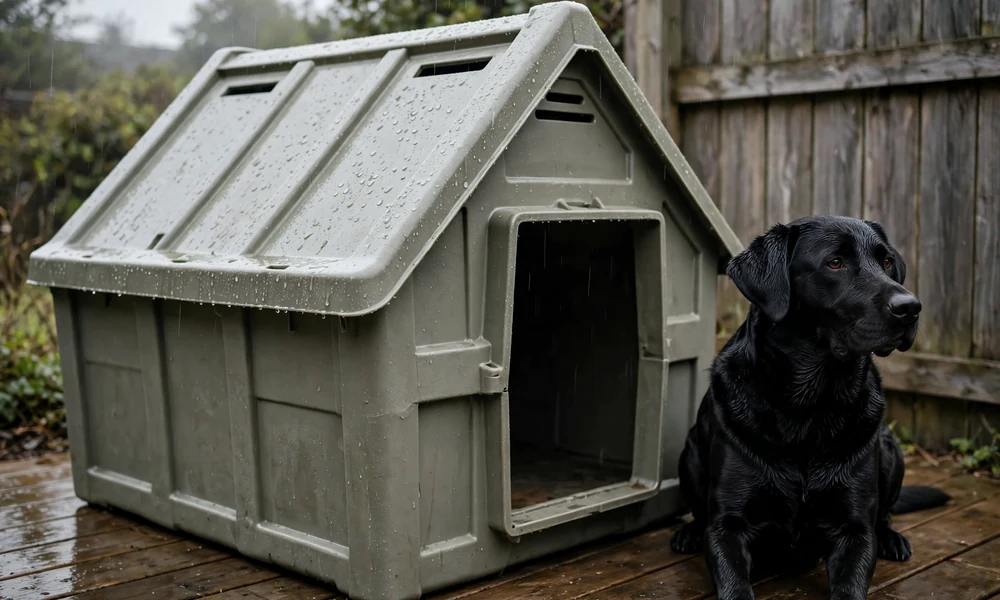
The moulded plastic house is the practical choice for wet gardens. Thick plastic never rots, it hoses clean in minutes, and it is light enough to move when you mow. Its weakness is insulation: thin plastic is cold in winter and hot in summer, so look for a double-wall or insulated model if your winters are harsh. A cheap single-skin plastic house is a greenhouse in July and a fridge in January.
The insulated double-wall house is the winter specialist. Two layers of timber or plastic with insulation between them hold the dog’s warmth through frosty nights, and a door flap keeps the wind out. It costs more and weighs more, but in a cold climate it is the difference between a house the dog uses in January and one it abandons until spring.
Materials and Build Quality
Solid timber is the warmest common material, and it earns its price. Cedar and pine houses feel steady, smell right to a dog, and can be repaired with a saw and a screwdriver when a board splits. Timber needs care, though: treat it with a dog-safe wood preservative once a year, check the roof felt each autumn, and replace any board that has gone soft before the winter rain finds it.
Moulded plastic is the low-maintenance choice. It will not rot, it will not need painting, and a muddy dog can be hosed out of it along with the floor. Check the thickness before you buy, because a thin plastic house flexes when a large dog leans on it, and a flexing house feels unsafe to the dog inside. Push the walls firmly in the shop: they should not bow.
Weatherproofing, Ventilation, and Warmth

Ventilation matters as much as waterproofing. A sealed house with no airflow goes damp inside, and damp bedding is what makes a dog cold. Look for a small vent near the roof, or a doorway that does not seal tight, and never block the vent to keep the house warmer: the dog’s breath alone will condense on cold walls if the air cannot move. Warmth comes from the dog and the bedding, not from sealing the house shut.
Bedding is the part people get wrong most often. Straw is the best outdoor bedding, because it drains, insulates, and stays warm even when the air is damp. Blankets and towels feel kind, but they soak up water and stay wet, and a wet blanket is colder than no blanket at all. A thick layer of straw, changed every week or two, beats any cushion you can buy. Inside the house, the same rule holds as indoors: a comfortable bed makes the den inviting, and our guide to a dog bed your dog will actually use explains how to match the bed to the way your dog sleeps.
Where to Put the House
Place the house where the dog can see the back door. This is the single most useful rule in this guide, and it is the one most often ignored. A dog is a social animal, and a house at the far end of the garden, behind a shed, feels like exile. A house near the back door, where the dog can watch people come and go, feels like a bedroom with a view, and the dog will use it.
Getting the Dog to Use It
Some dogs walk into a new house on the first day. Most need a little help, and the help is patience, not force. Never push a dog into its house or shut it inside to get it used to the place: a dog that is trapped in a house once will avoid it for months. Put the house in place, put straw and a familiar blanket inside, and let the dog investigate in its own time.
Before You Buy: A Short Checklist
- Measure the dog standing, lying flat, and sideways, and buy the house that fits those three numbers.
- Check the floor is raised off the ground and the roof overhangs the walls on every side.
- Push the walls firmly: they should not flex, and the joints should not rack.
- Look for a vent near the roof, and a doorway just big enough for the dog.
- Choose straw for bedding, and plan to change it every week or two.
- Place the house near the back door, facing away from the wind, on dry, high ground.
- Check you can lift the roof or remove the floor, so the house can actually be cleaned.
Frequently Asked Questions
How big should a dog house be? Tall enough for the dog to stand in, long enough for the dog to lie flat on its side, and wide enough for the dog to turn around. Add about ten centimetres to the dog’s standing height and about fifteen centimetres to its lying length.
Is a wooden or plastic dog house better? Wood insulates better and is easier to repair, while thick moulded plastic never rots and hoses clean. In a cold or wet climate, wood or an insulated model wins; in a mild, wet garden, plastic is the easier choice.
What bedding should I put in a dog house? Straw, changed every week or two. It drains, insulates, and stays warm when damp, while blankets and towels soak up water and stay cold.
Can a dog live outside in a dog house? A healthy adult dog can spend time outside in a sound, dry, insulated house with fresh water and shelter from extremes, but it still needs company, exercise, and time indoors with its people. A dog house is a shelter, not a substitute for a home, and walks still matter: our guide to a dog leash that will not fray covers the everyday walk that keeps an outdoor dog happy.
The Bottom Line
The best dog house of 2026 is the one your dog actually uses: dry inside, warm enough in winter, shaded in summer, and close enough to the back door that the dog never feels shut out. It is sized to the dog, not the garden, raised off the ground, roofed against real rain, and bedded with straw you change often.
Start with the tape measure, not the catalogue. Measure the dog, find the driest spot near the back door, and then choose the type that fits: a solid wooden house for most gardens, an insulated moulded house for wet winters, or a shaded shelter for hot summers. Put straw inside, give the dog a week to settle, and let the dog tell you whether you got it right.