
A good dog crate is not a cage and it is not a punishment. At its best it is a bedroom: a quiet, familiar den where a dog can sleep, settle, and feel safe when the house is busy. Dogs are den animals by instinct, and most of them take to a well-chosen crate quickly, provided the crate is the right size, the door is never used as a threat, and the inside is comfortable. The wrong crate, by contrast, is a daily annoyance: too small to stretch in, too flimsy to trust, too awkward to clean, or so ugly that it lives in the garage instead of the room where the dog actually spends time.
This guide looks at the dog crates worth buying in 2026, from the classic wire crate that suits most households to heavy-duty models for strong chewers, soft-sided crates for travel, and furniture-style crates that blend into a living room. We judged them on size range, build quality, safety, ease of cleaning, how quietly the doors and latches work, and whether a dog would genuinely choose to lie in one.
Key Takeaways
- The best crate for most dogs is a double-door wire crate with a divider panel, a removable tray, and latches that close with one hand.
- Measure your dog standing, sitting, and lying flat, then add room to turn around and stretch: a crate that is too small is worse than one that is slightly too big.
- For puppies, buy the adult size with a divider rather than a crate you will outgrow in three months.
- Strong chewers and escape artists need a heavy-duty steel crate with welded bars, not a standard wire crate with thinner gauge.
- A crate only works as a den if the door stays open at first, the inside is comfortable, and good things happen in there.
How We Judged
We started with the build, because a crate has to hold up to daily use by an animal that pushes, paws, chews, and leans on it. We looked at wire gauge and weld quality on metal crates, the strength of the latches, whether the doors sag after weeks of opening and closing, and whether the tray slides out without catching. A crate that rattles every time the dog shifts position will keep the whole house awake, so we paid attention to how quietly each design sits in a room.
Best Overall
The best overall dog crate is a double-door wire crate with a divider panel, a slide-out plastic tray, and two secure slide-bolt latches on each door. Wire is the right default for most dogs because it breathes: air moves freely, the dog can see the room, and you can see the dog. The open design also makes the crate less intimidating at first, which matters during the first week, when a nervous dog is deciding whether this new box is a safe place or a trap.
Two doors make a real difference in a real home. A front door and a side door mean the crate can sit in a corner, against a wall, or at the end of a sofa without the entrance facing the wrong way. The divider is what makes one crate last from puppyhood to adulthood: slide it forward while the puppy is small, so the sleeping area stays snug, and move it back as the dog grows. Without a divider, a puppy in an adult-sized crate may sleep at one end and toilet at the other, which defeats the whole point of crate training.

Best for Puppies
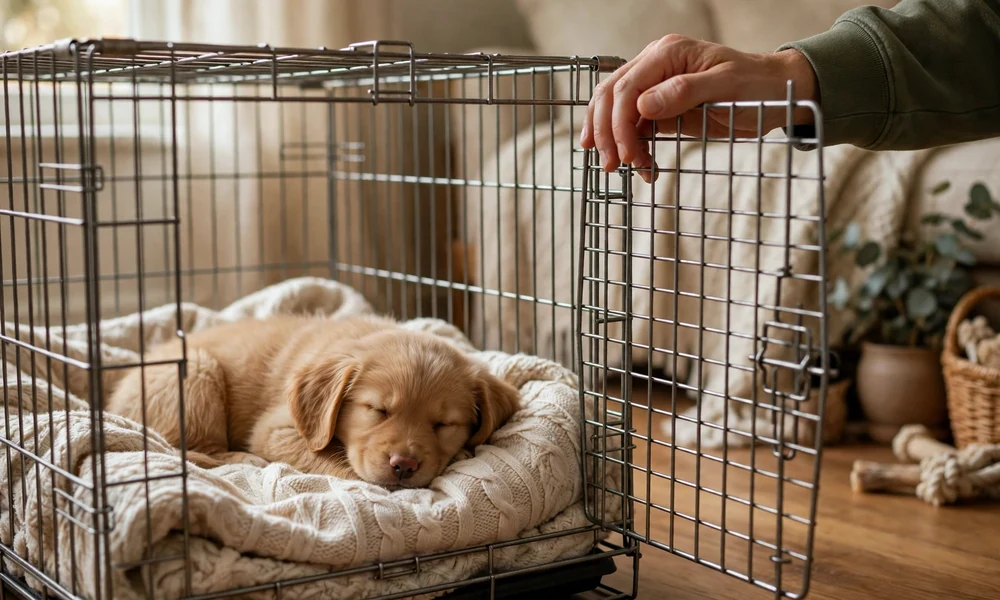
Puppies need a crate that grows with them, and that means a wire crate with a divider panel and a size chosen for the adult dog, not the eight-week-old puppy in front of you. It feels strange to buy a large crate for a small puppy, but the divider solves the problem: it keeps the sleeping space cosy while the puppy is little, and it moves back as the puppy grows. Buying a small crate now and a large one later costs more and forces the puppy to relearn a new den halfway through training.
Start slowly. Leave the door open, put meals and treats inside, and let the puppy wander in and out on its own terms for the first few days. Short, happy sessions beat long, forced ones, and a puppy that chooses the crate will sleep far better than one that is shut in it. A soft, washable pad inside makes the crate inviting, and a spare pad is worth having, because puppies have accidents and a wet pad left in place teaches nothing good.
Best Heavy-Duty Crate
Some dogs treat a standard wire crate as a puzzle to solve. Strong, determined chewers and escape artists can bend thin wire, work a simple latch, and push a door out of its frame, and a dog that escapes once will try again. For those dogs, the right answer is a heavy-duty steel crate with thicker bars, welded joints, and a latch that cannot be nosed open from the inside.
Even with a strong crate, the routine matters. A heavy-duty crate should still have a comfortable pad, still sit in a calm spot, and still be introduced gradually. Strength solves the escape problem, but it does not solve boredom: a dog left for hours with nothing to do will chew whatever is nearest, including the crate itself. A safe chew, a stuffed toy, and a proper walk before crating do more for a strong dog than thicker steel alone.
Best for Travel
For travel, the best crate is a soft-sided one: light, foldable, and easy to carry, with mesh panels for air and a familiar smell that goes wherever the dog goes. Soft-sided crates suit car trips, hotel stays, and visits to family, where a wire crate would be too bulky and too noisy. They pack flat, weigh very little, and give a dog the same den in a different place, which is exactly what an anxious traveller needs.
Soft-sided crates are not for every dog. A determined chewer can work through fabric and mesh, so they suit calm, crate-trained dogs rather than puppies still learning. Check the stitching, the zips, and the frame before you buy, and check the airline’s rules first for air travel, because cabin and hold requirements differ. A proper travel carrier is a different product again, and our guide to the best dog carriers for travel covers the smaller, carry-on options for dogs that travel in the cabin or on your shoulder rather than in the boot.
Best Furniture-Style Crate
A crate that lives in the living room has to look like it belongs there, and furniture-style crates are built for exactly that job. Made from wood or wood-look panels with slatted sides, they double as a side table or a console, with a flat top for a lamp or a stack of books. The best ones are sturdy, well ventilated, and finished well enough that they do not look like a kennel smuggled indoors.
Look for solid construction rather than thin veneer, a door that latches firmly, and a base that can be wiped clean. Ventilation matters most here: slats should be wide enough for real airflow, and the crate should never sit in direct sun or against a hot radiator. If the top is going to hold anything heavy, check the weight limit before you put a lamp on it.

Getting the Size Right
Sizing is where most crate purchases go wrong, and it is worth doing properly. Measure your dog standing, from the floor to the top of its head or ears, whichever is higher, and lying flat on its side, from nose to the base of the tail. The crate should be at least a few centimetres taller than the standing measurement and long enough for the dog to lie fully stretched out without touching either end. The dog should also be able to turn around comfortably and sit upright without ducking.
What goes inside matters too. A crate pad or bed should fit snugly without bunching up at the edges, and it should be washable, because it will need washing. Our guide to finding a dog bed your dog will actually use covers the shapes and materials that work inside a crate, from flat mats and crate pads for sprawlers to memory foam for older dogs. Avoid thick, loose bedding for puppies, which can be chewed and swallowed, and skip anything with ribbons, buttons, or stuffing that comes out easily.
Crate Training the Kind Way
Crate training works when the crate is associated with good things. Feed meals inside it, hide treats in the bedding, and let the dog go in and out freely for the first week. Close the door for a few minutes at a time, while you stay in the room, and open it before the dog gets distressed. Build up slowly: a few minutes becomes half an hour, half an hour becomes an afternoon nap, and the crate becomes the place the dog goes when it wants to rest.
What to Avoid
Avoid crates with sharp wire ends, flimsy latches, or a door that can be pushed open from the inside. Avoid leaving a collar on a crated dog, because a collar can catch on wire or a latch, and remove anything the dog could chew into pieces and swallow. Avoid the temptation to buy the cheapest crate available: thin wire bends, cheap zips fail, and a crate that collapses is dangerous. And avoid using the crate to solve a behaviour problem on its own: a dog that barks, chews, or toilets indoors needs training, exercise, and attention, not a smaller box.
Cleaning and Care
A crate needs regular cleaning, and the best designs make that easy. The tray should slide out and wash clean with warm soapy water, the wire should wipe down without rusting, and the bedding should go in the washing machine. Deep-clean the whole crate at least once a month, and straight after any accident, because smells build up quickly and a smelly crate is a crate the dog will not want to use. Keep the routine simple and it will happen: a quick wipe each week and a full wash each month is enough for most households, and regular grooming helps too, since a clean dog keeps a clean crate. Our guide to the best pet grooming kits covers the brushes and tools that make that part of the routine easier.
Check the crate itself from time to time. Look for bent wire, loose welds, a latch that no longer catches, and a tray that has cracked or warped. Replace worn parts promptly rather than waiting for them to fail, and retire a crate that no longer closes securely. A crate is a piece of safety equipment as much as it is furniture, and it deserves the same attention as a lead or a harness.
The best dog crate, in the end, is the one your dog walks into on its own, turns around in, and sighs as it lies down. Buy the right size, choose the build that matches your dog’s strength and temperament, keep it clean and comfortable, and introduce it with patience. Done that way, a crate is not a cage at all: it is the dog’s own room, in a house that is already its home.


