
The best drawer organizers of 2026 do one simple thing: they give everything in the drawer a fixed place to live. A drawer organizer is a tray, divider or set of small boxes that splits one big empty drawer into compartments, so the batteries stop rolling under the scissors, the pens stop tangling with the tape, and you can find what you need without emptying the whole drawer onto the counter. The junk drawer is not a storage problem. It is a drawer without divisions, and divisions fix it.
Every home has one: the kitchen drawer of batteries and takeaway menus, the bathroom drawer where hair ties vanish, the desk drawer where scissors hide under cables. The fix costs less than a takeaway and takes ten minutes, yet most people live with the mess for years. This guide compares the drawer organizers worth buying in 2026, explains how to measure and choose them, and shows how to end the junk drawer for good.
Key Takeaways
- Measure the drawer before you buy: an organizer one centimetre too wide is useless, however good it looks.
- One category per compartment is the rule that makes organizers work; a mixed compartment becomes a small junk drawer.
- Bamboo suits kitchens and bedrooms, clear acrylic suits bathrooms, and adjustable dividers suit drawers that keep changing.
- Start with the drawer you open most, not the worst one: a quick win makes the rest of the house feel possible.
- Empty the drawer completely before you organize it, and throw away or relocate a third of what comes out.
Why Drawers Become Junk Drawers
A drawer becomes a junk drawer for a simple reason: it has no structure. Every object that has no proper home ends up in the same drawer, and because the drawer is deep and dark, nobody sees the mess until it will not close. The problem is not the amount of stuff. It is that a flat, empty drawer treats a battery, a pair of scissors and a roll of tape as the same thing, and they slide around until they form one tangled layer.
An organizer changes the physics of the drawer. Compartments stop things sliding, walls stop piles toppling, and a fixed place for each category means putting something away takes one second instead of a decision. The effect is bigger than it sounds: when you can see everything at a glance, you stop buying duplicates of things you already own, and the morning routine gets faster, because nothing is ever lost in a drawer again.
The Drawer Organizer Types Worth Knowing
Every drawer organizer is a variation on a few basic ideas. Once you know the types, the choice is simple, because the right organizer depends on the room, the drawer and what lives in it.
Bamboo and wood trays
Bamboo trays are the classic kitchen drawer organizer, and they suit bedrooms and desks just as well. They look like furniture rather than plastic, are heavy enough not to slide around, and come in standard sizes that fit most kitchen drawers. Their weakness is water: bamboo swells and stains if it stays wet, so keep them out of the bathroom. Expandable trays adjust to the drawer width, which solves the measuring problem for odd sizes.
Clear acrylic organizers
Clear acrylic trays are the best choice for bathroom and makeup drawers, because you can see everything without lifting anything out. They wipe clean, do not mind water, and stack neatly for deep drawers. Their weakness is scratches: after a year of hard use cheap acrylic goes cloudy and shows fingerprints. Buy thicker acrylic, and keep trays out of direct sunlight, which yellows them.
Adjustable dividers
Adjustable dividers are spring-loaded or slotted panels that split a drawer into sections without a tray. They suit deep drawers, wide drawers and drawers whose contents keep changing, because you can move the dividers whenever the drawer changes. They are the cheapest and easiest option, but they do not stop small things rolling under each other, so pair them with a small tray for tiny items.
Fabric and honeycomb organizers
Fabric honeycomb organizers are soft, foldable cells that suit clothes drawers: socks, underwear, belts, scarves and ties. They weigh almost nothing, fold flat when empty, and turn a deep clothes drawer into a grid where every item is visible. Their weakness is structure: they sag when half empty and cannot be cleaned as easily as wood or plastic, so keep them for dry clothes drawers only.
Drawer Organizers Compared
| Organizer type | Best room | Best for | Watch out for |
|---|---|---|---|
| Bamboo and wood trays | Kitchen, bedroom | Cutlery, utensils, stationery | Swells if it stays wet |
| Clear acrylic trays | Bathroom | Cosmetics, toiletries | Scratches and goes cloudy |
| Adjustable dividers | Any room | Deep and wide drawers | Small items roll underneath |
| Fabric honeycomb | Bedroom | Socks, underwear, scarves | Sags when half empty |
| Metal and wire trays | Kitchen, office | Heavy tools, cables | Can scratch the drawer |
How to Measure a Drawer Before You Buy
Measure twice, buy once. Take a tape measure and record the inside width, depth and height of the drawer, measuring the inside walls rather than the outside of the drawer front. Subtract half a centimetre from the width and depth so the organizer slides in and out easily, and check the height: a tray that is taller than the drawer will stop it closing, which is the most common organizing mistake of all.
Watch for the details that ruin a fit: some drawers narrow towards the back, some have a lip at the front, and some have a screw head or runner sticking into the space. Measure at the back as well as the front, and the height at the lowest point. If the drawer is an odd size, buy an expandable tray or adjustable dividers, because a tray that almost fits is a tray you cannot use.
Ending the Junk Drawer, Step by Step
Start by emptying the drawer completely onto a table: you cannot organize what you cannot see, and most people are surprised by how much is in there. Sort everything into three piles, keep, move and throw away. The throw-away pile is always bigger than expected: dead batteries, dried-out pens, keys nobody recognises, cables for devices that no longer exist.
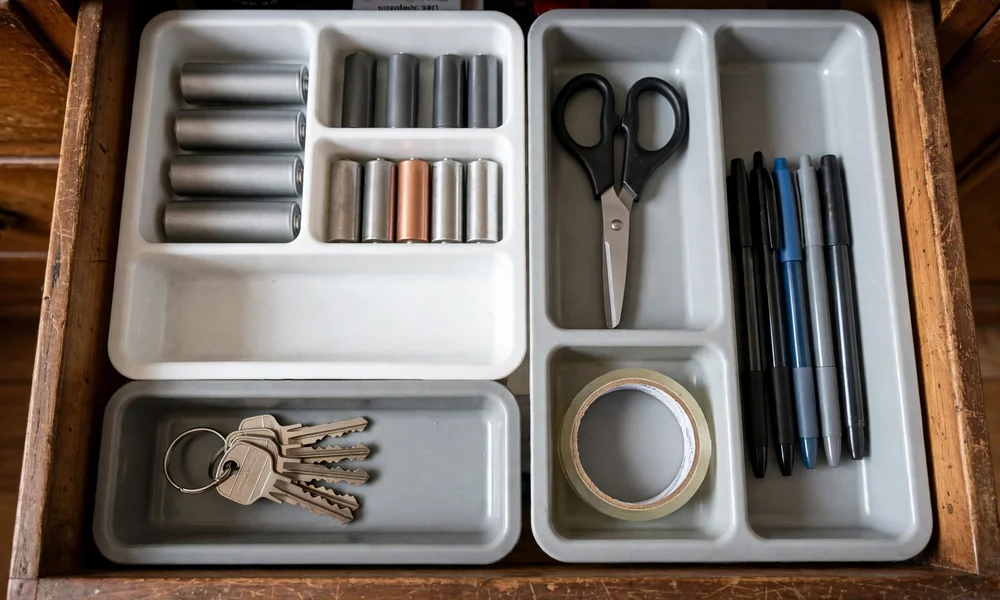
Clean the drawer, then put the organizers in empty and test the fit before you fill them. Assign one category per compartment: batteries in one, tape and scissors in another, pens in a third, and nothing else. Put the things you reach for most at the front, the things you use weekly at the back, and the things you use twice a year somewhere else entirely. Label the compartments if the drawer is shared, because a system only works when everyone in the house knows where things live.

Drawer Organizers by Room
The kitchen drawer is the one to fix first, because it is opened more than any other drawer in the house. A bamboo tray for cutlery and a smaller tray for the odds and ends, the foil, the clips and the spare batteries, will change the way the kitchen feels. Keep knives in a covered tray, and keep the drawer near the cooker for the utensils you use while cooking.
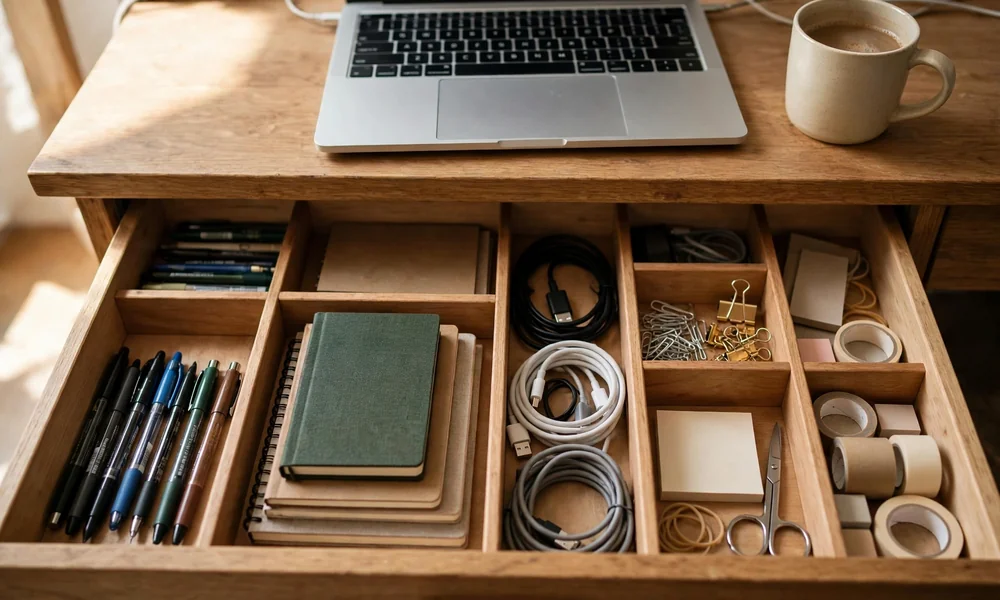
The bathroom drawer needs acrylic, because it gets wet. Small trays for toothbrushes and cosmetics keep the counter clear, and a deep tray keeps medicines together and out of reach of children. The bedroom drawer is where honeycomb organizers earn their place: socks and underwear in the cells, belts rolled in a divider, scarves folded in a tray. The desk drawer needs a tray for pens and a divider for cables and chargers.
Mistakes That Send the Drawer Back to Chaos
The first mistake is buying before measuring: an organizer that does not fit gets thrown in a cupboard, and the drawer goes back to chaos within a week. The second mistake is overfilling: a compartment crammed full is no better than a drawer crammed full, because you cannot see what is in it. Leave a little empty space in every compartment.
The third mistake is organizing without decluttering. An organizer does not create space; it only divides the space you have. If the drawer holds twice as much as it should, no tray will fix it. Throw away a third of what is in the drawer before you organize it, and be honest about what you actually use. For the wider storage system around your drawers, our guide to closet organizers that double your storage space shows how drawers fit into a whole-room plan.
The Junk Drawer Fix: Checklist
- Measure the inside width, depth and height of the drawer, and subtract half a centimetre for clearance.
- Empty the drawer completely, sort everything into keep, move and throw away, and clean the drawer.
- Choose the organizer for the room: bamboo for the kitchen, acrylic for the bathroom, honeycomb for clothes.
- Put the organizers in empty first, test the fit, and move dividers until every compartment has a purpose.
- Assign one category per compartment and put the most-used items at the front of the drawer.
- Check the drawer after a week and move anything that has drifted back into the wrong compartment.
Drawer Organizers: Frequently Asked Questions
What size drawer organizer do I need?
Measure the inside of your drawer, then subtract half a centimetre from the width and depth so the organizer slides in easily. Standard kitchen drawers suit a tray about 30 centimetres wide, but drawers vary, so never guess. Expandable trays and adjustable dividers are the safe choice for odd sizes.
Are bamboo drawer organizers good?
Yes, for dry drawers. Bamboo is sturdy, looks good, and is heavy enough not to slide around. It suits kitchens, bedrooms and desks, but it swells and stains if it stays wet, so keep it out of bathrooms and away from damp. Wipe it dry if it gets splashed.
How do I stop organizers sliding around?
Buy a tray that fits the drawer snugly, with less than half a centimetre of play. Heavy bamboo trays rarely slide, but light plastic trays do, so add small non-slip pads or a strip of grip liner underneath. A tray that slides defeats its own purpose within a week.
Can drawer organizers work in deep drawers?
Yes, with stacking trays or adjustable dividers. A single shallow tray in a deep drawer wastes the space below it, so stack a second tray on top or use dividers to split the full depth. Keep heavy items at the bottom and light items in the top tray.
What should go in a junk drawer?
Very little. A junk drawer should hold the small everyday items with no other home: batteries, tape, scissors, a pen or two, and a spare key. If it holds cables, medicines, tools and paperwork, those belong elsewhere, and the drawer needs a proper clear-out before any organizer will help.
How often should I reorganize a drawer?
Check it every few months and do a full clear-out once a year. A drawer stays tidy when the system is simple and everyone in the house knows it. If a compartment keeps filling with the wrong things, the category is wrong, not the person using it, so change the layout.
The Bottom Line
Drawer organizers are the cheapest, fastest home improvement you can buy. They cost less than a takeaway, they take ten minutes to install, and they end the daily hunt through a tangled drawer. Measure the drawer, empty it completely, throw away a third of what is inside, and give every category its own compartment. Start with the drawer you open most, and the rest of the house will follow. For the rooms around those drawers, our guides to desk organizers for small desks and pantry organizers that end the clutter cover the next two drawers most homes need to fix.


