A Guide to Pantry Organizers That End the Clutter in 2026
Pantry organizers are the difference between a kitchen cupboard you open with confidence and one you open with a sigh. Most pantries do not get messy because anyone is lazy. They get messy because a deep shelf with no structure turns every packet, jar and tin into a decision: where does this go, and what is behind it. Good organizers remove those decisions: everything gets a fixed address.
The best pantry organizers of 2026 are not the prettiest ones on a shop shelf, but the ones matched to your pantry’s exact problem: deep shelves that hide things, wasted height, or cans that topple.
Key Takeaways
- Measure every shelf before you buy: an organizer one centimetre too tall or too deep is one you will never use.
- Zone first, buy second. Group food by how you cook — breakfast, baking, dinner, snacks — and give each zone one type.
- Turntables solve deep-shelf blindness, risers double usable height, and can racks stop the avalanche of tins.
- Clear, airtight containers belong on dry goods you pour; solid baskets where you want the mess hidden.
- One category per container: mixed containers become junk drawers with lids.
Why Pantries Get Messy in the First Place
A pantry fails for three reasons, and only one is too much food. The first is depth. A standard kitchen shelf is 30 to 40 centimetres deep, so two or three rows of jars sit in front of each other. The front row gets used, the back rows get forgotten, and duplicates pile up unseen — food bought twice because it was hidden at the back is a leading avoidable source of waste in a home kitchen.
The second reason is height. Most pantry shelves sit 30 to 45 centimetres apart, but a tin of beans is only 11 centimetres tall and a packet of pasta barely 20 — leaving 15 to 25 centimetres of dead air above almost everything you store, roughly a third of the pantry’s total volume.
The third reason is mixed categories. When pasta, spices, snacks and baking supplies share one shelf, nothing has a home, so everything drifts. The fix is fewer containers, each holding exactly one category.
The Six Pantry Organizer Types That Do the Work
Every pantry organizer is a variation on six basic ideas. Once you know the six, the wall of choice in the shop stops being overwhelming, and you can match the tool to the problem instead of buying a matching set that solves nothing.
1. Turntables (Lazy Susans)
A turntable is a spinning disc that brings the back row of a shelf to the front with one flick of the wrist — the best organizer for deep shelves and for small things that vanish at the back: spices, sauces, oils and vinegars. A 25-centimetre turntable suits a narrow cupboard; a 38-centimetre one fits a wide walk-in shelf. Look for a raised rim so jars do not slide off mid-spin, and a non-slip base. Two-tier versions need at least 25 centimetres of clearance. If spices are the problem rather than the shelf, our guide to the best spice racks of 2026 compares the dedicated options.
2. Shelf Risers
A shelf riser is a small raised platform, usually metal or bamboo, that creates a second level inside a single shelf — the cheapest way to double usable space. It suits short, stackable things: tins, small jars and packets of soup. Buy risers in the width of your shelf; one that overhangs the edge is a tipping hazard.

3. Can Racks and Can Rotators
Cans are the pantry’s worst citizens: heavy, round, identical from the top, and they roll. A can rack — a sloped track that feeds cans forward as you take one — ends the problem. Gravity-fed racks hold 8 to 12 cans and make sure the oldest tin is always the one you grab next, cutting waste from out-of-date stock. Stepped risers do the same job more cheaply, each row higher than the one in front so you can read every label.
4. Pull-Out Drawers and Sliding Baskets
Pull-out drawers are baskets on runners that slide out of a deep cupboard like a drawer — the most expensive organizer type, and for deep base cupboards the most transformative, converting a dark 60-centimetre-deep hole into a drawer you can see into from above. A pull-out basket costs two to three times as much as a turntable of the same width, but it is the only organizer that genuinely solves a deep base cupboard. Cheaper slide-out trays do about 80 percent of the job for a third of the price.
5. Door Racks
The inside of a pantry door is free storage, and door racks claim it: a narrow wire or plastic rack hooked to the door holds spices, small jars, packets and wraps in space that would otherwise be dead air. Door racks add roughly 10 to 15 centimetres of usable depth without taking a centimetre from the shelves — the best organizer for small pantries. Keep them light, jars and packets, not tins: a heavy rack strains hinges. Measure the door-to-shelf gap first, leaving 2 centimetres of clearance.
6. Airtight Canisters and Clear Bins
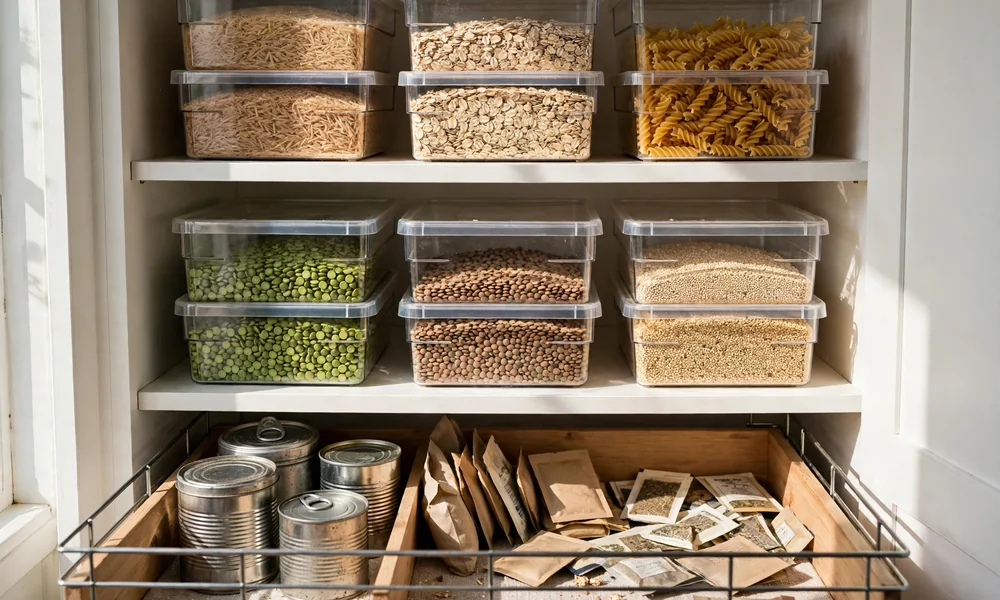
Decanting dry goods into matching airtight containers is the step that makes a pantry look organized and stay organized. Clear canisters show how much rice, pasta or flour is left, and airtight lids keep weevils, damp and staleness out — a sealed container keeps flour fresh twice as long as an open bag. Buy one footprint in two or three heights so containers stack, and decant only the dry goods you use weekly. For which bin types suit which room, our guide to storage bins worth buying for a tidier home in 2026 covers the full range.
Pantry Organizers Compared
| Organizer type | Best for | Typical price | Space gained | Watch out for |
|---|---|---|---|---|
| Turntable | Deep shelves, spices, sauces | £8–£25 | Uses back-row space | Needs a flat shelf |
| Shelf riser | Short tins and jars | £6–£20 | Doubles one shelf layer | Overhanging edges tip |
| Can rack | Tinned food, first-in-first-out | £10–£30 | Stops stacking waste | One type per track only |
| Pull-out drawer | Deep base cupboards | £25–£80 | Full depth becomes usable | Cost; needs exact width |
| Door rack | Small pantries, spices | £8–£25 | Adds 10–15 cm of depth | Heavy loads strain hinges |
| Airtight canisters | Flour, rice, pasta, cereals | £15–£40 a set | Stacking, freshness | Decanting takes time |
The cheapest organizers solve the most common problems: a £10 turntable and a £8 riser together fix the two biggest pantry faults — invisible back rows and wasted height — for less than one pull-out drawer. Spend big only where a cheap fix cannot reach: the deep base cupboard.
How to Zone Your Pantry So It Stays Tidy
Organizers fail when they are bought before the pantry is planned. Divide the pantry into four or five zones by how you cook, then give each zone one organizer type.
Zone by Use, Not by Food Type
Breakfast, baking, dinner, snacks and drinks beats grains, tins, jars and packets as a split, because you reach for a zone in one cooking moment. Put breakfast at eye level and baking nearest the worktop; heavy things go low, rarely used things go high.
Measure First, Buy Second
Before ordering, measure the width, depth and height of every shelf and write the numbers down. The most common mistake is a turntable 2 centimetres too wide for its shelf, or a can rack that blocks the door. A tape measure takes two minutes; a return takes a week. Under 25 centimetres of clearance rules out two-tier turntables; under 15, most risers.
The One-Category Rule
Each container holds one category, written on it. Pasta in one bin, rice in another, never a mixed “grains” bin — a mixed bin is a junk drawer with a lid. Labels matter more than matching containers: a £2 label on a plain tub beats a £20 designer jar nobody can identify. If you cook in batches and freeze portions, the same discipline pays off in the freezer — our guide to the best meal prep containers of 2026 shows which ones stack, seal and survive reheating.

Small Pantry vs Walk-In: What Changes
In a small pantry — a single cupboard or a narrow pull-out — the door rack and the turntable do almost all the work. There is no room for a can rack and a set of canisters, so choose the two organizers that attack your worst problem and stop there. Vertical space is everything: risers and stackable canisters earn their keep.
In a walk-in pantry, the risk flips: space is generous, so organizers multiply until the pantry holds more containers than food. Zone first and cap each zone at two organizer types. A walk-in also rewards the pull-out drawer, because its shelves are usually deeper. Either way, leave one shelf empty as a landing zone for shopping.
What to Avoid
The most common waste of money is the matching set: ten identical containers look wonderful in the shop and fail in a real pantry, which holds things of ten different sizes. Buy organizers one job at a time, and buy the second only after the first has proved itself for a fortnight. The second mistake is organizing by colour instead of by use: a rainbow of matching jars is satisfying to photograph and miserable to cook from. The third is skipping the clear-out — no organizer fixes three-year-old spices and duplicate flour. Empty the shelves and throw away anything out of date before you measure and buy.
Pantry Organizer Checklist
- Empty every shelf and throw away anything out of date before buying a single organizer.
- Measure the width, depth and height of each shelf.
- Divide the pantry into zones by how you cook: breakfast, baking, dinner, snacks.
- Give each zone one organizer type and one labelled category per container.
- Heavy tins low, daily-use items at eye level, rarely used things high.
- Leave one shelf empty as a landing zone for shopping.
Frequently Asked Questions
What is the best pantry organizer to buy first?
A turntable, in most pantries: it solves the most common fault — food hidden at the back of a deep shelf — for under £25, needs no installation, and works in a cupboard or a walk-in. If your shelves are short and tall, buy a shelf riser first.
Are airtight containers really worth it?
Yes, for dry goods you use weekly: flour, rice, pasta, oats, sugar and cereal. Airtight lids keep damp and pantry moths out and keep food fresh roughly twice as long.
How do I organize a very small pantry?
Use the door first: a door rack adds storage without taking shelf space. Then add one turntable for the deepest shelf and one or two shelf risers for tins. Keep it to four zones at most.
Should pantry containers match?
Matching containers stack neatly, but matching matters less than labelling. A labelled plain tub beats an unlabelled matching jar.
How often should I reorganize the pantry?
A full clear-out once or twice a year is enough, with a ten-minute tidy each month to return drifted items to their zones. If a zone keeps drifting, the zone is wrong — move it or change its organizer.
Do pull-out drawers work in rented kitchens?
Yes, if you choose slide-out trays that sit on the shelf rather than runners screwed into the carcass. They do most of the job without drilling, and they come with you when you move.
The Bottom Line
The best pantry organizers of 2026 fix your pantry’s actual faults, not the ones that look best in a photograph. Measure first, zone by how you cook, and buy one organizer per problem: a turntable for deep shelves, a riser for wasted height, a can rack for toppling tins, a door rack for small spaces, and airtight canisters for the dry goods you pour every day. Label everything, and the clutter ends for good.