
The best spice racks in 2026 do more than tidy a cupboard. They change how you cook. When every spice is visible, labelled and within arm’s reach, you season with confidence instead of guessing, you stop buying duplicates of jars you already own, and you actually use the paprika, cumin and cinnamon that used to hide at the back of a dark shelf.
Choosing the best spice rack is not about finding the prettiest one. It is about matching the rack to your kitchen, your spice collection and the way you cook. A wall-mounted rack suits a small kitchen with empty wall space. A drawer insert suits a cook who wants everything hidden but organised. A rotating carousel suits a large collection that needs to spin into view.
Key Takeaways
- Measure your space before you buy: wall, counter, cabinet and drawer racks all need different clearances.
- Glass jars with airtight lids keep spices fresher far longer than open tins or plastic shakers.
- Wall-mounted and door-mounted racks save the most counter space in small kitchens.
- A rack that holds 16 to 24 jars suits most home cooks; larger collections need a carousel or two-tier system.
- Label every jar the same way, and put your most-used spices at eye level or in the front row.
Why a Good Spice Rack Matters
Spices lose flavour when they sit in heat, light and damp air, and they lose flavour faster when they sit in a jumbled pile where you cannot find them. Most home cooks own between fifteen and thirty spices, yet the average kitchen stores them in three different places, which is how a jar bought last year sits unopened while you buy a second one.
A proper spice rack solves the storage problem and the flavour problem at the same time. It keeps jars upright, away from the heat of the hob, and in one place where you can see what you have. It also saves time. When you are mid-recipe and need the smoked paprika, you should be able to reach it in two seconds, not spend a minute digging through a cupboard while the onions burn. If you are setting up a kitchen from scratch, the same thinking applies to the rest of your kit: our guide to the best chef knives of 2026 covers the one tool every cook reaches for even more often than the spice rack.
How Many Spices Do You Actually Use?
Before you shop, count your spices. Pull every jar out of every cupboard and drawer and line them up on the counter. Most people are surprised twice: first by how many jars they own, and second by how few they actually use. The everyday rotation is small: salt, black pepper, paprika, cumin, chilli flakes, cinnamon, oregano, garlic powder, turmeric and mixed herbs. Those ten deserve the best spot; the rest can live in a second row.
Best Spice Racks by Type in 2026
There is no single best spice rack for every kitchen, because the right choice depends on your layout, your collection and your budget. The five types below cover almost every home cook.

Best Wall-Mounted Spice Rack
A wall-mounted rack is the best choice for a small kitchen. It uses vertical space that would otherwise be empty, it keeps spices visible at eye level, and it frees the counter and the cupboards for other things. Look for solid fixings rather than adhesive strips, because a rack full of glass jars is heavy. Wood and metal last longest; bamboo resists moisture well.
The trade-off is that wall racks hold fewer jars than a cabinet system, usually twelve to twenty, and they expose spices to light. If your wall gets direct sun, choose jars with dark glass or keep the rack on a shaded wall.
Best Rotating Carousel Spice Rack
A carousel, or lazy Susan, rack is the best choice for a large collection. It sits on the counter or inside a deep cupboard, and a gentle spin brings any jar to the front. Two-tier carousels hold twenty to twenty-four jars in the footprint of a dinner plate.
The weakness is stability. A cheap carousel wobbles when it is full, and tall jars can topple when you spin it quickly. Choose a model with a non-slip base and a low centre of gravity, and keep the heaviest jars on the bottom tier.
Best Drawer Insert Spice Rack
A drawer insert is the best choice for a cook who wants a clean, uncluttered kitchen. The jars lie flat in a tiered tray inside a drawer, labels facing up, and the whole collection disappears when the drawer closes. It is the tidiest option and it protects spices from light.
The limitation is drawer space. You need a wide, shallow drawer near the hob, and the insert must fit it exactly, so measure twice. Drawer racks also hide your collection, which means you have to open the drawer to see what you have. If you cook by inspiration and like to browse your spices, a visible rack suits you better.
Best Cabinet Door-Mounted Spice Rack
A door-mounted rack fixes to the inside of a cupboard door, turning wasted space into storage for eight to sixteen jars. It is the best choice for a rented home, because most models hang over the door or fix with a few small screws, and it keeps spices hidden but instantly accessible. It is also the cheapest way to add serious spice storage without buying new furniture.
The catch is depth. Cupboard doors are thin, so the rack must be shallow, and it only fits small jars. Measure the gap between the door and the shelf behind it before you buy, or the door will not close.
Best Countertop Tiered Spice Rack
A tiered countertop rack is the classic stepped shelf that displays jars in rising rows, like stadium seating. It is the best choice for a cook who wants everything visible at a glance without drilling a single hole. It holds twelve to eighteen jars, it moves easily if you rearrange the kitchen, and it works in a rented home with no fixings at all.
The downside is counter space, which is the most precious surface in any kitchen. A tiered rack occupies a permanent patch of worktop, and in a small kitchen that patch might be needed for chopping. Choose a model with a solid base and a wipe-clean finish.
What to Look For Before You Buy
A spice rack is a simple product, but the details decide whether it lasts a year or a decade. Check the material first: solid wood, bamboo and powder-coated metal survive a kitchen’s heat and humidity, while thin plastic warps and cheap chrome rusts near a sink. Standard spice jars are about 10 to 12 centimetres tall, but some racks only fit the slim jars they come with.
Jars matter as much as the rack. Glass is better than plastic because it does not absorb smells or stain, and it lets you see how much is left. Airtight lids matter more than anything else: a jar that does not seal will let a spice go stale in weeks. Look for silicone seals or screw-top lids with a proper gasket.
Labels, Lids and Freshness
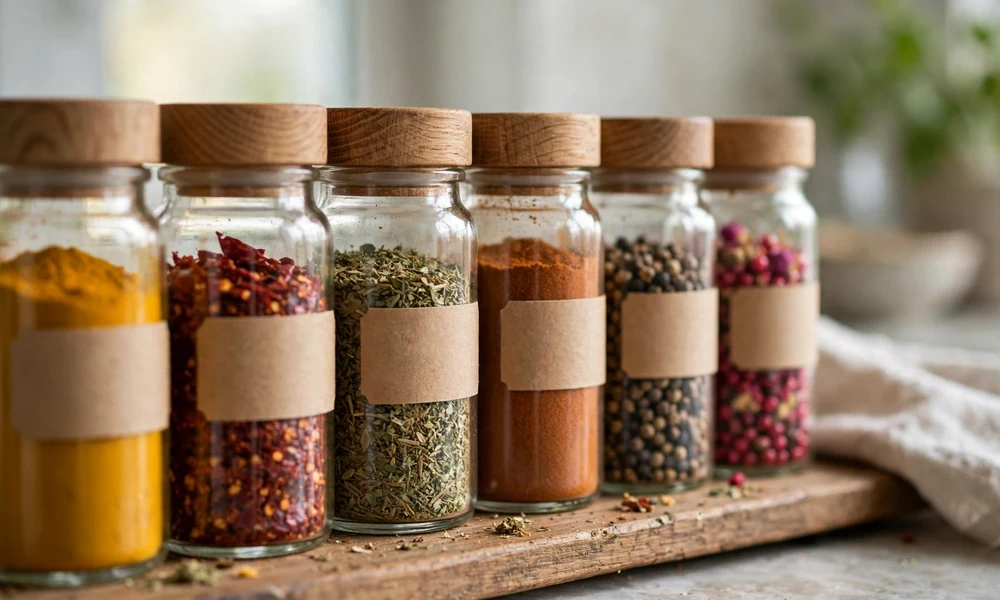
Label every jar on the lid and on the side, so you can find it whether the rack is viewed from above or from the front. Write the name and the date you filled it. Whole spices such as peppercorns, cumin seeds and cinnamon sticks keep for up to three years; ground spices fade after six to twelve months. A date on the label stops you seasoning with paprika that lost its flavour two summers ago.
Spice Racks Compared
| Rack Type | Best For | Typical Capacity | Typical Price |
|---|---|---|---|
| Wall-mounted | Small kitchens, eye-level access | 12–20 jars | £20–£60 |
| Rotating carousel | Large collections, deep cupboards | 16–24 jars | £15–£45 |
| Drawer insert | Minimalist kitchens, hidden storage | 12–18 jars | £20–£50 |
| Door-mounted | Rented homes, hidden storage | 8–16 jars | £10–£30 |
| Countertop tiered | Visible display, no drilling | 12–18 jars | £15–£40 |
How to Organise Your Spice Rack
Organisation is what turns a rack into a tool. Group spices by cuisine rather than alphabetically: keep the cumin, coriander, turmeric and garam masala together for Indian cooking, and the oregano, basil, rosemary and thyme together for Mediterranean dishes.
Put the everyday ten at the front or at eye level, and the occasional spices at the back or on the top tier. Refill from a bulk bag rather than buying a new jar each time, and decant into the rack jar with a small funnel so nothing spills. Once a year, take every jar out, check the dates, smell each spice, and throw away anything that smells of nothing. A spice that has lost its smell has lost its flavour, and keeping it only wastes space. A well-organised rack also makes the rest of the kitchen work better: if you are planning a kitchen refresh, our guide to the best pizza ovens of 2026 shows how one strong appliance can anchor a whole cooking setup, and clean water matters just as much as good seasoning, so our guide to the best water filters of 2026 covers the filters that make everyday cooking and drinking taste better.

Spice Rack Shopping Checklist
- Count your spice jars and add four before choosing a rack size.
- Measure the wall, drawer, door or counter space where the rack will live, including clearance above tall jars.
- Check the rack fits standard jar sizes, or buy the jars it is designed for.
- Choose glass jars with airtight, gasket-sealed lids over plastic shakers.
- Pick a spot away from heat, steam and direct sunlight to keep spices fresh.
- Label every jar with its name and fill date, on the lid and the side.
Frequently Asked Questions
What is the best type of spice rack for a small kitchen?
A wall-mounted rack is usually best for a small kitchen because it uses vertical space and keeps the counter clear. If you cannot drill into the walls, a door-mounted rack on the inside of a cupboard door is the best alternative.
Should spice jars be glass or plastic?
Glass is better. It does not absorb smells, it does not stain, and it lets you see how much spice is left. Choose glass jars with airtight lids and a silicone or rubber seal to keep spices fresh.
How long do spices last in a rack?
Whole spices keep for up to three years, while ground spices fade after six to twelve months. Store them away from heat and light, keep the lids sealed, and write the fill date on every jar so you know when to replace them.
Where should a spice rack go in the kitchen?
Within one step of the hob, but not directly above it. Heat and steam from cooking shorten a spice’s life, so a cool wall, a nearby cupboard or a drawer close to the stove is better than the shelf over the cooker.
How many jars should a spice rack hold?
Most home cooks need space for 16 to 24 jars. Count the jars you own, add four for growth, and choose a rack that fits that number. A rack that is slightly too big is far better than one that overflows after your next shop.
Are rotating spice racks worth it?
Yes, if you own a large collection. A carousel holds more jars in less space than any other type and makes every jar reachable with a spin. Choose one with a non-slip base and a low centre of gravity so it does not wobble when full.
The Bottom Line
The best spice racks in 2026 are the ones that fit your kitchen, not the ones that look best in a photograph. A wall-mounted rack suits a small kitchen, a carousel suits a big collection, a drawer insert suits a minimalist home, and a tiered rack suits a cook who wants everything on show. Measure your space, count your jars, choose glass with airtight lids, and keep the rack away from heat. Do that, and the spices you already own will taste better, last longer, and actually get used.


