The Egg Cookers Worth the Counter Space in 2026
An egg cooker is a small machine that does one job: it turns raw eggs into boiled, poached, or steamed eggs with almost no attention from you. For years it was dismissed as a luxury — a single-use gadget for a job a saucepan already does. But in 2026, the best egg cookers have quietly earned their place on the counter: they cook a dozen eggs at once, get the timing right every time, and free up a hob ring on the busiest morning of the week. This guide explains which egg cookers are worth the counter space, how they work, and how to choose one you will actually use.
Key takeaways
- A good egg cooker earns its counter space by cooking eggs more consistently than a saucepan — same result every morning, with no watching the clock.
- Capacity is the first decision: six-egg cookers suit one or two people, twelve-egg models suit families and weekly meal prep.
- Steam cookers are the most reliable type; microwave cookers are cheaper but cook less evenly.
- The features worth paying for are an automatic shut-off, a buzzer, and a measuring cup with doneness markings.
- An egg cooker is worth it if you eat eggs at least three times a week; below that, a saucepan is better.
Why an egg cooker at all?
The case against the egg cooker is easy: a saucepan, water, and a timer cost nothing and already live in your kitchen. The case for it comes down to consistency. Boiling eggs in a pan is an exercise in attention — water temperature, timer, cooling — and getting any of it slightly wrong gives you a green ring around the yolk or a cracked shell.
An electric egg cooker removes the attention. Add a measured amount of water, put the eggs in, switch it on, and walk away. The machine steams the eggs and switches itself off — or sounds a buzzer — when the water runs out, which is when the eggs are done. The result is the same every time.
There is also a practical argument: an egg cooker uses a fraction of the energy of boiling a full pan of water, and it does not steam up the kitchen. In a small kitchen it frees a hob ring for the rest of breakfast. For meal prep, the twelve-egg models are genuinely useful — a dozen hard-boiled eggs on a Sunday covers salads, sandwiches, and snacks for the week, cooked in one batch with no pot to watch.

How egg cookers work
Almost every electric egg cooker is a steam cooker. A heating plate boils a small amount of water, steam rises through a tray of eggs, and the eggs cook in the steam. The clever part is the measuring cup: markings for soft, medium, and hard eggs, and for the number of eggs in the tray. More water means more steam and a longer cook. You do not set a time — you set the amount of water, and the machine stops when the water is gone.
That design is why steam cookers are so consistent: the water measurement is the timer, and the machine cannot overcook the eggs once the water runs out. The buzzer or shut-off signals you to take the eggs out and cool them under cold water, which stops the cooking and makes peeling easier. Microwave cookers are faster but less even, because microwaves heat unevenly.
Poaching and omelette trays are the usual extras: most mid-range cookers include a small tray for poaching one or two eggs and a shallow dish for a small omelette. A built-in egg piercer is not worth paying for — a pin works just as well.
The main types of egg cooker, compared
| Type | Best for | Capacity | Watch out for |
|---|---|---|---|
| Electric steam cooker | Everyday boiled eggs | 6–12 eggs | Needs descaling if your water is hard |
| Microwave egg cooker | Quick single servings | 1–4 eggs | Uneven cooking, eggs can burst |
| Stovetop egg steamer | People who distrust gadgets | 6–7 eggs | Still needs a timer and attention |
| Multi-cooker egg function | Households with a multi-cooker already | 6–12 eggs | Slower to set up for one small job |
| Rapid egg boiler (compact) | Small kitchens, one or two people | 6–7 eggs | Small water tank, fiddly measuring cup |
The electric steam cooker is the right choice for almost everyone: the most consistent, the easiest to use, and the only type that truly lets you walk away. Microwave cookers are cheaper and smaller, but they cook less evenly and eggs can burst if the shell is not pierced. Stovetop steamers still need a timer and your attention, which removes most of the point, and a multi-cooker’s egg function is slow to heat up for one small job.
What to look for before you buy
Capacity
Capacity should follow your household, not your ambition. A six-egg cooker is enough for one or two people and takes up barely more counter space than a kettle. Twelve-egg cookers earn their footprint only if you regularly cook for a family or prep a dozen eggs at once; used for two eggs every morning, one is a waste of space and water.
Automatic shut-off and buzzer
These are the two features that make an egg cooker worth owning: an automatic shut-off stops the heating when the water runs out, so the eggs cannot overcook, and a buzzer tells you they are done. The best cookers have both. A cooker with neither is just a small kettle with a tray.
Ease of cleaning
An egg cooker lives or dies on cleaning. The heating plate builds up limescale if your water is hard, so look for a plate that is easy to wipe and a lid that comes apart. Stainless steel plates clean more easily than coated ones, and a removable egg tray goes in the dishwasher.
Footprint
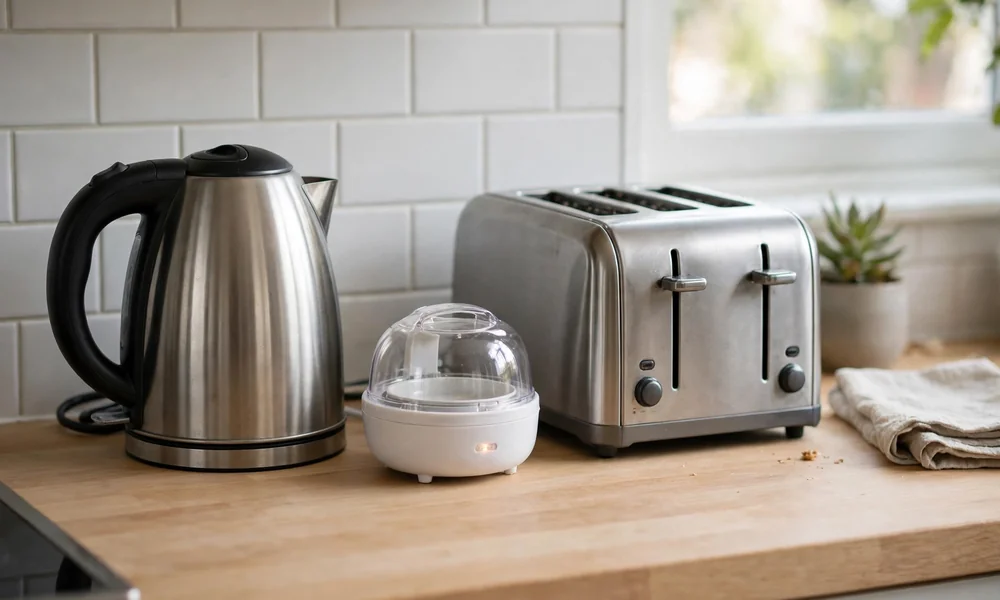
Measure the space before you buy. Most six-egg cookers are around 15 centimetres across — smaller than a toaster — while twelve-egg models are closer to 25 centimetres. The honest test is the one used by the best air fryers testers: if the gadget cannot live on the counter permanently, it will end up in a cupboard, and a gadget in a cupboard is a gadget you do not use.
Soft, medium, or hard: getting the result you want
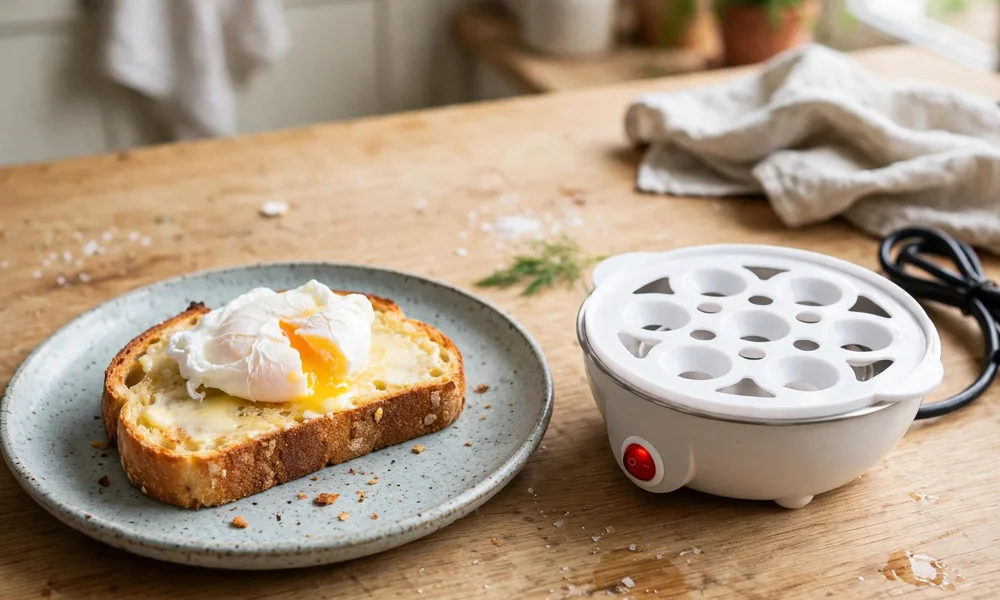
The measuring cup is the whole secret of an egg cooker. It has lines for soft, medium, and hard, and the lines move depending on how many eggs are in the tray — fewer eggs need more water. Fill to the line for the number of eggs and the doneness you want, and adjust slightly next time if the result is off.
Egg size matters too: the markings assume medium eggs, so large eggs need a touch more water and small eggs a touch less, and very fresh eggs peel worse than eggs a week old. If peeling is a problem, cool the eggs under cold running water as soon as the buzzer sounds, then roll them gently on the counter to crack the shell all over.
One warning: do not pierce eggs you plan to peel — the pin hole lets a little water in, which can make the white stick. Pierce only if your eggs crack regularly. And never cook an egg in its shell in a microwave cooker without piercing it, because the steam has nowhere to go and the egg can burst.
Egg cookers vs the saucepan: an honest comparison
The saucepan is free, already in your kitchen, and cooks eggs perfectly well when you pay attention. The egg cooker costs money, takes counter space, and does one thing. When is the cooker better? It comes down to frequency: once a week, the saucepan wins; three or more times a week, the cooker wins on consistency alone, because it removes the one variable that ruins boiled eggs — human attention on a busy morning.
The cooker also wins for batches: twelve eggs in a pan needs a large pot, a lot of water, and careful timing; twelve in a cooker needs one measuring cup of water and no attention. It wins on energy too, using roughly a tenth of the electricity of boiling a full pan on an electric hob.
Where the saucepan still wins is versatility: a pan can also make soup, pasta, and vegetables, while an egg cooker can only make eggs. The best stand mixers earn their space by doing many jobs; an egg cooker earns its space by doing one job perfectly, every single time. If that job matters to you daily, the cooker is worth it.
Mistakes that ruin the experience
The most common mistake is buying the biggest cooker: a twelve-egg model for a single person is a waste of counter space and water. Buy for the household you have. The second is using tap water in a hard-water area without descaling — limescale builds up on the plate and the eggs get less consistent. A splash of vinegar in the water once a month fixes it.
The third mistake is leaving the eggs in after the buzzer: they keep cooking in the residual heat, so a soft egg becomes medium. Take them out and cool them under cold water. The fourth is overfilling the water cup — the markings are calibrated, and guessing gives a worse result. Finally, do not store the cooker damp with the lid on: it will smell. Dry it and leave the lid ajar.
Before you buy: the checklist
- Count how often you eat eggs: three or more times a week makes a cooker worth it.
- Choose capacity for your household: six or seven eggs for one or two people, twelve for a family.
- Check for automatic shut-off and a buzzer — a cooker with neither is not worth the space.
- Measure the space beside your kettle: if it cannot live there permanently, it will end up in a cupboard.
- Look for a stainless steel heating plate and a removable, dishwasher-safe egg tray.
- Check the measuring cup has clear markings for soft, medium, and hard.
Frequently asked questions
Are egg cookers worth it?
Yes, if you eat eggs at least three times a week. A good steam cooker gives you the same result every morning with no attention and uses far less energy than boiling a pan of water. If you eat eggs rarely, a saucepan is better.
How long does an egg cooker take?
Most steam cookers take six to twelve minutes depending on doneness and the number of eggs — about the same as a pan, but the time is unattended: you can make coffee or pack a lunch while the eggs cook.
Can you cook more than boiled eggs in an egg cooker?
Most mid-range cookers include a poaching tray for one or two eggs and a small dish for an omelette. Do not expect it to replace a frying pan for anything else.
Do egg cookers use a lot of electricity?
No. A typical egg cooker uses around 350 to 400 watts for a few minutes — roughly a tenth of the energy of boiling a full pan of water on an electric hob. It is one of the cheapest appliances in the kitchen to run.
Why do my eggs crack in the egg cooker?
Eggs crack when trapped air expands faster than it can escape. Piercing a small hole in the wide end of the shell before cooking lets the air out and usually fixes it. Very cold eggs straight from the fridge are also more likely to crack — let them sit for a few minutes first.
How do you clean an egg cooker?
Wipe the heating plate after each use and descale it monthly with a splash of vinegar if your water is hard. The egg tray and lid usually go in the dishwasher. Always dry the cooker before storing it.
The bottom line
The best egg cookers are worth the counter space for one simple reason: they turn the most repeated small job in the kitchen into something you never have to think about. Buy a steam cooker in the right size for your household, check it has an automatic shut-off and a buzzer, and put it where it can live permanently beside the kettle. The same test applies to the rest of the kitchen — the best espresso machines earn their space the same way, by doing one daily job perfectly, every single time.