A Guide to Egg Flippers That Slide Under Yolks Without Breaking Them in 2026
An egg flipper is a thin, flexible turner made for one delicate job: sliding under a fried egg, lifting it cleanly, and turning it over without breaking the yolk. The best egg flippers in 2026 have a blade so thin it slips between the egg and the pan, flexible enough to follow the curve of the white, and stiff enough to carry the egg without folding. A thick spatula shoves the egg across the pan; a fork pierces the yolk; a good egg flipper does neither. This guide explains what makes one different from an ordinary turner, the types worth owning, how to flip without breaking a yolk, and how to choose one that suits your pan.
Key Takeaways
- An egg flipper is defined by its blade: thin, flexible and slightly tapered, so it slides under a fried egg without pushing or tearing it.
- Stainless steel suits cast iron and stainless pans; silicone or nylon is the safe choice for nonstick.
- Flip once, and flip late: wait until the white is set and the edges release on their own.
- A blade 7 to 9 centimetres wide suits a single egg; wider blades suit omelettes and two-egg cooks.
- Never use a metal flipper on a nonstick pan, and never store a flipper with its blade bent under a heavy pan.
What Makes an Egg Flipper Different
Every turner can flip food, but an egg is the hardest thing to flip well. A fried egg is fragile twice over: the white is thin and tears easily, and the yolk is a liquid sac that breaks under the smallest poke. A pancake forgives a clumsy turn; an egg does not. That is why an egg flipper is built differently. Its blade is thinner, so it slides under the egg instead of shoving it, and the leading edge is tapered and slightly rounded, so it does not catch on the white. The blade flexes just enough to follow the pan and lift the egg in one smooth motion.
Size is part of the difference too. A burger turner is wide and heavy, built to carry weight; an egg flipper is light and narrow, built for precision. A blade much wider than the egg is hard to aim and folds the white over on itself, while a blade much narrower lets the egg sag in the middle, which is when the yolk breaks.
Our guide to the best spatulas of 2026 covers the broad family of scrapers and turners, and an egg flipper is the specialist inside that family: the one built for the most delicate flipping job in the kitchen. If you only cook eggs occasionally, a good silicone turner from that guide may be enough. If eggs are a daily habit, a dedicated flipper earns its place.

The Main Types of Egg Flipper
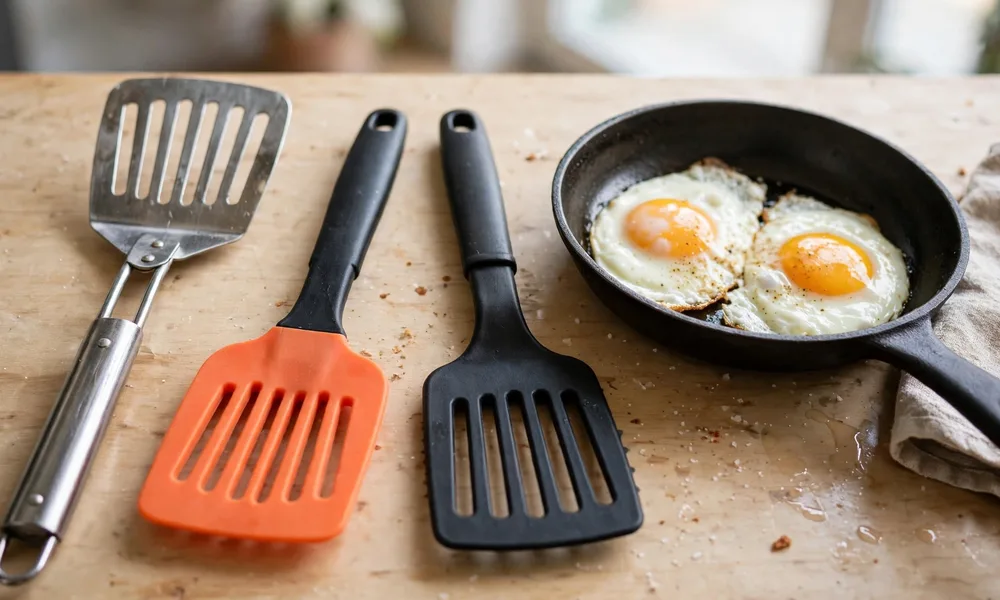
Egg flippers split into a few clear types, defined by blade material and shape. Each has a clear strength, a clear weakness and a pan it suits best.
Stainless steel fish-style flippers
The classic egg flipper is a thin stainless steel blade, slightly flexible, with a long handle. It slides under eggs, fish fillets and pancakes with far less damage than a thick blade, and its thin edge scrapes up the browned bits that carry flavour. Steel is the best choice for cast iron, carbon steel and stainless pans. The trade-off is nonstick: one careless scrape can score a coating.
Silicone flippers
A silicone flipper has a flexible heat-resistant head on a firm handle, and it is the safest choice for nonstick pans. Good silicone survives temperatures of 230 degrees Celsius or more, so it will not soften or warp at the edge of a hot pan. The head flexes to follow the pan and lifts the egg gently, and it will not scratch any coating. The weakness is precision: a silicone head is thicker than steel, so it pushes the egg slightly before it gets under it.
Nylon flippers
Nylon flippers sit between steel and silicone: thinner than silicone, softer than steel, and safe on nonstick. They are light, cheap and dishwasher safe. The limit is heat: nylon softens at lower temperatures than silicone, so it must never rest against a hot pan edge or sit in a dry, overheated pan.
Offset and mini flippers
An offset flipper has a bent neck that keeps your knuckles clear of the pan and the hot egg, which helps when you are flipping several eggs in a row. A mini flipper is a small, narrow blade made for a single egg or a small omelette, and the easiest to aim precisely. Both are specialist shapes, not the first flipper to buy: start with a standard blade.
Egg Flippers Compared
| Type | Best for | Pan safety | Heat tolerance | Price in 2026 |
|---|---|---|---|---|
| Stainless steel | Fried eggs, omelettes, fish | Cast iron, steel only | Very high | Low to mid |
| Silicone | Nonstick eggs, everyday use | All pans, incl. nonstick | 230°C and up | Low to mid |
| Nylon | Nonstick eggs, tight budgets | All pans, incl. nonstick | Moderate | Low |
| Offset | Several eggs at once | Depends on blade material | Depends on blade material | Mid |
| Mini | Single eggs, small omelettes | Depends on blade material | Depends on blade material | Low |
How to Flip an Egg Without Breaking the Yolk
Technique matters more than the tool, and the first rule is patience. A fried egg is ready to flip only when the white is fully set and the edges have released from the pan on their own. If you have to force the blade under the white, the egg is not ready: give it another thirty seconds. A little oil or butter helps the release, and a pan that is too hot sets the bottom too fast while the top stays raw, which makes the egg stick and tear.
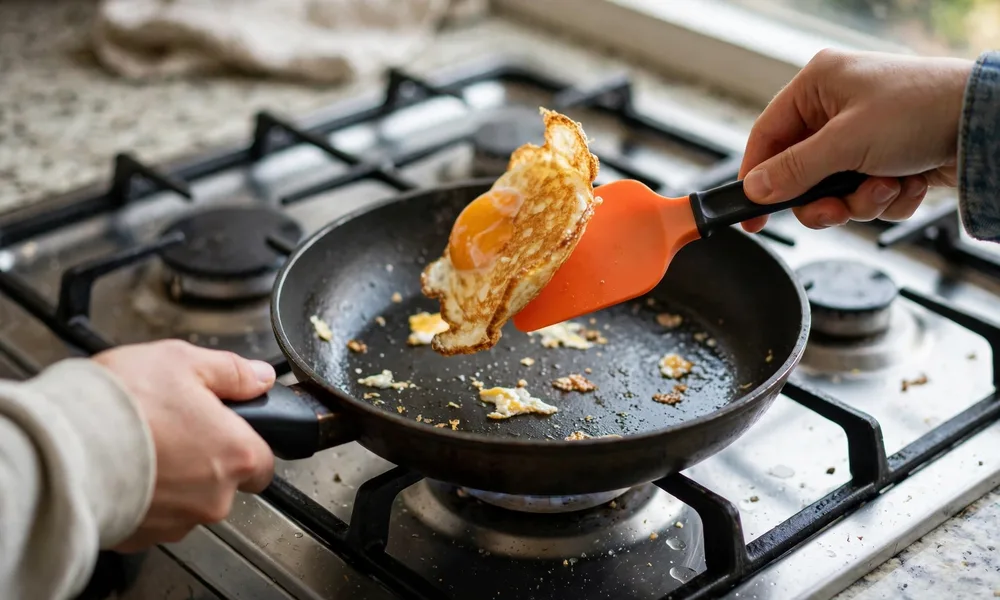
When the egg is ready, slide the blade in from the side, flat against the pan, in one smooth motion. Do not jab at the egg or lift the blade early: get the whole blade under the egg, let the egg settle onto it, then lift straight up and turn your wrist in one quick, confident motion. Hesitation is what breaks yolks: a fast, level flip lands the egg flat, while a slow, tilted flip drops it on its edge. Keep the flip low, just above the pan.
Omelettes need a different move. Fold rather than flip: slide the flipper under one half, lift it, and fold it over the other half in the pan, then slide the whole omelette out onto the plate. A wide blade helps here, because it supports the full width. For over-easy eggs, flip once and cook for no more than thirty seconds on the second side; for over-medium, give it a minute.
Choosing the Right Egg Flipper
Choose by your pan first, because the pan decides the material. If you cook eggs in cast iron or stainless steel, buy a thin stainless steel flipper: it slides best, lasts longest, and the pan can take it. If you cook in nonstick, buy silicone or nylon, and never let a metal blade near the coating. Our guide to nonstick pans that actually last in 2026 covers the pans themselves: soft tools for soft coatings, hard tools for hard pans.
Next, check the blade. Hold the flipper flat and press the edge against a table: it should flex slightly and meet the surface along its whole length, with no gaps at the corners. A blade that only touches in the middle will leave half the egg behind. The edge should be thin and smooth, with no burrs or rough spots. A blade about 7 to 9 centimetres wide suits a single egg; go wider for omelettes.
Weight matters more than it looks. A heavy flipper tires the wrist and is slow to turn, and slow turns break yolks. A light flipper is quick and precise. Stainless flippers are naturally heavier than silicone or nylon, so if you choose steel, look for a slim handle and a thin blade.
Care and Cleaning
An egg flipper is easy to look after, provided you clean it promptly. Egg white sets hard if it dries on a blade, and dried egg is stubborn to remove. Rinse the blade in hot water straight after cooking, wash it in hot soapy water, and dry it before putting it away. Stainless steel and silicone flippers go in the dishwasher without harm, while nylon should be washed by hand. For cooks who would rather not flip at all, our guide to the best egg poachers of 2026 covers the tool for the job.
Mistakes to Avoid
The most common mistakes are flipping too early, before the white has set and released; using a metal flipper on a nonstick pan, which scores the coating and ends the pan’s life; buying a blade too thick or too wide for a single egg, which shoves the egg around; a slow, hesitant flip, which drops the egg on its edge; leaving the flipper resting in a hot, dry pan, which softens nylon and warps silicone; and storing the blade bent under something heavy.
Egg Flipper Checklist
- Match the blade to your pan: steel for cast iron and stainless, silicone or nylon for nonstick.
- Choose a thin, flexible blade 7 to 9 centimetres wide for a single egg, wider for omelettes.
- Check the edge is smooth and meets a flat surface along its whole length.
- Wait until the white is set and the edges release before you slide the blade in.
- Flip once, fast and level, low over the pan, without hesitating halfway through.
- Rinse the blade straight after cooking, dry it, and store it flat so it never bends.
Frequently Asked Questions
What is the best egg flipper for a nonstick pan?
A silicone flipper with a heat rating of 230 degrees Celsius or more. It will not scratch the coating, it flexes to follow the pan, and it survives the heat of everyday frying. Nylon is a cheaper second choice.
Can I use a fish spatula to flip eggs?
Yes, and it is one of the best tools for the job. A thin stainless steel fish spatula is exactly the right shape for sliding under an egg, provided your pan is cast iron or stainless steel.
Why does my yolk break every time I flip?
Usually because the egg was flipped too early, or the flip was slow and tilted. Wait until the white is fully set and the edges release, slide the whole blade under the egg, then turn your wrist in one quick, level motion.
Do I need a special flipper, or will any spatula work?
Any thin, flexible turner can flip an egg, and a good silicone turner is enough for occasional cooks. A dedicated egg flipper earns its place if you cook eggs daily, because its narrow, tapered blade is easier to aim.
How wide should an egg flipper be?
About 7 to 9 centimetres for a single fried egg, which supports the egg without folding the white. For omelettes or two eggs at once, a wider blade of 10 to 12 centimetres supports the full width.
How do I stop eggs sticking to the pan?
Use medium heat, a little oil or butter, and a pan that is properly preheated before the egg goes in. Let the white set and release on its own before you touch it. A cold pan, too little fat or too high a heat all make eggs stick, whatever flipper you use.
The Bottom Line
An egg flipper is a small, cheap specialist that earns its keep every morning: a thin blade, matched to your pan, used with patience and one quick, level turn. Buy steel for cast iron and stainless, silicone for nonstick, keep the blade thin and the edge smooth, and wait until the white releases before you flip.


